

P0014 on 2010-2017 Buick LaCrosse: Causes and Fixes for Exhaust Camshaft Timing
On a 2010-2017 Buick LaCrosse, code P0014 is most often caused by low or dirty engine oil, or a failing Bank 1 exhaust camshaft position actuator solenoid. An oil change and a new solenoid (around $25-$50 for an aftermarket part, $50-$90 for OEM) is a common and straightforward DIY fix. Always check the oil level and condition first, as low or dirty oil is a primary trigger for this code.
- P0014 on your LaCrosse points to the exhaust camshaft on Bank 1 being timed incorrectly.
- Before buying any parts, check your engine oil. Low, old, or dirty oil is a very common cause. An oil change might fix it.
- The most likely failed part is the Bank 1 Exhaust Camshaft Position Actuator Solenoid. It's relatively inexpensive and easy to replace.
- On V6 engines, Bank 1 is against the firewall. The exhaust solenoid is the lower of the two solenoids on that side.
- Ignoring this code can lead to stalling, poor performance, and potentially more severe engine damage over time.
What's Unique About the 2010-2017 Buick LACROSSE

The GM 2.4L and 3.6L engines used in the LaCrosse are well-known for issues with their camshaft positioning systems. The problem is so common that General Motors has issued multiple Technical Service Bulletins (TSBs) related to this code and its counterparts (P0011, P0021, P0024). These bulletins often point towards issues with the camshaft actuator solenoids, which can stick or fail due to oil sludge or internal failure. Owner experiences and repair data consistently show that these solenoids, which control oil flow to the cam phasers, are a primary failure point. Some owners report that aftermarket solenoids may fail prematurely, with screens detaching and potentially causing further issues.
🎬 Watch: See a Buick LaCrosse solenoid that broke in halfDiagnostic Flowchart

Tap your situation to follow the diagnostic path that matches what you're seeing on this vehicle.
Generation note: This range covers the second generation LaCrosse (2010-2016) and the first year of the third generation (2017). Both generations used engines with Variable Valve Timing (2.4L I4, 3.0L V6, 3.6L V6) that are susceptible to this code. The diagnostic and repair process is similar across these model years and engines.
Symptoms You May Notice
- Check Engine Light is on
- Engine runs rough or idles poorly
- Engine stalls or shuts off while driving, especially at low speeds or when stopping
- Hard starting
- Reduced fuel economy
- A short, sharp rattle noise from the engine on startup
- Lack of acceleration or reduced engine power
- Replacing the camshaft position SENSOR. The sensor reads the camshaft's position, but it is rarely the cause of a performance code like P0014. The problem is usually with the mechanical control of the timing (oil or solenoid), not the sensor reporting it.
Most Likely Causes

- Low, Dirty, or Incorrect Viscosity Engine Oil 🔴 High Probability The VVT system is highly dependent on clean oil of the correct viscosity and pressure to function. Sludge or debris can clog the small passages and filter screens in the camshaft actuator solenoids, causing them to stick. The 2.4L Ecotec engine in particular is known for oil consumption, which can lead to low oil levels that trigger this code.
How to confirm: Check the engine oil level on the dipstick and review service records. If the oil is low, dark, or past its service interval, this is a likely contributor. A Reddit user with a 2015 Equinox noted the code would appear when the oil was low and sometimes showed 'muddy looking oil' on the dipstick.
Typical fix: Perform an engine oil and filter change using the manufacturer-specified oil (typically an ACDelco PF63E filter for the V6 or PF457G for the I4, and Dexos-approved 5W-30 synthetic oil). Clear the codes and drive to see if the issue is resolved.
Est. part cost: $40-$80 - Faulty Exhaust Camshaft Position Actuator Solenoid (Bank 1) 🔴 High Probability This is a very common failure point on these GM engines. TSB #GCUS-9-3286 directly mentions a sticking exhaust camshaft position actuator as a cause for P0014. The internal mechanism can fail or the filter screens can become clogged with debris or break off. Newer ACDelco parts have improved screen retention to prevent this.
How to confirm: After verifying oil level, this is the next step. You can test the solenoid's resistance with a multimeter (should be 5-12 ohms). A more definitive test is to swap the Bank 1 exhaust solenoid with the Bank 1 intake solenoid. On the 3.6L V6, Bank 1 is the rear bank (firewall side); the exhaust solenoid is the lower of the two. On the 2.4L I4, the exhaust solenoid is the rear one (black connector). If the code changes to P0011 (Intake Camshaft Position), the solenoid is confirmed bad.
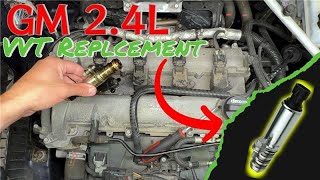
Typical fix: Replace the Bank 1 exhaust camshaft position actuator solenoid. It is held in by a single 10mm bolt. 🎬 See this walkthrough for replacing the 2.4L VVT solenoid Lubricate the new O-ring with clean engine oil before installation.
Est. part cost: $25-$90 - Stretched Timing Chain ⚪ Low Probability The 3.6L V6 engines, particularly earlier LLT versions (pre-2012), were known for premature timing chain stretch. While less common on later LFX engines, it can still occur at higher mileage, often due to extended oil change intervals. This is a major and expensive repair.
How to confirm: This is a more complex diagnosis. A startup rattle is a key symptom. A technician can use a scan tool to monitor desired vs. actual cam angles; significant deviation that doesn't resolve with a new solenoid points to a timing chain issue. Often, P0014 will be accompanied by correlation codes like P0016 or P0017 if the chain has stretched.
Typical fix: Replace the timing chains, guides, and tensioners. This is a labor-intensive job often costing thousands of dollars at a dealership, as the engine may need to be removed.
Est. part cost: $400-$800
Rare But Worth Checking
- Failed Camshaft Phaser (Actuator): The phaser is the mechanical gear at the end of the camshaft that the solenoid sends oil to. It can fail internally, getting stuck in an advanced position. TSB PIP5162 suggests that if cleaning the solenoid and its passages doesn't work, the phaser itself may need replacement. This is much less common than a solenoid failure and more expensive to fix.
- Wiring Harness or Connector Issue: The wiring to the solenoid can become damaged, or the connector pins can lose contact, preventing the ECM from controlling the solenoid properly. Check for frayed wires or a loose connection at the solenoid. If code P0013 (solenoid circuit fault) is present with P0014, it strongly points to a wiring or electrical issue.
Diagnosis Steps
- Check Engine Oil Level and Condition: Ensure the oil is full and clean. If it's low or overdue for a change, correct this first, clear the code, and see if it returns. This is the simplest and most common fix.
- Inspect the Solenoid Connector: Check the wiring and connector for the Bank 1 exhaust solenoid for any visible damage or looseness. On the 3.6L V6, Bank 1 is at the firewall, and the exhaust solenoid is the lower one. On the 2.4L I4, it's the rear solenoid with the black connector.
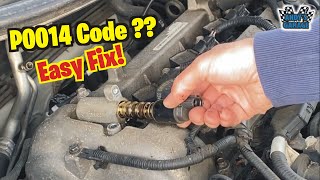
- Scan Tool Analysis: Use a capable OBD-II scanner to monitor the desired vs. actual camshaft position angles for Bank 1 Exhaust. If there is a large discrepancy that doesn't change with RPM, the system is not responding. 🎬 Watch: How to diagnose and replace VVT solenoids
- Test the Solenoid (Swap Method): The easiest way to test is to swap the Bank 1 exhaust (lower/rear) and intake (upper/front) solenoids. They are typically identical parts. Clear the codes and drive the vehicle. If the code returns as P0011 (Intake), the solenoid you moved is faulty.
- Inspect the Removed Solenoid: When the solenoid is removed, inspect its screens for metal shavings or thick sludge. If the screens are missing, they may have broken off and entered the oil passages, which can lead to more serious issues. TSB PIP5162 recommends cleaning the screens with brake cleaner if debris is found.
- Resistance Test: Alternatively, unplug the solenoid and measure the resistance between its two pins with a multimeter. A reading between 5 and 12 ohms is typical for a good solenoid. An open circuit (infinite resistance) or a short means the solenoid is bad.
- Advanced Diagnosis: If a new solenoid and clean oil do not fix the issue, the problem may be a stretched timing chain or a faulty cam phaser. This was the case for a 2012 GMC Acadia with a 3.6L engine, which required a full timing chain kit replacement. This step typically requires professional diagnosis.
Parts You'll Likely Need

- Camshaft Position Actuator Solenoid (VVT Solenoid) - Exhaust
(OEM #12655421 (Superseded by 12679100 for some applications))— This part is the most common point of failure for code P0014. It gets stuck or clogged, preventing proper oil flow to adjust the camshaft timing. TSB #GCUS-9-3286 directly points to this part sticking.
Trusted brands: ACDelco (OEM), Delphi, Dorman
OEM price range: $50-$90
Aftermarket price range: $25-$50 - Camshaft Position Actuator Solenoid (VVT Solenoid) - Intake
(OEM #12655420 (Superseded by 12679099 for some applications))
Related Codes That Often Appear With This One
- P0011 — Intake camshaft timing performance for Bank 1. Often appears with P0014 if there are oil pressure/quality issues affecting both solenoids on the same bank. TSB #PIP5568E notes these codes can set together. It will also appear if you swap a bad exhaust solenoid to the intake position for diagnosis.
- P0024 — Exhaust camshaft timing performance for Bank 2 (the front bank on V6). TSB #GCUS-9-3286 mentions P0014 and P0024 setting due to sticking actuators. If both codes are present, it could indicate a systemic oil pressure or quality issue.
- P0013 — This is a circuit code for the Bank 1 exhaust solenoid. If you have P0013 and P0014 together, it strongly points to a failed solenoid or a wiring problem, as the circuit fault (P0013) is causing the performance issue (P0014).
Technical Service Bulletins (TSBs) & Recalls
- PIP5568E: Investigates DTCs P0011, P0014, P0021, P0024 setting together or in pairs.
- GCUS-9-3286 (Special Coverage 16115): Acknowledges P0014/P0024 can be set by a sticking exhaust camshaft position actuator.
- PIP5096C: Mentions a group of VVT codes (P0011, P0014, P0021, P0024) and an engine sticker inspection.
- PIP4716F: Links a startup rattle noise to timing codes P0011, P0014, P0016, or P0017, suggesting a timing chain issue.
- PIP5162: Advises technicians to inspect and clean solenoid screens for debris when diagnosing P0011/P0014. If that fails, it points towards replacing the cam phaser.
Platform-Specific Known Issues
- GM issued Special Coverage Adjustment #16115 related to TSB #GCUS-9-3286, acknowledging that P0014 could be set by a sticking exhaust camshaft position actuator. This coverage extended the warranty for this specific condition on some vehicles, but details vary by model and year.
- TSB #PIP5162 provides diagnostic advice for when P0011 and P0014 appear. It instructs technicians to first inspect the solenoid screens for debris and clean them. If that fails, it advises blowing out the oil passages in the head with light air pressure and, if necessary, replacing the camshaft actuator (phaser) itself.
- TSB #PIP4716F connects codes like P0014 to a potential startup rattle, which can be an early indicator of timing chain guide or tensioner problems, particularly on the 3.6L V6.
Mechanic-Grade Diagnostic Values
- Camshaft Position Actuator Solenoid Resistance — expected: 5-12 ohms between the two terminals.. Failure: A reading outside this range, or infinite resistance (open circuit), indicates a faulty solenoid.
- Camshaft Position Actuator Solenoid Control Circuit Voltage — expected: 1.5-4.5 V (Key On, Engine Off). Failure: Voltage outside this range may indicate a wiring issue or a problem with the ECM. Note: A test lamp is recommended for this test as the circuit is pulled-up to a low current voltage.
- Scan Tool Live Data: Desired vs. Actual Camshaft Position — expected: The actual position should closely track the desired position as engine RPM changes.. Failure: A difference of more than 20 degrees between the desired and actual position can trigger the P0014 code.
Scan Tool Commands That Help
- GDS2 / Tech2 (or equivalent professional scan tool): Camshaft Position Actuator Control / Actuator Test — This bidirectional command allows the technician to manually activate the Bank 1 exhaust VVT solenoid while the engine is running. If the engine hesitates or stalls when the command is sent, it confirms the solenoid and oil passages are working. If there is no change in engine operation, it points to a faulty solenoid, clogged oil passages, or a stuck phaser.
Wiring & Ground Locations
- Q6 Camshaft Position Actuator Solenoid Valve Connector — On the 3.6L V6, Bank 1 (firewall side), the exhaust solenoid is the lower of the two solenoids on the front of the cylinder head. On the 2.4L I4, it is the rear-most solenoid. The connector is a 2-wire plug.. This is the direct electrical connection to the component most likely to fail. Inspecting for corrosion, damage, or a loose fit is a critical first step. The two terminals are for the ignition circuit (pin 1) and the control circuit from the ECM (pin 2).
- G102 / G104 — On many GM V6/V8 engines, grounds are located on the rear of the cylinder heads, bolted to the block. For example, G104 can be on the passenger's side cylinder head near the firewall. G102 is often on the left rear of the engine.. The ECM and its sensors rely on clean ground connections. A corroded or loose engine ground can cause erratic sensor readings and unpredictable behavior from actuators like the VVT solenoids, potentially leading to performance codes like P0014.
- G103 — Often located on the right front side of the engine near the thermostat housing on some GM models. On others, it may be on the cowl above the brake booster.. This ground point often serves the ECM and various other modules. A poor connection here can lead to a wide range of electrical issues, including fault codes.
Real Owner Repair Stories
- YouTube video by 'Carl's Garage' (2015 Buick LaCrosse 3.6L V6, 46,000 miles) — Check Engine Light with code P0014. No other performance issues were noted.
❌ Tried (didn't work) The video directly proceeds to the fix, implying no other parts were tried first.
✅ What actually fixed it The Bank 1 (firewall side) exhaust (lower) camshaft position actuator solenoid was replaced. After replacement, the code was cleared and did not return.
When the Usual Fixes Don't Work
- If replacing the Bank 1 exhaust solenoid and performing an oil change does not resolve the P0014 code, the issue is likely deeper within the mechanical timing system. The next most probable causes are a stretched timing chain (especially on higher-mileage or pre-2012 3.6L LLT engines) or a mechanically failed (stuck) camshaft phaser. In these cases, diagnosis requires checking cam/crank correlation with a scan tool and may involve significant engine disassembly to inspect the timing components, a job best left to a professional.
OEM Part Supersession History
12655421→12679100— The newer part number often features design improvements, such as better retention for the filter screens to prevent them from breaking off and entering oil passages.12628348, 12646784, 12578518→12655421 (and subsequently 12679100)— Represents an earlier series of part numbers for the same exhaust VVT solenoid that have been consolidated into the newer numbers.
Model Year Variations Within This Range
- 2010-2011 (approx.): Models in this range with the 3.6L V6 typically used the LLT engine. This engine was known for a higher incidence of premature timing chain stretch, especially if oil change intervals were extended. While P0014 is a primary symptom, it is more likely to be accompanied by P0016/P0017 on these earlier engines if the chain is the root cause.
- 2012-2017 (approx.): Models in this range with the 3.6L V6 used the updated LFX engine. The LFX featured redesigned cylinder heads with integrated exhaust manifolds and a different ECM (Delphi instead of Bosch). While still susceptible to VVT solenoid failures, the timing chain issues were less prevalent than on the LLT.
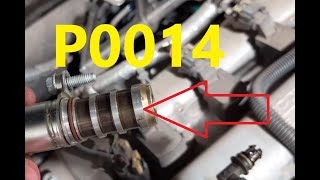
Helpful Videos
We Have This Part in Stock

The information in this article is provided for general reference and educational purposes only. Vehicle specifications, procedures, and part compatibility can vary by production date, trim level, and region. Always consult your vehicle's factory service manual and verify part numbers before purchasing or performing repairs. Safety-critical components such as airbags, seat belts, and braking systems should be installed by a qualified professional.
- Buick LACROSSE:
- 🎬 Helpful Videos
- 🛍️ Shop This Part
- What's Unique About the 2010-2017 Buick LACROSSE
- Diagnostic Flowchart
- Symptoms You May Notice
- Most Likely Causes
- Rare But Worth Checking
- Diagnosis Steps
- Parts You'll Likely Need
- Related Codes That Often Appear With This One
- Technical Service Bulletins (TSBs) & Recalls
- Platform-Specific Known Issues
- Mechanic-Grade Diagnostic Values
- Scan Tool Commands That Help
- Wiring & Ground Locations
- Real Owner Repair Stories
- When the Usual Fixes Don't Work
- OEM Part Supersession History
- Model Year Variations Within This Range
- 🎟️ Get 5% Off