

P0012 on 2015-2019 Ford Flex: Causes for Over-Retarded Camshaft Timing and Fixes
On a 2015-2019 Ford Flex, code P0012 is most often caused by low/dirty engine oil or a faulty Variable Camshaft Timing (VCT) solenoid on Bank 1 (the rear cylinder head, closer to the firewall). An oil change using the correct viscosity oil may fix it, but replacing the VCT solenoid is a common repair. Expect professional repair costs of $260-$350+ for a single solenoid replacement, with costs being higher as the Bank 1 solenoid is difficult to access and requires removing the upper intake manifo
- P0012 on your Ford Flex is very likely an oil-related issue.
- Always start by checking your oil level and condition; an oil change is the cheapest and easiest first step.
- The most common part to fail is the Bank 1 (rear) intake VCT solenoid, which is labor-intensive to replace.
- Per Ford's own service bulletins, debris in the oil is a known cause for this part sticking.
- If you hear a rattling noise, stop driving and have the timing chain system professionally inspected immediately.
What's Unique About the 2015-2019 Ford FLEX
Ford has issued multiple Technical Service Bulletins (TSBs) for this exact issue on this platform. The TSBs, such as SSM 48423, state that P0012 and related codes can be caused by small debris in the engine oil, which causes the Variable Camshaft Timing (VCT) solenoid to stick. This makes oil quality and VCT solenoid health the primary focus for diagnosis. Furthermore, accessing the Bank 1 (rear) solenoids on the 3.5L V6 requires removing the entire upper intake manifold, a labor-intensive job. This significantly increases repair time and cost compared to the easily accessible Bank 2 solenoids on the front of the engine.
Diagnostic Flowchart
Tap your situation to follow the diagnostic path that matches what you're seeing on this vehicle.
Symptoms You May Notice
- Check Engine Light illuminated
- Rough, unstable, or low idle
- Engine stalling at low speeds or when stopping
- Sluggish acceleration and general loss of power
- Decreased fuel efficiency
- Rattling noise from the engine on startup (may indicate timing chain issues)
- Hard starting
- Replacing the camshaft position sensor when the root cause is a sticking VCT solenoid or contaminated engine oil.
- Replacing only the VCT solenoid when the underlying issue is a stretched timing chain, leading to the code returning.
Most Likely Causes
- Low or Dirty Engine Oil 🔴 High Probability The VCT system is hydraulic and highly sensitive to oil pressure and cleanliness. Ford TSBs cite debris in the oil as a direct cause of VCT solenoid failure for this code. Some owners report the code appearing immediately after an oil change, possibly due to dislodged sludge, and then clearing on its own after a few days of driving.
How to confirm: Check the oil level on the dipstick and inspect its color and consistency. If the oil is low, black, or appears sludgy, it needs to be changed. Ensure the correct oil viscosity (e.g., 5W-20 for the naturally aspirated 3.5L) is being used, as incorrect oil can also cause this issue.
Typical fix: Perform an engine oil and filter change using the manufacturer-specified grade (e.g., Motorcraft 5W-20 or 5W-30 depending on the engine) and a quality filter like Motorcraft. Consider using an engine flush product before the oil change if sludge is suspected.
Est. part cost: $40-$80 - Sticking or Failed VCT Solenoid 🔴 High Probability As noted in Ford TSBs #SSM 48423 and #SSM 47170, these solenoids are prone to sticking due to small debris. The screens on the solenoids can become clogged, restricting oil flow.
How to confirm: After checking the oil, the solenoid can be removed and inspected for clogged screens or sludge. A mechanic can command the solenoid with a scan tool (per TSB SSM 48423, cycling it 10 times may clear debris) 🎬 See how to diagnose P0012 and test the solenoid. or test its resistance with a multimeter. You can also apply 12V to the solenoid to see if it 'clicks' open and closed.
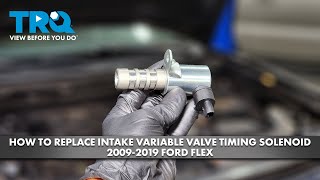
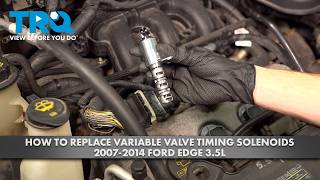
Typical fix: Replace the Bank 1 intake VCT solenoid. 🎬 Watch: Step-by-step guide to replacing the intake VVT solenoid. Due to the high labor cost of removing the intake manifold to access the rear bank, it is strongly recommended to replace both the intake and exhaust solenoids on Bank 1 at the same time, along with the valve cover gaskets.
Est. part cost: $40-$100 - Stretched Timing Chain or Faulty Cam Phaser ⚪ Low Probability The Ford 3.5L engine family, particularly the EcoBoost version, can be susceptible to timing chain stretch and cam phaser failure, especially at higher mileage (over 100k miles) or with poor maintenance history. This is a known issue across the platform.
How to confirm: This is difficult to confirm without significant disassembly. A persistent rattling noise on startup that lasts more than a few seconds is a strong indicator. A professional diagnosis measuring camshaft deviation with a scan tool is required. Codes like P0016 are often present as well.
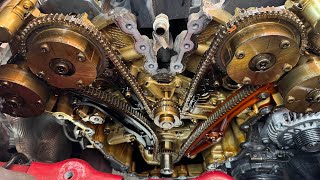
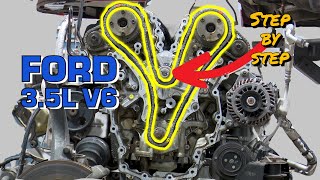
Typical fix: This is a major and expensive repair that involves replacing the timing chains, guides, tensioners, and often the cam phasers and the internal water pump, which is driven by the timing chain. 🎬 Watch: Full DIY guide for timing chain and water pump replacement.
Est. part cost: $400-$800
Rare But Worth Checking
- Faulty Camshaft Position Sensor: While possible, this is less common than VCT solenoid or oil-related issues. The sensor reports the position, but doesn't cause it to be incorrect. It's often misdiagnosed as the primary fault, though some owners replace it as a 'while you're in there' item during a timing job.
- Clogged Oil Passages: In engines with severe sludge buildup, the small oil passages leading to the VCT solenoids and cam phasers can become blocked. Even with a new solenoid, the code may persist if oil flow is restricted. An engine flush may help, but severe cases could require significant engine disassembly to clean.
Diagnosis Steps
- Check Engine Oil Level and Condition: This is the first, easiest, and most important step. If the oil is low, dirty, or the wrong viscosity, perform an oil and filter change with the correct Motorcraft-specified oil. Clear the code and drive to see if it returns.
- Scan for Other Codes: Check for other related codes (like P0022, P0016, etc.) that can help pinpoint the problem. A P0016 strongly suggests a base timing issue (chain/phaser).
- Listen for Engine Noises: Carefully listen for any rattling or chain noise during cold startups. A brief rattle is normal, but a persistent noise points towards a timing chain/phaser issue.
- Test the VCT Solenoid: If the oil change doesn't work, the next step is the VCT solenoid. A scan tool can be used to command the solenoid on and off to check for response, per Ford TSB SSM 48423. Alternatively, remove the solenoid (requires intake manifold removal for Bank 1) and test it by applying 12V to see if it actuates. Inspect its screens for debris.
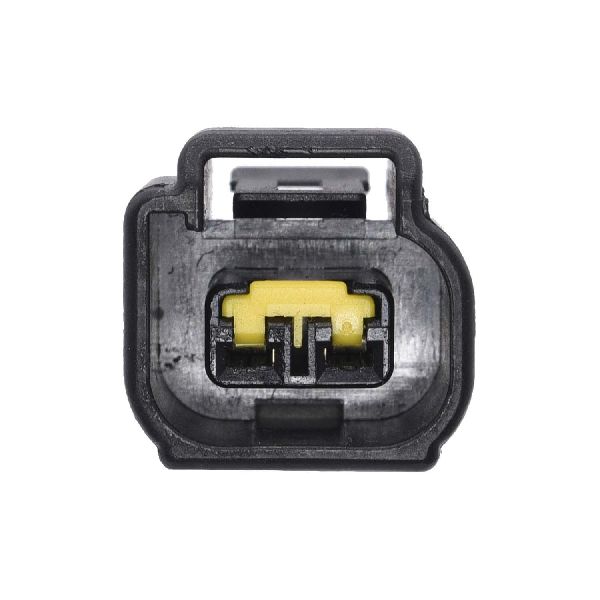
- Inspect Wiring: Check the wiring harness and connector for the Bank 1 VCT solenoid for any damage, corrosion, or loose connections.
- Seek Professional Diagnosis: If the solenoid tests good or a replacement does not resolve the code, or if a timing chain rattle is present, the vehicle should be taken to a professional for an in-depth diagnosis of the mechanical timing system (timing chain, guides, phasers).
Parts You'll Likely Need
- Variable Camshaft Timing (VCT) Solenoid
(OEM #7T4Z-6M280-C)— This part directly controls camshaft timing with oil pressure and is cited in Ford TSBs as the component that sticks due to debris, causing code P0012. This part number fits both 3.5L and 3.7L engines and supersedes older versions 7T4Z-6M280-A, 7T4Z-6M280-AA, and 7T4Z-6M280-B.
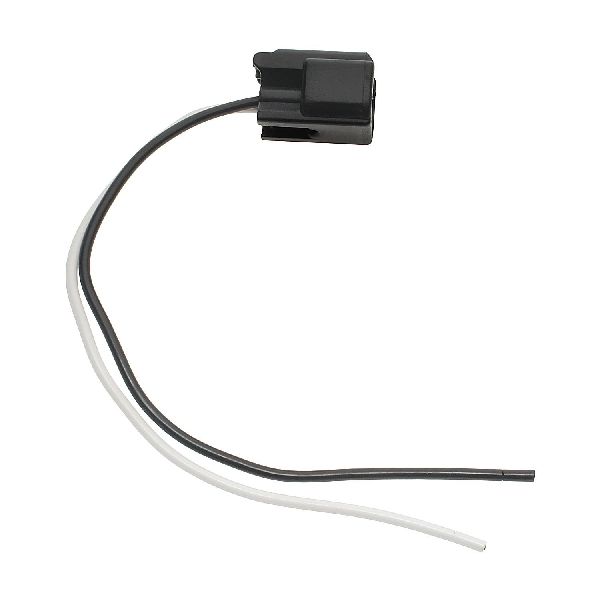
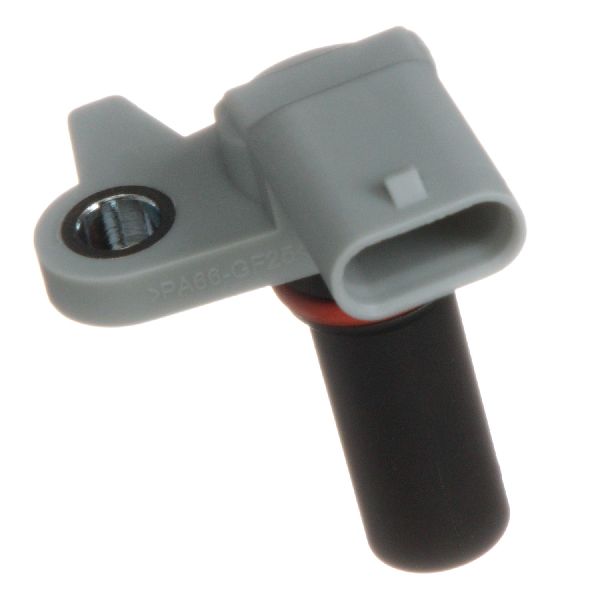
Trusted brands: Motorcraft (OEM), Standard Motor Products (SMP), Dorman
OEM price range: $60-$90
Aftermarket price range: $30-$60 - Upper Intake Manifold Gasket Set
(OEM #Look for Fel-Pro MS 96920 or equivalent)— Required for replacing the Bank 1 (rear) VCT solenoids, as the intake manifold must be removed to access them. These are single-use gaskets and must be replaced to prevent vacuum leaks.
Trusted brands: Motorcraft, Fel-Pro, Mahle
OEM price range: $30-$50
Aftermarket price range: $15-$30
Related Codes That Often Appear With This One
- P0022 — This is the same 'over-retarded' fault but for Bank 2 (the front bank). The underlying causes (like old oil) affect both banks. It's common to see both codes together.
- P0016 — This code indicates a correlation issue between the crankshaft and camshaft. It can appear alongside P0012 if the timing chain has stretched or jumped a tooth, pointing to a more serious mechanical problem.
- P052B — This code specifically points to an over-retarded camshaft during a cold start, often appearing with P0012 and pointing strongly to a sticking VCT solenoid or phaser.
Technical Service Bulletins (TSBs) & Recalls
- SSM 48423: Notes that P0012 can be caused by small debris causing the VCT solenoid to stick and suggests a diagnostic procedure to cycle the solenoid before replacement.
- SSM 54366: Mentions P0012 in a list of VCT-related codes and refers to specific diagnostic pinpoint tests in the service manual.
- SSM 47170: An earlier bulletin also identifying sticking VCT solenoids from debris as a cause for P0012.
Platform-Specific Known Issues
- TSB Guidance on VCT Solenoid Debris: Ford Technical Service Bulletin (TSB) #SSM 48423 explicitly states that for some 2015-2020 Ford vehicles, DTCs including P0012 may be caused by 'small debris causing the VCT solenoid to stick'. The TSB recommends using a scan tool to cycle the affected solenoid 10 times to attempt to clear the debris before replacing the part.
- Bank 1 Access Difficulty: On the transverse 3.5L V6 in the Flex, Bank 1 is against the firewall. Replacing the VCT solenoids requires the complete removal of the upper intake manifold, a job that involves disconnecting numerous hoses, wires, and removing the throttle body.
Mechanic-Grade Diagnostic Values
- VCT Solenoid Internal Resistance — expected: 7.0 to 14.0 Ohms. Some sources state a tighter range of 8-12 Ohms.. Failure: A reading of OL (Open Loop/infinite resistance) indicates a broken internal coil. A reading near zero indicates a short. Any reading outside the specified range warrants replacement.
- VCT Solenoid Voltage Supply (Key On, Engine Off) — expected: 12V+ (Battery Voltage) at the power supply pin of the connector.. Failure: No voltage indicates a wiring or fuse issue upstream from the solenoid.
- FORScan Live Data: VCT_INT_ERR1 (Bank 1 Intake Cam Timing Error) — expected: Close to 0 degrees at stable idle. The value will fluctuate as the PCM commands timing changes.. Failure: Large, persistent non-zero values (e.g., swinging wildly or stuck at a high number like 40 degrees) when the commanded and actual angles do not match, especially if it corresponds with rough running, indicates a control problem.
Hidden / Shadow Codes Worth Checking
- Mode $06, TID $53: This is not a DTC, but a test ID within the generic OBD-II Mode $06 data. It provides raw data for the misfire monitor on a per-cylinder basis. While P0012 is a timing code, associated engine instability can sometimes be misconstrued as a misfire. Reviewing this data can help rule out a primary ignition problem. (see via A scan tool capable of displaying Mode $06 data, such as FORScan or higher-end professional scanners.)
Scan Tool Commands That Help
- Ford IDS / FORScan: Pinpoint Test HK / VCT Solenoid Cycle Test — As recommended by Ford TSBs (like SSM 48423), this function should be used after an oil change but before solenoid replacement. It cycles the VCT solenoid rapidly 10 times to dislodge small debris that may be causing it to stick. If the code clears after this test, it can prevent an unnecessary part replacement.
Wiring & Ground Locations
- G101 / G102 — G101 is located on the left front of the engine compartment. G102 is on the right rear of the engine compartment. These are primary grounds for components in the engine bay.. The Powertrain Control Module (PCM) and its sensors rely on clean ground connections for accurate readings and commands. A corroded or loose engine ground can cause erratic behavior in the VCT system, although it would likely be accompanied by other codes and symptoms.
- PCM Connector C175B — This is one of the main connectors at the Powertrain Control Module (PCM), located near the rear of the engine compartment.. The control signal for the VCT solenoids originates from the PCM. Technicians performing advanced diagnosis for a persistent P0012 (after replacing parts) would test for signal continuity from the pins at this connector to the VCT solenoid connector to rule out a wiring harness break.
Real Owner Repair Stories
- Reddit user post on r/FordFlex (2009 Ford Flex 3.5L) — Initially had codes P0012, P0016, P0022 and a rough run.
❌ Tried (didn't work) A full timing job was performed (chains, sprockets, water pump, guides). The VCT solenoids were removed, cleaned, and tested with 12V (they clicked open and closed), then reinstalled. Cam sensors were also changed. The engine ran smoothly for several hundred miles.
✅ What actually fixed it The P0012 code returned by itself after about 500 miles. The user concluded that despite passing a bench test, one of the original VCT solenoids was likely failing intermittently or that debris stirred up during the major repair had clogged a screen, necessitating replacement of the solenoids rather than just cleaning them.
OEM Part Supersession History
7T4Z-6M280-A, 7T4Z-6M280-AA, 7T4Z-6M280-B→7T4Z-6M280-C— Standard part revision and improvement by the manufacturer over time.
Heads up: The -C revision is the current, correct OEM part and is backward compatible, replacing the previous versions for 3.5L and 3.7L applications.
Model Year Variations Within This Range
- 2018-2019: For the 2018 model year, the base 3.5L V6 in some Ford platforms was replaced by a smaller 3.3L V6. While the Flex retained the 3.5L as its standard engine through 2019, it's a point of awareness for technicians working across the Ford lineup, as parts and specifications can differ. The underlying Ti-VCT technology, however, remains conceptually the same.
Helpful Videos
Used OEM Parts in Stock


New Aftermarket Parts Available


The information in this article is provided for general reference and educational purposes only. Vehicle specifications, procedures, and part compatibility can vary by production date, trim level, and region. Always consult your vehicle's factory service manual and verify part numbers before purchasing or performing repairs. Safety-critical components such as airbags, seat belts, and braking systems should be installed by a qualified professional.
- Ford FLEX:
- 🎬 Helpful Videos
- 🛍️ Shop This Part
- What's Unique About the 2015-2019 Ford FLEX
- Diagnostic Flowchart
- Symptoms You May Notice
- Most Likely Causes
- Rare But Worth Checking
- Diagnosis Steps
- Parts You'll Likely Need
- Related Codes That Often Appear With This One
- Technical Service Bulletins (TSBs) & Recalls
- Platform-Specific Known Issues
- Mechanic-Grade Diagnostic Values
- Hidden / Shadow Codes Worth Checking
- Scan Tool Commands That Help
- Wiring & Ground Locations
- Real Owner Repair Stories
- OEM Part Supersession History
- Model Year Variations Within This Range
- 🎟️ Get 5% Off