

P0008 on 2007-2010 Pontiac G6: Timing Chain Causes and Fixes
On a 2007-2010 Pontiac G6 with the 3.6L V6 engine, code P0008 almost always means the timing chains have stretched. This is a well-documented issue requiring the replacement of the timing chains, tensioners, and guides. The repair is labor-intensive and expensive, often costing between $1,800 and $3,000. Ignoring it can lead to catastrophic engine failure.
- P0008 on a 3.6L G6 is a serious code that points directly to a stretched timing chain.
- This is a known manufacturing defect, not a random failure. The only correct fix is to replace the chains, tensioners, and guides with an updated kit.
- Do not waste money replacing camshaft or crankshaft sensors; they are almost never the cause.
- This is a major, expensive repair that is not recommended for DIY unless you are a highly experienced mechanic with the proper tools.
- Using high-quality synthetic oil and shortening the oil change interval to 5,000 miles can help prolong the life of the replacement chains.
What's Unique About the 2007-2010 Pontiac G6
The 3.6L V6 (RPO code LY7) engine used in this generation of Pontiac G6 is notorious for premature timing chain stretching. The issue was so widespread that General Motors issued multiple Technical Service Bulletins (TSBs) and a Special Coverage Adjustment (11340C) that extended the warranty to 10 years or 120,000 miles for this specific problem. The failure is often attributed to a combination of factors, including extended oil change intervals encouraged by the GM Oil Life Monitor (OLM), the original timing chain design, and potential PCV system issues that lead to oil degradation and consumption.
Diagnostic Flowchart
Tap your situation to follow the diagnostic path that matches what you're seeing on this vehicle.
Symptoms You May Notice
- Check Engine Light is on
- Engine rattling noise, especially on a cold start, that may last for a few seconds
- Rough or fluctuating idle
- Reduced engine power and poor acceleration
- Worse than normal fuel economy
- Engine may struggle or hesitate when accelerating
- Replacing only the camshaft or crankshaft position sensors. While these sensors provide the data, they are rarely the root cause of P0008 on this engine. The problem is almost always the mechanical timing components they are monitoring. Swapping sensors is a waste of money if the underlying mechanical fault isn't addressed.
Most Likely Causes
- Stretched Timing Chains 🔴 High Probability The original timing chains on the 3.6L LY7 engine were made of a material that was susceptible to premature wear and stretching. This is a widely acknowledged factory issue, exacerbated by long oil change intervals.
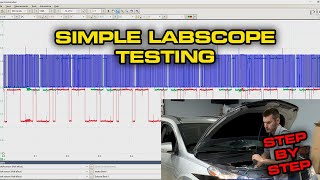
How to confirm: A technician will use an advanced scan tool to view cam/crank deviation data; 🎬 Watch: How to use a labscope to test for timing stretch. significant deviation confirms the timing is off. The definitive diagnosis is a physical inspection of the chains' slack after removing the engine timing cover.
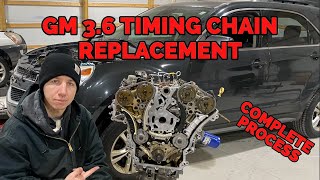
Typical fix: Replace all three timing chains, all tensioners, and all guides with an updated-design kit. It is critical to replace all components, not just the stretched chain.
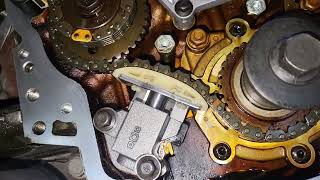
Est. part cost: $250-$600 - Worn or Failed Timing Chain Tensioners 🔴 High Probability The tensioners, which use oil pressure to keep the chains tight, can weaken or fail. This is considered part of the overall timing system weakness and is often a result of the same oil degradation issues that harm the chains.
How to confirm: Diagnosed during the physical inspection for a stretched timing chain. A rattling noise that subsides after the engine builds oil pressure is a key symptom. 🎬 See and hear what a failing tensioner sounds like at startup.
Typical fix: Tensioners are always replaced as part of a complete timing chain service. Never reuse old tensioners.
Est. part cost: $50-$150 (if bought separately) - Low or Degraded Engine Oil 🟡 Medium Probability The GM Oil Life Monitor often allowed for very long oil change intervals (sometimes over 10,000 miles). Degraded or low oil loses its lubricating properties and hydraulic pressure, accelerating wear on the timing chains and tensioners which rely on it. This is considered a primary contributing factor to the epidemic of failures.
How to confirm: Check the oil level on the dipstick and inspect its condition. If it's low, black, or gritty, it's a contributing factor. Reviewing the vehicle's service history for oil change frequency can also be telling.
Typical fix: Change the engine oil and filter using a full synthetic oil meeting GM's Dexos specification. This is critical for prevention and for the longevity of new parts, but it will not fix chains that are already stretched.
Est. part cost: $40-$80
Rare But Worth Checking
- Shifted Crankshaft Reluctor Wheel: GM issued TSBs (including PIP3423P) indicating that in some cases, the reluctor wheel that the crankshaft position sensor reads can physically move on the crankshaft. This perfectly mimics the symptoms of a stretched chain by sending incorrect crankshaft position data to the ECM. Diagnosis may require a borescope or partial engine disassembly to visually confirm the wheel's position relative to TDC. This requires crankshaft replacement, a massive repair.
Diagnosis Steps
- Verify the code with an OBD-II scanner.
- Check engine oil level and condition. If low or dirty, correct this first, clear codes, and see if they return. Note that this will not fix a stretched chain.
- Using an advanced scan tool (like a GM Tech 2 or equivalent), monitor the cam/crank correlation data PIDs. Deviations of more than +/- 4 degrees on any of the four camshafts strongly suggest chain stretch.
- Listen for a rattling noise from the front of the engine (timing cover area), especially during a cold start for the first 2-5 seconds.
- If a timing chain issue is suspected, the next step is to remove the timing cover for a direct visual inspection of the chains, guides, and tensioners. Check for broken guides or excessive slack in the chains.
- While diagnosing, a technician may also use a borescope through the crankshaft position sensor hole to inspect the reluctor wheel for any signs of movement, as noted in GM TSB PIP3423P.
Parts You'll Likely Need
- Engine Timing Chain Kit
(OEM #12700436 (Latest successor kit))— This is the definitive fix. A complete kit replaces the stretched chains and worn supporting components (tensioners, guides) with updated parts designed for longer life. It is crucial to use a complete, updated kit.
Trusted brands: ACDelco (OEM), Cloyes (e.g., 9-0753S, a popular and respected aftermarket choice), Gates
OEM price range: $400-$600
Aftermarket price range: $250-$450 - Timing Cover Gasket and Seals — These are single-use gaskets and seals that are required to re-seal the engine after replacing the timing components to prevent oil leaks.
Trusted brands: Fel-Pro, ACDelco
OEM price range: $50-$100
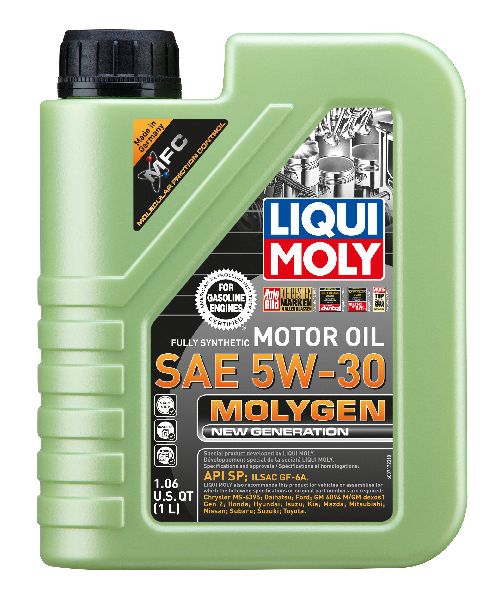
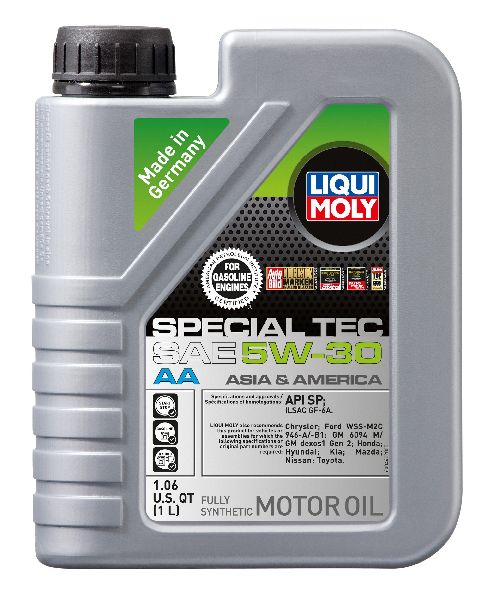
Aftermarket price range: $30-$60 - Engine Oil and Filter — Fresh, clean oil is critical for the longevity of the new timing components. Use a full synthetic oil meeting GM's Dexos specification and commit to shorter change intervals (3,000-5,000 miles) to prevent recurrence.
Trusted brands: ACDelco, Mobil 1, Pennzoil
OEM price range: $50-$90
Aftermarket price range: $40-$70
Related Codes That Often Appear With This One
- P0017 — Crankshaft Position - Camshaft Position Correlation Bank 1 Exhaust. This code is often set along with P0008 because the ECM is detecting a timing error specific to the Bank 1 exhaust camshaft.
- P0016 — Crankshaft Position - Camshaft Position Correlation Bank 1 Intake. Similar to P0017, this points to a timing error on the Bank 1 intake camshaft.
- P0009 — Engine Position System Performance Bank 2. This is the companion code for the other cylinder bank (Bank 2, closer to the radiator). If both P0008 and P0009 are present, it strongly indicates a problem with the primary timing chain that serves both banks, confirming a major timing system failure.
Technical Service Bulletins (TSBs) & Recalls
- 12-06-01-009F: Announces the availability of comprehensive timing chain kits for repairing stretched chains that cause codes like P0008, and supersedes earlier versions.
- PIP3423P: Advises technicians to inspect for loose timing chains, tensioners, or a shifted crankshaft reluctor wheel when P0008 or related codes are present, confirming the multiple potential mechanical causes.
- 11340C: This is the Special Coverage Adjustment that extended the warranty to 10 years/120,000 miles for this specific issue, detailing the affected vehicles and the no-cost repair for eligible owners.
- 10-06-01-008G: While not directly for the G6, this TSB addresses oil consumption issues on related GM engines due to PCV system and internal component design, which is a known contributing factor to the oil degradation that causes timing chain failure.
Platform-Specific Known Issues
- GM issued Special Coverage Adjustment 11340C, extending the warranty for timing chain wear to 10 years or 120,000 miles. While these vehicles are now past that age, it serves as official acknowledgment of the defect and the repair procedure.
- The problem is specifically with the 3.6L LY7 V6 engine. The 3.5L and 3.9L V6 engines available in the G6 have a different (pushrod) design and do not share this common timing chain failure.
- A contributing factor can be a poorly designed PCV system, which can lead to increased oil consumption. GM released TSB 10-06-01-008G for other vehicles with similar engine architecture to address oil consumption, highlighting the importance of the PCV system in overall engine health.
Mechanic-Grade Diagnostic Values
- Crankshaft Reluctor Wheel Position — expected: 25 to 26 mm from the end of the machined surface of the crankshaft throw to the edge of the open space in the reluctor wheel.. Failure: Any measurement outside this range indicates the wheel has slipped on the crankshaft, requiring crankshaft replacement.
- Timing Chain Tensioner Bolt Torque — expected: 18 lb ft. Failure: Improper torque can lead to incorrect tensioner operation or bolts backing out.
- VVT Solenoid (Oil Control Valve) Resistance — expected: Generally between 5 and 25 ohms, but vehicle-specific manual should be consulted.. Failure: A reading that is too high, too low, or shows infinite resistance (open circuit) indicates a faulty solenoid.
- Cam/Crank Waveform Analysis via Oscilloscope — expected: A consistent, repeating pattern that matches a known-good waveform for the LY7 engine.. Failure: A deviation or shift in the camshaft sensor's waveform relative to the crankshaft sensor's waveform indicates a timing discrepancy.
Scan Tool Commands That Help
- GM Tech 2 / GDS2 or equivalent: Cam/Crank Correlation PIDs — This is the primary data to monitor live. It shows the degrees of deviation between the camshafts and crankshaft, with more than +/- 4 degrees suggesting a mechanical timing issue.
- GM Tech 2 / GDS2 or equivalent: Actuate Variable Oil Pump Solenoid — Used during advanced diagnostics to test the functionality of the VVT system's oiling circuit, which can influence cam phasing.
- Oscilloscope: Camshaft vs. Crankshaft Waveform Capture — To visually and definitively confirm a timing correlation error electronically before committing to engine disassembly. This method bypasses the car's computer and directly measures sensor output.
Wiring & Ground Locations
- G108 (for 3.6L) — On the right rear corner of the cylinder head.. A poor ground at this location can affect the Engine Control Module (ECM) or nearby sensors, potentially causing erratic readings that could be misinterpreted as a timing fault, although less common than a mechanical issue.
- G106 (for 3.6L) — On the front of the engine, at a transmission stud.. This is a major engine ground point. Corrosion or looseness here can cause a wide range of issues, including starting problems and incorrect sensor readings. One owner reported a rotted ground at this location caused a no-start condition.
- ECM (Engine Control Module) — Left side of the engine compartment.. Knowing the ECM's location is critical for inspecting its connectors and wiring harness for damage or corrosion, which could theoretically cause a P0008 code.
Real Owner Repair Stories
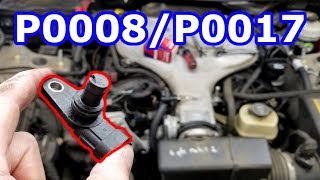
- YouTube user 'The Fit RV' (2007 Cadillac CTS (with the same 3.6L LY7 engine)) — Check Engine Light with codes P0008 and P0017.
❌ Tried (didn't work) Replacing the Bank 1 Sensor B camshaft position sensor.
✅ What actually fixed it The sensor replacement did NOT fix the codes, reinforcing that the issue is mechanical. The owner proceeded with a full timing chain replacement in a subsequent video, which is the correct repair. - Speed-Talk Forum user 'gn69z28' (GM 3.6L (unspecified vehicle)) — After a complete engine rebuild with all new OEM timing components (chains, guides, tensioners, phasers, solenoids), the engine produced a timing chain rattle for a few seconds on cold start.
❌ Tried (didn't work) Using all new, correct parts from the start.
✅ What actually fixed it The issue was suspected to be a brand new tensioner that was leaking down oil pressure overnight. This story highlights that even with a proper repair using new parts, a defective new component can cause symptoms to persist.
"I Checked Everything" — The Actual Cause
- While a smoke test is not applicable for P0008, a similar pattern exists: a technician may find that all camshaft and crankshaft sensors test perfectly for resistance and voltage, and the wiring shows no faults. Yet, the code persists. The actual cause in this scenario is often a mechanical issue the sensors are correctly reporting, such as a stretched chain, or an issue with the component the sensor reads, like a shifted crankshaft reluctor wheel.
When the Usual Fixes Don't Work
- The most significant counter-evidence to the 'it's always the timing chain' diagnosis is the shifted crankshaft reluctor wheel, as documented in GM TSB PIP3423P. A technician could perform a complete, expensive timing chain replacement, only for the P0008 code to return immediately because the crankshaft itself is providing a bad reference point for the sensor. This makes inspecting the reluctor wheel, either with a borescope or by removing the oil pan, a critical, though often skipped, diagnostic step when the timing chain slack is not obviously excessive.
OEM Part Supersession History
12651450 (and earlier versions)→12679117 -> 12693218 -> 12700436 (latest)— GM has updated the timing chain kits multiple times to improve the durability of the chains and guides to combat premature stretching.
Heads up: Using an older, superseded kit will likely lead to a repeat failure. It is critical to source the latest available OEM part number or a high-quality aftermarket equivalent based on the latest design.
Model Year Variations Within This Range
- 2009: Pontiac introduced a mid-year facelift for the G6 in 2009 (often called 2009.5) which included cosmetic updates and some feature changes. However, searches did not indicate any significant changes to the 3.6L LY7 engine's internal timing components within the 2007-2009 model years that would alter the diagnosis or repair of code P0008.
Helpful Videos
Used OEM Parts in Stock

New Aftermarket Parts Available



The information in this article is provided for general reference and educational purposes only. Vehicle specifications, procedures, and part compatibility can vary by production date, trim level, and region. Always consult your vehicle's factory service manual and verify part numbers before purchasing or performing repairs. Safety-critical components such as airbags, seat belts, and braking systems should be installed by a qualified professional.
- Pontiac G6:
- 🎬 Helpful Videos
- 🛍️ Shop This Part
- What's Unique About the 2007-2010 Pontiac G6
- Diagnostic Flowchart
- Symptoms You May Notice
- Most Likely Causes
- Rare But Worth Checking
- Diagnosis Steps
- Parts You'll Likely Need
- Related Codes That Often Appear With This One
- Technical Service Bulletins (TSBs) & Recalls
- Platform-Specific Known Issues
- Mechanic-Grade Diagnostic Values
- Scan Tool Commands That Help
- Wiring & Ground Locations
- Real Owner Repair Stories
- "I Checked Everything" — The Actual Cause
- When the Usual Fixes Don't Work
- OEM Part Supersession History
- Model Year Variations Within This Range
- 🎟️ Get 5% Off