

OBD-II Code P0001: Fuel Volume Regulator Control Circuit/Open
An ASE Master Technician's Expanded Guide to P0001
- Code P0001 indicates a definitive physical break—an 'open' circuit—in the 2-wire electrical connection controlling your fuel volume regulator.
- Over 70% of P0001 faults stem from corroded wiring harnesses or a failed internal solenoid coil, rather than a catastrophic fuel pump failure.
- Stop driving immediately; ignoring a P0001 code forces the engine to run excessively rich or lean, risking a $1,500+ catalytic converter replacement.
- Always test the regulator's resistance with a multimeter (looking for an 'OL' reading) before spending $800+ on a new high-pressure fuel pump.
What Does P0001 Mean?

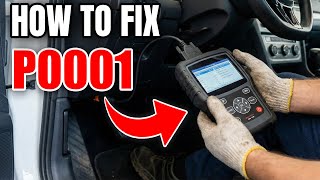
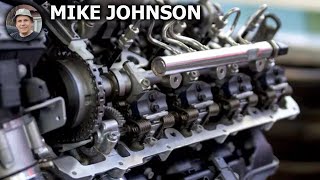
P0001 means your car's main computer (ECU or PCM) detects a physical break or 'open' in the electrical circuit controlling the fuel volume regulator. This regulator, often called a Fuel Volume Control Valve (FVCV), manages the exact amount of fuel sent to the high-pressure fuel pump. When the circuit breaks, the computer loses all ability to command fuel pressure, triggering 🎬 Watch: A deep dive into how the fuel volume regulator works. immediate engine performance failures.
Technical definition: The official SAE/OBD-II definition is "Fuel Volume Regulator Control Circuit/Open." The Powertrain Control Module (PCM) detects a complete loss of continuity in the electrical circuit for the fuel volume solenoid. The PCM controls both the power and ground sides of this two-wire solenoid; a break in either wire, the connector, or the internal solenoid coil sets this code.
Can I Drive With P0001?
Yes, But With Caution. You can drive short distances, but it is highly discouraged. The fault causes sudden stalling, a no-start condition, or 'limp mode', leaving you stranded in unsafe locations. Continued driving forces the engine to run excessively rich or lean, destroying the catalytic converter—a repair costing $800 to $2,500. Tow the vehicle or drive directly to a repair shop.
Common Causes

- Wiring or Connector Breakage (Very Common) — The wiring harness or electrical connectors going to the regulator suffer damage, severe corrosion, or rodent chewing. Exposure to road salt and moisture creates a physical break in the circuit, or a poor ground connection creates infinite resistance.
- Failed Fuel Volume Regulator (FVR) Solenoid (Very Common) — The regulator solenoid fails internally. The internal copper coil breaks due to thermal cycling, vibration, or fuel impurities, creating an open circuit inside the part itself.
- Blown Fuse or Faulty Relay (Common) — A blown fuse or a failed relay in the fuel pump or ECU circuit cuts power to the regulator entirely, causing the PCM to read an open circuit.
- Failed High-Pressure Fuel Pump (HPFP) (Less Common) — In many modern direct-injection and diesel vehicles, the regulator is permanently integrated into the high-pressure fuel pump assembly. An internal electrical fault in the pump triggers this code, requiring full pump replacement.
- Control Module or Software Failure (Rare) — The driver circuit within the PCM or Fuel Pump Control Module (FPCM) fails, or corrupted software erroneously triggers the code. This requires a module replacement or a manufacturer software reflash (TSB).
Symptoms

- Engine Stalling — The engine stalls unexpectedly at idle, at low speeds, or under heavy load (like driving uphill) due to sudden fuel starvation.
- No-Start or Extended Cranking — The engine cranks indefinitely but refuses to start because the high-pressure pump receives no fuel volume command.
- Check Engine Light Illuminated (also visible on scanner) — The light illuminates steadily immediately after the fault occurs, or flashes if the resulting fuel mixture causes severe engine misfires.
- Limp Mode and Power Loss (also visible on scanner) — The PCM forces the vehicle into 'limp mode,' drastically limiting throttle response and acceleration to protect internal engine components.
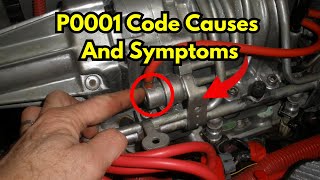
- Plummeting Fuel Economy and Exhaust Smoke (also visible on scanner) — Unregulated fuel delivery destroys gas mileage and causes the engine to run rich, emitting visible black smoke from the tailpipe. 🎬 See a breakdown of common P0001 symptoms and causes.
Diagnostic Flowchart
Tap your situation to follow the diagnostic path that matches what you're seeing on this code.
Common Fixes & Costs
- Repairing Damaged Wiring or Connectors — Parts: $10-$50, Labor: $100-$250, ~1.5 hr book time (Intermediate)
- Replacing the Fuel Volume Regulator — Parts: $100-$450, Labor: $100-$300, ~1.2 hr book time (DIY)
- Replacing a Blown Fuse or Relay — Parts: $5-$20, Labor: $50-$100, ~0.5 hr book time (DIY)
- Replacing the High-Pressure Fuel Pump (HPFP) — Parts: $800-$2,500, Labor: $300-$600, ~3.5 hr book time (Professional)
- Replacing or Reprogramming the ECM/PCM — Parts: $500-$1,200, Labor: $150-$300, ~1.5 hr book time (Professional)
Used vs. New Parts: Buying Guide
When a used part is worth it: Only consider used parts for an expensive high-pressure fuel pump ($800+) on a vehicle nearing the end of its lifespan. For a standalone regulator ($150), the labor cost negates any savings, making a new part mandatory.
Donor-vehicle mileage cap: roughly under 60000 miles for the part to have meaningful remaining life.
Donor quality checklist:
- Verify the donor vehicle was rear-ended, not scrapped for engine failure.
- Match the OEM part number exactly; electronic solenoids are highly specific.
- Reject any part with green corrosion on the electrical connector pins.
Decision logic:
- If The part is a standalone Fuel Volume Regulator costing under $250. → Buy new. The labor to replace a failed used part costs more than the part itself.
- If The part is an integrated High-Pressure Fuel Pump ($800+ new) and the car has 150,000+ miles. → Buy a tested, warranted used pump from a reputable auto recycler.
- If The part is a known high-failure item (e.g., BMW N54 HPFP). → Buy a new OEM or upgraded aftermarket part. Used parts carry a massive risk of immediate failure.
Warranty tradeoff: Used parts offer 30-day warranties covering the part only. New parts offer 1-year to lifetime warranties. If a used part fails, you pay the mechanic's labor rate twice.
Worst-case if a used part fails: $300-$600 in repeat labor costs if the used component fails.
What Happens If You Wait — Timeline
- 0-1 week: Check Engine Light illuminates. The vehicle experiences intermittent hard starting or slight hesitation. The issue may temporarily vanish on restart. (MPG impact: 0-5%% · Added cost: $0)
- 1-4 weeks: Symptoms become permanent. Engine stalls at idle. Limp mode activates frequently, making highway driving dangerous. Fuel economy drops noticeably. (MPG impact: 10-15%% · Added cost: $50-$100 in wasted fuel.)
- 1-3 months: The vehicle becomes completely unreliable, suffering frequent no-start conditions. The erratic fuel mixture begins overheating the catalytic converter. (MPG impact: 15-25%% · Added cost: $200 in towing fees.)
- 3+ months: Catastrophic failure. The rich/lean fuel condition melts the catalytic converter substrate. Continued stress destroys the high-pressure fuel pump. (MPG impact: >25%% · Added cost: $1500-$3500+)
Cost of Not Fixing It
- Immediate (0-1 month): Severe drop in fuel economy (10-25%), engine stalling, and high risk of being stranded. (Added cost: $100-$250 in wasted fuel and towing fees.)
- Medium Term (1-6 months): Raw fuel dumps into the exhaust, overheating and melting the catalytic converter substrate. (Added cost: $800-$2,500 for catalytic converter replacement.)
- Long Term (6+ months): Continued erratic pressure destroys the internal seals and bearings of the high-pressure fuel pump. (Added cost: $1,000-$3,500 for high-pressure fuel pump replacement.)
Diagnosis Steps

- Scan for TSBs and All Stored Codes
Use an OBD-II scanner to read all codes. Address P0001 first, as it causes low-pressure codes like P0087. Check manufacturer Technical Service Bulletins (TSBs) for known software updates that fix false P0001 triggers.
Tools: OBD-II Scanner, Internet Access (Beginner) - Visually Inspect Wiring and Perform a 'Wiggle Test'
Examine the wiring harness and connector at the Fuel Volume Regulator. Look for broken wires, green corrosion, or melted plastic. While monitoring the circuit with a multimeter in continuity mode, gently wiggle the harness. If the reading drops out, you have found an internal wire break.
Tools: Flashlight, Multimeter (Beginner) - Inspect Fuses and Relays
Check the fuse box for blown fuses or failed relays related to the fuel pump, FPCM, or ECU. A blown fuse cuts power to the circuit, instantly triggering an open circuit code.
Tools: Fuse Puller, Multimeter (Beginner) - Test Regulator Solenoid Resistance
Disconnect the regulator. Set a multimeter to Ohms (Ω) and measure across the two pins on the regulator itself. Compare to factory specs (usually under 5 ohms). A reading of 'OL' (Open Loop) confirms the internal coil is broken and the part must be replaced.
Tools: Multimeter, Repair Manual (Intermediate) - Test Circuit Power and Ground
Turn the key ON, engine OFF. Disconnect the regulator. Use a multimeter to check the harness power wire for reference voltage (usually 5V or 12V). Check the ground wire for continuity to the chassis (under 0.1 Ohms). 0V or 'OL' indicates a harness or PCM failure.
Tools: Multimeter, Wiring Diagram (Intermediate) - Command Regulator via Bi-Directional Scan Tool
Use a bi-directional scanner to command the regulator ON/OFF. Listen for an audible click. If it clicks but live data shows no fuel pressure change, the valve is mechanically stuck. If it doesn't click, the electrical fault is confirmed.
Tools: Bi-Directional Scan Tool (Advanced) - Analyze Waveform with an Oscilloscope
Connect an oscilloscope to the control and ground wires. A healthy circuit shows a clean pulse-width modulated (PWM) square wave. An open circuit shows a flat line at source voltage with no modulation, pinpointing the exact failure point.
Tools: Oscilloscope, Back-Probe Adapters (Professional)
When This Code Triggers (Freeze-Frame Conditions)
- Engine Coolant Temp: 175-210°F (Engine at full operating temperature.)
- RPM: 1200-2800 RPM (During acceleration or steady-state cruising.)
- Engine Load: 25-70% (Moderate to heavy engine load, when fuel demand fluctuates.)
- Vehicle Speed: 25-60 mph (City or highway driving under load.)
Related Codes
- P0002 — P0001 means the circuit is completely broken (open). P0002 means the circuit is intact but performing out of range. A multimeter shows infinite resistance (OL) for P0001, but an incorrect numerical resistance for P0002.
- P0003 — P0003 indicates a short to ground (voltage too low). A multimeter test on the signal wire shows continuity to ground for P0003, whereas P0001 shows no continuity at all.
- P0004 — P0004 indicates a short to power (voltage too high). A multimeter test shows battery voltage on the signal wire when it shouldn't, distinct from the dead circuit of P0001.
- P0087 — P0087 (Fuel Rail Pressure Too Low) is the physical symptom caused by the P0001 electrical fault. Always fix the P0001 wiring issue first; it will resolve the P0087 pressure issue.
Climate & Environmental Factors
- Road Salt and High Humidity: Winter road salt and coastal humidity aggressively corrode the regulator's electrical connector pins. This moisture intrusion is the leading environmental cause of an open circuit.
- Extreme Cold: Sub-zero temperatures cause plastic connectors and wire insulation to become brittle and crack. Cold also contracts metal pins, worsening a loose connection and triggering the code on startup.
- Poor Fuel Quality: Contaminated or low-lubricity fuel causes the internal mechanical valve of the regulator to bind. The electrical solenoid overheats trying to move the stuck valve, eventually burning out the coil.
How to Talk to a Mechanic About This Code
Say this: "I have a P0001 code indicating an open circuit for the Fuel Volume Regulator. Please test the continuity of the wiring, the connector, and the resistance of the regulator solenoid itself before quoting a full high-pressure fuel pump replacement."
This proves you understand the code is strictly electrical. It forces the shop to perform proper circuit diagnostics rather than immediately upselling a $2,000 fuel pump.
Avoid saying:
- 'My car is stalling, just fix whatever is wrong.'
- 'The internet says I need a new fuel pump.'
- 'Just replace the regulator.'
Questions to ask before authorizing the repair:
- Did you test the regulator solenoid's resistance with a multimeter? What was the exact Ohm reading?
- Did you confirm 12V power and a solid ground at the regulator's electrical connector?
- If quoting a new fuel pump, is it because the regulator is permanently integrated and cannot be replaced separately?
- Does your quote cover a full wiring harness replacement, or just splicing in a new pigtail connector?
Where to Take It: Dealer vs Independent vs Chain
- Dealer:
Use only if under warranty or if a specific software update (TSB) is required. Otherwise, avoid.
Best for: Vehicles under powertrain or emissions warranty., Vehicles with known TSBs requiring a PCM software reflash., Complex European vehicles requiring proprietary diagnostic software.
Downsides: Highest labor rates ($150-$250/hr)., Dealers default to replacing entire expensive assemblies (like the HPFP) instead of repairing a $20 wire. (Typical cost: +50% vs. baseline) - Independent Shop:
Highly recommended. A skilled independent diagnostician will trace the electrical fault logically and save you thousands.
Best for: Out-of-warranty vehicles., Diagnosing complex electrical faults., Performing targeted, cost-effective repairs like splicing a new connector.
Downsides: Diagnostic skill varies. You must find a shop with an ASE-certified diagnostician (L1 certification). (Typical cost: +0% vs. baseline) - Chain Shop:
Avoid completely. The risk of misdiagnosis and unnecessary fuel pump replacement is extremely high.
Best for: Oil changes, tires, and brake pads.
Downsides: Technicians lack deep electrical diagnostic experience., Corporate models incentivize rapid parts replacement over meticulous circuit testing. (Typical cost: -10% vs. baseline)
When to Walk Away From the Repair
If the repair estimate exceeds 40% of the vehicle's private-party Kelley Blue Book value, sell the car as-is.
- Car worth $3500, fix is $2000: Walk away. The repair is over half the car's value. Sell to a salvage buyer or as a 'mechanic's special'.
- Car worth $12000, fix is $450: Fix it. A $450 regulator or wiring repair restores the vehicle's full value.
- Car worth $8000, fix is $2500: Borderline. Get a second opinion from an independent auto electrician to confirm if a cheaper wiring fix is possible before authorizing a pump replacement.
What Scan Tool You Need for This Code
Minimum: A scanner that reads/clears codes and displays live data PIDs for 'Desired' vs 'Actual' fuel rail pressure.
A $20 code reader only confirms the P0001 code. It cannot show live fuel pressure data, which is mandatory to see if the PCM's commands are reaching the regulator.
Budget: BlueDriver Pro (~$100) — Connects via Bluetooth. Reads/clears codes, shows freeze-frame data, and displays live fuel pressure data—the minimum required for DIY diagnosis.
Mid-range: Foxwell NT510 Elite (~$180) — Offers bi-directional control. Allows you to manually command the regulator ON/OFF to listen for a click, instantly isolating the problem between the wiring and the part.
Professional: Autel MaxiCOM MK808S (~$450) — Provides comprehensive bi-directional control, all-system diagnostics, and detailed live data graphing. Essential for tracing complex electrical faults.
Rent vs buy: Auto parts stores loan basic scanners for free, but they lack live data. Buying the BlueDriver is a mandatory investment for diagnosing this specific code.
How to Clear the Code After You Fix It
- Reconnect the battery if disconnected during repair.
- Use an OBD-II scan tool to formally clear the P0001 code.
- Perform a complete OBD-II drive cycle to reset readiness monitors.
Drive cycle (~20 minutes): Start cold. Idle for 3 minutes with A/C and defroster on. Accelerate to 55 mph and hold steady for 5 minutes. Decelerate to 20 mph without touching the brakes. Accelerate back to 60 mph for 5 minutes. Stop and idle in park for 2 minutes.
Readiness monitors affected: Fuel System Monitor, Catalyst (CAT) Monitor, Oxygen (O2) Sensor Monitor
Before emissions retest: drive at least 50 miles to fully set monitors.
Watch out for:
- Disconnecting the battery clears the code but resets all monitors to 'Not Ready', guaranteeing an emissions failure.
- The code returns instantly on startup if the open circuit was not actually repaired.
- Having less than 1/4 tank of gas prevents the EVAP monitor from running during the drive cycle.
Will This Fail Emissions / State Inspection?
Yes — this code typically fails an OBD-II emissions inspection.
- California: An active P0001 is an automatic failure. You must repair the fault and complete a full drive cycle to set all monitors to 'Ready' before passing.
- New York: Any illuminated Check Engine Light results in an automatic failure. Clearing the code requires a subsequent drive cycle before re-inspection.
- Texas: In emissions-testing counties, P0001 causes an OBD-II failure. For 2001+ vehicles, only one non-continuous monitor can be 'Not Ready' to pass.
Most Commonly Affected Vehicles
- Ford F-250/350 (6.7L Power Stroke) (2011-2022) — Highly common. Often related to the Fuel Quantity Solenoid on the CP4 pump. Check for PCM software update TSBs before replacing hardware.
- Chevrolet / GMC Silverado / Sierra (Duramax Diesel) (2004-2016) — Common on LBZ, LMM, and LML engines. The fuel pressure regulator is a known failure point but can be replaced separately from the high-pressure pump.
- BMW 135i, 335i, 535i (N54/N55 engines) (2007-2015) — The plastic electrical connector on top of the HPFP becomes brittle and breaks, causing an open circuit. Inspect this before replacing the pump.
- Volkswagen / Audi Jetta, Golf, A4 (TDI & 2.0T engines) (2009-2016) — Prevalent in both diesel and direct-injection gas engines. The N290/N276 regulator on the HPFP fails frequently due to low-quality fuel.
- Hyundai / Kia Sonata, Optima, Sorento (GDI engines) (2011-2018) — Failures link directly to the HPFP containing the integrated regulator. Check for active recalls or warranty extensions before paying out of pocket.
- Subaru WRX, Forester XT (2014-2021) — Direct injection models suffer from wiring harness chafing or rodent damage near the HPFP, triggering the open circuit code.
Manufacturer-Specific Notes
- Ford: On 6.7L Power Strokes, the regulator is part of the CP4 pump. Dealers often quote a full pump replacement for P0001. Always verify if a PCM software reflash TSB applies to your VIN first, as it fixes false codes.
- GM (Duramax): Unlike Ford, GM Duramax engines (like the LML) allow the fuel pressure regulator to be replaced independently of the high-pressure pump, saving owners thousands of dollars in parts.
- BMW: On N54/N55 engines, the HPFP connector is notoriously fragile. Mechanics frequently misdiagnose a cracked $10 plastic connector housing as a failed $800 fuel pump.
- Hyundai/Kia: These brands have massive, ongoing recalls for failing GDI high-pressure fuel pumps. An electrical failure triggering P0001 is often covered under extended 10-year/120k-mile warranties.
Real Owner Stories
2016 Ford Focus ST with intermittent 'limp mode'
Car randomly lost boost and entered limp mode, throwing code P0001. Restarting the car fixed it temporarily.
What they tried:
- Owner suspected a bad boost solenoid or sticky wastegate.
- Forum members suggested replacing the high-pressure fuel pump (HPFP).
Outcome: The actual issue was a frayed pigtail connector going into the HPFP. Splicing in a $20 replacement connector resolved the open circuit permanently.
Lesson: For intermittent electrical codes, wiring is the primary suspect. Perform a 'wiggle test' on the harness before replacing expensive hard parts.
2011 Chevy Silverado 2500HD (Duramax) with no-start
Truck failed to start and displayed P0001. The owner researched and found this is a known pattern failure on LML Duramax engines.
What they tried:
- Owner skipped generic diagnostics and immediately tested the fuel pressure regulator on the CP4 pump.
Outcome: Replacing the fuel pressure regulator (available as a sub-component) fixed the no-start condition. The part cost $150.
Lesson: Check vehicle-specific forums. On certain engines, P0001 points to a highly specific, known failure point, saving hours of diagnostic time.
2018 Subaru WRX with flashing cruise control
Check engine light illuminated alongside flashing cruise control and sport mode lights. Code reader showed P0001.
What they tried:
- Owner visually inspected the engine bay to locate the Fuel Volume Control Valve.
Outcome: The owner found rodent damage on the wiring harness near the high-pressure fuel pump. Repairing the chewed wires cleared the code.
Lesson: An 'open circuit' code is literal. A thorough visual inspection of the wiring harness is the mandatory first step.
How to Prevent This Code From Triggering
- Use top-tier fuel and a lubricity additive for diesel engines. (Every fill-up) — Ultra-Low Sulfur Diesel (ULSD) lacks lubricity, accelerating wear on high-pressure pumps and regulators. Additives restore lubrication, preventing internal mechanical binding that leads to electrical failure.
- Replace fuel filters strictly according to the manufacturer schedule. (Every 15,000-30,000 miles) — Clogged filters strain the entire fuel system. Clean filters ensure proper fuel volume delivery and prevent microscopic debris from jamming the regulator solenoid.
- Apply dielectric grease to the regulator's electrical connector. (Once a year or during major services) — Corrosion is the leading cause of an 'open' circuit. Dielectric grease seals the connection against moisture and road salt, preventing P0001.
- Keep the fuel tank above 1/4 full. (Daily habit) — Running low draws air into the system, causing a loss of lubrication in the high-pressure pump and overheating the in-tank pump.
Frequently Asked Questions
What is the most common mistake when diagnosing P0001?
The biggest mistake is immediately replacing the high-pressure fuel pump without performing electrical tests. P0001 specifically points to a 'circuit/open' problem, usually caused by a broken wire, corroded connector, or blown fuse. Always use a multimeter to verify circuit integrity first.
Can a bad battery or low voltage cause a P0001 code?
While a bad battery causes random electrical gremlins, it is not a direct cause of P0001. This code indicates a physical break in a single, specific circuit. However, chronic low voltage can eventually damage the PCM, leading to false codes.
Where is the Fuel Volume Regulator located?
The regulator is almost always bolted directly to the high-pressure fuel pump on the engine block. On a few specific models, it mounts on the fuel rail. Consult a vehicle-specific repair manual to pinpoint its exact location.
How much does it cost to fix code P0001?
Repairs range from $150 for a simple wiring splice to over $2,500 if the entire high-pressure fuel pump requires replacement. The average cost for diagnosis and a new regulator falls between $250 and $700.
Will a P0001 code clear itself?
No. P0001 is a 'hard fault' indicating a persistent electrical break. The Check Engine Light remains illuminated until the physical wiring or component is repaired and the code is cleared with a scanner.
Will my car pass an emissions test with a P0001 code?
No. An active P0001 code and an illuminated Check Engine Light result in an automatic emissions test failure. You must repair the fault and complete a drive cycle before retesting.
What is the difference between a Fuel Volume Regulator and a Fuel Pressure Sensor?
The regulator is an actuator that physically changes fuel flow. The sensor is a monitor that reads the resulting pressure. P0001 relates strictly to the electrical control circuit of the actuator, not the sensor.
Key Takeaways
- Code P0001 indicates a definitive physical break—an 'open' circuit—in the 2-wire electrical connection controlling your fuel volume regulator.
- Over 70% of P0001 faults stem from corroded wiring harnesses or a failed internal solenoid coil, rather than a catastrophic fuel pump failure.
- Stop driving immediately; ignoring a P0001 code forces the engine to run excessively rich or lean, risking a $1,500+ catalytic converter replacement.
- Always test the regulator's resistance with a multimeter (looking for an 'OL' reading) before spending $800+ on a new high-pressure fuel pump.
Helpful Videos


The information in this article is provided for general reference and educational purposes only. Vehicle specifications, procedures, and part compatibility can vary by production date, trim level, and region. Always consult your vehicle's factory service manual and verify part numbers before purchasing or performing repairs. Safety-critical components such as airbags, seat belts, and braking systems should be installed by a qualified professional.
- 🎬 Helpful Videos
- What Does P0001 Mean?
- Can I Drive With P0001?
- Common Causes
- Symptoms
- Diagnostic Flowchart
- Common Fixes & Costs
- Used vs. New Parts: Buying Guide
- What Happens If You Wait — Timeline
- Cost of Not Fixing It
- Diagnosis Steps
- When This Code Triggers (Freeze-Frame Conditions)
- Related Codes
- Climate & Environmental Factors
- How to Talk to a Mechanic About This Code
- Where to Take It: Dealer vs Independent vs Chain
- When to Walk Away From the Repair
- What Scan Tool You Need for This Code
- How to Clear the Code After You Fix It
- Will This Fail Emissions / State Inspection?
- Most Commonly Affected Vehicles
- Manufacturer-Specific Notes
- Real Owner Stories
- 2016 Ford Focus ST with intermittent 'limp mode'
- 2011 Chevy Silverado 2500HD (Duramax) with no-start
- 2018 Subaru WRX with flashing cruise control
- How to Prevent This Code From Triggering
- Frequently Asked Questions
- What is the most common mistake when diagnosing P0001?
- Can a bad battery or low voltage cause a P0001 code?
- Where is the Fuel Volume Regulator located?
- How much does it cost to fix code P0001?
- Will a P0001 code clear itself?
- Will my car pass an emissions test with a P0001 code?
- What is the difference between a Fuel Volume Regulator and a Fuel Pressure Sensor?
- Key Takeaways
- 🎟️ Get 5% Off