

C2580 on 2019-2024 Nissan Altima: Front Radar Fault Causes and Fixes
Code C2580 on a 2019-2024 Nissan Altima indicates a fault in the front radar sensor, disabling safety features like Automatic Emergency Braking (AEB) and Intelligent Cruise Control (ICC). Per Nissan TSB NTB21-106B, if the code is in 'Past' memory, simply erasing it is the first step. If it's a 'Current' fault, the cause is likely a blocked, misaligned, or failed sensor requiring professional calibration, which can be costly.
- C2580 disables important safety features like Automatic Emergency Braking, so it should be addressed promptly.
- Before any repair, the first step is to clean the front radar sensor area on the grille.
- A professional scan tool is needed to determine if the code is 'Past' or 'Current', which dictates the repair path.
- Per a Nissan TSB, if the code is 'Past', simply erasing it may be the only fix needed.
- Any replacement or physical adjustment of the radar sensor requires a mandatory, precise calibration by a qualified shop.
What's Unique About the 2019-2024 Nissan ALTIMA

The sixth-generation Altima relies heavily on its front radar for the ProPILOT Assist system. Nissan has acknowledged that this code can be set intermittently without a hard failure. The manufacturer issued Technical Service Bulletin NTB21-106B, which instructs technicians to simply erase the code if it's found in the 'PAST' history, as it may have been triggered by a temporary condition like heavy rain or a dirty sensor. This 'erase first' procedure is a key, money-saving diagnostic step specific to this platform before considering expensive parts replacement. This issue is not unique to the Altima and is common across many 2014-2024 Nissan models with ProPILOT assist.
Diagnostic Flowchart

Tap your situation to follow the diagnostic path that matches what you're seeing on this vehicle.
Symptoms You May Notice

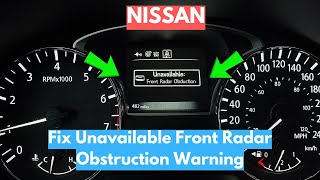
- "Unavailable: Front Radar Obstruction" me 🎬 Watch: Troubleshooting the front radar obstruction warning messagessage on the dashboard.
- "Forward Driving Aids Temporarily Disabled" message.
- AEB (Automatic Emergency Braking) or FCW (Forward Collision Warning) system warning light illuminated.
- Intelligent Cruise Control (ICC) is inoperative or will not set.
- ProPILOT Assist system is disabled. 🎬 Watch: A guide to how ProPILOT Assist should function
- Replacing the radar sensor immediately without first checking if the code is 'Past' or 'Current'. The TSB explicitly advises against this, as simply erasing a 'Past' code often resolves the issue.
- Assuming the sensor is bad when only the mounting bracket is bent. A user on Reddit was advised to try replacing the bracket first before paying for the much more expensive sensor.
Most Likely Causes

- Intermittent/Past Fault Stored in Memory 🔴 High Probability As documented in Nissan TSB NTB21-106B, the system is known to log this code as a 'Past' fault that does not indicate a current hardware failure. This can be triggered by temporary environmental conditions like heavy rain or road spray.
How to confirm: Use a professional-grade scan tool to read codes from the ADAS/LASER/RADAR module. Confirm if C2580-49 is listed in the "Past" or "History" column.
Typical fix: Erase the Diagnostic Trouble Code (DTC) and test drive the vehicle to see if the code returns. No parts are replaced.
Est. part cost: $0 - Obstructed Radar Sensor 🟡 Medium Probability The sensor is located in the lower front grille area or behind the Nissan emblem, making it highly susceptible to being blocked by snow, ice, mud, heavy rain, bugs, or even a thick film of soap or wax after a car wash. On some models, salt residue can get behind the emblem and cause a blockage.
How to confirm: Visually inspect the front bumper and grille area where the sensor is located. The warning light may appear during bad weather and disappear after cleaning or when conditions improve.
Typical fix: Thoroughly clean the sensor area with a soft cloth and water. Do not use abrasive materials. Ensure no aftermarket license plate brackets or grille guards are blocking the sensor's view.
Est. part cost: $0 - Misaligned Radar Sensor or Bracket 🟡 Medium Probability Even a minor front-end impact, like hitting a curb, a parking block, or road debris, can bend the sensor's mounting bracket. This can throw off the precise alignment without any visible damage to the bumper cover. A Nissan technician noted that even small fender benders will put these sensors 'out of wack'.
How to confirm: If the code is 'Current' and the sensor is clean, misalignment is a strong possibility. This is a common diagnosis after minor front-end impacts. This must be checked professionally using ADAS calibration equipment.
Typical fix: A qualified shop must perform a radar sensor alignment and calibration. If the bracket is bent, it will need to be replaced before calibration. A Reddit user with a 2021 Rogue was quoted $250 for the bracket and 5 hours of labor ($750) for this job.
Est. part cost: $50-$250 for a new bracket, plus $400-$800+ in labor for calibration. - Failed Front Radar Sensor ⚪ Low Probability While less common than alignment or obstruction issues, the sensor can fail internally, which is what the C2580-49 code technically describes. A Reddit user's 2021 Rogue experienced an internal sensor failure that caused phantom braking and was replaced under a service plan.
How to confirm: This is the diagnosis after all other causes (obstruction, 'Past' code, misalignment, wiring issues) have been ruled out. The code will be 'Current' and will return immediately after being cleared.
Typical fix: Replace the front radar sensor assembly, followed by a mandatory calibration by a dealership or ADAS-certified repair shop.
Est. part cost: $900-$1200 for the part, with total repair cost potentially reaching $2000-$3000 after labor and calibration.
Rare But Worth Checking
- Wiring or Connector Issue: The harness connecting to the radar sensor is in a vulnerable location. Moisture intrusion or damage from road debris can cause an intermittent connection, setting the code. A 'wiggle test' on the harness during diagnosis can help find this.
Diagnosis Steps
- Visually inspect the front radar sensor (located in the lower grille or behind the Nissan emblem) for any obstructions like dirt, snow, ice, or damage. Clean the area thoroughly with a soft cloth.
- Use a professional-grade scan tool (not a basic code reader) to access the 'LASER/RADAR' module.
- Determine if code C2580-49 is stored as 'CURRENT' or 'PAST'.
- If the code is 'PAST', follow Nissan TSB NTB21-106B: Erase the code, do not replace any parts, and perform a road test to see if the warning returns.
- If the code is 'CURRENT' and returns immediately, inspect the sensor's mounting bracket for any signs of damage or shifting from a minor impact.
- If the bracket appears secure, the next step is professional diagnosis to check for sensor misalignment. This requires specialized ADAS calibration equipment, 🎬 See how technicians perform a professional radar calibration with costs starting around $399.
- If alignment and calibration fail or are not possible, inspect the wiring harness and connector for damage or moisture. A 'wiggle test' can help identify intermittent wiring faults.
- If all other steps fail, the front radar sensor itself has likely failed and requires replacement, followed by mandatory calibration.
Parts You'll Likely Need
- Front Radar Sensor
(OEM #28437-6RJ2A (supersedes 28437-6RB0A, 28437-6RB7A, 28437-6RJ0A, 28437-6RU8A))— This part is only replaced if the code is 'Current' and cannot be resolved by cleaning, erasing a 'Past' code, or recalibration, indicating an internal failure.
Trusted brands: Nissan (OEM)
OEM price range: $900-$1200
Aftermarket price range: Not typically available - Front Radar Sensor Bracket
(OEM #28452-6CA0A (for 2019-2020 models))— The bracket can be bent from a minor impact, throwing off the sensor's alignment and causing a 'Current' fault. It must be replaced if damaged before a new calibration can be performed.
Trusted brands: Nissan (OEM)
OEM price range: $150-$250
Aftermarket price range: Not typically available
Related Codes That Often Appear With This One
- C1A17-49 — This code for 'ICC Sensor Malfunction' is often stored alongside C2580-49. Nissan addresses both codes in the same Technical Service Bulletin (NTB21-106B) with the same diagnostic procedure.
- C1A16 or C2582 — These are related codes for radar obstruction or sensor faults that appear on other Nissan models like the Rogue and Sentra with the same symptoms. They are often addressed by similar TSBs.
Technical Service Bulletins (TSBs) & Recalls
- NTB21-106B: States that if C2580-49 or C1A17-49 is stored in the 'PAST' column in the LASER/RADAR module, the code should be erased and no parts should be replaced. This is the most current version.
- NTB21-106 / NTB21-106A: Earlier versions of the bulletin with the same core service information for 'PAST' codes, also applicable to other models like the Kicks.
Platform-Specific Known Issues
- The sixth-generation Altima, along with other contemporary Nissan models, is known for having sensitive ADAS electronics that can log faults from temporary environmental conditions or minor physical disturbances.
Mechanic-Grade Diagnostic Values
- Voltage check at front radar sensor connector B257 — expected: Battery voltage at Pin 4 (Blue wire) with Ignition ON. Failure: No voltage indicates a power supply issue from the main harness or fuse.
- Ground continuity check at front radar sensor connector B257 — expected: Near 0 Ohms resistance between Pin 3 (Black wire) and a known good chassis ground.. Failure: High or infinite resistance indicates a broken ground wire in the harness.
- CAN Bus resistance check — expected: Approximately 60 Ohms between Pin 1 (White wire, CAN H) and Pin 2 (Blue wire, CAN L) at the sensor connector (with battery disconnected).. Failure: 120 Ohms may indicate a break in one of the CAN circuits; 0 Ohms indicates a short between the lines.
Hidden / Shadow Codes Worth Checking
- C2580-49: The '-49' suffix is a component-specific identifier used by Nissan's diagnostic logic. It confirms the fault is an 'internal electronic failure' within the LASER/RADAR control unit itself, rather than an obstruction or communication error. (see via A professional scan tool like the Nissan CONSULT or other high-end scanners capable of reading manufacturer-specific codes from the ADAS/LASER/RADAR module.)
Scan Tool Commands That Help
- Nissan CONSULT: Work Support > ADAS Aiming — This function is mandatory after replacing the front radar sensor or its bracket, or after any front-end collision. It initiates the static calibration procedure, which requires physical targets to be set up at precise distances and heights in front of the vehicle.
Wiring & Ground Locations
- B257 — The main 8-pin electrical connector on the back of the front radar sensor, located in the lower front grille area.. This is the primary point for electrical testing. Damage or corrosion at this connector can cause a loss of power, ground, or CAN bus communication, leading to a C2580 fault.
- Main Engine Harness Ground — The ground wire from connector B257 (Pin 3, Black) routes into the main engine harness and terminates at a chassis ground point, typically on the front frame rail inside the engine bay.. A loose or corroded main ground for this section of the harness can cause intermittent and difficult-to-diagnose electronic faults, including with the ADAS radar sensor.
Real Owner Repair Stories
- YouTube Commenter (2019 Nissan Altima) — "Front radar obstruction" warning light and disabled AEB/ICC systems.
❌ Tried (didn't work) Cleaning the sensor multiple times., Clearing the code, which would return immediately.
✅ What actually fixed it The vehicle had a minor front-end bump. The dealer found the radar sensor's mounting bracket was slightly bent, which was not visible from the outside. Replacing the bracket and performing a radar alignment/calibration resolved the C2580 code permanently.
OEM Part Supersession History
28437-6RB0A, 28437-6RB7A, 28437-6RJ0A, 28437-6RU8A→28437-6RJ2A— Part revisions are typically made to improve reliability and address known failure points. Given the TSB related to intermittent faults, the newer part likely has improved internal electronics to be more resilient against logging erroneous codes.
Model Year Variations Within This Range
- 2023-2024: The 2023 model year refresh introduced a new front fascia and grille design. While the radar sensor's function and location (lower grille area) remain the same, the mounting points and surrounding bumper/grille structure are different from the 2019-2022 models. This can affect alignment procedures and susceptibility to obstruction.
Helpful Videos



The information in this article is provided for general reference and educational purposes only. Vehicle specifications, procedures, and part compatibility can vary by production date, trim level, and region. Always consult your vehicle's factory service manual and verify part numbers before purchasing or performing repairs. Safety-critical components such as airbags, seat belts, and braking systems should be installed by a qualified professional.
- Nissan ALTIMA:
- 🎬 Helpful Videos
- What's Unique About the 2019-2024 Nissan ALTIMA
- Diagnostic Flowchart
- Symptoms You May Notice
- Most Likely Causes
- Rare But Worth Checking
- Diagnosis Steps
- Parts You'll Likely Need
- Related Codes That Often Appear With This One
- Technical Service Bulletins (TSBs) & Recalls
- Platform-Specific Known Issues
- Mechanic-Grade Diagnostic Values
- Hidden / Shadow Codes Worth Checking
- Scan Tool Commands That Help
- Wiring & Ground Locations
- Real Owner Repair Stories
- OEM Part Supersession History
- Model Year Variations Within This Range
- 🎟️ Get 5% Off