

OBD-II Code C2116: ABS Pump Motor Supply Low Voltage
The Ultimate 2026 Guide to Diagnosing and Fixing C2116
- Code C2116 disables your ABS and traction control due to low voltage at the pump motor, increasing emergency stopping distances by up to 25% on slippery roads.
- Always load-test the ABS power and ground circuits with a sealed-beam headlight before replacing the module; a multimeter showing 12V cannot prove the circuit carries the required 20+ amps.
- Repairing your original ABS control module via a mail-in service costs $150-$300 and avoids the mandatory, expensive dealer programming required for new units.
- On 2010 Mitsubishi Lancer models, a dead 12V battery permanently bricks the ABS module software, requiring replacement with a 2011 or newer unit.
What Does C2116 Mean?

Code C2116 indicates the Antilock Brake System (ABS) Control Module detected a low voltage condition in the power supply circuit for the ABS pump motor. This electric motor generates the hydraulic pressure required to rapidly pulse the brakes during an emergency. When voltage drops too low, the module shuts down all active braking safety systems as a fail-safe and illuminates your dashboard warning lights.
Technical definition: The ABS Module detected that voltage in the ABS pump motor power supply circuit fell below the manufacturer's specified threshold. This fault sets when the module commands the pump motor ON and registers insufficient voltage, or during the key-on/engine-off self-test if it detects abnormal voltage while the pump is deactivated.
Can I Drive With C2116?
Yes, But With Caution. Yes, you can technically drive, as your standard hydraulic brakes remain functional. However, driving is strongly discouraged except to reach a repair shop. Code C2116 disables your Anti-lock Braking System (ABS), Traction Control (TCS), and Electronic Stability Program (ESP). In a panic stop, your wheels will lock up, causing a skid and complete loss of steering control. Stopping distances on wet or gravel surfaces increase significantly, making emergency maneuvers a serious safety liability.
Common Causes

- Faulty ABS Control Module (Very Common) — The electronic control module operating the ABS pump is the most frequent failure point. Internal components, specifically solder joints on the power relay or main circuit board, fracture from engine heat and vibration, creating an open circuit for the pump motor.
- Corroded or Loose Ground Connection (Common) — The ABS module and pump motor require a robust chassis ground to handle high current draw (often 20-30 amps). Rust, paint, or a loose ground bolt creates high resistance, causing a severe voltage drop under load that triggers the code.
- Blown ABS Pump Motor Fuse (Common) — A dedicated high-amperage fuse (typically 30A to 60A) protects the pump motor circuit. If this fuse blows due to a short circuit or a seizing pump motor, it cuts all power, causing an immediate low voltage fault.
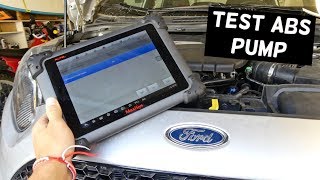
- Defective ABS Pump Motor (Worn Brushes) (Common) — Inside the ABS pump motor, carbon brushes transfer electricity to the commutator. Over years of self-tests and ABS activations, these brushes wear down, creating a poor connection that the module interprets as low voltage. 🎬 Watch: How to test the ABS pump without removing it. Internal shorts or seized bearings also cause this.
- Failing Battery or Alternator (Less Common) — A weak battery or failing alternator causes overall system voltage to drop below the required threshold (typically under 10.5V). This triggers low voltage codes in sensitive modules like the ABS, especially during engine cranking.
- Damaged Wiring or High Resistance in Fuse Block (Less Common) — Thick-gauge power and ground wires can chafe or corrode. Additionally, the terminals inside the fuse block (or TIPM on Chrysler vehicles) lose tension or corrode over time. Both scenarios create high resistance, heating the circuit and dropping voltage before it reaches the ABS module.
- CAN Bus Communication Error (Rare) — On specific vehicles, particularly Mitsubishi, network communication errors on the CAN bus trigger an incorrect C2116 DTC. Diagnosing CAN bus lines for integrity is required before condemning the ABS module.
Symptoms

- ABS and Traction Control Warning Lights Illuminated — The primary symptom. The ABS, Traction Control (TCS), and Stability Control (ESP/ESC) lights illuminate and remain on as long as the fault is active.
- ABS and Traction Control Systems Inoperative — You will have no anti-lock braking assistance during a hard stop, allowing wheels to lock and skid. Traction control fails to prevent wheel spin on slippery surfaces.
- Warning Lights Turn Off and On Intermittently — If caused by a loose ground or failing internal relay, warning lights extinguish while driving and reappear later, often triggered by bumps or temperature changes.
- Audible Buzzing or Grinding from ABS Pump — A failing pump motor or stuck internal relay causes the pump to run continuously or make unusual noises, even with the ignition off, rapidly draining the battery.
- Brake Pedal Feels Hard or Vibrates — If the failure involves the hydraulic portion of the unit seizing, drivers experience a continuous vibration or a harder-than-normal brake pedal.
Common Fixes & Costs
- Repair or Rebuild Original ABS Control Module — Parts: $150-$300 (mail-in service), Labor: $150-$300, ~1.5 hr book time (Professional)
- Clean or Repair ABS Ground Connection — Parts: $0-$10, Labor: $75-$150, ~0.8 hr book time (DIY)
- Replace Blown ABS Fuse and Inspect Fuse Block — Parts: $5-$50, Labor: $50-$150, ~0.5 hr book time (DIY)
- Replace ABS Module with a New or Used Unit — Parts: $150-$1500+, Labor: $200-$400, ~2.5 hr book time (Professional)
- Repair Damaged Wiring Harness — Parts: $10-$30, Labor: $150-$450, ~2.5 hr book time (Intermediate)
Used vs. New Parts: Buying Guide
When a used part is worth it: A used ABS module is a budget-friendly option for older vehicles where a new part is cost-prohibitive. It makes sense only if sourced from a reputable seller with a warranty, and you have access to programming tools.
Donor-vehicle mileage cap: roughly under 100000 miles for the part to have meaningful remaining life.
Donor quality checklist:
- Verify the part number EXACTLY matches your original module.
- Purchase from a seller offering at least a 90-day warranty.
- Avoid parts from rust-belt states to minimize corrosion risk.
Decision logic:
- If Your original module is available for repair → Repair your original module. This is the most cost-effective option and avoids VIN programming.
- If Vehicle is newer or has low mileage and budget allows → Buy a new OEM part for the longest lifespan and peace of mind.
- If Budget is strict and you have access to professional programming → Buy a used part, but factor in the cost and hassle of dealer programming.
Warranty tradeoff: Used parts typically carry a 30-90 day warranty. Aftermarket remanufactured parts offer 1-year to lifetime warranties. OEM new parts carry a 1-year warranty.
Worst-case if a used part fails: $400-$800. If a used part fails, you pay for diagnostic and installation labor again, plus the cost of another replacement part and programming.
Cost of Not Fixing It
- Immediate: ABS, Traction Control, and Stability Control are disabled. Risk of skidding and loss of control during panic braking is significantly increased. (Added cost: N/A (Safety Risk))
- 1-6 months: Continued operation without safety systems. Potential for a dead battery if the failure is a stuck pump relay causing a parasitic drain. (Added cost: $150-$300 (New Battery + Tow))
- 6+ months: Extreme safety liability. The vehicle is unsafe in emergency maneuvers. Resale value is diminished by at least $500. (Added cost: $500 (Diminished Value))
Diagnosis Steps

- Verify Battery and Charging System Health
Confirm the core electrical system is healthy. A good battery reads at least 12.4 volts with the engine off. With the engine running, the alternator must produce 13.5 to 14.5 volts. Low system voltage is a simple, frequently overlooked cause.
Tools: Multimeter (Beginner) - Inspect the ABS Pump Motor Fuse
Locate the main high-amperage cartridge fuse (30A-60A) for the ABS pump in the under-hood fuse box. Remove it and test for continuity using a multimeter. Inspect the fuse block terminals for melting, corrosion, or signs of overheating.
Tools: Fuse puller, Multimeter (Beginner) - Inspect and Clean the ABS Module Ground Connection
Locate the thick black ground wire bolted to the chassis near the ABS unit. Unbolt it, use a wire brush to clean the terminal and chassis contact point to bare metal, apply dielectric grease, and re-secure tightly. Poor grounds cause 30% of these codes.
Tools: Socket set, wire brush, dielectric grease (Intermediate) - PROFESSIONAL TIP: Load Test the Power and Ground Circuits
A multimeter showing 12V does not prove the wire can carry 20+ amps. Disconnect the ABS module. Connect a sealed-beam headlight or Power Probe between the main power and ground pins on the harness. The light must be intensely bright. A dim light proves high resistance exists in the wiring, ground, or fuse block.
Tools: Sealed-beam headlight or Power Probe, jumper wires, wiring diagram (Advanced) - Activate Pump with a Bidirectional Scan Tool
Command the ABS pump motor ON using a professional scan tool while monitoring live voltage data at the module. If voltage plummets below 10.5V during activation, you have a power delivery issue. If the pump fails to activate entirely, the module or motor is dead.
Tools: Bidirectional Scan Tool (Advanced) - PROFESSIONAL TIP: Test ABS Pump Motor Resistance
Measure resistance between the motor's power and ground pins directly on the hydraulic control unit (HCU). A healthy motor reads 0.5 to 5.0 ohms. An infinite reading (OL) indicates an open circuit (worn brushes), while near-zero ohms indicates a dead short.
Tools: Multimeter, long probes (Advanced) - ADVANCED: Measure ABS Pump Motor Current Draw
Place a DC amp clamp around the main ABS power wire and command the pump ON. A healthy pump draws 15 to 25 amps. A draw exceeding 30 amps indicates a seized motor. A zero amp draw confirms an open circuit in the module, wiring, or motor.
Tools: DC Amp Clamp, Bidirectional Scan Tool (Advanced)
When This Code Triggers (Freeze-Frame Conditions)
- System Voltage: 10.5-12.0V (Recorded during key-on self-test or while driving.)
- Vehicle Speed: 0 mph (Code frequently sets during the initial key-on-engine-off self-test.)
- ABS Pump Motor Status: Commanded ON / Deactivated (Fault is detected when the pump is activated and voltage drops, or when deactivated and voltage is abnormal.)
- DTC Status: Active / Stored (Indicates a current, hard fault within the electrical system.)
Related Codes
- C2200 — Indicates 'Anti-lock Brake Module Internal' fault. If C2116 and C2200 appear together, the module has failed its internal self-test and is definitively broken. If you only have C2116, the fault is more likely external (wiring, fuse, ground).
- U0121 — Indicates 'Lost Communication With ABS Control Module'. This is a network problem, not a circuit problem. With U0121, the scan tool cannot talk to the module at all, usually due to a blown main module fuse or broken CAN bus wire.
- C102B — Indicates 'ABS Pump Motor Circuit Performance'. While similar, C2116 specifically flags 'Low Voltage', pointing directly toward a voltage drop or high resistance. C102B is a broader performance fault.
- Honda 52-01 / 61-1 — The manufacturer-specific equivalents of C2116 for Honda/Acura. They translate to 'ABS Pump Motor Failure' or 'Pump Motor Relay Circuit Open', requiring the exact same diagnostic and repair steps.
Climate & Environmental Factors
- Road Salt and High Humidity: In the 'Rust Belt' or coastal areas, salt spray accelerates corrosion at the main chassis ground point and inside the fuse block, creating the high resistance that triggers this code.
- Extreme Cold: Cold temperatures cause weakened solder joints inside the ABS module to contract and break contact, triggering intermittent failures. The light often extinguishes once the engine bay warms up.
- Extreme Heat: High ambient temperatures combined with engine heat increase thermal stress on the ABS module, degrading internal circuit board components and accelerating solder joint failure.
How to Clear the Code After You Fix It
- Reconnect battery if disconnected for repair.
- Use an OBD-II scan tool to erase the C2116 code from the ABS module.
- Cycle the ignition from OFF to ON.
- Drive the vehicle above 25 mph (40 km/h) to allow the system to complete a self-test and confirm the light stays off.
Drive cycle (~10 minutes): A short drive exceeding 25 mph is sufficient for the ABS module to re-test the pump circuit. No complex emissions drive cycle is required.
Readiness monitors affected: None
Watch out for:
- Clearing the code without fixing the physical problem causes the code to return immediately on the next self-test.
- On 2010 Mitsubishi Lancers, the code becomes permanent after a battery disconnect and cannot be cleared with any scan tool.
Will This Fail Emissions / State Inspection?
No — by itself this code doesn't fail OBD inspection (but it can keep readiness monitors from setting, which causes a separate fail).
- California: An illuminated ABS light will NOT cause a failure of the standard biennial smog check, which focuses strictly on emissions.
- New York: An illuminated ABS light is an advisory item. It will not prevent the vehicle from passing the safety inspection.
- Texas: The Texas DPS explicitly states an ABS warning lamp is not a cause for rejection. Furthermore, most non-commercial vehicles are exempt from safety inspections as of 2025.
Most Commonly Affected Vehicles
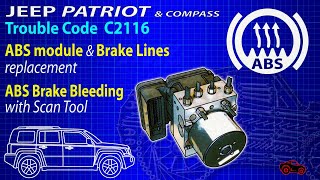
- Jeep Patriot (2007-2017) — Extremely common failure of the ATE MK26 ABS module. 🎬 See this step-by-step Jeep ABS pump replacement walkthrough. Often presents alongside code C2200. Modules are highly specific to FWD/AWD configurations.
- Dodge Caliber (2007-2012) — Shares the failure-prone ATE MK26 ABS module platform with the Jeep Patriot and Compass. Subject to the same mandatory programming requirements.
- Jeep Grand Cherokee (2002-2011) — Particularly common on 2005-2011 (WK) models. Internal module failure is the typical cause, frequently storing both C2116 and C2200 codes.
- Mitsubishi Lancer (2007-2017) — A critical known issue affects 2010 models: a dead battery causes a software glitch that permanently sets C2116. 🎬 Watch: Diagnosing a faulty Mitsubishi Lancer ABS module. The fix requires replacing the module with a 2011+ updated unit.
- Jeep Wrangler (2007-2018) — The JK Wrangler ABS module frequently fails due to its location in the engine bay, exposing it to severe heat and vibration.
- Dodge Journey (2009-2020) — Owners frequently report C2116 accompanied by C2200. Misdiagnosis is common; wiring and power supply issues must be thoroughly load-tested before replacing the module.
- Mitsubishi Outlander (2007-2013) — Utilizes an ATE MK61 ABS pump known to fail and generate C2116, frequently due to worn internal motor brushes.
- Honda Accord, CR-V, Civic (2005-2012) — Honda stores this equivalent fault as code '52-01' (ABS pump motor relay open circuit). It points to the exact same internal failure inside the ATE-manufactured ABS module.
Manufacturer-Specific Notes
- Mitsubishi: On 2010 Lancer and Outlander models, allowing the battery to die causes a software glitch in the ATE MK61 ABS module. This sets a permanent C2116 code that cannot be erased. The only fix is replacing the module with a 2011+ unit.
- Jeep/Dodge/Chrysler: These brands heavily utilized the ATE MK26 ABS module, which suffers from a well-documented internal break in the pump motor's power supply circuit, almost always triggering C2116 and C2200 simultaneously.
- Honda/Acura: These brands use proprietary codes like 52-01 instead of generic C-codes. The root cause remains identical: failure of the internal pump motor relay inside the ATE-manufactured ABS control unit.
- Volkswagen/Audi: Vehicles using similar ATE ABS pumps store this fault as '01130 - ABS Operation: Implausible Signal'. Certain models received a limited warranty extension (Warranty Key U30) specifically for this ABS control module failure.
Frequently Asked Questions
Is it safe to drive my car with code C2116?
No. Your ABS, traction control, and stability control are disabled, dramatically increasing your risk of skidding in an emergency. Drive directly to a repair shop.
Will clearing the C2116 code fix the problem?
No. C2116 is a hard fault indicating a physical electrical problem. The code returns immediately upon the next ignition cycle or system self-test.
I replaced my ABS module and the code is still there. What now?
This indicates a misdiagnosis where the fault lies in the vehicle's wiring, ground, or fuse block. You must load-test the power and ground circuits to find the high resistance. A multimeter alone cannot prove the circuit carries heavy current.
Can a bad wheel speed sensor cause code C2116?
No. A bad wheel speed sensor triggers specific C0035-C0050 codes. Code C2116 exclusively flags the ABS pump motor's electrical supply circuit.
Can I replace just the electronic module or do I have to replace the whole pump?
On most vehicles, you can unbolt the electronic control module from the hydraulic pump assembly. This avoids opening the hydraulic brake lines and eliminates the need to bleed the brake system.
Do I need to program a replacement ABS module?
Yes. New and used modules require programming to match your car's Vehicle Identification Number (VIN) and specific options. Failing to program it results in a non-functional module and configuration codes.
What happens if I don't perform the 'ABS Bleed' procedure after replacing the pump?
Replacing the entire hydraulic unit introduces air that cannot be removed by manual bleeding. You must use a bidirectional scan tool to cycle the internal valves and purge this air. Skipping this leaves a spongy, dangerous brake pedal.
Is it better to repair my ABS module or buy a new one?
Repairing your original module is the most cost-effective and reliable option. It costs significantly less than a new part and completely avoids expensive dealer programming fees.
Key Takeaways
- Code C2116 disables your ABS and traction control due to low voltage at the pump motor, increasing emergency stopping distances by up to 25% on slippery roads.
- Always load-test the ABS power and ground circuits with a sealed-beam headlight before replacing the module; a multimeter showing 12V cannot prove the circuit carries the required 20+ amps.
- Repairing your original ABS control module via a mail-in service costs $150-$300 and avoids the mandatory, expensive dealer programming required for new units.
- On 2010 Mitsubishi Lancer models, a dead 12V battery permanently bricks the ABS module software, requiring replacement with a 2011 or newer unit.
Helpful Videos


The information in this article is provided for general reference and educational purposes only. Vehicle specifications, procedures, and part compatibility can vary by production date, trim level, and region. Always consult your vehicle's factory service manual and verify part numbers before purchasing or performing repairs. Safety-critical components such as airbags, seat belts, and braking systems should be installed by a qualified professional.
- 🎬 Helpful Videos
- What Does C2116 Mean?
- Can I Drive With C2116?
- Common Causes
- Symptoms
- Common Fixes & Costs
- Used vs. New Parts: Buying Guide
- Cost of Not Fixing It
- Diagnosis Steps
- When This Code Triggers (Freeze-Frame Conditions)
- Related Codes
- Climate & Environmental Factors
- How to Clear the Code After You Fix It
- Will This Fail Emissions / State Inspection?
- Most Commonly Affected Vehicles
- Manufacturer-Specific Notes
- Frequently Asked Questions
- Is it safe to drive my car with code C2116?
- Will clearing the C2116 code fix the problem?
- I replaced my ABS module and the code is still there. What now?
- Can a bad wheel speed sensor cause code C2116?
- Can I replace just the electronic module or do I have to replace the whole pump?
- Do I need to program a replacement ABS module?
- What happens if I don't perform the 'ABS Bleed' procedure after replacing the pump?
- Is it better to repair my ABS module or buy a new one?
- Key Takeaways
- 🎟️ Get 5% Off