

OBD-II Code C2112: ABS/Traction Control Valve Relay Fault
What C2112 means, why it triggers, and how to fix it
- Code C2112 indicates a power supply failure to the ABS control module's internal valve relay, instantly disabling your ABS and traction control systems.
- Check the 30A or 40A ABS fuses in the engine bay first; a blown fuse strongly points to an internal module short circuit.
- Rebuilding your original ABS module costs $300-$700 total and avoids the $200+ dealer programming fee required for new or used replacements.
- Do not ignore this code on 2003-2020 Hyundai or Kia vehicles, as it frequently links to active safety recalls for engine compartment fires.
What Does C2112 Mean?

Code C2112 means the Anti-lock Brake System (ABS) control module detected a fault in its own power supply circuit. Specifically, an internal relay providing power to the hydraulic solenoid valves is not receiving or holding the correct voltage. This triggers a fail-safe, shutting down the ABS and traction control systems and illuminating dashboard warning lights.
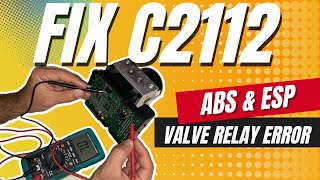
Technical definition: The technical definition for C2112 is 'Valve Relay Error'. 🎬 Watch this guide to testing and fixing the C2112 valve relay error. The ABS module, also known as the Hydraulic and Electronic Control Unit (HECU), constantly monitors the voltage of an internal valve relay. This code sets when the module detects relay voltage dropping below a specified threshold (e.g., under 5V when commanded ON) for as little as 56 milliseconds. This indicates a critical power supply interruption.
Can I Drive With C2112?
Yes, But With Caution. Yes, but with significant caution. Standard hydraulic brakes function normally, but the Anti-lock Braking System (ABS) and Traction/Stability Control (TCS/ESC) are disabled. This increases stopping distances on wet or icy roads by up to 35% and removes the vehicle's ability to automatically correct for skids. Long-distance driving is unsafe.
Common Causes

- Defective ABS/HECU Module (Internal Relay Failure) (Very Common) — The valve relay is soldered onto the circuit board inside the sealed ABS module. These relays fail internally, or their solder joints crack from years of thermal cycles and vibration, creating an open circuit.
- Blown High-Amperage ABS Fuse (Common) — The ABS module receives power through dedicated high-amperage fuses (typically 30A or 40A) in the engine bay. These fuses blow due to an internal short in the module or from age, instantly cutting power to the valve relay.
- Corroded or Damaged Wiring Harness/Connectors (Common) — Failed weather seals allow water to seep into the main ABS electrical connector. This moisture corrodes the power and ground pins, increasing resistance and causing a voltage drop that triggers the code.
- Low System Voltage (Weak Battery or Alternator) (Less Common) — A weak battery or failing alternator causes system-wide voltage to drop low enough during engine cranking or high electrical load to trigger a fault in sensitive modules like the ABS controller.
- Improper Jump-Starting Procedures (Uncommon) — Connecting jumper cables incorrectly (reverse polarity) creates a massive voltage spike. This permanently damages sensitive electronics within the ABS control module, causing internal faults like C2112.
Symptoms

- ABS and Traction Control Warning Lights Illuminated — The primary symptom. The ABS light, along with the Traction Control/Stability Control lights (e.g., TCS, ESC, VSC), illuminate permanently on the instrument cluster.
- Speedometer Erratic or Inoperative — The ABS module interprets wheel speed sensor data and sends it to the speedometer. A power fault within the module disrupts this signal.
- Standard Hydraulic Brakes Function Normally — The standard hydraulic braking system is unaffected by this electronic fault. The car brakes normally under non-emergency conditions.
- ABS and Traction Control Systems Disabled (also visible on scanner) — Wheels lock up and skid during hard stops, and traction control fails to prevent wheel spin on slippery surfaces.
Diagnostic Flowchart

Tap your situation to follow the diagnostic path that matches what you're seeing on this code.
Common Fixes & Costs
- Repair or rebuild the original ABS module — Parts: $150-$400 for a mail-in rebuild service., Labor: $150-$300 for removal, reinstallation, and brake bleeding (Total: $300-$700), ~2.5 hr book time (Professional)
- Replace blown ABS fuse — Parts: $5-$20 for high-amperage cartridge fuse., Labor: $0 (DIY), ~0.1 hr book time (DIY)
- Repair damaged wiring, connectors, or grounds — Parts: $20-$75 for new connector pigtails, wire, or terminals., Labor: $150-$500 depending on the location and extent of damage (Total: $170-$575), ~2.5 hr book time (Intermediate)
- Replace the ABS module with a new OEM unit — Parts: $800-$2500+, Labor: $200-$400 for installation, brake bleeding, and mandatory VIN programming (Total: $1000-$2900+), ~2.5 hr book time (Professional)
Used vs. New Parts: Buying Guide
When a used part is worth it: A used ABS module is a budget-friendly option for older, high-mileage vehicles where a new part is cost-prohibitive. It only makes sense if you have access to a shop with the correct scan tools for mandatory VIN programming.
Donor-vehicle mileage cap: roughly under 100000 miles for the part to have meaningful remaining life.
Donor quality checklist:
- Purchase from a reputable supplier offering a warranty.
- Match the part number exactly. Slight variations are incompatible.
- Avoid parts from flood-damaged cars.
Decision logic:
- If The original module can be repaired → Send the original module for a rebuild. This is the best value as it retains VIN programming and is plug-and-play.
- If Vehicle is newer or low-mileage and budget allows → Buy a new OEM part. This is the most expensive but most reliable option.
- If Budget is the primary concern and the original module is unrepairable → A used module is acceptable, but factor in the added cost of professional programming.
Warranty tradeoff: Used parts typically have a 30-90 day warranty. Rebuilt services offer 1-year to lifetime warranties. New OEM parts carry a 1-year or longer warranty.
Worst-case if a used part fails: $300-$600 if a used part is dead on arrival, covering repeat labor and programming fees.
What Happens If You Wait — Timeline
- Immediate: ABS, Traction Control, and Stability Control warning lights illuminate. Safety systems are disabled. Standard hydraulic brakes remain functional. (MPG impact: 0%% · Added cost: $0 (but significant safety risk is present))
- Ongoing: For millions of recalled Hyundai/Kia vehicles, a persistent internal short circuit in the ABS module creates a risk of an engine compartment fire, even when parked. (MPG impact: 0%% · Added cost: Potential total loss of vehicle ($5,000 - $25,000+).)
- 1 week - 2 months: In some failure modes, the internal relay sticks, causing the ABS pump motor to run continuously even when the car is off. This creates a noticeable humming sound. (MPG impact: 0%% · Added cost: $150-$350 for a new battery ruined by the constant draw.)
- 2+ months: If the ABS pump runs continuously without being addressed, the pump motor burns out from overheating. This turns a repairable module into one requiring full replacement. (MPG impact: 0%% · Added cost: $200-$500 increase in repair cost.)
Cost of Not Fixing It
- Immediate: Loss of ABS, Traction Control, and Stability Control. This creates a significant safety risk, increasing the chance of wheel lock-up and loss of control in panic stops. (Added cost: Potential for accident-related costs.)
- Ongoing: For millions of recalled Hyundai and Kia vehicles, a known defect causes the ABS module to short circuit, leading to a vehicle fire even when parked. (Added cost: Total loss of vehicle and potential property damage.)
- 1-3 months: In some failure modes, the ABS pump motor runs continuously, even with the car off. This drains and ruins the vehicle's battery. (Added cost: $150-$350 for a new battery.)
- 2+ months: If the ABS pump runs continuously without being addressed (by pulling the fuse), the pump motor burns out from overheating. This turns a repairable module into one requiring full replacement.
Diagnosis Steps
- Check the High-Amperage ABS Fuses
Locate the engine compartment fuse box. Identify the main fuses for the ABS/VSC system (usually 30A or 40A cartridge fuses). Remove and visually inspect them for a broken internal strip. A blown fuse often points to a shorted module.
Tools: Owner's manual, fuse puller (Beginner) - Inspect the Battery and Charging System
Ensure the battery is fully charged (above 12.4V with the engine off) and terminals are clean. Start the engine and verify the alternator outputs 13.5V to 14.5V. Low voltage triggers false ABS codes.
Tools: Multimeter, wire brush (Beginner) - Inspect the ABS Module Connector and Ground
Disconnect the battery. Unplug the large electrical connector from the ABS module. Inspect both sides for green/white corrosion, bent pins, or moisture. Trace the ground wire to the chassis and ensure the connection is clean and tight.
Tools: Basic hand tools, flashlight, dielectric grease (Intermediate) - Test Power and Ground at the ABS Connector
With the module unplugged, reconnect the battery and turn the ignition ON. Using a wiring diagram, probe the main power supply pins on the harness connector for 12V+. Switch the multimeter to Ohms and verify the ground pins show less than 1 Ohm of resistance to the chassis.
Tools: Multimeter, vehicle-specific wiring diagram, T-pins (Advanced) - [PRO TIP] Load Test the Power Supply Circuit
A multimeter shows 12V on a corroded wire with no load, but voltage vanishes under load. Connect a sealed-beam headlamp (or 5-amp bulb) between the power and ground pins on the harness connector. A bright light confirms the circuit carries current; a dim light indicates high resistance.
Tools: Sealed-beam headlamp with test leads, wiring diagram (Advanced) - [PRO TIP] Perform a Harness 'Wiggle Test'
With the module plugged in and ignition ON, gently wiggle the wiring harness leading to the ABS module. If the dashboard warning lights flicker or the scanner loses communication, you have an intermittent break in that section of the harness.
Tools: Scan tool (optional), hands (Advanced) - Send ABS Module for Testing and Repair
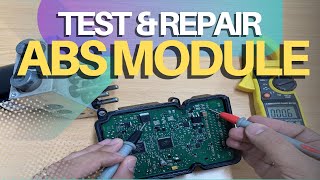
If fuses are good and the power/ground circuits pass a load test, the fault is definitively internal to the ABS module. Remove the module and send it to a specialized electronics rebuilder.
Tools: Advanced hand tools, brake bleeder, professional scan tool (Professional)
When This Code Triggers (Freeze-Frame Conditions)
- Vehicle Speed: 0-15 mph (The fault is detected during the system's power-on self-test or the low-speed dynamic test that runs shortly after driving off.)
- System Voltage: 11.8-14.5V (The code sets when the module's internal relay voltage drops below a specific threshold, recording the overall system voltage at that exact moment.)
- Time Since Engine Start: < 1 minute (Because the self-test happens at startup, freeze frame data is almost always captured immediately after the vehicle is started.)
Related Codes
- U0121 — Lost Communication With ABS Control Module. Set by other modules when they cannot communicate with the ABS module. If you scan the ABS and find C2112, communication lines are okay. If you find U0121, it points to a total power/ground failure or a completely dead module.
- C2402 — ABS Pump Motor Electrical Fault. Commonly seen alongside C2112. The valve relay and pump motor share related power supply circuits. Always diagnose them together, starting with the high-amperage fuses.
- C12xx (Wheel Speed Sensor Codes) — Point to issues with specific wheel speed sensor signals. Always diagnose the C2112 power-related code first, as a module without proper power cannot accurately report sensor data.
- C1513 — Traction Control Switch Circuit Malfunction. Refers specifically to the physical on/off button in the cabin. A C2112 fault disables traction control regardless of the switch's position, but the switch itself is not the cause.
Climate & Environmental Factors
- Humidity and Road Salt: High humidity and road salt significantly accelerate corrosion on the ABS module connector pins and ground points. Moisture intrusion into the sealed module is a primary cause of internal short circuits.
- Extreme Thermal Cycles: Repeated heating and cooling of the ABS module in the hot engine bay causes expansion and contraction. Over time, this thermal stress cracks the solder joints on the internal circuit board, causing an open circuit.
How to Talk to a Mechanic About This Code
Say this: "My ABS and traction control lights are on, and I have a C2112 fault code. Please start by checking the fuses, and then load-test power and ground at the ABS module connector before recommending a module replacement. I want to confirm if it's a wiring issue or an internal module fault."
This directs the mechanic to follow a logical diagnostic process. It prevents them from immediately jumping to the most expensive conclusion (replacing the module) and focuses on proving where the fault lies.
Avoid saying:
- 'My ABS light is on, can you just fix it?'
- 'I think I need a new ABS module.'
- 'Just do whatever you think is best.'
Questions to ask before authorizing the repair:
- Did you load-test the power and ground circuit to the module, or only check for voltage?
- What are the price differences between a new OEM part, a used part, and sending my original module for a rebuild?
- Does the repair quote include mandatory programming and an ABS brake bleed service?
- What is the warranty on both the replacement part and your labor?
Where to Take It: Dealer vs Independent vs Chain
- Dealer:
Recommended only for recall work or if the vehicle is under warranty. For out-of-pocket repairs, they are the most expensive option.
Best for: Vehicles under warranty, Performing safety recalls (critical for Hyundai/Kia fire risk), Complex programming for new modules
Downsides: Highest labor rates and part costs, Will exclusively recommend a brand new, expensive module instead of affordable repair options (Typical cost: +100% vs. baseline) - Independent Shop:
Best overall fit. A good independent shop is the most cost-effective choice for diagnosing wiring and handling the removal/reinstallation of a module for rebuilding.
Best for: Out-of-warranty vehicles, Cost-effective diagnosis and repair, Willingness to install customer-supplied or rebuilt parts
Downsides: Quality and electrical diagnostic skill vary greatly. (Typical cost: +0% vs. baseline) - Chain Shop:
AVOID for diagnosing this code. They are likely to misdiagnose or recommend an unnecessary module replacement without performing proper electrical tests.
Best for: Simple jobs like tires and oil changes.
Downsides: Technician skill is inconsistent, Lack in-depth diagnostic tools for complex electrical faults, High pressure to upsell (Typical cost: -10% vs. baseline)
When to Walk Away From the Repair
If the estimated repair cost exceeds 40-50% of the car's private-party value, pause and evaluate your options.
- Car worth $5000, fix is $700: Fix it. This cost is well within the threshold and restores a critical safety feature.
- Car worth $5000, fix is $2200: Borderline. This repair is ~44% of the car's value. Get a second opinion and push for a module rebuild (~$700) instead of a new one (~$2200).
- Car worth $3000, fix is $1800: Walk away. The repair cost is 60% of the vehicle's value. It is not economically sensible to proceed.
What Scan Tool You Need for This Code

Minimum: A scanner that can read and clear ABS/SRS (Chassis) codes.
A basic $20 engine code reader only reads P-codes and will NOT see the C2112 code. The ABS system requires a capable scanner to communicate with its specific control module.
Budget: Autel AP200 or BlueDriver Pro (~$60) — These Bluetooth dongles pair with your smartphone to read/clear ABS codes and display live data from the ABS module. This is enough to confirm the code and monitor system voltage.
Mid-range: Foxwell NT630 Plus or Autel MaxiCheck MX808 (~$250) — These handheld tools offer dedicated ABS diagnostics and include an 'ABS Auto Bleed' function, which is mandatory after replacing the hydraulic module.
Professional: Autel MaxiCOM MK808BT Pro or Launch X431 Series (~$550-1200) — These professional tablets offer full bidirectional control, allowing you to command the ABS pump and solenoids on/off to test them directly.
How to Clear the Code After You Fix It
- Reconnect the battery if it was disconnected for the repair.
- Use an OBD-II scan tool to access the ABS module and select 'Clear Codes'.
- Perform a short test drive reaching at least 20 mph to allow the system to run its dynamic self-test.
- Perform two firm, straight-line stops from 25 mph in a safe area to ensure normal brake operation.
Drive cycle (~10 minutes): A complex drive cycle is not required. A 10-minute drive with mixed city speeds (up to 40 mph) and a few complete stops is sufficient for the ABS module to verify the repair.
Readiness monitors affected: None
Watch out for:
- Disconnecting the battery does not clear the code from the ABS module's memory; a scan tool is mandatory.
- The code returns immediately upon startup if the root cause (fuse, wiring, or module) is not fixed.
- Failing to bleed the brakes properly after replacing a hydraulic module leads to a spongy pedal and unsafe braking, even if the light is off.
Will This Fail Emissions / State Inspection?
No — by itself this code doesn't fail OBD inspection (but it can keep readiness monitors from setting, which causes a separate fail).
- California: An illuminated ABS light will NOT cause a failure of a standard biennial smog check. However, for a rebuilt or salvaged vehicle requiring a Vehicle Safety Systems Inspection (VSSI), a faulty ABS system is grounds for failure.
- New York: Under current NYS DMV inspection rules, an illuminated ABS warning light is NOT a cause for failure on a standard safety inspection. Legislation has been proposed to change this, so verify current regulations.
- Texas: The annual Texas vehicle inspection checks service brakes, but an illuminated ABS light is not a specific failure criterion for a standard passenger car.
Most Commonly Affected Vehicles
- Hyundai Tucson, Santa Fe, Sonata, Accent, Elantra (2003-2019) — Extremely common across the lineup, almost always indicating an internal HECU failure. Numerous recalls exist for fire risk due to internal ABS module shorts.
- Kia Sportage, Sorento, Optima (2008-2020) — Sharing platforms with Hyundai, Kia vehicles exhibit the same high failure rate for the ABS module. Widespread recalls for HECU fire risk are in effect.
- Ford Focus, Fusion, Escape, Fiesta (2012-2019) — C2112 points to a 'Traction Control Module' fault, which is an internal failure of the ABS module's electronics.
- Chevrolet / GM Cruze, Malibu, Equinox, Silverado (2010-2018) — Failure is often traced to cracked solder joints on the internal circuit board from heat and vibration.
- Nissan Altima, Rogue, Sentra, Murano (2007-2015) — Frequently seen alongside C1111 (ABS Pump Motor) and points to a power supply issue. Diagnosis must focus on main fuses and wiring first.
- Mazda 3, 6, CX-5 (2010-2018) — Often appears with a cluster of other ABS-related codes. Loss of power steering assist sometimes occurs simultaneously as it relies on wheel speed data.
- Volvo XC90, S60, V70 (2003-2014) — Indicated by an 'Anti-Skid Service Required' message. Points to a faulty Brake Control Module (BCM) caused by failing internal solder joints.
- Subaru Outback, Forester, Impreza (2010-2019) — Related to the Vehicle Dynamics Control (VDC) unit. Less common, but presents with identical warning lights.
Manufacturer-Specific Notes
- Hyundai / Kia: Numerous safety recalls (e.g., NHTSA 23V-651, 23V-652) exist for millions of vehicles due to a fire risk where moisture enters the HECU/ABS module, causing an electrical short even when the vehicle is off. The remedy involves installing a new relay or changing the fuse rating.
- Dodge / Chrysler / Jeep: On Chrysler-family vehicles, C2112 means 'Target Idle Speed Not Reached' or 'Locker Sensor Supply Circuit High'. This is an engine control or axle-locking issue and is entirely unrelated to the braking system.
- Toyota / Lexus: For certain Toyota models, C2112 means 'Implausible Data Received From ESM' or relates to a Tire Pressure Monitoring System (TPMS) transmitter failure. This is a communication or sensor issue, not an ABS power fault.
Real Owner Stories
2011 Kia Sportage with ~100K miles
ABS and Traction Control lights came on suddenly.
What they tried:
- Checked the ABS fuses (30A and 40A) in the engine bay fuse box. Found the 40A fuse was blown.
Outcome: Replacing the $5 40A fuse cleared the code and the lights went out. The owner noted that if the fuse blew again, it would indicate a short in the ABS module itself.
Lesson: Always start with the simplest fix. A blown fuse is a common cause for C2112 and saves a trip to the mechanic.
2013 Hyundai Elantra with jerky performance
Car ran poorly at idle. The check engine light came on, along with ABS/TCS lights.
What they tried:
- Scanned codes and found P0303 (Cylinder 3 Misfire) along with C1283 and C2112.
- Replaced the faulty ignition coil for cylinder 3.
Outcome: Replacing the ignition coil fixed the misfire, and all ABS codes cleared automatically. The ABS/TCS system fault was a symptom of low voltage during misfires, not the root cause.
Lesson: If C2112 appears with engine codes, fix the engine codes first. A healthy power supply is required for the ABS module to function.
2009 Ford F-150 with ABS pump running continuously
The ABS pump motor would not shut off, even with the key out of the ignition, draining the battery.
What they tried:
- Pulled the ABS fuses to stop the battery drain.
- Mechanic load-tested the power and ground wires to the module connector, proving the circuit could handle the current.
Outcome: Since wiring and fuses were good under load, the fault was isolated to the ABS module. The module had an internal 'power relay fault' causing the pump to run constantly. The module was replaced.
Lesson: A continuously running ABS pump is a sign of a stuck internal relay. Pull the ABS fuse immediately to prevent battery drain and pump burnout. Load testing the circuit is crucial to confirm wiring is not the issue.
How to Prevent This Code From Triggering
- Flush brake fluid every 2-3 years. (Every 2-3 years) — Brake fluid absorbs moisture from the air. This moisture causes internal corrosion of the delicate valves and electronic components within the ABS module, leading to seizure or electrical faults.
- Clean and protect main electrical connectors and chassis grounds. (Every 2 years) — Applying dielectric grease to the weather seal of the ABS connector and ensuring the chassis ground bolt is clean prevents corrosion and voltage drops that trigger false codes.
- Ensure battery terminals are clean and the charging system is healthy. (Annually) — A weak battery causes low system voltage, which puts stress on sensitive electronics like the ABS module and triggers voltage-related fault codes.
Frequently Asked Questions
Can I just replace the bad relay inside the ABS module?
While technically possible, it is not a DIY-friendly task. The relay is soldered to a multi-layer circuit board requiring specialized micro-soldering equipment. Leave this to a professional electronics repair service.
Is it safe to drive with the C2112 code?
You can drive, but you lack the safety net of ABS, traction control, or stability control. Standard brakes work, but wheels will lock up during panic stops, causing skids. Note: Many Hyundai and Kia vehicles have active fire risk recalls for this issue and must be parked outside until repaired.
Will clearing the code fix the problem?
No. C2112 is a 'hard fault' indicating a persistent electrical problem. The code returns immediately upon the next self-test (usually at startup) until the underlying fuse, wiring, or module issue is repaired.
My mechanic says I need a new ABS module, but the fuse was also blown. What should I do?
A short circuit inside the ABS module is the most likely reason the fuse blew. If you just replace the fuse, it will blow again instantly. Disconnect the ABS module's electrical connector and replace the fuse; if it doesn't blow, the fault is internal to the module.
Can I use a used ABS module from a junkyard?
Yes, a used module is a viable, cost-saving option. However, it requires VIN programming and initialization using a dealer-level scan tool to function correctly. Failure to program it results in the ABS light staying on.
Does a repaired original ABS module need to be programmed?
No. When you send your specific module for repair, all original programming and VIN information is retained. Once reinstalled, it is plug-and-play, saving you programming fees.
Why is replacing the whole ABS module so expensive?
The ABS module is a critical safety component integrating a high-pressure hydraulic pump, solenoid valves, and a computer. New OEM parts are costly, and replacement requires specialized brake bleeding and VIN programming. This combination of expensive hardware and specialized labor drives up the price.
Key Takeaways
- Code C2112 indicates a power supply failure to the ABS control module's internal valve relay, instantly disabling your ABS and traction control systems.
- Check the 30A or 40A ABS fuses in the engine bay first; a blown fuse strongly points to an internal module short circuit.
- Rebuilding your original ABS module costs $300-$700 total and avoids the $200+ dealer programming fee required for new or used replacements.
- Do not ignore this code on 2003-2020 Hyundai or Kia vehicles, as it frequently links to active safety recalls for engine compartment fires.
Helpful Videos

The information in this article is provided for general reference and educational purposes only. Vehicle specifications, procedures, and part compatibility can vary by production date, trim level, and region. Always consult your vehicle's factory service manual and verify part numbers before purchasing or performing repairs. Safety-critical components such as airbags, seat belts, and braking systems should be installed by a qualified professional.
- 🎬 Helpful Videos
- What Does C2112 Mean?
- Can I Drive With C2112?
- Common Causes
- Symptoms
- Diagnostic Flowchart
- Common Fixes & Costs
- Used vs. New Parts: Buying Guide
- What Happens If You Wait — Timeline
- Cost of Not Fixing It
- Diagnosis Steps
- When This Code Triggers (Freeze-Frame Conditions)
- Related Codes
- Climate & Environmental Factors
- How to Talk to a Mechanic About This Code
- Where to Take It: Dealer vs Independent vs Chain
- When to Walk Away From the Repair
- What Scan Tool You Need for This Code
- How to Clear the Code After You Fix It
- Will This Fail Emissions / State Inspection?
- Most Commonly Affected Vehicles
- Manufacturer-Specific Notes
- Real Owner Stories
- 2011 Kia Sportage with ~100K miles
- 2013 Hyundai Elantra with jerky performance
- 2009 Ford F-150 with ABS pump running continuously
- How to Prevent This Code From Triggering
- Frequently Asked Questions
- Can I just replace the bad relay inside the ABS module?
- Is it safe to drive with the C2112 code?
- Will clearing the code fix the problem?
- My mechanic says I need a new ABS module, but the fuse was also blown. What should I do?
- Can I use a used ABS module from a junkyard?
- Does a repaired original ABS module need to be programmed?
- Why is replacing the whole ABS module so expensive?
- Key Takeaways
- 🎟️ Get 5% Off