

OBD-II Code C2006: Left Electronic Parking Brake Actuator Stuck
The Ultimate 2026 Guide: What C2006 means, why it triggers, and how to fix it for good
- Code C2006 indicates a failed left rear electronic parking brake actuator, creating a severe roll-away risk on inclines.
- If diagnosing a 2014-2021 Land Rover or Jaguar, perform the free TSB SSM74004 recalibration procedure before replacing any parts, as software glitches cause 80% of these faults.
- Inspect the rear axle wiring harness on 2017-2023 Ford F-150 and Expedition models immediately, as chafed wires are the primary trigger and are covered under NHTSA recall 23V509.
- Never manually compress the rear brake caliper piston; you must use a bidirectional scan tool to engage 'EPB Service Mode' to prevent destroying the $400+ caliper assembly.
What Does C2006 Mean?

C2006 indicates a fault with the left rear Electronic Parking Brake (EPB) actuator motor. The Anti-lock Brake System (ABS) module triggers this code when it commands the actuator to engage or release, but the motor fails to move, jams mechanically, or draws an incorrect amount of electrical current.
Technical definition: The SAE/ISO definition for C2006 translates to 'Left Actuator – Actuator Stuck' or 'Electric Parking Brake Motor Gear Unit (LH) Circuit Malfunction'. The ABS or EPB control module logs this fault when it commands the left rear EPB actuator and does not detect the expected mechanical movement, position change, or electrical response. On Land Rover/Jaguar, this code appears with a '-71' suffix; on Mazda, it appears as C2006:07 (high current draw) or C2006:12 (short to power).
Can I Drive With C2006?
No — Do Not Drive. Do not drive. The parking brake is unreliable and will fail to hold the vehicle on an incline. If the brake is stuck ON, driving destroys the rear brake pads ($150), warps the brake rotor ($200), and damages the wheel hub bearing ($400+), turning a simple motor fix into a multi-thousand dollar repair.
Common Causes

- Failed EPB Actuator Motor (Very Common) — The small electric motor bolted to the rear caliper is the primary failure point. Exposed to water, salt, and dirt, its internal components corrode, gears strip, or the motor burns out, becoming too weak to move the brake piston.
- Software Glitch / Calibration Error (Very Common) — On Land Rover and Jaguar vehicles, a software logic error falsely triggers this code alongside C2005, C2007, and C2008. This occurs when a release command is interrupted. A manual recalibration procedure resolves it without parts.
- Damaged Wiring Harness or Connector (Common) — Wires leading to the actuator motor break or corrode. On Ford Expedition, Lincoln Navigator, and F-150 models, the harness chafes against the rear axle housing, causing wires to fail from repeated flexing. Water intrusion at the connector also causes high resistance.
- Low or Unstable Battery Voltage (Common) — Modern European vehicles are highly sensitive to voltage drops. A weak, aging, or improperly registered battery causes the EPB module to log C2006 because it lacks the stable 12V+ required to operate the high-draw actuator motors.
- Seized Rear Brake Caliper (Less Common) — The mechanical brake caliper piston or slide pins rust and seize. The EPB actuator motor cannot overcome this immense physical resistance, triggering a 'stuck' or 'high current draw' fault.
- Faulty EPB Switch (Less Common) — The center console switch used to activate the parking brake fails internally, sending erratic signals. The control module misinterprets this faulty signal and sets an actuator fault code.
- Failing ABS Control Module (Rare) — An internal driver circuit failure within the ABS module causes it to send incorrect signals or falsely report a fault. Replace this only after ruling out all wiring and motor issues.
Symptoms

- “Park Brake Fault” Warning Message — A direct warning message appears on the instrument cluster explicitly stating a fault in the parking brake system.
- Flashing Red Parking Brake Light — The parking brake indicator light flashes continuously or remains illuminated to signal a system malfunction.
- Grinding or Clicking Noises from Left Rear Wheel — Unusual sounds from the left rear wheel indicate a struggling motor or stripped internal gears. Total silence indicates a dead motor or severed wiring.
- Vehicle Rolls When Parked — The actuator fails to apply enough clamping force, allowing the vehicle to roll on an incline.
- Parking Brake Fails to Apply or Release (also visible on scanner) — The EPB is completely unresponsive, either failing to engage or getting stuck on and immobilizing the vehicle.
Diagnostic Flowchart
Tap your situation to follow the diagnostic path that matches what you're seeing on this code.
Common Fixes & Costs
- Replace EPB Actuator Motor
— Parts: $70 - $250, Labor: $150 - $300, ~1.5 hr book time
(Intermediate)
Ford Expedition / Lincoln Navigator (2018-2023): OEM JL3Z-2B712-C (Alt: Dorman 926-640)
Jaguar XF, F-Pace, XE (2016-2024): OEM T4N7523 (Alt: Various online retailers) - EPB System Recalibration — Parts: $0, Labor: $0 - $180, ~1.0 hr book time (DIY)
- Repair Wiring Harness Pigtail
— Parts: $25 - $60, Labor: $150 - $300, ~1.5 hr book time
(Intermediate)
Ford Expedition / F-150: OEM JL3Z-14A411-A (Full Harness) (Alt: Standard Motor Products S2534 (Pigtail)) - Replace Battery and Register — Parts: $200 - $350, Labor: $50 - $150, ~0.8 hr book time (Intermediate)
- Replace Rear Brake Caliper Assembly
— Parts: $250 - $600, Labor: $250 - $500, ~2.5 hr book time
(Professional)
Ford Expedition (2018-2021): OEM Motorcraft BRCF-606 (Alt: Duralast 18-B5708)
Used vs. New Parts: Buying Guide
When a used part is worth it: Buying a used EPB actuator motor is never recommended due to high failure rates from internal corrosion. Only consider a used part if the vehicle is over 15 years old and new aftermarket parts are entirely discontinued.
Donor-vehicle mileage cap: roughly under 50000 miles for the part to have meaningful remaining life.
Donor quality checklist:
- Verify the part number matches exactly.
- Inspect the electrical connector for green corrosion.
- Avoid parts from rust-belt regions.
- Ensure the donor caliper piston moves freely.
Decision logic:
- If The EPB actuator motor is sold separately and costs under $250 new → Buy a new OEM or quality aftermarket motor. The labor savings are not worth the risk of a used part failing.
- If The entire caliper assembly must be replaced → Purchase a new or professionally remanufactured caliper. Remanufactured units include new seals and motors at a lower cost than new OEM.
Warranty tradeoff: Used parts offer 30-day warranties covering only the part. New aftermarket parts offer 1-year to lifetime warranties. If a used motor fails, you pay the $150-$300 labor cost a second time.
Worst-case if a used part fails: $600
What Happens If You Wait — Timeline
- Immediate: Code C2006 is logged. The left rear parking brake is stuck ON or will not engage. Vehicle is unsafe to park. (MPG impact: 0%% · Added cost: $0)
- 0-50 miles (if driven with brake stuck on): Dragging brake generates intense heat. Rear brake pads are rapidly destroyed, and the brake rotor warps. (MPG impact: 5-10%% · Added cost: $350)
- 50-200 miles (if driven with brake stuck on): Extreme heat damages the rubber seals inside the caliper piston and breaks down wheel hub bearing grease. (MPG impact: 10-15%% · Added cost: $800)
- 200+ miles (if driven with brake stuck on): Catastrophic failure. Wheel bearing seizes. Brake fluid boils, causing total loss of hydraulic pressure for the service brake. (MPG impact: 15-25%% · Added cost: $1500+)
Cost of Not Fixing It

- Immediate: The parking brake is unreliable, creating a critical safety risk of the vehicle rolling away on an incline. (Added cost: $0)
- 0-1 month (if driven with brake stuck on): Extreme heat from the dragging brake destroys the rear brake pads and severely warps the brake rotor. (Added cost: $350)
- 1-3 months (if driven with brake stuck on): Heat boils the brake fluid causing hydraulic failure, and destroys the caliper seals and wheel hub bearing. (Added cost: $1200)
Diagnosis Steps

- Check Battery Voltage & Read All Fault Codes
Confirm the battery rests above 12.4V. Use a professional OBD-II scanner to read ABS/Chassis codes. On Land Rover/Jaguar, the simultaneous presence of C2005, C2006, C2007, and C2008 confirms a software/calibration issue, not a hardware failure.
Tools: Multimeter, Professional OBD-II Scanner (Beginner) - Attempt EPB Recalibration (Land Rover/Jaguar)
If the four-code cluster is present, perform the recalibration in Land Rover TSB SSM74004: lock the vehicle, wait 10 minutes, unlock, start the engine, and cycle the EPB switch (press down to release, wait 2 seconds, pull up to apply).
Tools: None (Beginner) - Visually Inspect Wiring and Connector
Safely raise the vehicle. Inspect the wiring harness running to the left rear EPB actuator. On Ford trucks, check for chafing against the rear axle housing. Unplug the connector and check for green corrosion or water intrusion.
Tools: Jack, Jack Stands, Flashlight (Intermediate) - Activate EPB Service Mode
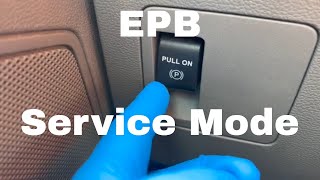
Use a bidirectional scan tool to put the EPB system into 'Service Mode'. This fully retracts the brake piston. Failing to do this before removing the motor or servicing brakes permanently destroys the caliper.
Tools: Bidirectional Scan Tool (Intermediate) - Test Actuator Motor with a 12V Source
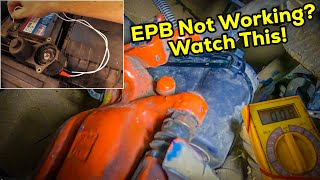
With the connector unplugged, use a fused jumper wire to apply 12V and ground to the two pins on the actuator motor. Reversing polarity reverses direction. If the motor makes no noise or struggles, replace it. If it runs smoothly, the fault is in the wiring.
Tools: Power Probe or Fused Jumper Wires (Advanced) - Measure Motor Winding Resistance
Set a multimeter to Ohms and measure resistance between the two motor pins. A healthy motor shows 0.5 to 2.0 Ohms. An open circuit (OL) means a broken internal winding; 0 Ohms means an internal short. Both require motor replacement.
Tools: Multimeter (Advanced) - Check Motor Current Draw
Clamp a DC current meter around one actuator wire and command the EPB with a scan tool. Normal operating current is 2-5A. A sustained draw over 20A indicates the motor is straining against a seized caliper. 0A indicates an open circuit.
Tools: DC Current Clamp, Bidirectional Scan Tool (Advanced) - Inspect Caliper for Mechanical Seizure
Remove the EPB motor from the caliper (two bolts). Attempt to manually turn the piston retraction mechanism with a Torx T40 bit. If it is impossible to turn, the caliper is seized and the entire assembly requires replacement.
Tools: Basic Hand Tools, Torx Sockets (Advanced)
When This Code Triggers (Freeze-Frame Conditions)
- Vehicle Speed: 0 mph (Vehicle is stationary when the fault is logged during EPB activation or release.)
- System Voltage: 11.8 - 14.8V (Fault triggers on low voltage (weak battery) or normal voltage during a mechanical failure.)
- EPB Switch Status: Pressed or Pulled (Code sets in direct response to a driver command via the EPB switch.)
- Commanded State: Apply / Release (Module logs the fault when commanded movement lacks the expected position or current feedback.)
Related Codes
- C2005 — Identical 'Actuator Stuck' code for the right side. On Land Rover/Jaguar, seeing C2005 and C2006 simultaneously confirms a software or voltage fault, not two independent hardware failures.
- C2008 — Means 'Left Motor – Actuator Stuck Open'. C2006 indicates a general stuck condition, while C2008 specifies the actuator failed to retract during a release command.
- C2007 — Companion code to C2008 for the right side. The presence of C2005, C2006, C2007, and C2008 together is the hallmark of the Land Rover/Jaguar software issue.
- U3001-77 — Means 'Control Module Improper Shutdown'. Often appears alongside EPB faults, pointing to a low-voltage event or logic error rather than mechanical failure.
Climate & Environmental Factors
- Cold Weather: Temperatures below 14°F (-10°C) thicken lubricants and increase internal motor resistance, preventing the brake from releasing. Mazda issued TSB 04-002/15 requiring caliper and motor replacement for this specific cold-weather failure.
- Road Salt and Humidity: Exposure to winter road salt accelerates corrosion on the motor housing and electrical connector, causing water intrusion that seizes the motor or destroys the electrical pins.
How to Talk to a Mechanic About This Code
Say this: "I have a 'Park Brake Fault' warning and code C2006 for the left rear actuator. Based on my vehicle, please check for simple causes like wiring harness chafing or software recalibration before recommending a full caliper replacement."
Directs the mechanic to perform a logical diagnosis instead of jumping to the most expensive conclusion, establishing you as an informed consumer.
Avoid saying:
- 'My parking brake is broken, fix it.'
- 'The 'P' light is flashing, can you just look at it?'
- 'Do whatever you think is best.'
Questions to ask before authorizing the repair:
- Can you give me a detailed breakdown of the parts and labor costs?
- Did you check for a software recalibration or wiring harness chafing before recommending a full caliper replacement?
- Is the actuator motor available separately, or do I have to buy the entire caliper assembly?
- Did you confirm the caliper itself is seized, or is it just the motor?
- What is the warranty on the parts and your labor for this specific repair?
Where to Take It: Dealer vs Independent vs Chain
- Dealer:
Necessary for warranty/recall work or complex software faults; otherwise, too expensive.
Best for: Vehicles under warranty or covered by a specific recall (like the Ford F-150 wiring harness)., Complex software issues, like the Land Rover/Jaguar recalibration TSB.
Downsides: Highest labor rates., Defaults to replacing the entire expensive caliper assembly when only the motor failed. (Typical cost: +50% vs. baseline) - Independent Shop:
Best overall fit, provided you vet the shop to ensure they are properly equipped for EPB service.
Best for: Out-of-warranty vehicles., Common hardware failures like a seized motor, broken wire, or seized caliper., Shops specializing in your vehicle's brand.
Downsides: MUST confirm they have a bidirectional scanner capable of EPB 'Service Mode'. (Typical cost: +0% vs. baseline) - Chain Shop:
AVOID. The risk of a technician causing further damage by not following the correct EPB procedure is too high.
Best for: Simple, unrelated maintenance like oil changes or tires.
Downsides: High risk of improper procedure (not using 'Service Mode'), causing severe caliper damage., High pressure to upsell services. (Typical cost: -10% vs. baseline)
When to Walk Away From the Repair
If the estimated repair cost for the C2006 fault, plus any other known issues, exceeds 50% of your car's private-party value, consider selling or trading it in.
- Car worth $15000, fix is $750: Fix it. The repair cost is a small fraction of the vehicle's value.
- Car worth $5000, fix is $1800: Borderline. Get a second opinion and evaluate the car's overall health before proceeding.
- Car worth $3000, fix is $1600: Walk away. The repair cost is more than half the car's value.
What Scan Tool You Need for This Code
Minimum: A scanner that reads ABS/Brake Control Module codes and performs the EPB Service/Maintenance Mode function.
A cheap $20 scanner only reads engine codes and lacks the bidirectional control needed to command the EPB system into 'Service Mode', which is essential for safely performing any repair.
Budget: XTOOL A30M / Topdon TopScan Lite (~$70-120) — Smartphone-based Bluetooth dongles offering basic bidirectional control, including critical EPB service functions (retract and engage) with no recurring subscription fees.
Mid-range: Autel MaxiDiag MD806 Pro / Foxwell NT650 Elite (~$200-350) — Handheld tools offering all-system diagnostics and reliable EPB service mode, ABS bleeding, and SAS calibration.
Professional: Autel MaxiCOM MK808 / XTOOL D7 (~$450-600) — Full-featured diagnostic tablets with extensive bidirectional controls, live data graphing, recalibration, and motor activation tests.
Rent vs buy: Auto parts stores do NOT rent bidirectional scanners. Buying a midrange tool is a mandatory investment if you plan to do your own brake work.
How to Clear the Code After You Fix It
- Perform the physical repair.
- Use a professional OBD-II scanner to clear the C2006 code from the ABS/Brake Control Module.
- Exit EPB Service Mode using the scan tool.
- Perform an EPB system recalibration by cycling the parking brake on and off 4 times to confirm normal operation.
Drive cycle (~10 minutes): A traditional emissions drive cycle is not required. Start the vehicle, press the service brake, and pull the EPB switch to apply the brake. Confirm the warning light illuminates. Push the switch to release the brake and confirm the light turns off. Repeat 4 times, then test drive to ensure no faults return.
Readiness monitors affected: None
Watch out for:
- Using a basic engine code reader that cannot access the ABS module to clear the code.
- Forgetting to exit 'Service Mode' after repairs, which disables the EPB and logs new codes.
- Failing to perform the recalibration cycle, causing the module to immediately flag a position error.
Will This Fail Emissions / State Inspection?
No — by itself this code doesn't fail OBD inspection (but it can keep readiness monitors from setting, which causes a separate fail).
- California: This code does not fail the OBD-II emissions check, but inspectors will refuse to test the vehicle if the red brake warning light is illuminated due to safety liability.
- New York: An illuminated red brake warning light results in an automatic failure of the mandatory annual safety inspection.
- Texas: For commercial vehicles requiring safety inspections, a malfunctioning parking brake results in immediate failure.
- Virginia: Fails the Virginia Safety Inspection. The parking brake system must physically hold the vehicle on an incline.
Most Commonly Affected Vehicles
- Land Rover Range Rover (L405) / Range Rover Sport (L494) (2014-2021) — Extremely prone to a software glitch triggering C2006-71 alongside C2005, C2007, and C2008. TSB SSM74004 details the no-parts recalibration fix.
- Jaguar XF, XJ, F-PACE (2003-2024) — Shares the Land Rover EPB system and software sensitivity. TSB S206-04 warns the system must be recalibrated after any rear brake service.
- Ford Expedition / Lincoln Navigator / F-150 (2017-2023) — Notorious for the EPB wiring harness chafing against the rear axle housing. Ford issued recall 23S35 (NHTSA 23V509) to replace the harness free of charge.
- Volkswagen / Audi Passat, Golf, Tiguan, Q5 (2010-2024) — Internal plastic gears of the caliper-mounted actuator motor strip frequently, requiring motor replacement.
- Mazda Mazda3 / CX-5 / CX-9 (2014-2018) — TSB 04-002/15 addresses EPB failures in cold weather (code C2006:19), requiring replacement of both the actuator and caliper with improved parts.
- Volvo S80, V70, XC70, XC60 (2007-2016) — Actuator motors fail frequently. Lacking an emergency release cable, the motor must be manually removed and wound back with a Torx bit if stuck.
- Chrysler / Dodge Pacifica / Grand Caravan (2017-2024) — The dashboard EPB switch fails internally, triggering actuator-related codes.
- Hyundai / Kia Tucson, Santa Fe, Sportage (2016-2024) — EPB faults trigger frequently due to low battery voltage or immediately following a battery replacement without registration.
Manufacturer-Specific Notes
- Land Rover / Jaguar: If C2006, C2005, C2007, and C2008 appear together, do not replace parts. Check the battery and perform the recalibration procedure in TSB SSM74004.
- Ford: On 2017-2023 trucks, the wiring harness is the prime suspect. Check for Ford recall 23S35 (NHTSA 23V509) regarding rear axle wire harness chafing before replacing the motor.
- Mazda: If C2006:19 triggers in freezing temperatures, TSB 04-002/15 dictates replacing both the EPB motor and the entire rear caliper assembly with updated parts.
- Volvo: There is no emergency release cable. If stuck, you must apply 12V directly to the motor pins or remove the motor and manually wind the piston back with a Torx bit.
Real Owner Stories
2018 Land Rover Discovery with multiple EPB codes
Owner received a 'Park Brake Fault' message. A scan revealed codes C2005, C2006, C2007, and C2008 simultaneously.
What they tried:
- Suspected a major hardware failure.
- Found Land Rover TSB SSM74004 online.
- Performed the manual recalibration procedure: lock car, wait 10 minutes, unlock, start engine, cycle EPB switch.
Outcome: The manual reset cleared all codes and restored function without parts. The root cause was a software glitch triggered by a low battery event.
Lesson: On Land Rover/Jaguar, the cluster of four EPB codes indicates a software issue. Perform the free recalibration before replacing hardware.
2021 Ford F-150 with intermittent 'Park Brake Fault'
At 45,000 miles, the truck showed a 'Park Brake Fault'. The dealer claimed the harness passed the recall 23S35 inspection.
What they tried:
- Owner self-inspected the wiring harness near the rear axle.
- Found a wire with chafed insulation rubbing on the axle housing.
- Performed a temporary splice repair, which immediately fixed the problem.
Outcome: The owner escalated to Ford corporate to have the recall re-opened. The dealer replaced the harness under NHTSA recall 23V509.
Lesson: For Ford trucks, physically inspect the rear axle wiring harness yourself. Dealer visual inspections often miss chafed wires hidden against the axle.
2016 Mazda CX-5 with EPB stuck on in winter
During a 10°F cold snap, the EPB would not release. Scan showed code C2006:19.
What they tried:
- Unable to move the vehicle.
- Towed to a Mazda dealership.
Outcome: Dealer identified the issue under Mazda TSB 04-002/15. Replaced the left rear brake caliper and EPB motor assembly with updated parts under warranty.
Lesson: On 2014-2018 Mazdas, C2006 in cold weather requires replacing the caliper and motor with updated parts per the TSB.
2017 Jaguar F-Pace with C2006 after brake service
Immediately after an independent shop replaced rear brake pads, code C2006 triggered.
What they tried:
- Shop re-bled brakes and cleared code; it returned instantly.
- Shop replaced the left rear EPB actuator motor; fault persisted.
Outcome: A Jaguar specialist diagnosed that the first shop failed to use 'Service Mode' before compressing the piston, destroying the original caliper's internal mechanism. Required a $600 caliper replacement.
Lesson: Rear brake service on EPB vehicles requires a bidirectional scan tool. Failing to use 'Service Mode' guarantees expensive caliper damage.
How to Prevent This Code From Triggering
- Cycle the EPB regularly (At least once a week) — Regular use prevents the actuator motor and caliper mechanisms from seizing due to corrosion or inactivity.
- Maintain a healthy, fully charged battery (Ongoing) — EPB systems require stable voltage. A weak battery causes low voltage, leading to spurious fault codes like C2006.
- Clean and inspect the rear caliper area (Annually or during tire rotation) — Washing the area removes corrosive road salt. Visual inspection catches wiring damage before it causes a failure.
Frequently Asked Questions
What are the most common misdiagnoses for C2006?
The biggest mistake is replacing the EPB actuator on Land Rover/Jaguar vehicles without first attempting the free software recalibration. Another error is replacing the expensive central ABS module when the code specifically points to a wiring fault at the left wheel.
How do I move my car if the parking brake is stuck on?
Block the wheels securely. Remove the actuator motor from the caliper (two bolts) and manually turn the internal piston back with a T40 Torx bit. Some vehicles have a manual release cable in the trunk, but this is increasingly rare.
Why did my parking brake fail right after a brake job?
The mechanic failed to put the system into 'Service Mode' with a scan tool before compressing the rear brake pads. Forcing the caliper pistons back manually destroys the internal gearing of the actuator and caliper. You will likely need a new caliper assembly.
What does the '-71' or ':19' suffix mean on a C2006 code?
These are manufacturer-specific identifiers. C2006-71 on a Land Rover means 'Left Actuator – Actuator Stuck'. On a Mazda, C2006:19 means 'Circuit malfunction' and is tied to a specific cold-weather failure TSB.
My car is stuck in EPB Maintenance Mode, what do I do?
This occurs if a hardware fault prevents the system from recalibrating upon exit. You must diagnose and replace the seized motor or caliper before the module will allow the system to exit Maintenance Mode.
Can I just ignore code C2006?
No. This is a critical safety fault indicating your vehicle could roll away when parked. If the brake sticks while driving, it will destroy your rear brake components and potentially cause a fire.
Can I replace just the motor or do I need the whole caliper?
Most manufacturers sell the actuator motor separately for $70-$250. However, if the mechanical caliper piston is seized, or if a specific TSB requires it (like Mazda's cold weather fix), you must replace the entire caliper assembly.
Key Takeaways
- Code C2006 indicates a failed left rear electronic parking brake actuator, creating a severe roll-away risk on inclines.
- If diagnosing a 2014-2021 Land Rover or Jaguar, perform the free TSB SSM74004 recalibration procedure before replacing any parts, as software glitches cause 80% of these faults.
- Inspect the rear axle wiring harness on 2017-2023 Ford F-150 and Expedition models immediately, as chafed wires are the primary trigger and are covered under NHTSA recall 23V509.
- Never manually compress the rear brake caliper piston; you must use a bidirectional scan tool to engage 'EPB Service Mode' to prevent destroying the $400+ caliper assembly.
Helpful Videos

The information in this article is provided for general reference and educational purposes only. Vehicle specifications, procedures, and part compatibility can vary by production date, trim level, and region. Always consult your vehicle's factory service manual and verify part numbers before purchasing or performing repairs. Safety-critical components such as airbags, seat belts, and braking systems should be installed by a qualified professional.
- 🎬 Helpful Videos
- What Does C2006 Mean?
- Can I Drive With C2006?
- Common Causes
- Symptoms
- Diagnostic Flowchart
- Common Fixes & Costs
- Used vs. New Parts: Buying Guide
- What Happens If You Wait — Timeline
- Cost of Not Fixing It
- Diagnosis Steps
- When This Code Triggers (Freeze-Frame Conditions)
- Related Codes
- Climate & Environmental Factors
- How to Talk to a Mechanic About This Code
- Where to Take It: Dealer vs Independent vs Chain
- When to Walk Away From the Repair
- What Scan Tool You Need for This Code
- How to Clear the Code After You Fix It
- Will This Fail Emissions / State Inspection?
- Most Commonly Affected Vehicles
- Manufacturer-Specific Notes
- Real Owner Stories
- 2018 Land Rover Discovery with multiple EPB codes
- 2021 Ford F-150 with intermittent 'Park Brake Fault'
- 2016 Mazda CX-5 with EPB stuck on in winter
- 2017 Jaguar F-Pace with C2006 after brake service
- How to Prevent This Code From Triggering
- Frequently Asked Questions
- What are the most common misdiagnoses for C2006?
- How do I move my car if the parking brake is stuck on?
- Why did my parking brake fail right after a brake job?
- What does the '-71' or ':19' suffix mean on a C2006 code?
- My car is stuck in EPB Maintenance Mode, what do I do?
- Can I just ignore code C2006?
- Can I replace just the motor or do I need the whole caliper?
- Key Takeaways
- 🎟️ Get 5% Off