

OBD-II Code C1809: Advanced Driver-Assistance System Unavailable
What C1809 means, why it triggers, and how to fix it
- Code C1809 is a manufacturer-specific code, primarily used by Mitsubishi, indicating the Adaptive Cruise Control (ACC) or Forward Collision Mitigation (FCM) system has shut down.
- Clean the front grille emblem and windshield camera, then test the 12V battery; these two simple steps resolve over 80% of C1809 codes.
- You can safely drive the vehicle mechanically, but the lack of Automatic Emergency Braking increases your risk of a front-to-rear collision by up to 50%.
- Professional ADAS recalibration costs $250 to $600, while replacing a failed radar sensor or camera exceeds $1,500.
What Does C1809 Mean?
Code C1809 means the vehicle's computer disabled the Adaptive Cruise Control (ACC) and Forward Collision Mitigation (FCM) systems. The system detected an obstruction, voltage drop, or hardware fault preventing it from reliably judging the road ahead, forcing a safety shutdown.
Technical definition: The official definition, primarily used by Mitsubishi, is "ACC/FCM TEMPORARY NOT AVAILABLE". This indicates the ACC/FCM electronic control unit (ECU) disabled the system due to a detected performance issue, external interference, invalid data from another module, or an internal fault.
Can I Drive With C1809?
Yes, But With Caution. Yes. The vehicle operates mechanically, but Forward Collision Warning and Automatic Emergency Braking are disabled. This increases your risk of a front-to-rear collision. Maintain extra following distance and rely entirely on manual braking.
Common Causes
- Obstructed Radar Sensor or Camera (Very Common) — Physical blockage of the front-facing radar sensor (behind the grille emblem) or the windshield camera is the primary trigger. Dirt, mud, snow, ice, car wash stickers, toll passes, or internal windshield condensation blind the sensors. 🎬 See this guide on keeping your car sensors clean and clear.
- Weak or Failing 12V Battery (Common) — The FCM/ACC system is highly sensitive to voltage drops. A low battery voltage or failing charging system forces the module to shut down, triggering C1809. This frequently occurs after a difficult start or jump-start.
- Poor Weather or Environmental Conditions (Common) — Heavy rain, dense fog, snow, or driving directly into bright, low-hanging sunlight interferes with sensor visibility. The system temporarily shuts down until conditions improve.
- Misaligned Radar Sensor or Camera (Less Common) — A minor front-end bump, parking lot impact, suspension work, or hitting a large pothole knocks the radar sensor or camera out of alignment. The system disables itself because misaligned readings are unsafe.
- CAN Bus Network Fault (Less Common) — The ADAS module requires constant communication with the ABS and ECM over the Controller Area Network (CAN bus). A wiring issue or a fault in another module interrupts this data, forcing a shutdown and setting related 'U' codes (e.g., U0121).
- Faulty Forward Radar Sensor or Camera (Rare) — The radar sensor or camera fails due to internal electronic faults, water intrusion, or overheating. This requires complete component replacement and professional recalibration.
- Faulty ACC/FCM Control Module or Software (Rare) — The electronic control module processing sensor data fails, or a software glitch forces a fail-safe mode. Manufacturers frequently issue recalls (like Mitsubishi SR-18-007) to update buggy software.
Symptoms
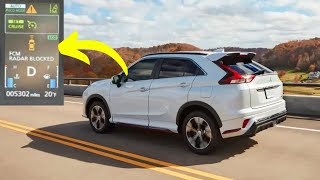
- ACC/FCM Unavailable Message — The instrument cluster displays "ACC/FCM Temporarily Unavailable," "FCM Radar Blocked," or an equivalent warning.
- Active Safety Systems Disabled — Adaptive cruise control, automatic emergency braking, and forward collision alerts are completely inactive. The vehicle will not maintain distance or brake automatically.
- Multiple Warning Lights Illuminated — The FCM/ACC warning light turns on, often accompanied by ASC (Active Stability Control), ABS, or LDW (Lane Departure Warning) lights, especially if a weak battery or CAN bus issue is the root cause.
Diagnostic Flowchart
Tap your situation to follow the diagnostic path that matches what you're seeing on this code.
Common Fixes & Costs
- Cleaning Front Radar Sensor and/or Windshield Camera — Parts: $0, Labor: $0, ~0.1 hr book time (DIY)
- Replacing Weak 12V Battery
— Parts: $150-$350, Labor: $0-$50, ~0.5 hr book time
(DIY)
Mitsubishi Outlander (2018-2022): OEM - ADAS Sensor Recalibration — Parts: $0, Labor: $250-$600, ~2.5 hr book time (Professional)
- Replacing a Faulty Forward Radar Sensor
— Parts: $400-$1,300, Labor: $150-$400, ~3.0 hr book time
(Professional)
Mitsubishi Outlander (2016-2020): OEM
Mitsubishi Eclipse Cross (2018-2022): OEM - Replacing a Faulty Forward Camera
— Parts: $800-$2,000, Labor: $250-$600, ~2.5 hr book time
(Professional)
Mitsubishi Outlander / Eclipse Cross (2018-2022): OEM
DIY vs Professional
- Cleaning Front Radar Sensor and/or Windshield Camera — Beginner:
Tools: Soft cloth, glass cleaner - Replacing Weak 12V Battery — Beginner:
Tools: Socket set, wrench, battery terminal cleaner - ADAS Sensor Recalibration — Beginner:
Tools: OEM scan tools, calibration targets, perfectly level shop floor - Replacing a Faulty Forward Radar Sensor or Camera — Beginner:
Tools: Hand tools, trim removal tools, professional recalibration equipment
Used vs. New Parts: Buying Guide
When a used part is worth it: A used part offers high savings but requires mandatory professional recalibration. Buy used only if you verify the donor vehicle had no front-end damage and the OEM part numbers match exactly.
Donor-vehicle mileage cap: roughly under 100000 miles for the part to have meaningful remaining life.
Donor quality checklist:
- Verify the donor vehicle was not involved in a front-end collision.
- Ensure the part number is an exact match; superseded numbers often cause compatibility errors.
- Inspect the lens for deep scratches and the connector pins for corrosion.
- Demand a minimum 30-day warranty to protect against dead-on-arrival electronics.
Decision logic:
- If The failure is due to a known software issue or TSB → Do not buy any part. Get the free or low-cost software update from the dealer.
- If The part is a radar sensor or forward camera → Buy used only if budget is tight, but remember you must still pay $250-$600 for professional recalibration.
Warranty tradeoff: Used parts carry a 30-90 day warranty covering the part only. If the used part fails, you lose the $250-$600 spent on the recalibration labor.
Worst-case if a used part fails: $300-$800 in wasted labor and calibration fees if the used part is faulty.
What Happens If You Wait — Timeline
- Immediate: Code C1809 sets. Automatic emergency braking and adaptive cruise control functions disable instantly. (MPG impact: 0%% · Added cost: $0)
- Ongoing: Collision risk increases significantly. You forfeit the 50% reduction in rear-end crashes provided by AEB systems. (MPG impact: 0%% · Added cost: Potential cost of an at-fault accident ($500 deductible to $10,000+ in repairs).)
- 1-6 months (if caused by battery): If a failing 12V battery is the root cause, slow starting and random module faults worsen until the vehicle fails to start. (MPG impact: 0-5%% · Added cost: $150-$350 for the inevitable battery replacement.)
Cost of Not Fixing It
- Immediate: All Forward Collision Mitigation (FCM) and Automatic Emergency Braking (AEB) functions are disabled. The vehicle will not brake to prevent a frontal collision. (Added cost: N/A)
- Ongoing: Significantly increased risk of a front-to-rear collision. IIHS studies show vehicles with forward collision warning and autobrake reduce front-to-rear crashes by 50%. Ignoring the code forfeits this major safety benefit. (Added cost: Potential cost of an at-fault accident, ranging from a $500 deductible to over $10,000 in repairs and insurance hikes.)
- Long-term: Ignoring C1809 causes no progressive mechanical damage to other components. The cost is purely a safety risk, forcing total reliance on driver reaction time. (Added cost: N/A)
Diagnosis Steps
- Visually Inspect and Clean the Sensors
Inspect the front grille emblem and the windshield area in front of the rearview mirror. Clean these areas with a soft cloth and glass cleaner to remove dirt, bugs, snow, or ice. Remove any toll passes or phone mounts blocking the camera.
Tools: Soft cloth, glass cleaner (Beginner) - Restart the Vehicle (Power Cycle)
After cleaning the sensors, turn the vehicle off, wait 60 seconds, and restart it. A simple power cycle resets the system and clears the code if the obstruction or weather event was temporary.
Tools: Ignition key/button (Beginner) - Check and Test the 12V Battery
Use a multimeter to check battery voltage with the car off; it must be above 12.4V. Start the car and check voltage again; it must be between 13.7V and 14.7V. A low reading proves the battery or alternator is causing the module shutdown.
Tools: Multimeter or battery tester (Beginner) - Check for Physical Damage
Inspect the front bumper, grille, and sensor mounting brackets for impact damage. Even minor parking lot bumps cause sensor misalignment. Inspect the windshield for cracks in the camera's field of view.
Tools: Flashlight (Beginner) - Read Fault Codes with an ADAS-Capable Scanner
Connect an OBD-II scanner capable of reading Chassis (C-codes) and Network (U-codes). Confirm C1809 is active and note any communication codes (like U0121) that point to a network failure rather than a sensor failure.
Tools: ADAS-capable OBD-II Scanner (Intermediate) - Check for Technical Service Bulletins (TSBs) and Recalls
Search your VIN for ADAS-related TSBs or recalls. Manufacturers frequently release software updates to fix bugs causing false C1809 warnings (e.g., Mitsubishi recalls SR-18-007 and SR-18-008).
Tools: Internet access, VIN (Intermediate) - [PRO TIP] Check CAN Bus Termination Resistance
If U-codes are present, disconnect the battery and measure resistance between CAN High (Pin 6) and CAN Low (Pin 14) at the OBD-II port. A reading of 60 Ω is normal. A reading of 120 Ω indicates an open circuit or missing terminating resistor.
Tools: Multimeter, wiring diagram (Advanced) - [PRO TIP] Check CAN Bus Voltage
With the key on and engine off, measure voltage on the CAN lines at the OBD-II port. CAN High (Pin 6) should be ~2.5-3.5V and CAN Low (Pin 14) should be ~1.5-2.5V. Abnormal voltages indicate a wiring short.
Tools: Multimeter with back-probe pins (Advanced) - [PRO TIP] Analyze Live Data PIDs
Access the live data stream for the FCM/ACC module. Monitor 'Module Input Voltage' (must match battery voltage) and 'Radar Blockage Status' (must read 'Not Blocked'). Parameters reading 'Fault' or 'Unavailable' isolate the failed component.
Tools: ADAS-capable OBD-II Scanner (Advanced) - Have the System Professionally Diagnosed and Recalibrated
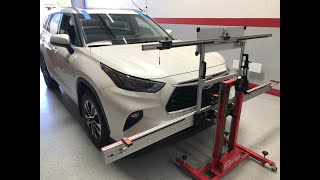
If basic steps fail, take the vehicle to a shop equipped with ADAS targeting systems. They will test sensor outputs and perform a static or dynamic recalibration to fix misalignment. This cannot be done at home.
Tools: Professional ADAS calibration tools and targets (Professional)
When This Code Triggers (Freeze-Frame Conditions)
- Vehicle Speed: 10-75 mph (16-120 kph) (The fault sets when the vehicle is in motion, as the system only activates above a minimum speed threshold (approx. 6 mph).)
- Engine RPM: 1200-2800 RPM (Occurs during steady-state driving or cruise control conditions on the highway.)
- System Voltage: 11.5-13.0V (A value below the normal operating range (13.7-14.7V) points directly to a failing 12V battery or alternator as the root cause.)
- Weather/Environmental Data: N/A (The fault heavily correlates with external conditions like heavy rain, snow, fog, or driving into direct, low sunlight.)
Related Codes
- C1751 — Means 'ECU Failure.' If C1751 is present alongside C1809, the ACC/FCM control unit itself is internally faulty and requires replacement.
- C1753 — Means 'Radar Blockage Detected.' C1753 points specifically to physical dirt or snow on the sensor, whereas C1809 is a general shutdown code.
- U0121 — Means 'Lost Communication With ABS Module.' The FCM requires the ABS to apply brakes. If communication fails, the FCM shuts down and sets C1809.
- U0401 — Means 'Invalid Data Received From ECM.' The FCM disables itself if it receives corrupt vehicle speed data from the engine computer.
Climate & Environmental Factors
- Precipitation (Heavy Rain, Snow, Sleet): Water droplets and snowflakes scatter radar waves and blind optical cameras, forcing a temporary system shutdown.
- Sunlight (Low, Bright Sun): Driving directly into a low-hanging, bright sun overwhelms the optical forward camera, blinding it and triggering a fault.
- Fog and High Humidity: Dense fog interferes with radar waves, while high humidity causes internal windshield condensation that blocks the camera's view.
How to Talk to a Mechanic About This Code
Say this: "I have a C1809 code and an 'FCM Unavailable' message. I've cleaned the front radar and windshield camera. Please test the 12V battery and check for communication codes or TSBs before quoting a sensor recalibration."
This proves you've done basic troubleshooting and forces the shop to rule out cheap fixes (like a weak battery) before upselling you on a $600 calibration or a $1,500 sensor.
Avoid saying:
- 'My cruise control isn't working, can you fix it?'
- 'My car is beeping at me and a light is on.'
- 'Just do whatever it takes to fix it.'
Questions to ask before authorizing the repair:
- What diagnostic steps did you perform to arrive at this recommendation?
- If recommending recalibration, what evidence suggests misalignment? Was it preceded by a collision or windshield replacement?
- Did you check for manufacturer TSBs or software updates related to this system?
- What is the warranty on both the parts and the labor for this specific repair?
Where to Take It: Dealer vs Independent vs Chain
- Dealer:
Recommended. The dealer guarantees access to the latest software updates and OEM-specific ADAS targeting tools required for this code.
Best for: Vehicles under warranty., Performing recall or TSB software updates., Complex diagnostics involving proprietary software or CAN bus issues.
Downsides: Highest labor rates, often 1.5-2x more than independent shops., Quick to replace entire assemblies rather than diagnose sub-components. (Typical cost: +50% vs. baseline) - Independent Shop:
Viable with vetting. Only use an independent shop if you confirm they own up-to-date ADAS calibration equipment (e.g., Autel, Hunter). Otherwise, they will just sublet the car to a dealer.
Best for: Out-of-warranty vehicles where cost is a major factor., Shops explicitly advertising modern ADAS calibration services.
Downsides: Many general mechanics lack the $15,000+ ADAS calibration equipment required to fix this. (Typical cost: +0% vs. baseline) - Chain Shop:
Avoid for diagnosis and repair. Use chains strictly for a free 12V battery test to rule it out as the root cause.
Best for: Free battery testing., Purchasing and installing a new 12V battery.
Downsides: Not equipped for ADAS diagnostics or calibration., Technicians lack specialized training for complex electronic networks. (Typical cost: -10% vs. baseline)
When to Walk Away From the Repair
If the estimated ADAS repair cost exceeds 40-50% of the car's private-party value, pause. Because this fault does not prevent the car from driving mechanically, the threshold is flexible.
- Car worth $10000, fix is $2500: Fix it. The repair restores a critical safety feature and preserves the car's resale value.
- Car worth $5000, fix is $2500: Borderline. Get a second opinion. If the diagnosis is firm, consider selling the car 'as-is' with full disclosure.
- Car worth $3000, fix is $2500: Walk away. The repair cost is over 80% of the car's value and is not economical.
What Scan Tool You Need for This Code
Minimum: A scanner that reads manufacturer-specific Chassis ('C') and Network ('U') codes, and displays live data from the ADAS/FCM module.
A basic $20 code reader only sees Powertrain ('P') codes. It cannot see, clear, or diagnose a C1809 code.
Budget: Autel AP200 / Foxwell FW601 (~$70) — Reads and clears Chassis and Network codes via a smartphone app, providing sufficient data for initial DIY diagnosis.
Mid-range: Foxwell NT710 / NT809BT (~$250) — Offers full-system diagnostics, live data graphing, and bidirectional controls to investigate CAN bus or module voltage problems.
Professional: Autel MaxiCOM MK808 / Launch X431 Series (~$500) — Provides professional-level diagnostics and the ability to perform static ADAS calibration functions (requires separate target purchase).
Rent vs buy: For a one-time diagnosis, use a free loaner tool from an auto parts store. Buy a scanner only if you plan to perform regular DIY diagnostics.
How to Clear the Code After You Fix It
- Fix the underlying cause (clean sensor, replace battery, or perform recalibration).
- Use an ADAS-capable OBD-II scan tool to access the ADAS/FCM module and select 'Clear/Erase Codes'.
- Perform a drive cycle to verify the system activates and the code remains clear.
Drive cycle (~20 minutes): Drive for 15-20 minutes on a well-marked road with other traffic at speeds above 30 mph. The system requires clear lane markings and lead vehicles to confirm sensor functionality and complete its self-check.
Readiness monitors affected: None
Watch out for:
- Clearing the code without fixing the root cause results in the code returning immediately.
- Using a basic $20 code reader fails because it cannot access Chassis ('C') codes.
- Disconnecting the battery does not clear hard faults from the ADAS module's non-volatile memory.
Will This Fail Emissions / State Inspection?
No — by itself this code doesn't fail OBD inspection (but it can keep readiness monitors from setting, which causes a separate fail).
- California: Smog Check focuses strictly on powertrain ('P') codes and emissions monitors. C1809 will not cause an emissions failure.
- New York: While it passes the emissions test, an inspector can fail the vehicle's separate safety inspection for an illuminated ADAS warning light.
- Texas: Passes the OBD emissions test, but fails the mandatory safety inspection, which requires all factory-installed safety equipment to function.
Most Commonly Affected Vehicles
- Mitsubishi Outlander / Outlander Sport (2017-2024) — Extremely well-documented code for these models. Recalls SR-18-007 and SR-18-008 addressed software issues on 2017-2018 models.
- Mitsubishi Eclipse Cross (2018-2024) — Shares ADAS technology with the Outlander. 2018-2019 models were included in Safety Recalls for FCM software issues.
- Mitsubishi Triton (2019-2024) — Owners report persistent issues with the FCM system disabling, triggering this specific diagnostic trouble code.
Manufacturer-Specific Notes
- Mitsubishi: Mitsubishi is the primary user of code C1809. The system is highly sensitive to low battery voltage. Recalls SR-18-007 and SR-18-008 address software bugs in 2017-2019 models causing improper braking.
- Subaru: Subaru's EyeSight system exhibits identical symptoms but uses different codes. It is extremely sensitive to aftermarket windshields; OEM glass and mandatory recalibration are required.
- General (Ford, GM, Toyota, etc.): C1809 is not a standard SAE code. Other automakers use proprietary 'C', 'B', or 'U' codes to report identical ADAS failures.
Real Owner Stories
2020 Mitsubishi Outlander Sport - The Car Wash Short
After a car wash, the dash displayed "FCM Temporarily not available" and the car entered limp mode.
Outcome: The issue resolved itself after the vehicle dried out completely in a garage. The codes were cleared and did not return.
Lesson: If faults appear immediately after a high-pressure car wash, allow the vehicle to dry thoroughly before authorizing expensive electronic repairs.
2018 Mitsubishi Eclipse Cross - The Hidden Battery Drain
The vehicle struggled to start, fuel consumption spiked, and the FCM warning light illuminated.
Outcome: Replacing the 12V battery for $300 resolved all symptoms, including the FCM warning.
Lesson: Multiple unrelated electronic issues (FCM unavailable, poor starting) point directly to a failing 12V battery. Test the battery before replacing ADAS components.
2023 Mitsubishi Outlander - The Dealership Upsell
The "FCM System Off" warning blinked constantly despite no physical damage or accidents.
Outcome: The owner declined the repair, suspecting a software glitch or CAN bus error rather than physical damage.
Lesson: Reject diagnoses that assume expensive physical damage without proof. Persistent C1809 codes require checking for TSBs and network errors before replacing hardware.
How to Prevent This Code From Triggering
- Regularly clean the radar sensor and forward camera (Weekly or as needed) — Wiping the grille emblem and windshield prevents the most common cause of faults: physical obstruction from dirt and bugs.
- Test the 12V battery annually after 3 years (Once per year) — ADAS modules are highly sensitive to low voltage. Annual testing catches a weakening battery before it triggers random electronic faults.
- Ensure proper ADAS recalibration after specific repairs (After any relevant service) — Mandatory recalibration after windshield replacement, suspension work, or collision repair ensures sensors remain perfectly aimed.
- Avoid mounting items that obstruct the camera's view (Daily habit) — Toll passes, phone holders, or stickers placed near the rearview mirror block the camera's line of sight and trigger faults.
Frequently Asked Questions
Can I fix the C1809 code myself?
Sometimes. The most common causes are a dirty sensor on the front of your car or a weak 12V battery. You can easily fix these by cleaning the sensor area on the grille/windshield or by testing and replacing your car's battery.
What's the difference between C1809 and C1753?
C1753 ('Radar Blockage Detected') specifically means the radar sensor is physically blocked by dirt or snow. C1809 ('ACC/FCM Temporary Not Available') is a general code triggered by blockages, weak batteries, software glitches, or sensor misalignment. C1753 points directly to an obstruction, while C1809 requires broader diagnosis.
Why did the C1809 code appear after a battery change or jump-start?
ADAS modules are highly sensitive to voltage fluctuations. A weak battery, jump-starting, or disconnecting the battery forces the module to temporarily glitch and set this code. A simple vehicle restart after the battery stabilizes usually clears the code.
Is it safe to drive with code C1809?
Yes, the vehicle is mechanically safe to drive. However, your automatic emergency braking and adaptive cruise control are turned off. You must rely entirely on your own braking and maintain a safe following distance.
Does a windshield replacement cause a C1809 code?
Yes, windshield replacement is a primary cause. The forward-facing camera mounts to the windshield and requires mandatory recalibration after installation. Skipping this $250-$500 calibration step immediately triggers ADAS fault codes.
Can I use regular cruise control if adaptive cruise is unavailable?
It depends on the vehicle manufacturer. On many Mitsubishis and Subarus, you can engage standard non-adaptive cruise control by pressing and holding the main cruise control button for three seconds. Check your owner's manual for the specific override procedure.
My dealer wants over $2,000 to fix this. Is that reasonable?
Yes, depending on the required repair. While a simple recalibration costs $250-$600, replacing a failed radar sensor or camera is highly expensive. A new OEM radar sensor or camera assembly easily exceeds $1,000 before labor and calibration.
Key Takeaways
- Code C1809 is a manufacturer-specific code, primarily used by Mitsubishi, indicating the Adaptive Cruise Control (ACC) or Forward Collision Mitigation (FCM) system has shut down.
- Clean the front grille emblem and windshield camera, then test the 12V battery; these two simple steps resolve over 80% of C1809 codes.
- You can safely drive the vehicle mechanically, but the lack of Automatic Emergency Braking increases your risk of a front-to-rear collision by up to 50%.
- Professional ADAS recalibration costs $250 to $600, while replacing a failed radar sensor or camera exceeds $1,500.
Helpful Videos




The information in this article is provided for general reference and educational purposes only. Vehicle specifications, procedures, and part compatibility can vary by production date, trim level, and region. Always consult your vehicle's factory service manual and verify part numbers before purchasing or performing repairs. Safety-critical components such as airbags, seat belts, and braking systems should be installed by a qualified professional.
- 🎬 Helpful Videos
- What Does C1809 Mean?
- Can I Drive With C1809?
- Common Causes
- Symptoms
- Diagnostic Flowchart
- Common Fixes & Costs
- DIY vs Professional
- Used vs. New Parts: Buying Guide
- What Happens If You Wait — Timeline
- Cost of Not Fixing It
- Diagnosis Steps
- When This Code Triggers (Freeze-Frame Conditions)
- Related Codes
- Climate & Environmental Factors
- How to Talk to a Mechanic About This Code
- Where to Take It: Dealer vs Independent vs Chain
- When to Walk Away From the Repair
- What Scan Tool You Need for This Code
- How to Clear the Code After You Fix It
- Will This Fail Emissions / State Inspection?
- Most Commonly Affected Vehicles
- Manufacturer-Specific Notes
- Real Owner Stories
- 2020 Mitsubishi Outlander Sport - The Car Wash Short
- 2018 Mitsubishi Eclipse Cross - The Hidden Battery Drain
- 2023 Mitsubishi Outlander - The Dealership Upsell
- How to Prevent This Code From Triggering
- Frequently Asked Questions
- Can I fix the C1809 code myself?
- What's the difference between C1809 and C1753?
- Why did the C1809 code appear after a battery change or jump-start?
- Is it safe to drive with code C1809?
- Does a windshield replacement cause a C1809 code?
- Can I use regular cruise control if adaptive cruise is unavailable?
- My dealer wants over $2,000 to fix this. Is that reasonable?
- Key Takeaways
- 🎟️ Get 5% Off