

C1717 on 2014-2024 Porsche Macan: Air Suspension Fault Causes and Fixes
On a Porsche Macan, code C1717 almost always indicates a fault in the air suspension system, triggering a 'Chassis System Faulty' warning. The most common fix is replacing the air suspension compressor relay and the 40A fuse, which is an inexpensive repair. If that doesn't work, the compressor itself may be failing due to leaks or being overworked by a faulty relay.
- Code C1717 on a Macan means you have a fault in the air suspension system, usually accompanied by a 'Chassis System Faulty' warning.
- Always start your diagnosis by checking the 40A fuse and replacing the compressor relay. This is the cheapest and most common fix.
- Do not replace the air compressor without also replacing the relay, as a faulty relay can destroy the new compressor.
- If the vehicle is sagging or you hear a hissing noise, you likely have a leak in an air strut which will need to be replaced to prevent repeat failure of the compressor.
What's Unique About the 2014-2024 Porsche Macan

The Porsche Macan shares its underlying MLB platform and some components with other VAG products like the Audi Q5. The air suspension system, while providing excellent performance, is complex and has several common failure points. Issues are often electrical in nature, starting with an inexpensive relay, rather than an immediate mechanical failure. Cold climates can exacerbate problems, causing fuses to blow or exposing failing components under high load, as reported by owners of similar VAG air suspension systems.
Generation note: The 2014-2024 model years cover the first generation of the Porsche Macan (Type 95B), which includes facelifts around 2019 and 2021. The air suspension system components and common failure points are largely consistent across this entire generation.
Symptoms You May Notice

- "Chassis System Faulty" or "Warning Chassis System" message on the dashboard
- Vehicle is stuck at one ride height (either high or low)
- Uneven ride height (leaning to one side or corner)
- Vehicle sags overnight or after being parked
- Harsh, bouncy, or stiff ride quality
- Ride height adjustment controls are inoperative
- Audible hissing from a corner of the vehicle, indicating an air leak
- Air suspension compressor runs continuously or is excessively loud
- Replacing the air suspension compressor without first replacing the relay. A bad relay can cause a new compressor to fail immediately.
- Replacing a ride height sensor when the actual problem is a simple broken plastic linkage.
- Replacing only the 40A fuse without replacing the faulty relay that caused it to blow.
Most Likely Causes

- Faulty Air Suspension Compressor Relay 🔴 High Probability The relay, often labeled with '645', can stick in the 'on' position, causing the compressor to run constantly until it overheats and blows the main 40A fuse. This is a very common first point of failure in the system, as documented by numerous owner experiences.
How to confirm: If the 40A fuse is blown, the relay is the most likely cause. If the compressor runs continuously even after the vehicle is off, the relay is stuck closed. The relay is located under the driver's side dashboard and can be difficult to access.
Typical fix: Replace the relay. It is strongly recommended to replace the relay any time the compressor or fuse is replaced. A DIY replacement is possible but requires removing under-dash panels.
Est. part cost: $20-$60 - Blown 40A Air Suspension Compressor Fuse 🔴 High Probability This fuse is designed to protect the circuit. It will blow when the compressor pulls too much current, which is typically caused by a stuck relay or a worn-out compressor that has been overworked due to system leaks.
How to confirm: Visually inspect the large, often orange, 40A fuse in the fuse panel located on the driver's side of the dashboard. In many Macans, this is in position A1 or a similar marked slot for the PASM compressor.
Typical fix: Replace the fuse. IMPORTANT: If the fuse is blown, you must also replace the compressor relay, as a faulty relay is the most common reason for the fuse to blow. Simply replacing the fuse will likely result in it blowing again.
Est. part cost: $5-$15 - Failing Air Suspension Compressor 🟡 Medium Probability The compressor is often overworked due to leaks in the air springs (struts). Over time, the constant running wears out the piston seal, and the motor fails, leading to an inability to generate pressure. A stuck relay can also destroy the compressor quickly.
How to confirm: After confirming the fuse and relay are good, listen for the compressor. If it does not turn on, test for power at its electrical connector. If it gets power but doesn't run, or is excessively loud, it has likely failed. The compressor is located in the right rear of the vehicle, often behind the wheel well liner. 🎬 See this step-by-step compressor and valve replacement guide
Typical fix: Replace the air suspension compressor, along with its relay and fuse.
Est. part cost: $400-$1200 - Leaking Air Strut / Air Spring 🟡 Medium Probability The rubber air springs can develop cracks and leaks over time due to age and environmental exposure. This is a primary cause of compressor failure, as the leak forces the compressor to run constantly to maintain pressure.
How to confirm: With the vehicle running, spray a soapy water solution on the air springs at each corner. Bubbles will form at the site of any leak. You may also hear a hissing sound or notice one corner sagging after the vehicle is parked for a few hours.
Typical fix: Replace the leaking air strut assembly. It is often recommended to replace them in pairs (both front or both rear) to maintain balanced handling.
Est. part cost: $800-$1500 per strut - Faulty Ride Height Level Sensor or Linkage ⚪ Low Probability The plastic linkages connecting the sensor to the suspension control arms can become brittle and break, or the ball joints can corrode and seize. This provides an incorrect reading to the control module, causing a system fault.
How to confirm: Visually inspect the sensors and linkages at all four corners for physical damage. Use a scan tool to monitor the live data from each sensor; the reading should change smoothly as you push down on that corner of the vehicle.
Typical fix: Replace the broken sensor or linkage.
Est. part cost: $100-$250
Rare But Worth Checking
- Valve block malfunction
- Air line damage or leaks
- Wiring harness issue to compressor or sensors
Diagnosis Steps
- Read the specific fault codes using a Porsche-compatible diagnostic scanner. Note any other codes present, such as 000257 or 000220, which have been associated with a faulty relay.
- Check the 40A fuse for the air suspension system, located in the fuse box on the driver's side of the dashboard.
- If the fuse is blown, replace it AND the air suspension compressor relay. The relay is located under the driver's side dashboard and is a primary cause of blown fuses.
- If the fuse and relay are good, listen for the compressor running (located in the right rear). If it never runs, check for power at the compressor connector. If it runs constantly, suspect a large leak or a stuck relay.
- Inspect the air springs at all four corners for leaks using soapy water. Listen for hissing sounds. Pay close attention to corners that appear to sag after the vehicle is parked.
- Visually inspect the ride height sensors and their connecting linkages at each wheel for any signs of damage, corrosion, or disconnection.
- If possible, use a scan tool to monitor live data from the ride height sensors to ensure they are reporting correctly.
Parts You'll Likely Need

- Air Suspension Compressor Relay
(OEM #95861502900)— This is the most common failure point. It gets stuck and causes the compressor to burn out and blow the fuse. It should always be replaced when the fuse is blown or the compressor is changed. It is often a grey relay marked '645'.
Trusted brands: Genuine Porsche, Bosch
OEM price range: $30-$50
Aftermarket price range: $15-$30 - Air Suspension Compressor
(OEM #95B616006D)— Fails due to being overworked from system leaks or from a stuck relay causing it to run constantly.
Trusted brands: Genuine Porsche, Arnott, Vigor
OEM price range: $1000-$1500
Aftermarket price range: $350-$700 - Front Air Suspension Strut — The flexible rubber air spring develops leaks with age, causing the system to lose pressure and overwork the compressor.
Trusted brands: Genuine Porsche, Arnott, Bilstein
OEM price range: $1500-$2000
Aftermarket price range: $700-$1200 - 40 Amp Fuse — This fuse protects the compressor circuit and is a clear indicator of an over-current situation, usually caused by a bad relay or failing compressor.
Trusted brands: Genuine Porsche, Littelfuse
OEM price range: $10-$15
Aftermarket price range: $5
Related Codes That Often Appear With This One
- 000257
- 000220
Technical Service Bulletins (TSBs) & Recalls
- AMA8: A recall for certain 2021 models where shock absorber screw connections might not be properly tightened, which could lead to instability or damage to the braking system. While not directly causing C1717, it's a related suspension safety issue.
Mechanic-Grade Diagnostic Values
- Compressor Circuit Fuse Rating — expected: 40A. Failure: A blown fuse indicates excessive current draw, most often from a stuck relay or a failing compressor.
Hidden / Shadow Codes Worth Checking
- 000257: Relay for suspension compressor - Electrical error. This code specifically points to the relay circuit and is a strong indicator that the relay itself has failed. (see via Porsche-specific scan tool like PIWIS or high-end multi-brand scanners (iCarsoft, Autel, Launch).)
- 000220: Valve for residual pressure holding - Upper limit value exceeded. This can indicate a problem with the valve block, often triggered by pressure fluctuations from a leak or failing compressor. (see via Porsche-specific scan tool like PIWIS or high-end multi-brand scanners.)
- 000284: Control position not adjustable. This code sets when the system fails to reach a target ride height, often due to a blown fuse, dead compressor, or major leak. (see via Porsche-specific scan tool like PIWIS or high-end multi-brand scanners.)
Scan Tool Commands That Help
- PIWIS (or equivalent like Launch X431, Autel): Level Control/PASM Calibration — Required after replacing a ride height sensor or air strut to ensure the system knows the correct vehicle height at all corners.
- PIWIS (or equivalent): Coding without Rules -> Correction Values — Used to make fine adjustments to the ride height at each corner without performing a full, complex calibration. This is often used by owners to lower the vehicle slightly.
- PIWIS (or equivalent): Component Actuation Test — To individually test the compressor and each solenoid in the valve block. This helps isolate a non-functioning component without having to physically remove it first.
- Vehicle Console: Disable Level Control (Jacking Mode) — Before lifting the vehicle on a jack or lift, press and hold the ride height lowering button for at least 10 seconds until a 'Level adjust switched off' message appears. This prevents the system from trying to self-level while being lifted, which can cause damage.
Wiring & Ground Locations

- Air Suspension Compressor Relay — Under the driver's side dashboard in the main relay carrier. Access requires removing the lower dash panel.. This is the most common failure point. A stuck relay will burn out the compressor and blow the 40A fuse, triggering the chassis fault.
- 40A Compressor Fuse — In the fuse panel on the driver's side of the dashboard, accessible when the door is open. It is typically a large orange fuse in position A1.. This fuse is the primary protection for the compressor circuit. If it's blown, it's a definitive sign of an over-current event.
- Air Suspension Control Module — In the right-hand side of the luggage compartment, behind the carpeted side panel.. This is the brain of the system. While module failure is rare, water ingress or physical damage in this area can cause system-wide faults.
- Air Suspension Compressor — In the right rear of the vehicle, behind the inner fender liner in the wheel well.. This is the component that generates air pressure. Its location exposes it to road debris and moisture, which can contribute to failure over time.
Real Owner Repair Stories
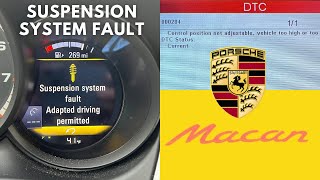
- YouTube user Omar's Garage (2016 Porsche Macan Turbo) — 'Suspension System Fault Adapted Driving Permitted' message on the dash. Scanned and found code 000284.
❌ Tried (didn't work) Considered a low battery, but it was not the cause., Checked for overnight suspension sag to find leaks, but none were apparent.
✅ What actually fixed it The 40A fuse for the air suspension compressor was blown. Replacing the fuse resolved the warning message and restored system function. The owner noted that the relay should also be replaced as a best practice. - YouTube user 'I fixed it myself' (Porsche Macan (year not specified)) — 'Chassis System Fault' warning light.
❌ Tried (didn't work) Initially quoted $5,000 by the dealer for a new compressor and other parts.
✅ What actually fixed it The owner diagnosed and replaced the air suspension compressor relay (Part No. 95861502900) located under the driver's dashboard. This was the sole point of failure and fixed the issue completely.
OEM Part Supersession History
8D0951253A→4H0951253A— Standard component revision across the VAG line.
Heads up: Both part numbers refer to the common '645' relay and are generally interchangeable for this application.95B616006 / A / B / C→95B616006D / E / F— Revisions to the air suspension compressor to improve durability and performance.
Heads up: Later revisions are direct replacements for earlier ones and are generally preferred when replacing the unit.
Diagnostic Flowchart
Other Known Issues on This Vehicle
Issues unrelated to this code that are worth knowing about as an owner of this generation:
- Timing Cover Oil Leak 🔴 High — Common on 2015-2018 V6 models (95B.1). Caused by original aluminum bolts stretching or breaking. (Ref: Porsche issued a service bulletin allowing for a less-invasive repair by replacing the aluminum bolts with steel ones without removing the engine.)
- Transfer Case Failure 🔴 High — Affects 2015-2018 models most frequently. Symptoms include shuddering, jerking, or bucking at low speeds. Often caused by fluid degradation. (Ref: Porsche offered an extended 7-year warranty for this issue on some vehicles, though many have now expired.)
- PDK Transmission Faults 🔴 High — Can occur at various mileages. Symptoms include rough shifting, hesitation, gear change failures, or entering limp mode. Often caused by faulty sensors or mechatronic unit issues.
Used vs. New Parts: Buying Guide for This Vehicle
When a used part is the smart pick: A used OEM air suspension control module or ride height sensor from a low-mileage donor vehicle can be a cost-effective option, provided the part numbers match exactly.
Donor-vehicle mileage cap: roughly under 60000 miles for the part to have meaningful remaining life.
What to inspect on the donor part:
- For compressors, check for signs of excessive corrosion on the housing.
- For control modules, ensure connectors are clean with no bent pins or signs of water damage.
- For air struts, inspect the rubber bladder for any visible cracking, perishing, or abrasion marks.
OEM-only on this vehicle (don't cheap out):
- Air Suspension Compressor Relay: Due to the low cost of a new OEM-branded relay (e.g., Bosch, Genuine Porsche) and the high risk of a faulty used relay destroying an expensive compressor, a new part is always recommended.
Aftermarket brands forum-validated for this vehicle:
- Arnott: Widely regarded as a high-quality alternative for air struts and compressors, often with design improvements over the original.
- Bilstein: An OEM supplier to Porsche, their aftermarket struts are a reliable choice.
Brands owners have reported issues with on this vehicle:
- Unbranded, low-cost compressors and air struts from online marketplaces are frequently reported to have high failure rates and should be avoided.
Real Owner Stories
Aggregated from forums and TSBs cited above. Mileages and costs reflect what owners reported in those sources.
2014-2024 Porsche Macan
Symptoms: The owner was looking for the fuse location for the air suspension compressor due to a system fault.
What fixed it: Discussion focused on identifying the 40A fuse and the necessity of checking the compressor circuit.
Source hint: Rennlist thread titled 'Fuse location for air suspension compressor'
Related OBD-II Codes
Frequently Asked Questions
My 2021 Macan has a suspension warning; is there a specific recall I should check for?
Where is the air suspension compressor fuse located on the Macan?
I found a blown 40A orange fuse; can I just replace it to fix the C1717 code?
Where is the air suspension compressor relay located, and is it easy to change?
My Macan sags on one side overnight. Does this mean the compressor is dead?
Can I use parts from an Audi Q5 to fix my Macan's suspension?
Helpful Videos
We Have This Part in Stock



The information in this article is provided for general reference and educational purposes only. Vehicle specifications, procedures, and part compatibility can vary by production date, trim level, and region. Always consult your vehicle's factory service manual and verify part numbers before purchasing or performing repairs. Safety-critical components such as airbags, seat belts, and braking systems should be installed by a qualified professional.
- Porsche Macan:
- 🎬 Helpful Videos
- 🛍️ Shop This Part
- What's Unique About the 2014-2024 Porsche Macan
- Symptoms You May Notice
- Most Likely Causes
- Rare But Worth Checking
- Diagnosis Steps
- Parts You'll Likely Need
- Related Codes That Often Appear With This One
- Technical Service Bulletins (TSBs) & Recalls
- Mechanic-Grade Diagnostic Values
- Hidden / Shadow Codes Worth Checking
- Scan Tool Commands That Help
- Wiring & Ground Locations
- Real Owner Repair Stories
- OEM Part Supersession History
- Diagnostic Flowchart
- Other Known Issues on This Vehicle
- Used vs. New Parts: Buying Guide for This Vehicle
- Real Owner Stories
- 2014-2024 Porsche Macan
- Related OBD-II Codes
- Frequently Asked Questions
- 🎟️ Get 5% Off