

Ultimate Guide to OBD-II Code C1634: Front Right Wheel Speed Sensor Fault
The Most Comprehensive Resource for What C1634 Means, Why It Triggers, and How to Fix It for Good
- Code C1634 on Ford, Lincoln, and Mercury vehicles specifically identifies a circuit failure in the front right wheel speed sensor, instantly disabling ABS and traction control.
- Perform a visual inspection of the sensor wiring and connector before buying parts, as chafed wires or corroded pins cause over 40% of these faults.
- Driving with C1634 increases stopping distances by up to 20% on loose surfaces like gravel or snow because the disabled ABS allows the wheels to lock up.
- Verify the C1634 definition for your specific vehicle year and make, as Hyundai, GM, and Mitsubishi use this exact code for unrelated cruise control or steering angle failures.
What Does C1634 Mean?

Code C1634 signifies that the vehicle's powertrain or ABS control module detects an electrical fault in the circuit for the front right wheel speed sensor. This sensor reports the rotational speed of the front right wheel to the vehicle's safety systems. Without this data, the ABS, traction control, and stability control shut down, triggering warning lights.
Technical definition: While not a universal SAE/ISO standard, C1634 is most commonly used by Ford, Lincoln, and Mercury to indicate a 'Front Right Wheel Speed Sensor Circuit Short to Battery or Open'. It means the Anti-lock Brake System (ABS) module detects a specific electrical problem—like a broken wire, short circuit, or faulty sensor—in the front right wheel speed sensor circuit. On other manufacturers (such as Hyundai, GM, BMW, or Mitsubishi), this code points to entirely different systems, making it crucial to verify the definition for your specific vehicle.
Can I Drive With C1634?
Yes, But With Caution. You can operate the vehicle, but your Anti-lock Braking System (ABS) and Traction/Stability Control systems shut down. This is a significant safety compromise. Without ABS, you lose the ability to steer during a panic stop because the wheels lock up. Studies show stopping distances increase by over 20% on loose surfaces like gravel and by 5-10% on wet pavement, dramatically increasing the risk of an accident.
Common Causes

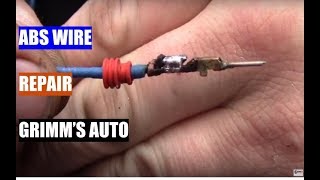
- Damaged or Corroded Wiring/Connector (Very Common) — The sensor's wiring harness is exposed to road debris, moisture, and constant suspension movement. This causes chafed or broken wires, 🎬 Watch this guide on repairing damaged wheel speed sensor wiring and corrosion in the connectors, which is the most frequent cause of this fault.
- Failed Wheel Speed Sensor (Very Common) — The sensor itself is a common failure point. Internal electronic components fail from age, heat cycles, and vibration, leading to a complete loss of signal or erratic readings.
- Contaminated or Damaged ABS Tone Ring (Common) — The toothed reluctor ring (or magnetic encoder ring) that the sensor reads cracks from rust, breaks entirely, or accumulates metallic brake dust 🎬 See how a cracked tone ring causes ABS failure on the sensor tip. This contamination or physical damage disrupts the clean signal required by the ABS module.
- Failed Wheel Hub Bearing Assembly (Less Common) — On many modern vehicles, the wheel speed sensor and/or tone ring is integrated directly into the wheel hub bearing assembly. A failing wheel bearing creates excessive movement (play), damaging the internal sensor or ring and requiring replacement of the entire hub.
- Faulty Steering Angle Sensor (or Calibration) (Less Common) — On many GM, BMW, and VW vehicles, a C1634-range code is triggered not by a primary wheel speed sensor fault, but by the stability control module seeing an implausible difference between the steering angle and wheel speeds. This happens after an alignment or if the wheel speed sensor sends bad data.
- Failed ABS Control Module (Rare) — In rare instances, the fault lies within the ABS control module itself. The internal driver circuit for the front right sensor fails. Consider this only after exhaustively ruling out the sensor, wiring, and tone ring.
Symptoms

- ABS and Traction Control Lights Illuminated — This is the primary and most certain symptom. The ABS light and Traction/Stability Control (ESC, VSC, DSC) lights on the instrument cluster illuminate and remain on because these systems rely on wheel speed data.
- Safety Systems Disabled (Wheels Lock During Braking) — During a hard or emergency stop, the wheels lock up and skid. The familiar pulsing sensation in the brake pedal is absent, stopping distances increase, and the drive wheels spin excessively when accelerating on wet surfaces.
- Erratic Speedometer Behavior — On vehicles where vehicle speed is calculated using data from the wheel speed sensors, a faulty front right sensor causes the speedometer to read incorrectly, fluctuate wildly, or drop to zero.
- Disabled Advanced Driver-Assistance Systems (ADAS) — Modern features like Adaptive Cruise Control, Collision Avoidance, and sometimes All-Wheel Drive (AWD) systems shut down as they depend on accurate wheel speed information.
Diagnostic Flowchart
Tap your situation to follow the diagnostic path that matches what you're seeing on this code.
Common Fixes & Costs
- Replace the Front Right Wheel Speed Sensor — Parts: $40-$220, Labor: $100-$200, ~0.8 hr book time (DIY)
- Repair Damaged Wiring or Connector — Parts: $15-$60, Labor: $125-$250, ~1.5 hr book time (Intermediate)
- Replace the Front Wheel Hub Bearing Assembly — Parts: $250-$550, Labor: $150-$300, ~1.8 hr book time (Professional)
- Clean or Replace Separate ABS Tone Ring — Parts: $20-$80, Labor: $100-$200, ~1.5 hr book time (Intermediate)
- Repair or Replace the ABS Control Module — Parts: $200-$2500, Labor: $125-$200, ~1.2 hr book time (Professional)
DIY vs Professional
- Replace Wheel Speed Sensor — Beginner:
Tools: Jack, jack stands, lug wrench, basic socket/wrench set, penetrating oil. - Repair Damaged Wiring — Beginner:
Tools: Soldering iron, quality solder, heat shrink tubing (marine grade preferred), wire strippers, multimeter. - Replace Wheel Hub Assembly — Beginner:
Tools: Full socket set, breaker bar, torque wrench, axle nut socket, potentially a slide hammer or hub puller.
Used vs. New Parts: Buying Guide
When a used part is worth it: Given the low cost and high failure rate of the electronic components, buying a used wheel speed sensor is generally not recommended. The labor to replace a failed used part often exceeds any initial savings. A used sensor only makes sense if it is part of a complete, low-mileage used wheel hub assembly that is known to be in good condition.
Donor-vehicle mileage cap: roughly under 50000 miles for the part to have meaningful remaining life.
Donor quality checklist:
- Verify the donor vehicle had low mileage and was not scrapped due to brake or hub issues.
- Avoid parts from the 'rust belt' as corrosion is a primary cause of failure.
- Ensure the part number matches exactly, as different sensors have different internal resistance or voltage outputs.
Decision logic:
- If The part is an external electronic sensor. → Always buy new. The price difference is minimal compared to the risk and labor of a repeat failure.
- If The sensor is integrated into a wheel hub assembly and the budget is extremely tight. → A used hub from a low-mileage, non-corroded donor is a possibility, but a new aftermarket hub is a much safer bet.
- If The vehicle is a high-performance or late-model car with advanced ADAS systems. → Favor new OEM or premium aftermarket parts to ensure perfect compatibility with safety systems.
Warranty tradeoff: Used parts typically offer a 30-90 day warranty at best. Quality new aftermarket sensors often come with a 1-year to limited lifetime warranty. OEM parts carry a 12-month warranty if installed by a dealer.
Worst-case if a used part fails: $150-$300 if a used sensor fails after installation, primarily due to repeat labor costs plus the price of another part.
What Happens If You Wait — Timeline
- Immediate: ABS, Traction Control (TCS), and Electronic Stability Control (ESC) shut down. The corresponding warning lights illuminate on the dashboard. (MPG impact: 0%% · Added cost: $0)
- 1-3 months: On some vehicles, an erratic sensor signal causes incorrect ABS activation at low speeds, leading to grinding noises and uneven brake pad wear. (MPG impact: 0-1%% · Added cost: $200-$500)
- 3-6 months: On vehicles that use wheel speed sensors to calculate vehicle speed, the speedometer becomes erratic or fails, and cruise control shuts down. This also leads to incorrect mileage accumulation. (MPG impact: 0-5%% · Added cost: $50-$150)
- 6+ months: Continued driving normalizes the disabled safety systems, increasing long-term accident risk. The vehicle fails state safety inspections in many jurisdictions. Neglecting the repair negatively impacts resale value. (MPG impact: 0-5%% · Added cost: Potential accident costs, failed inspection fees, and diminished vehicle resale value.)
Cost of Not Fixing It
- Immediate: Loss of ABS, traction control, and stability control, resulting in a significant safety risk. Increased chance of losing control in a panic stop or on slippery surfaces. (Added cost: Potential for accident-related costs.)
- 1-6 months: On some vehicles, incorrect ABS activation caused by an erratic sensor leads to unnecessary and uneven brake pad and rotor wear. (Added cost: $200-$500 for premature brake replacement.)
- 6+ months: Continued driving with disabled safety systems normalizes risky operation. On vehicles where the speedometer relies on this sensor, incorrect mileage accumulates, affecting resale value. In rare cases, an erratic signal causes transmission shifting issues. (Added cost: Variable, including potential transmission diagnostic costs or diminished vehicle value.)
Diagnosis Steps

- Scan for All ABS/Chassis Codes
Use a professional-grade OBD-II scanner that accesses the ABS/Chassis module. Confirm C1634 is present and note all other codes. Codes for other wheel sensors, the steering angle sensor (e.g., C1278), or module communication (U-codes) are critical clues for an accurate diagnosis.
Tools: OBD-II Scanner (with ABS/Chassis capability) (Beginner) - [PRO TIP] Analyze Live Data with a Scan Tool
Using an ABS-capable scan tool, view the live data stream for all four wheel speed sensors. As you drive slowly in a straight line, all four PIDs should read nearly identically. A sensor that reads 0 MPH, drops out intermittently, or shows a speed wildly different from the others is the source of the fault. This is the fastest way to confirm which wheel is failing.
Tools: OBD-II Scanner (with ABS Live Data) (Advanced) - Perform a Detailed Visual Inspection
Safely raise and support the vehicle and remove the front right wheel. Meticulously inspect the entire length of the wheel speed sensor wiring harness from the sensor to where it enters the main loom. Look for chafing, melting, pinch points, and green or white corrosion inside the connector plug.
Tools: Jack, Jack Stands, Lug Wrench, Flashlight (Beginner) - Inspect and Clean the Sensor and Tone Ring
Remove the sensor's retaining bolt and gently extract it from the steering knuckle. Clean the magnetic tip of any accumulated metallic debris. Use a flashlight and a small pick to inspect the ABS tone ring inside the hub for cracks, missing teeth, or heavy rust buildup.
Tools: Socket/Wrench Set, Brake Cleaner, Rag (Intermediate) - Check for Power and Ground (Active Sensors)
For a 3-wire active sensor, leave it connected and turn the ignition ON (engine OFF). Carefully back-probe the connector to check for a reference voltage (usually 5V or 12V) and a good ground. The third wire is the signal. If power or ground is missing, the problem is in the wiring or ABS module, not the sensor. Some systems use a 2-wire active sensor that receives a bias voltage from the module, typically between 1.5V and 5V.
Tools: Multimeter, Back-probe Kit, Vehicle Wiring Diagram (Intermediate) - Test Sensor Resistance (Passive Sensors Only)
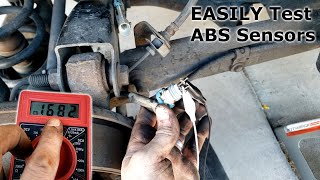
For a 2-wire passive sensor (common on pre-~2010 vehicles), disconnect it and measure the resistance across its two pins with a multimeter. Compare the reading to the manufacturer's specification, typically in the 800-1900 Ohm range for many Ford models. An open circuit (infinite resistance) or a short (near zero) confirms a failed sensor. Note: This test is invalid for 3-wire active sensors or newer 2-wire active sensors which have much higher resistance (e.g., 480-490 kΩ on a 2016 F-150).
Tools: Multimeter (Intermediate) - Test Wiring Continuity to the ABS Module
If all sensor tests pass or if power is missing at the connector, check the wiring itself. Disconnect the harness from both the sensor and the ABS module. Use a multimeter to test the continuity of each individual wire from end to end. Check for shorts between the wires and to ground. This definitively identifies any breaks or shorts in the harness.
Tools: Multimeter, Vehicle-specific Wiring Diagram (Advanced) - [PRO TIP] Test AC Voltage Output (Passive Sensors)
With the 2-wire passive sensor disconnected, set your multimeter to AC Volts. Connect the probes to the sensor's pins and spin the wheel hub by hand at a steady pace (approx. one revolution per second). A healthy sensor generates a small AC voltage, typically above 100mV (0.1V), that increases with speed. No voltage output indicates a dead sensor or a problem with the tone ring.
Tools: Multimeter (Advanced) - [PRO TIP] Analyze the Waveform with an Oscilloscope
This is the definitive test. Back-probe the sensor's signal and ground wires with the sensor connected and ignition on. Spin the wheel. A good active sensor produces a clean, digital square wave that switches between a low (e.g., ~0.7V) and high (e.g., ~1.4V) voltage. A passive sensor produces an analog sine wave that increases in frequency and amplitude with wheel speed. A messy, erratic, or missing waveform confirms a bad sensor or a damaged tone ring.
Tools: Oscilloscope, Back-probe Kit (Advanced)
When This Code Triggers (Freeze-Frame Conditions)
- Vehicle Speed: Above 10 mph (The ABS module continuously compares wheel speeds once the vehicle is in motion. The code often sets when a significant discrepancy is first noted.)
- System Voltage: 11.5-14.5V (The fault is most likely to be detected when the system voltage is stable and within normal operating range, ruling out low-voltage glitches.)
- Brake Pedal Status: Not Applied (The code is typically set during steady driving, as the module is always monitoring for signal plausibility, not just during braking events.)
- ABS/TCS Status: Inactive (The fault is usually detected during normal driving before any ABS or traction control activation is requested.)
Related Codes
- C0040 — This is the generic SAE OBD-II code for 'Right Front Wheel Speed Sensor Circuit'. C1634 is the manufacturer-specific equivalent used by Ford and others. The diagnostic approach is identical.
- C1234 — This is another Ford-specific code for 'Right Front Wheel Speed Sensor Input Signal Missing'. C1234 points to a complete loss of signal (dead sensor, severed wire), while C1634 is a broader circuit fault that also includes shorts or intermittent signals.
- C1278 — This code indicates a 'Steering Wheel Angle Sensor Signal Fault'. It is often seen with GM and BMW vehicles. The stability control system flags this when the steering angle data contradicts the wheel speed data. Always fix the wheel speed sensor code first, as a bad wheel speed signal is often the root cause.
- U0121 — This code means 'Lost Communication With ABS Control Module'. If this appears with C1634, it points to a more serious issue. A single sensor fault won't cause U0121; this combination suggests a failing ABS module, or a major power, ground, or data bus issue affecting the entire module.
Climate & Environmental Factors
- Cold Climates / Snow & Ice: Extremely common trigger. Packed snow and ice physically block the sensor's signal or build up on the tone ring, causing a temporary fault that clears when it melts. Extreme cold makes wiring insulation brittle and prone to cracking.
- Humidity / Salt Belt Regions: This is a primary cause of long-term failure. Road salt and moisture accelerate corrosion of the wiring harness, connector pins, and the sensor itself. Temperature cycles allow moisture to seep into connectors, where it causes corrosion and signal degradation.
- High Heat / Arid Climates: Less common than cold/wet, but high ambient heat accelerates the aging of the sensor's internal electronics and makes plastic wiring insulation brittle and more susceptible to cracking from vibration.
How to Talk to a Mechanic About This Code
Say this: "I have an ABS light on and a C1634 code for the front right wheel speed sensor circuit. I'd like to schedule a diagnostic to test the full circuit—not just the sensor, but also the wiring, connector, and the tone ring for any issues."
This signals you understand that the problem is often in the wiring or tone ring, not just the sensor itself. It prevents a shop from simply replacing the sensor without a full diagnosis, which is a common cause of repeat repairs.
Avoid saying:
- 'My ABS light is on, can you fix it?' (too vague, invites guesswork)
- 'Just replace the front right speed sensor.' (prevents proper diagnosis)
- 'I think it's a bad wire.' (Let them diagnose, don't lead them to a specific repair without proof)
Questions to ask before authorizing the repair:
- Did you see the fault on the live data from the scan tool?
- Did you test the wiring for continuity and shorts between the sensor and the ABS module?
- Did you visually inspect the tone ring for cracks or damage?
- What is the warranty on this specific repair, including both parts and labor?
Where to Take It: Dealer vs Independent vs Chain
- Dealer:
A good option for complex cases, but likely overkill and overpriced for the most common failures (sensor, wiring, tone ring).
Best for: Vehicles still under warranty., Complex electrical issues where a known manufacturer-specific quirk is suspected., When an independent shop has failed to diagnose the problem correctly.
Downsides: Highest labor rates, often 1.5-2x more than independent shops., Often replaces entire wiring harnesses instead of repairing a single wire, leading to very high costs. (Typical cost: +50% vs. baseline) - Independent Shop:
Best fit for most C1634 repairs. A good independent shop has the tools and experience to diagnose the entire circuit effectively without the dealership price tag.
Best for: Out-of-warranty vehicles where cost is a factor., Diagnosing common failures like bad sensors, wiring damage, or cracked tone rings., Building a long-term relationship with a trusted mechanic.
Downsides: Diagnostic skill varies; look for shops with good reviews and ASE-certified technicians specializing in electrical/diagnostics. (Typical cost: +0% vs. baseline) - Chain Shop:
Risky. Acceptable if you have already diagnosed a bad sensor yourself and just need it replaced, but AVOID for initial diagnosis of an ABS light.
Best for: Simple, straightforward part replacements when the diagnosis is already certain.
Downsides: Technicians are often incentivized to replace parts rather than perform detailed diagnostics., High risk of an incorrect diagnosis, leading to repeat visits and unnecessary spending., May lack the advanced diagnostic tools or experience for wiring and module issues. (Typical cost: -10% vs. baseline)
When to Walk Away From the Repair
If the estimated repair cost exceeds 40-50% of the car's private-party value (check Kelley Blue Book), you should seriously consider selling or trading in the vehicle instead of repairing it.
- Car worth $4000, fix is $1800: Walk away. The repair cost is approaching half the car's value. A wiring harness or ABS module replacement is not economical here.
- Car worth $12000, fix is $450: Fix it. A standard sensor or wiring pigtail repair is a small fraction of the vehicle's value and restores a critical safety system.
- Car worth $3000, fix is $350: Borderline, but likely worth fixing. The cost is low enough to justify restoring the safety systems, which also improves resale value.
What Scan Tool You Need for This Code
Minimum: A scanner that reads and clears ABS/Chassis (C-prefix) trouble codes and displays live data for all four wheel speed sensors.
A basic $20 engine code reader cannot communicate with the ABS module. It shows 'no codes' even when the ABS light is on. To diagnose C1634, you must see the live speed reading from each wheel to confirm which one is failing.
Budget: BlueDriver Pro (~$100) — Connects to your smartphone via Bluetooth. It reads and clears ABS codes and, most importantly, graphs the live data from all four wheel speed sensors simultaneously, making it easy to spot the sensor that drops out or reads 0 MPH.
Mid-range: Foxwell NT630 Plus / Autel MaxiCheck Series (~$150) — These are dedicated handheld units that provide robust ABS/SRS diagnostics. In addition to live data, some models offer basic bi-directional controls, such as activating the ABS pump for brake bleeding, which is a step up for more advanced DIY jobs.
Professional: Autel MaxiCOM MK808 / XTOOL D7 (~$450-600) — Offers full bi-directional control, allowing you to command modules and test circuits directly. These professional-level tools perform advanced functions like ABS module coding and provide dealership-level diagnostics for complex wiring or module failures.
Rent vs buy: Many auto parts stores (like AutoZone) loan you an ABS-capable scanner for free with a refundable deposit. For a one-time fix, this is the most cost-effective option. Buy a tool only if you plan to perform your own diagnostics regularly.
How to Clear the Code After You Fix It
- Use an OBD-II scan tool with ABS capability to clear the fault codes from the ABS module.
- Turn the ignition off, then back on.
- Perform the ABS drive cycle to allow the module to verify the repair.
Drive cycle (~10 minutes): After clearing the code, drive the vehicle in a straight line, exceeding 15-20 mph. The ABS light should extinguish within the first minute of driving if the repair was successful. A short drive with a few turns and stops confirms the fix and allows the system to return to a 'Ready' state.
Readiness monitors affected: This is a chassis code (C-code) and does not directly affect emissions readiness monitors like the Catalyst or O2 sensor monitors.
Watch out for:
- Using a basic OBD-II reader that cannot access or clear codes from the ABS module.
- Not performing the drive cycle, which is necessary for the ABS module to self-test and confirm the sensor signal is restored.
- The code returning immediately, which indicates the root cause (often wiring) was not fixed, or a defective replacement part was used.
Will This Fail Emissions / State Inspection?
Yes — this code typically fails an OBD-II emissions inspection.
- California: An illuminated ABS warning light is grounds for a safety inspection failure. While not part of the emissions (smog) check itself, many shops will not pass a vehicle with active safety system warning lights.
- New York: An illuminated ABS warning light is considered grounds for the vehicle to fail the annual safety inspection.
- Texas: As of 2025, most non-commercial vehicles are exempt from the safety inspection. However, for commercial vehicles that still require it, an illuminated ABS light is not cause for rejection, but a lit 'Brake' warning light is.
Most Commonly Affected Vehicles
- Ford F-150 (2004-2014) — Extremely common. Often caused by wiring harness damage near the suspension or failure of the sensor integrated into the wheel hub. A known issue involves harness chafing on 2004-2006 models.
- Ford Explorer (2002-2010) — Highly susceptible to this code, frequently due to the ABS tone ring on the CV axle cracking from rust or the sensor itself failing.
- Ford Fusion (2006-2012) — Wiring harness fatigue is a common culprit, especially where the harness flexes with steering and suspension movement, leading to intermittent faults.
- Lincoln Navigator (2003-2014) — Shares the same platform and failure-prone ABS components as the Ford F-150 and Expedition, particularly the integrated hub/sensor assemblies.
- Ford F-250/F-350 Super Duty (2008-2016) — Heavy-duty use accelerates wear on the front wheel bearings, which house the sensor. Wiring damage from off-road or worksite conditions is also frequent.
- Chevrolet / GMC Cruze, Malibu, Equinox, Terrain (2010-2017) — On these GM vehicles, a C1634-range code is often related to the Steering Angle Sensor requiring calibration, not a primary wheel speed sensor fault. This is typically required after battery replacement, alignment, or suspension work and is done with a scan tool.
- BMW 3-Series (E90), 5-Series (E60) (2005-2013) — Often part of the 'trifecta' (ABS/DSC/Brake lights). The root cause is frequently a corroded rear reluctor ring sending a bad signal, which the DSC module interprets as a conflict with the steering angle sensor, setting faults for both systems.
- Volkswagen / Audi Golf, Jetta, A3 (2006-2014) — Commonly presents as a steering angle sensor fault that cannot be calibrated. The true cause is often a corroded or swollen rear ABS tone ring (integrated into the wheel bearing) sending an erratic signal, which prevents the steering sensor calibration from completing.
Manufacturer-Specific Notes
- Ford / Lincoln / Mercury: This is the primary group of manufacturers where C1634 reliably points to a front right wheel speed sensor circuit fault. While no specific recall exists for this issue on the most-affected 2004-2014 models, wiring harness chafing is a well-documented, common failure point.
- Hyundai: On many Hyundai models, C1634 indicates a 'Speed Correction Signal Error' within the Smart Cruise Control (SCC) system and is unrelated to the ABS wheel speed sensors.
- Jaguar: On certain Jaguar vehicles, C1634 is defined as a 'Damper Solenoid Circuit Fault' related to the CATS (Computer Active Technology Suspension) adaptive suspension system.
- MG: On some MG models, C1634 is defined as a 'Throttle/Actuator Control Module (TACM)' fault or is associated with a steering angle sensor calibration issue after a battery disconnect.
- Mitsubishi: On specific models, C1634 is defined as 'EPS CAN DATA (NOT RECEIVED),' indicating a communication loss between the All-Wheel Control (AWC) ECU and the Electronic Power Steering (EPS) ECU, not a wheel speed sensor.
Real Owner Stories
2007 Ford Explorer at 115K miles
ABS and Traction Control lights came on intermittently, especially after hitting bumps. Eventually, the lights stayed on permanently.
What they tried:
- Initially ignored the light. Replaced the front right wheel speed sensor, but the C1634 code returned immediately.
Outcome: A mechanic diagnosed a cracked ABS tone ring on the front CV axle. The crack opened and closed, causing the intermittent signal. Replacing the tone ring, which required removing the axle shaft, resolved the issue.
Lesson: If a new sensor fails to fix the code, the tone ring is the next most likely culprit, especially on Ford Explorers. A visual inspection for cracks or looseness is key before assuming a wiring problem.
2010 Ford F-150 at 140K miles
ABS light came on. A basic code reader showed C1634. The owner is a competent DIYer.
What they tried:
- Tested the sensor's resistance with a multimeter and got an open circuit (infinite resistance), confirming the sensor was dead.
Outcome: Replaced the front right wheel speed sensor (part number AL3Z-2C204-A) in about 45 minutes. The retaining bolt was rusted but came free with penetrating oil. Cleared the code, and it did not return.
Lesson: A simple multimeter resistance test definitively confirms a failed passive sensor, saving diagnostic time and preventing the replacement of good parts. An open circuit or near-zero resistance indicates a bad sensor.
2019 Jeep Wrangler JLU
Dashboard lit up with ABS, traction control, and other warning lights. An independent shop replaced the wheel speed sensor, but the problem persisted.
What they tried:
- Independent shop replaced the sensor with no success. The owner then took it to a dealership for advanced diagnosis.
Outcome: The dealer found two wires in the main ABS wiring harness shorted together. They quoted $4,500 to replace the entire harness. The owner sought a second opinion from an auto electronics specialist who located the short (chafing near the engine bay) and repaired the individual wires for under $500.
Lesson: Dealers often replace entire harnesses as a policy. If diagnosed with a harness fault, always seek a quote from a specialist in automotive electrical repair to isolate and fix the specific damaged wire for a fraction of the cost.
2010 Mitsubishi Outlander
ABS and traction control lights were on, and the automatic transmission shifted erratically and sometimes refused to shift properly until the traction light illuminated.
What they tried:
- Owner posted on a forum asking if the issues were related after a recent transmission rebuild.
Outcome: Forum members confirmed the Transmission Control Module (TCM) uses wheel speed sensor data to determine shift points. A faulty ABS sensor signal confused the TCM, causing the shifting problems. Replacing the failed ABS sensor resolved both the warning lights and the transmission issues.
Lesson: On many modern vehicles, a bad wheel speed sensor causes secondary problems with the transmission, speedometer, or cruise control. If you experience shifting issues alongside an ABS light, the wheel speed sensor is the likely root cause.
How to Prevent This Code From Triggering
- Apply Dielectric Grease to Connectors (Whenever a connector is unplugged for service) — Dielectric grease seals the connector's rubber gaskets from moisture and oxygen, preventing the pins from corroding. Apply it to the connector housing to seal it, not packed onto the pins themselves.
- Perform Annual Undercarriage Wash (Once per year, especially after winter in 'salt belt' regions) — Road salt is a primary cause of corrosion that destroys wiring harnesses and sensor bodies. A thorough cleaning removes the corrosive salt and allows you to visually inspect the wiring.
- Secure Wiring Harnesses Away from Moving Parts (During any brake or suspension work) — Ensure the ABS sensor wire is properly clipped into its retainers and has enough slack for suspension travel without being stretched or rubbing against the tire, CV axle, or suspension arms. Chafing is a leading cause of failure.
- Apply Anti-Corrosion Coating to Undercarriage (Once every 2-3 years) — Using a professional oil-based or wax-based undercoating service (like Krown) protects the entire wiring harness, frame, and brake components from the elements that lead to rust and electrical failures.
- Clean Sensor Mounting Surface During Brake Jobs (Every brake pad or rotor replacement) — Rust buildup on the hub surface where the sensor mounts pushes the sensor slightly away, increasing the air gap to the tone ring and causing a weak or lost signal. Cleaning this surface and applying a thin layer of bearing grease ensures a correct fit.
Frequently Asked Questions
Can I just clear the C1634 code to fix the problem?
No. Clearing the code only extinguishes the warning light for a moment. The control module runs its self-test as soon as the vehicle starts moving and immediately re-triggers the code.
What happens if I ignore code C1634?
While your standard hydraulic brakes still function, you lose ABS, traction control, and stability control. This major safety hazard increases your risk of skidding and experiencing longer stopping distances in an emergency.
I replaced the sensor, but the C1634 code came back. What's next?
This is a very common scenario. Meticulously re-inspect the wiring harness for hidden damage, check the connector pins for a loose fit, and carefully inspect the ABS tone ring for cracks. If those are perfect, non-Ford vehicles often require a steering angle sensor calibration.
Does ABS actually shorten stopping distances?
ABS prevents wheel lock-up to maintain steering control during panic stops. On wet pavement, it shortens stopping distances by 5-10%, but on loose gravel or snow, it increases distances by up to 20%. A locked, plowing tire stops faster on loose surfaces than a rolling ABS-managed tire.
Can I replace just the ABS tone ring?
This depends entirely on the vehicle's design. On some vehicles, the tone ring is a separate replaceable metal ring pressed onto the CV axle shaft. On many modern cars, the ring is integrated into a non-serviceable wheel bearing, requiring a complete hub replacement.
My ABS light came on after hitting a large pothole. Could that cause a C1634 code?
Absolutely. A sharp impact from a pothole instantly severs the delicate sensor wiring, cracks the brittle plastic sensor housing, or fractures the ABS tone ring. Any of these instantly trigger a C1634 fault.
Is a wheel speed sensor the same as a vehicle speed sensor (VSS)?
No. A car has four wheel speed sensors but only one or two Vehicle Speed Sensors (VSS) measuring transmission output speed. However, many modern cars calculate vehicle speed from the average of the four wheel speed sensors, meaning one faulty wheel sensor disrupts the speedometer.
Why did my traction control and steering light come on with the ABS light?
All of these safety systems are interconnected. The Electronic Stability Control (ESC) module needs accurate data from all four wheel speed sensors and the steering angle sensor to work. If one wheel speed signal drops, the ESC module disables itself and turns on its own warning light as a precaution.
Key Takeaways
- Code C1634 on Ford, Lincoln, and Mercury vehicles specifically identifies a circuit failure in the front right wheel speed sensor, instantly disabling ABS and traction control.
- Perform a visual inspection of the sensor wiring and connector before buying parts, as chafed wires or corroded pins cause over 40% of these faults.
- Driving with C1634 increases stopping distances by up to 20% on loose surfaces like gravel or snow because the disabled ABS allows the wheels to lock up.
- Verify the C1634 definition for your specific vehicle year and make, as Hyundai, GM, and Mitsubishi use this exact code for unrelated cruise control or steering angle failures.
Helpful Videos


The information in this article is provided for general reference and educational purposes only. Vehicle specifications, procedures, and part compatibility can vary by production date, trim level, and region. Always consult your vehicle's factory service manual and verify part numbers before purchasing or performing repairs. Safety-critical components such as airbags, seat belts, and braking systems should be installed by a qualified professional.
- 🎬 Helpful Videos
- What Does C1634 Mean?
- Can I Drive With C1634?
- Common Causes
- Symptoms
- Diagnostic Flowchart
- Common Fixes & Costs
- DIY vs Professional
- Used vs. New Parts: Buying Guide
- What Happens If You Wait — Timeline
- Cost of Not Fixing It
- Diagnosis Steps
- When This Code Triggers (Freeze-Frame Conditions)
- Related Codes
- Climate & Environmental Factors
- How to Talk to a Mechanic About This Code
- Where to Take It: Dealer vs Independent vs Chain
- When to Walk Away From the Repair
- What Scan Tool You Need for This Code
- How to Clear the Code After You Fix It
- Will This Fail Emissions / State Inspection?
- Most Commonly Affected Vehicles
- Manufacturer-Specific Notes
- Real Owner Stories
- 2007 Ford Explorer at 115K miles
- 2010 Ford F-150 at 140K miles
- 2019 Jeep Wrangler JLU
- 2010 Mitsubishi Outlander
- How to Prevent This Code From Triggering
- Frequently Asked Questions
- Can I just clear the C1634 code to fix the problem?
- What happens if I ignore code C1634?
- I replaced the sensor, but the C1634 code came back. What's next?
- Does ABS actually shorten stopping distances?
- Can I replace just the ABS tone ring?
- My ABS light came on after hitting a large pothole. Could that cause a C1634 code?
- Is a wheel speed sensor the same as a vehicle speed sensor (VSS)?
- Why did my traction control and steering light come on with the ABS light?
- Key Takeaways
- 🎟️ Get 5% Off