

OBD-II Code C1603: Steering, Stability, or Communication System Fault
What C1603 means, why it triggers, and how to fix it
- Code C1603 on Hyundai and Kia vehicles indicates an overheated electric power steering motor, requiring a 30-minute cool-down period rather than expensive parts replacement.
- The definition of C1603 changes by manufacturer; it flags a failed ABS module on 2012-2018 Ford Focus models but points to a throttle body fault on vintage Nissans.
- Driving with a C1603 code disables Electronic Stability Control (ESC) and ABS, significantly increasing your risk of skidding during emergency braking or on wet roads.
- Diagnosing C1603 requires an advanced OBD-II scanner capable of reading Chassis (C) and Network (U) codes, as a basic $20 engine code reader will show zero faults.
What Does C1603 Mean?

Code C1603 is a manufacturer-specific chassis code. In Hyundai and Kia vehicles, it means the electric power steering (EPS) motor overheated, prompting the computer to reduce power to prevent damage. In other brands, it flags a communication failure between safety system modules, a dead ABS module, or a throttle body fault on older Nissans.
Technical definition: The SAE/ISO J2012 definition for C1603 varies by manufacturer. Common definitions include 'EPS Thermal Overload Protection Activated' (Hyundai/Kia), 'ECU Internal Thermal & Voltage Error' (Hyundai), 'ECU/TCU Communication Error' (Toyota), or 'CAN Communication Line - Short' (Ssangyong).
Can I Drive With C1603?
Yes, But With Caution. Yes, but with significant caution. Your power steering becomes heavy, requiring more effort during quick maneuvers. More critically, your Electronic Stability Control (ESC) and Anti-lock Braking System (ABS) shut down. This disables automatic skid correction, significantly increasing the risk of a spin on slippery roads. Avoid high speeds and adverse weather conditions until the vehicle is repaired.
Common Causes

- Excessive Steering While Stationary (Hyundai/Kia) (Very Common) — On Hyundai and Kia cars, turning the steering wheel lock-to-lock multiple times while parked causes the electric power steering motor to overheat. The system triggers C1603 as a protective measure to limit current and prevent the motor from melting.
- Failing ABS Control Module (Ford Focus) (Common) — A frequent cause on 2012-2018 Ford Focus models is the internal failure of the ABS control module. Solder joints inside the module break, causing it to drop off the communication network and log a C1603 fault.
- Damaged CAN Bus Wiring or Poor Connections (Less Common) — The CAN bus network wires connecting the car's computers become corroded, pinched, or broken. A poor connection at the ABS module, EPS module, or a central junction connector isolates a module and triggers this code.
- Low Battery Voltage or Faulty Alternator (Less Common) — A weak battery (below 12.4V) or a failing alternator starves the vehicle's sensitive electronic modules of stable voltage. This causes unpredictable module shutdowns and communication errors.
- Failing Electric Power Steering (EPS) Motor or Module (Less Common) — Beyond temporary overheating, the electric motor that assists steering develops a permanent internal short. The EPS control module itself also fails due to heat, vibration, and age.
- Faulty Steering Angle Sensor Calibration (Less Common) — The steering angle sensor tells the stability control system the precise position of the steering wheel. If this sensor loses its calibration after a wheel alignment or battery replacement, it sends illogical data, forcing the ESC system to shut down.
- Faulty Transmission Control Unit (TCU) (Rare) — On brands like Ssangyong, a C1603 code indicating a CAN bus overload traces back to an internal short within the Transmission Control Unit (TCU), which corrupts network communication.
- Faulty Throttle Body (Nissan-specific) (Rare) — On vintage Nissan models (e.g., Sunny, Bluebird), C1603 points to a fault in the throttle chamber or Idle Air Adjustment (IAA) unit, completely unrelated to the steering or stability systems.
Symptoms

- Electronic Stability Control (ESC) Light On — The 'ESC' or 'car with squiggly lines' light illuminates on the dashboard, indicating the stability system is offline.
- Heavy or Stiff Steering — The steering wheel becomes much harder to turn because the electric power assist is reduced or completely disabled.
- ABS Light On — The Anti-lock Braking System warning light illuminates alongside the ESC light, as a fault in one interconnected system disables both.
- Cruise Control Inoperative — The vehicle's computer disables the cruise control system as a safety precaution when a fault is detected in the braking or stability systems.
Diagnostic Flowchart
Tap your situation to follow the diagnostic path that matches what you're seeing on this code.
Common Fixes & Costs
- Allow System to Cool and Clear Code (Hyundai/Kia) — Parts: $0, Labor: $0-$150 (for shop diagnosis), ~0.5 hr book time (DIY)
- Replace ABS Control Module — Parts: $150-$400 (Reman) or $800-$1,200 (New OEM), Labor: $200-$400 (includes bleeding and programming), ~2.5 hr book time (Professional)
- Replace Blown Fuse — Parts: $5-$10, Labor: $0, ~0.1 hr book time (DIY)
- Repair Damaged Wiring or Connector — Parts: $10-$50, Labor: $150-$500+, ~2.5 hr book time (Professional)
- Replace Electric Power Steering (EPS) Rack/Assembly — Parts: $800-$1,500, Labor: $300-$600 (includes programming and alignment), ~4.0 hr book time (Professional)
Used vs. New Parts: Buying Guide
When a used part is worth it: For the common Ford Focus ABS module failure, a remanufactured or used module is highly cost-effective. A used unit from a low-mileage vehicle provides the same function for a fraction of the dealer price.
Donor-vehicle mileage cap: roughly under 80000 miles for the part to have meaningful remaining life.
Donor quality checklist:
- Match the part number exactly. Different part numbers will not communicate with your vehicle.
- Purchase from a supplier that offers at least a 90-day warranty.
- Visually inspect the connector pins for any signs of green corrosion before purchasing.
Decision logic:
- If The part is for a Ford Focus and a new OEM module is over $800. → A remanufactured module ($150-$400) is the best choice, provided your shop can program it.
- If The vehicle is older and the budget is tight. → A used part is acceptable, but factor in the mandatory $100-$150 programming fee.
- If You want the longest possible warranty and peace of mind. → Buy a new OEM part with a 1-2 year dealership warranty.
Warranty tradeoff: Used parts typically have a 30-90 day warranty. Remanufactured parts offer a 1-year warranty. New OEM parts carry a 1-2 year warranty if installed by a dealer.
Worst-case if a used part fails: $400 if a used part is faulty, covering the wasted labor and programming fee.
What Happens If You Wait — Timeline
- Immediate: Code sets, ABS and ESC warning lights illuminate. Power steering assist is lost. The vehicle's primary safety systems are offline. (MPG impact: 0%% · Added cost: $0)
- 1-3 months: Driving without ABS/ESC significantly increases accident risk. For Hyundai/Kia, repeatedly triggering the thermal fault causes premature wear on the EPS motor. (MPG impact: 0%% · Added cost: $1500 (if EPS rack fails from repeated abuse))
- 3-12 months: A failing module with an internal short creates a parasitic battery drain, leading to a dead battery and a no-start condition. (MPG impact: 0%% · Added cost: $200 for a new battery.)
Cost of Not Fixing It
- Immediate: Loss of ABS and Electronic Stability Control (ESC). Increased risk of skidding and loss of control in emergency braking. Power steering becomes heavy. (Added cost: $0)
- 1-6 months: For Hyundai/Kia, repeatedly overheating the EPS motor causes permanent damage, turning a temporary issue into an expensive steering rack replacement. (Added cost: $1500-$2500)
- 6+ months: A failing electronic module causes wider network communication issues or creates a parasitic drain, killing the battery. (Added cost: $150-$300)
Diagnosis Steps
- Read Fault Codes from ALL Modules
Use an advanced OBD-II scanner capable of reading Chassis (C) and Network (U) codes. Confirm C1603 is present and look for communication codes like U0121, which pinpoint exactly which module dropped offline.
Tools: Advanced OBD-II Scanner (Beginner) - Let the System Cool Down (Hyundai/Kia)
If you drive a Hyundai or Kia and were just parking, turn the car off. Let it sit for 30 minutes for the EPS motor to cool down. Clear the code and test drive. If it stays off, the issue was temporary overheating.
Tools: OBD-II Scanner (Beginner) - Check Battery, Charging System, and Fuses
Verify the battery voltage is above 12.4 volts with the car off, and between 13.7 and 14.7 volts with the engine running. Check all fuses related to the ABS, ESC, and Power Steering systems in both fuse panels.
Tools: Multimeter, Fuse Puller (Beginner) - [PRO TIP] Check CAN Bus Network Resistance
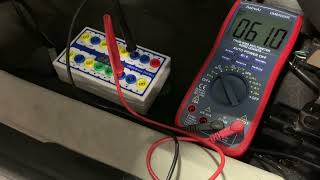
With the battery disconnected, set a multimeter to Ohms (Ω). Measure the resistance between Pin 6 and Pin 14 at the OBD-II port. A healthy network reads 60 Ω. A reading of 120 Ω means a module is disconnected or wiring is broken. A reading near 0 Ω indicates a short circuit.
Tools: Multimeter (Advanced) - Inspect Wiring and Connectors
Visually inspect the wiring harnesses going to the ABS and power steering modules. Unplug the connectors and look for green corrosion, bent pins, or moisture intrusion.
Tools: Flashlight, Socket Set (Intermediate) - Test Module Power and Ground
Using a wiring diagram, check for proper power and ground signals at the connector for the suspect module (e.g., ABS). Confirm battery voltage at the power pins and less than 1 ohm of resistance on the ground pins.
Tools: Multimeter, Vehicle-Specific Wiring Diagram (Advanced) - [PRO TIP] Check Steering Angle Sensor Live Data
Access the live data stream for the Steering Angle Sensor (SAS). With the steering wheel perfectly centered, the sensor must read 0° (+/- 5.0°). Turn the wheel lock-to-lock to ensure the reading changes smoothly without dropping out.
Tools: Advanced OBD-II Scanner (with Live Data) (Advanced) - [PRO TIP] Check CAN Bus Signal with an Oscilloscope
Connect oscilloscope probes to Pin 6 and Pin 14 at the DLC. A healthy CAN bus shows two clean, square-wave signals that are mirror images. Look for distorted or missing signals to pinpoint interference or a short to ground.
Tools: Oscilloscope, Breakout Leads (Professional) - Isolate the Faulty Module
If CAN resistance is 120 Ohms, disconnect modules one by one from the network. When the reading returns to 60 Ohms after disconnecting a specific module (like the ABS module), you have found the internal short.
Tools: Wiring Diagram, Basic Hand Tools, Multimeter (Professional)
When This Code Triggers (Freeze-Frame Conditions)
- Vehicle Speed: 0-5 mph (For Hyundai/Kia, the fault triggers during low-speed parking maneuvers with high steering input.)
- Steering Input Speed: >180 deg/sec (Rapid back-and-forth turning of the steering wheel causes the EPS motor to heat up, triggering the protective fault.)
- Module Voltage: 13.5-14.5 V (For communication faults, the code sets at any speed when the ABS module loses power, but system voltage typically remains normal.)
- Time Since Engine Start: Varies (A communication fault occurs immediately at startup if a module fails its self-test, or intermittently during driving if wiring is damaged.)
Related Codes
- U0121 — Means 'Lost Communication With Anti-Lock Brake System (ABS) Control Module.' If paired with C1603, the ABS module has failed or lost power. Diagnosis must focus entirely on the ABS module.
- C1604 — Means 'EPS ECU Hardware Error' on Hyundai/Kia. C1603 is a temporary thermal warning, but C1604 means the steering control module has permanently failed and requires replacement.
- C1206 — Relates to a faulty wheel speed sensor circuit. A bad sensor provides corrupt data, causing the ESC module to shut down and log C1603 as a secondary fault. Fix the wheel speed sensor first.
- U0073 — Means 'Control Module Communication Bus A Off.' Indicates the entire communication network is down due to a major wiring short circuit, where C1603 is just one of many resulting faults.
Climate & Environmental Factors
- High Ambient Temperature: Hot weather significantly increases the likelihood of the EPS motor overheating on susceptible Hyundai and Kia models, the most common trigger for C1603.
- High Humidity / Road Salt: Salt and moisture dramatically accelerate corrosion on wiring, connectors, and control module pins, causing the communication errors that trigger C1603.
How to Talk to a Mechanic About This Code
Say this: "I have a [Year/Make/Model] with a C1603 code and the ABS/ESC lights are on. Based on my research, this is often a temporary overheat issue (if Hyundai/Kia) or a failed ABS module (if Ford Focus). Can you please check for any related 'U' communication codes and verify power and ground at the relevant module before recommending a major component replacement?"
This signals you are an informed customer. It directs the technician toward a logical diagnostic process (checking codes, power/ground) rather than immediately replacing expensive parts.
Avoid saying:
- My 'check engine' light is on.
- The car is acting weird, can you fix it?
- Just do whatever it takes to fix it.
- My friend who's a mechanic said I need a new steering rack.
Questions to ask before authorizing the repair:
- What specific codes were found in ALL modules (Chassis, Body, Network)?
- If it's a Hyundai/Kia, did you confirm it wasn't just a temporary thermal overload by letting it cool and test driving?
- Did you confirm the suspect module has proper power, ground, and communication signals first?
- Does the replacement module require programming to my vehicle's VIN, and is that included in the quote?
Where to Take It: Dealer vs Independent vs Chain
- Dealer:
A safe but expensive choice. Necessary if the fix requires complex software flashing not available to independent shops.
Best for: Vehicles still under warranty., Complex electrical issues requiring proprietary diagnostic software.
Downsides: Highest labor rates and parts costs., Will refuse to install customer-supplied or remanufactured parts. (Typical cost: +50% vs. baseline) - Independent Shop:
Best fit for most scenarios. An independent shop is more likely to trace wiring faults and work with remanufactured parts to save you money.
Best for: Out-of-warranty vehicles where cost is a factor., Well-known issues like the Ford Focus ABS module failure., Shops specializing in automotive electronics.
Downsides: Diagnostic tool capabilities vary; ensure they have a scanner that reads manufacturer-specific Chassis codes. (Typical cost: +0% vs. baseline) - Chain Shop:
AVOID for diagnosis. They can handle a battery replacement, but do not use them to diagnose a complex electronic fault like C1603.
Best for: Simple, routine maintenance like oil changes and battery replacement.
Downsides: Technicians lack experience with complex electrical diagnostics., Lack the advanced scan tools needed for C1603. (Typical cost: -10% vs. baseline)
When to Walk Away From the Repair
If the estimated repair cost exceeds 50% of the car's private-party market value, seriously consider selling or trading it in.
- Car worth $3000, fix is $2200: Walk away. The repair cost is over 70% of the car's value.
- Car worth $10000, fix is $800: Fix it. The repair is only 8% of the vehicle's value and restores critical safety systems.
- Car worth $5000, fix is $2000: Borderline. The repair is 40% of the car's value. Get a second opinion and consider the car's overall condition.
What Scan Tool You Need for This Code

Minimum: Must read manufacturer-specific Chassis ('C') codes. A basic engine-only code reader will not see code C1603.
A cheap $20 scanner only reads 'P' (Powertrain) codes and reports 'No Codes Found.' To diagnose C1603, you must access the ABS, steering, and stability control modules.
Budget: BlueDriver Pro (~$99) — Reads and clears ABS, SRS, and chassis codes on a wide range of vehicles. Displays live data from the ABS and steering modules via your smartphone.
Mid-range: Foxwell NT630 Plus / Autel MaxiCOM MK808S (~$150-380) — Offers bidirectional control to perform an 'ABS Bleed' after replacing a module. Provides Steering Angle Sensor (SAS) calibration functions.
Professional: Autel MaxiCOM MK900 / Foxwell NT809 (~$500-900) — Professional-grade tools offering wider vehicle coverage, faster processing, and extensive service functions and coding options.
Rent vs buy: Auto parts stores offer free loaner tools, but verify their rental scanner reads ABS/Chassis codes. Buying a capable scanner like the BlueDriver Pro is a wise investment for C1603.
How to Clear the Code After You Fix It
- Reconnect battery if disconnected for repair.
- Use an advanced OBD-II scan tool to clear codes from all modules (Engine, ABS, EPS).
- Perform a 20-minute drive cycle to ensure the fault does not return.
Drive cycle (~20 minutes): 1. Cold start (coolant temp below 122°F). 2. Idle for 3 minutes with A/C on. 3. Drive for 10 minutes at steady highway speeds (55-60 mph). 4. Drive for 10 minutes in stop-and-go city traffic. 5. Coast down from speed without braking.
Readiness monitors affected: Comprehensive Component Monitor (CCM)
Before emissions retest: drive at least 50 miles to fully set monitors.
Watch out for:
- Using a basic code reader that only clears engine codes ('P' codes) but leaves chassis codes ('C' codes) active.
- The code returning immediately, indicating a hard failure (like a dead module) rather than a temporary glitch.
- Failing to perform a Steering Angle Sensor calibration after replacing steering components.
Will This Fail Emissions / State Inspection?
Yes — this code typically fails an OBD-II emissions inspection.
- California: An illuminated ABS or ESC warning light is grounds for a safety inspection failure.
- New York: An illuminated ABS warning light is an automatic failure for the annual safety inspection.
- Texas: While non-commercial vehicles are exempt from safety inspections in 2025, an illuminated warning light causes a failure during the OBD-II scan portion of the emissions test.
Most Commonly Affected Vehicles
- Hyundai i20, i30, Elantra, Accent (2008-2017) — Routinely experiences C1603 due to the electric power steering motor overheating during low-speed maneuvers. No parts are typically required.
- Kia Soul, Forte, Rio (2010-2016) — Shares the power steering design with Hyundai, making it highly susceptible to the same thermal overload issue.
- Ford Focus (2012-2018) — Notorious for internal ABS module failures that cause communication faults, setting C1603 and disabling ABS/ESC.
- Chevrolet Various (2010-2019) — On models with Motor Driven Power Steering (MDPS), C1603 is defined as 'MDPS Thermal Low Assist,' identical to the Hyundai/Kia overheating issue.
- Toyota Various (2005-2015) — A C1603 code points specifically to a CAN bus communication error between the transmission control module (TCM) and the engine control module (ECM).
- Ssangyong Kyron, Rexton (2005-2014) — Indicates a 'Short to the CAN communication line', often pointing to an issue with the Transmission Control Unit (TCU) wiring harness.
- Nissan Sunny, Bluebird (1982-1987) — On these vintage models, C1603 indicates a fault with the throttle chamber and Idle Air Adjustment (IAA) unit, not the steering or stability systems.
Manufacturer-Specific Notes

- Hyundai / Kia: This code is almost always a temporary thermal protection fault triggered by turning the wheel excessively while parked. Do not replace parts unless it is accompanied by C1604 (Hardware Error).
- Ford: On the 2012-2018 Focus, the ABS module is a guaranteed failure point for C1603. Specialists offer repair services for these modules for a fraction of the cost of a new dealership unit.
- Nissan: For vintage Nissan models, C1603 is completely unrelated to steering or stability control. It points to a fault in the throttle chamber, requiring a completely different diagnostic path.
Real Owner Stories
2013 Hyundai Elantra at 110k miles
While parallel parking, the steering suddenly became very heavy and the EPS/ESC warning lights illuminated.
What they tried:
- Checked the EPS fuse, which was intact.
- Learned about thermal overload protection online.
- Let the car sit overnight.
Outcome: The next morning, the car started normally with full power steering assist. The code C1603 was stored but did not return. The issue was confirmed as temporary overheating.
Lesson: For Hyundai/Kia owners, always let the vehicle cool down for 30 minutes before assuming a part has failed.
2012 Ford Focus at 85k miles
ABS, ESC, and Hill Start Assist warning lights illuminated simultaneously with no noticeable driving symptoms.
What they tried:
- A local garage scanned the car and found code C1603 and U0121 (Lost Communication with ABS module).
- The garage spent hours tracing wires with no success.
- Took the car to a specialist who identified the internal ABS module failure.
Outcome: The specialist sent the ABS module to a repair service for $200. After reinstalling the repaired module, all codes cleared. The total cost was $1,000 less than a new dealer module.
Lesson: On a Ford Focus, C1603 combined with communication codes guarantees a failed ABS module. Use a module repair service to save money.
2018 Kia Soul at 105k miles
The power steering felt intermittently heavy for months, but no warning lights were on.
What they tried:
- The dealership ran a diagnostic scan, found no codes, and sent the owner home.
- The problem worsened until the EPS light finally came on, storing code C1603.
Outcome: With the code present, the dealership diagnosed a failing steering column assembly containing the torque sensor. The replacement cost was $2,000.
Lesson: Intermittent heavy steering without a code is an early sign of a failing torque sensor. Ask the mechanic to test drive the vehicle, as a simple scan misses early-stage failures.
How to Prevent This Code From Triggering
- Avoid Excessive Steering While Stationary (Daily driving habit) — Minimizing lock-to-lock turns while parked prevents the EPS motor from overheating and activating its thermal protection mode on Hyundai/Kia models.
- Regularly Change Brake Fluid (Every 2-3 years) — Brake fluid absorbs moisture over time. This moisture causes internal corrosion within the ABS hydraulic unit, leading to electronic failure.
- Apply Dielectric Grease to Connectors (During any related repair) — Applying dielectric grease to the seals of critical connectors blocks moisture and prevents corrosion on the pins.
Frequently Asked Questions
Why did the C1603 light turn on right after I parallel parked?
Turning the wheel back and forth while stopped overworks the electric power steering motor on Hyundai and Kia models, causing it to overheat. The car sets code C1603 to protect the motor from melting. Letting the vehicle cool down for 30 minutes resolves the issue.
My mechanic says I need a new power steering rack for a C1603. Is this right?
On a Hyundai or Kia, this is often a misdiagnosis of a temporary thermal protection code. Always let the system cool down, clear the code, and test drive first. Only replace the rack if the code returns instantly or pairs with a C1604 'ECU Hardware Error'.
What's the difference between a C1603 and a P1603 code?
'C' codes indicate faults in Chassis systems like ABS, stability control, and steering. 'P' codes flag Powertrain issues in the engine or transmission. A C1603 on a Kia is a steering overheat issue, while a P1603 indicates an engine stall history.
Is it safe to drive with the ESC light on and code C1603?
You can drive, but your electronic stability control and ABS will not activate in an emergency. Your power steering also becomes heavy or completely disabled. Avoid high speeds and slippery conditions until you repair the fault.
Can I fix code C1603 myself?
You can fix the common Hyundai/Kia overheating issue by letting the car cool and clearing the code. You can also easily test the battery and replace blown fuses. However, replacing a failed ABS module or tracing a CAN bus short requires advanced diagnostic tools and professional programming.
Will a weak car battery cause a C1603 code?
Yes. Low voltage from a dying battery (below 12.4V) or a faulty alternator starves sensitive electronic modules. This triggers communication errors between the ABS and steering controllers, logging a C1603.
Why is replacing an ABS module so expensive?
The ABS module is a complex, safety-critical computer that often costs over $800 for a new OEM unit. Labor is intensive because it requires bleeding the entire hydraulic brake system. Furthermore, the new module requires dealer-level software to program it to your specific vehicle's VIN.
Can a C1603 code be caused by a bad wheel speed sensor?
Yes. A failing wheel speed sensor sets its own code (like C1206) but provides corrupt data to the stability control system. The main ESC module shuts down in response and logs a generic C1603 fault because it cannot operate without accurate wheel speeds.
Key Takeaways
- Code C1603 on Hyundai and Kia vehicles indicates an overheated electric power steering motor, requiring a 30-minute cool-down period rather than expensive parts replacement.
- The definition of C1603 changes by manufacturer; it flags a failed ABS module on 2012-2018 Ford Focus models but points to a throttle body fault on vintage Nissans.
- Driving with a C1603 code disables Electronic Stability Control (ESC) and ABS, significantly increasing your risk of skidding during emergency braking or on wet roads.
- Diagnosing C1603 requires an advanced OBD-II scanner capable of reading Chassis (C) and Network (U) codes, as a basic $20 engine code reader will show zero faults.
Helpful Videos
![How To Test CAN BUS With A Multimeter [CAN Bus Resistance Check] Mechanic Mindset](https://img.youtube.com/vi/JPE42HSJxAk/mqdefault.jpg)


The information in this article is provided for general reference and educational purposes only. Vehicle specifications, procedures, and part compatibility can vary by production date, trim level, and region. Always consult your vehicle's factory service manual and verify part numbers before purchasing or performing repairs. Safety-critical components such as airbags, seat belts, and braking systems should be installed by a qualified professional.
- 🎬 Helpful Videos
- What Does C1603 Mean?
- Can I Drive With C1603?
- Common Causes
- Symptoms
- Diagnostic Flowchart
- Common Fixes & Costs
- Used vs. New Parts: Buying Guide
- What Happens If You Wait — Timeline
- Cost of Not Fixing It
- Diagnosis Steps
- When This Code Triggers (Freeze-Frame Conditions)
- Related Codes
- Climate & Environmental Factors
- How to Talk to a Mechanic About This Code
- Where to Take It: Dealer vs Independent vs Chain
- When to Walk Away From the Repair
- What Scan Tool You Need for This Code
- How to Clear the Code After You Fix It
- Will This Fail Emissions / State Inspection?
- Most Commonly Affected Vehicles
- Manufacturer-Specific Notes
- Real Owner Stories
- 2013 Hyundai Elantra at 110k miles
- 2012 Ford Focus at 85k miles
- 2018 Kia Soul at 105k miles
- How to Prevent This Code From Triggering
- Frequently Asked Questions
- Why did the C1603 light turn on right after I parallel parked?
- My mechanic says I need a new power steering rack for a C1603. Is this right?
- What's the difference between a C1603 and a P1603 code?
- Is it safe to drive with the ESC light on and code C1603?
- Can I fix code C1603 myself?
- Will a weak car battery cause a C1603 code?
- Why is replacing an ABS module so expensive?
- Can a C1603 code be caused by a bad wheel speed sensor?
- Key Takeaways
- 🎟️ Get 5% Off