

OBD-II Code C1506: Steering Angle Sensor Malfunction
The Ultimate 2026 Guide to What C1506 Means, Why It Triggers, and How to Fix It
- Code C1506 indicates a steering angle sensor fault or miscalibration, immediately disabling your vehicle's Electronic Stability Control (ESC) and ABS systems.
- Verify your manufacturer's specific definition before replacing parts; C1506 means a failed ABS module on Fords and an idle control error on 2001-2011 Hyundais.
- The #1 cause of C1506 is a skipped sensor calibration after a wheel alignment or battery replacement, requiring a $75-$150 professional scan-tool reset.
- While the car remains mechanically drivable, driving with C1506 increases your risk of a fatal rollover crash by up to 90% due to the disabled ESC system.
What Does C1506 Mean?

Code C1506 means the vehicle's computer has detected a problem with the steering angle sensor (SAS). This sensor is the crucial communication link between your steering inputs and the car's safety systems. It tells the computer the precise angle, direction, and speed of your turn. This data is mandatory for the Anti-lock Braking System (ABS), Electronic Stability Control (ESC), and advanced features like lane-keeping assist to function.
Technical definition: The official SAE/OBD-II definition for code C1506 is not standardized and varies significantly by manufacturer. The most common definition is a Steering Wheel Sensor Malfunction. However, it means 'Dynamic Stability Control Right Rear Valve Malfunction' on Fords, 'Idle up line error' on older Hyundais, and 'Left Front Tire Pressure Trigger Module Performance' on some Chryslers. Always verify the exact definition for your specific VIN.
Can I Drive With C1506?
Yes, But With Caution. Driving with C1506 immediately disables your Electronic Stability Control (ESC), a critical safety feature. According to the Insurance Institute for Highway Safety (IIHS), ESC reduces the risk of fatal single-vehicle crashes by 50% and fatal rollover crashes by up to 90%. Your Anti-lock Braking System (ABS) is also disabled, increasing stopping distances on slick surfaces and eliminating your ability to steer during a panic stop. While the vehicle remains mechanically drivable, the risk of losing control in an emergency maneuver is significantly higher.
Common Causes

- Improper Steering Angle Sensor Calibration (Very Common) — The sensor requires recalibration after a wheel alignment, battery disconnect, or suspension repair. If this electronic step is skipped, the sensor's stored 'straight-ahead' position is incorrect, triggering the code because the car thinks you are turning when you are driving straight.
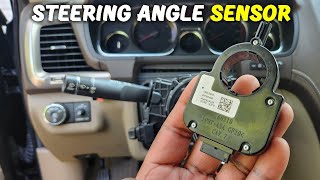
- Failed Steering Angle Sensor (Common) — The sensor fails internally due to age, wear on its moving parts, or electronic faults. This is a sealed unit that cannot be repaired and must be replaced. 🎬 See this step-by-step guide on replacing a steering angle sensor.
- Damaged Wiring or Loose Connections (Common) — The wires connecting the steering angle sensor to the control module become frayed, corroded, or disconnected inside the steering column, interrupting the signal.
- Faulty Clock Spring (Less Common) — The steering angle sensor mounts directly onto the clock spring assembly behind the steering wheel. A broken internal ribbon cable in the clock spring disrupts the sensor's connection.
- Low Battery Voltage or Power Supply Issues (Less Common) — A weak battery or failing alternator provides insufficient voltage to the steering angle sensor and ABS modules, causing erratic behavior and triggering fault codes.
- Malfunctioning ABS/ESC Control Module (Uncommon) — The control module receiving the sensor's signal has an internal fault. This is the primary and definitive cause for Ford vehicles displaying this code.
- CAN Bus Communication Failure (Uncommon) — The sensor sends data over the Controller Area Network (CAN) bus. A short or open circuit on the CAN bus wiring prevents the ABS/ESC module from receiving the signal.
Symptoms

- Traction Control or Stability Control (ESC) Light is On — The most common symptom. The light looks like a car with squiggly lines behind it or says 'TRAC OFF', 'VSC', or 'ESC'.
- ABS Light is On — Because the ABS system relies on steering angle data, a sensor fault immediately triggers the ABS warning light.
- Advanced Safety Features are Disabled — Systems like lane-keeping assist, adaptive cruise control, automatic emergency braking, and blind-spot monitoring shut down because they depend on accurate steering data.
- Unstable, Heavy, or Off-Center Steering — The steering feels unusually heavy or pulls to one side. If the sensor is miscalibrated, the stability control makes tiny, incorrect braking adjustments, causing a pulling sensation even if the mechanical alignment is perfect.
Diagnostic Flowchart
Tap your situation to follow the diagnostic path that matches what you're seeing on this code.
Common Fixes & Costs
- Steering Angle Sensor Calibration — Parts: $0, Labor: $75-$150, ~0.5 hr book time (Professional)
- Replace Steering Angle Sensor — Parts: $150-$400, Labor: $150-$300, ~1.5 hr book time (Professional)
- Repair Wiring or Connectors — Parts: $10-$50, Labor: $100-$200, ~1.5 hr book time (Intermediate)
- Replace ABS/DSC Control Module — Parts: $400-$1,200, Labor: $150-$400, ~2.5 hr book time (Professional)
- Replace Idle Air Control (IAC) Valve — Parts: $70-$400, Labor: $50-$100, ~1 hr book time (DIY)
Used vs. New Parts: Buying Guide
When a used part is worth it: For a high-cost assembly like a combined clock spring and steering angle sensor on an older, low-value vehicle, a used part from a low-mileage donor is a budget-conscious choice. However, it is generally discouraged due to high labor costs if the part fails.
Donor-vehicle mileage cap: roughly under 60000 miles for the part to have meaningful remaining life.
Donor quality checklist:
- Verify the donor vehicle's VIN to ensure it wasn't scrapped for flood damage.
- Match the part number exactly; subtle differences make a part incompatible.
- Inspect connectors for corrosion or broken pins.
Decision logic:
- If The vehicle is less than 10 years old or has high value → Buy a new OEM or high-quality aftermarket part. The safety function is too critical to risk on a used component.
- If The cost of a new part plus labor exceeds 30% of the vehicle's value → A warrantied used part is an acceptable risk, provided you accept it has a shorter lifespan.
- If The part is an ABS module (Ford) → A professionally remanufactured unit with a warranty is a better value than a new OEM or used junkyard part.
Warranty tradeoff: Used salvage parts offer a 30-90 day warranty. New aftermarket parts offer 1-year to lifetime warranties. New OEM parts carry a 12-month/12,000-mile warranty.
Worst-case if a used part fails: $300-$600 if a used part fails, primarily from repeating the 2-3 hours of labor for replacement and calibration.
What Happens If You Wait — Timeline
- 0-1 month: Code sets, ABS and ESC warning lights illuminate. Active safety features are disabled. The vehicle is mechanically drivable but lacks safety backup. (MPG impact: 0%% · Added cost: $0)
- 1-4 months: If miscalibrated, the car pulls slightly to one side as the disabled stability system stops making micro-corrections, causing subtle, uneven tire wear. (MPG impact: 0-1%% · Added cost: $50-$100 in premature tire wear.)
- 4-12 months: Uneven tire wear becomes significant, potentially 'cupping' the tires. The driver becomes accustomed to driving without safety aids, increasing latent risk. (MPG impact: 1-2%% · Added cost: $300-$600 for a pair of new tires.)
- 12+ months: The primary cost is the sustained, high risk of a loss-of-control accident that ESC is designed to prevent. The initial problem does not worsen other mechanical parts over time. (MPG impact: 1-2%% · Added cost: Potentially thousands in accident-related costs.)
Cost of Not Fixing It
- Immediately: Electronic Stability Control (ESC) and Anti-lock Brakes (ABS) are disabled. The risk of losing control in an emergency maneuver or on slippery surfaces increases dramatically. Advanced driver-assistance systems are inoperative. (Added cost: N/A)
- 1-6 months: If the fault causes the vehicle's stability system to make micro-corrections, the car pulls to one side, leading to premature and uneven tire wear. (Added cost: $300-$600 for new front tires)
- 6+ months: Continued driving normalizes a high-risk situation. The primary cost is the significantly elevated risk of a serious accident. There is no direct progressive mechanical damage to other components from ignoring this specific code. (Added cost: Potentially catastrophic accident costs)
Diagnosis Steps

- Read the Fault Codes
Use an OBD-II scanner capable of reading Chassis (C) codes to confirm C1506 is present. Note any accompanying codes. Codes like C1219 (Signal Error) or C2205 (Internal Error) point directly to a dead sensor.
Tools: OBD-II Scanner (with ABS/Chassis capability) (Beginner) - Check for Manufacturer-Specific Definitions
Search for your vehicle's make, model, year, and 'C1506'. On a Ford, this code points to a DSC valve inside the ABS module, not the steering sensor. On older Hyundais, it points to the Idle Air Control valve. This step prevents expensive misdiagnosis.
Tools: Internet access (Beginner) - Check Live Data with a Scan Tool
View the live data stream for the steering angle sensor. With the engine running and wheels pointed perfectly straight, the angle must read 0° (within +/- 5°). As you turn the wheel, the reading must change smoothly. If the value is stuck, jumps erratically, or reads 15° when driving straight, you have found the problem.
Tools: Advanced OBD-II Scanner with Live Data (Intermediate) - Attempt a Steering Angle Sensor Reset/Calibration
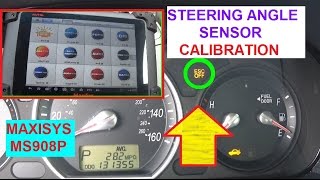
If the live data shows an incorrect angle while straight, perform a calibration. Start the engine, turn the steering wheel all the way to the left lock, then all the way to the right lock, and return to center. If this manual reset fails, use a professional bi-directional scan tool to perform the electronic 'Zero-Point Calibration'.
Tools: Professional bi-directional scan tool (Intermediate) - Perform a Visual Inspection
Visually inspect the wiring harness around the steering column and under the dashboard. Look for frayed wires, loose connectors, or corrosion at the sensor plug.
Tools: Flashlight (Beginner) - PRO TIP: Test Analog Sensor Circuit with a Multimeter
For older analog sensors, disconnect the sensor and test the connector. Verify the 5-volt reference wire and ground wire. Reconnect and back-probe the signal wire. As you turn the wheel lock-to-lock, the voltage must sweep smoothly between 0.5V and 4.5V. No voltage or erratic jumps confirm a dead sensor.
Tools: Multimeter, Vehicle-specific wiring diagram (Advanced) - PRO TIP: Analyze Digital Sensor Signal with an Oscilloscope
For modern digital sensors, a multimeter is too slow. Connect an oscilloscope to the signal and ground wires. As you turn the wheel, you must see a clean, consistent square wave pattern. Dropouts or a missing signal confirm sensor failure.
Tools: Oscilloscope, Vehicle-specific wiring diagram (Professional) - Check the CAN Bus Network
If the sensor circuit tests good but the code persists, check the CAN bus communication lines. Use a multimeter to check for 60 Ohms of resistance between the CAN High and CAN Low pins at the diagnostic port. Readings of 120 Ohms or 0 Ohms indicate a network failure.
Tools: Multimeter, Wiring Diagram (Professional) - Advanced Diagnosis for Hyundai 'Idle up line error'
For 2001-2011 Hyundai models, diagnosis shifts entirely to the Idle Air Control (IAC) system. The ABS ECU expects engine idle to increase to 1,250 RPM during braking. Check the IAC valve, its wiring, and vacuum lines for leaks.
Tools: Advanced OBD-II Scanner, Multimeter, Vacuum Gauge (Advanced)
When This Code Triggers (Freeze-Frame Conditions)
- Vehicle Speed: 20-45 mph (35-70 km/h) (The code sets when the vehicle is driven straight at a steady speed, but the sensor incorrectly reports a turning angle.)
- Steering Angle vs. Yaw Rate: Mismatch (Triggered when the yaw rate sensor detects a turn, but the steering angle sensor's output signal remains static.)
- Engine RPM: 1200-2500 RPM (Typical for steady-speed driving when the discrepancy between actual vehicle direction and sensor data becomes apparent to the ECU.)
- System Voltage: 12.0-14.8V (The code sets when system voltage is normal, ruling out a power supply issue as the immediate trigger.)
Related Codes
- C1505 — On Mitsubishi vehicles, C1505 (Abnormal Neutral Point) indicates the sensor's stored center position is incorrect, while C1506 points to a general internal failure. Diagnosis for both leads to calibration or replacement.
- C1219 / C2205 — Specific steering angle sensor faults ('Signal Error' and 'Internal Error'). They accompany C1506 and confirm the sensor itself has failed. C2205 means the sensor is dead and must be replaced.
- C1503 / C1504 / C1505 (Ford) — On Fords, these indicate malfunctions in the other solenoid valves within the ABS module. Seeing these together points definitively to an internal failure of the ABS hydraulic unit, not a steering sensor.
- P0505 / P1508 — On Hyundai models where C1506 is an idle-related code, these Powertrain codes for 'Idle Air Control System Malfunction' appear alongside it, confirming an engine idle issue.
Climate & Environmental Factors
- Humidity and Moisture: Water ingress is a primary cause of failure for ABS modules. Moisture seeps into the housing, causing corrosion on the circuit board and leading to communication errors.
- Road Salt (Salt Belt Regions): Saltwater is highly conductive and corrosive, severely damaging wiring harnesses and the ABS module located in the exposed engine bay or undercarriage.
- Extreme Temperatures: High heat from the engine bay and extreme cold stress the electronic components and solder joints within the steering angle sensor and ABS module, leading to premature failure.
How to Talk to a Mechanic About This Code
Say this: "I have an ABS/ESC light on and my scanner shows code C1506. I'd like to schedule a diagnostic. Can you please check the live data from the steering angle sensor to see if it just needs a zero-point calibration before quoting a replacement part?"
This signals you are an informed customer. It directs the technician to start with the $100 calibration fix instead of immediately quoting a $600 sensor replacement. It also protects you from misdiagnosis on brands like Ford where the code means something else entirely.
Avoid saying:
- 'My traction control light is on, can you just fix it?'
- 'My car is acting weird, just do whatever it needs.'
- 'I read online it's the steering sensor, please replace it.' (Never self-diagnose without proof)
Questions to ask before authorizing the repair:
- What was the steering angle reading on the scan tool when the wheels were straight?
- Did you attempt a steering angle sensor recalibration, and did it fail?
- For my specific vehicle, does C1506 definitely point to the steering sensor, or is it the ABS module?
- If the sensor needs replacing, is the electronic calibration included in the labor quote?
- What is the warranty on this repair for both parts and labor?
Where to Take It: Dealer vs Independent vs Chain
- Dealer:
A safe but expensive option. Necessary if the fix requires module programming, but overkill for a simple calibration.
Best for: Vehicles under warranty., Complex cases where manufacturer-specific definitions apply (e.g., Ford, Hyundai)., Repairs requiring VIN-specific programming of a new ABS control module.
Downsides: Highest labor rates, often 1.5-2x an independent shop., Defaults to replacing entire assemblies rather than diagnosing smaller components. (Typical cost: +50% vs. baseline) - Independent Shop:
Best fit for most situations. Ask them if they have the equipment to read ABS codes and perform a steering angle sensor calibration before dropping off the car.
Best for: Most out-of-warranty C1506 cases., Diagnosing and performing a scan-tool calibration., Standard steering angle sensor replacement.
Downsides: The shop must have a modern, bi-directional scan tool to perform SAS calibration; not all small shops do., Quality varies; look for ASE certifications in electronic diagnostics. (Typical cost: +0% vs. baseline) - Chain Shop:
Avoid for diagnosis. They are likely to misdiagnose the root cause. Go here only if you are 100% certain what part needs replacing and they are just providing labor.
Best for: Simple, unrelated maintenance like oil changes or tires.
Downsides: Technician skill and diagnostic equipment are highly variable., Less likely to have the advanced scan tools needed for SAS calibration., High pressure to upsell leads to replacing parts when only a calibration is needed. (Typical cost: -10% vs. baseline)
When to Walk Away From the Repair
If the total estimated repair cost for this safety-critical system exceeds 50% of the car's private-party value, consider alternatives. Because this fault disables ESC and ABS, the car's value is significantly reduced for a private sale without the fix.
- Car worth $4000, fix is $150: Fix it. A $150 calibration is a small price to restore critical safety features and vehicle value.
- Car worth $4000, fix is $1100: Borderline. The repair is 28% of the car's value. Get a second opinion to confirm a full ABS module replacement is necessary before proceeding.
- Car worth $2500, fix is $1600: Walk away. The repair cost is 64% of the vehicle's value. The car's value is now essentially its scrap value.
What Scan Tool You Need for This Code
Minimum: A scanner that reads Chassis (C) codes and displays live sensor data. A basic $20 engine code reader will not see C1506.
Standard scanners only read Powertrain (P) codes from the engine. C1506 is stored in the ABS/ESC module. You cannot diagnose this problem without a tool that accesses ABS modules.
Budget: BlueDriver Pro (~$99) — Reads and clears ABS codes and displays live steering angle sensor data on your phone. Excellent for diagnosis, but it does NOT perform the bi-directional calibration function.
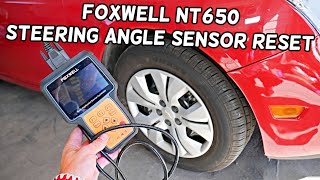
Mid-range: Foxwell NT510 Elite / Autel MaxiCOM MK808S (~$180-400) — The sweet spot for DIYers. These tools offer bi-directional control, including the specific 'Steering Angle Sensor (SAS) Calibration' function needed to complete the repair.
Professional: Autel MaxiSys Series / Launch X431 Series (~$500-1500) — Provides full OEM-level diagnostics, module programming, and guided diagnostic procedures. Handles any C1506 variation on any vehicle.
Rent vs buy: Auto parts store loaner tools will NOT work for this job; they are basic engine code readers. If this is a one-time fix, pay a shop $100 for a professional calibration. Buy a midrange scanner only if you plan to do advanced DIY work regularly.
How to Clear the Code After You Fix It
- Perform the steering angle sensor zero-point calibration using a bi-directional scan tool.
- Use the scan tool to clear the C1506 fault code from the ABS/ESC module.
- Perform a verification drive cycle to ensure the code does not return.
Drive cycle (~10 minutes): Start the engine. Drive the vehicle in a straight line on a level surface at a speed over 25 mph (40 km/h) for at least 10 seconds. Perform several turns, both left and right. Park, turn the ignition off, restart, and check if warning lights reappear.
Readiness monitors affected: Not applicable for emissions readiness monitors.
Watch out for:
- Clearing the code without performing the calibration causes the code to return immediately.
- Attempting a manual reset (lock-to-lock turning) often fails on modern vehicles; a scan tool is required.
- Skipping the verification drive cycle leads to the code returning the next day.
Will This Fail Emissions / State Inspection?
Yes — this code typically fails an OBD-II emissions inspection.
- California: An illuminated ABS or stability control warning light is cause for a safety inspection failure. Since the safety check is part of the Smog Check, this code results in a failed test.
- New York: State law S6334 explicitly makes an illuminated anti-lock brake system (ABS) warning light grounds for failing the annual safety inspection.
- Texas: While annual safety inspections ended in 2025 for non-commercial vehicles, in the 17 counties requiring emissions tests, an illuminated critical safety light is grounds for failure at the inspector's discretion.
Most Commonly Affected Vehicles
- Mitsubishi Outlander, L200, Grandis (2007-2017) — Known for steering angle sensor issues, often appearing with codes C1219 and C2205 after suspension work. Diagnosis requires a specific road test (driving straight at over 35 km/h for 5 seconds) to confirm the fault.
- Ford Focus, Transit, Escape, F-150 (2005-2015) — On Fords, C1506 specifically points to a 'Dynamic Stability Control Right Rear Valve Malfunction' inside the ABS module. Replacing the steering angle sensor will not fix the issue.
- Subaru Outback, Forester, Impreza (2006-2014) — Commonly experiences steering angle sensor failures. Replacement requires removing the steering wheel and clock spring assembly.
- Hyundai Terracan, Accent (2001-2011) — On older Hyundais, C1506 is defined as an 'Idle up line error' related to the Idle Air Control actuator circuit, which is entirely unrelated to steering.
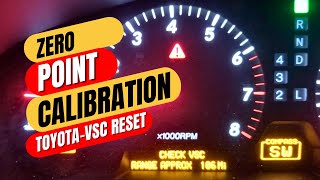
- Toyota Corolla, Camry, RAV4, Prius (2009-2022) — Highly sensitive to steering angle sensor calibration issues after alignments, triggering VSC/TRAC lights. A manual zero-point calibration using a jumper wire is often possible.
- Chevrolet / GM Cruze, Malibu, Equinox (2008-2016) — Requires steering angle sensor calibration after suspension work or battery replacement to clear 'Service StabiliTrak' messages.
- Kia Soul, Sorento, Optima (2006-2019) — Calibration is required after replacing the EPS (Electronic Power Steering) module or performing an alignment to prevent stability control faults.
- Nissan Rogue, Altima, Murano (2008-2022) — A steering angle sensor reset and G-sensor calibration are common procedures needed after replacing steering components.
Manufacturer-Specific Notes

- Ford: C1506 is not a steering sensor issue. It means 'Dynamic Stability Control Right Rear Valve Malfunction', pointing to a fault inside the ABS hydraulic control unit. The ABS module is the problem.
- Hyundai: On 2001-2011 models, C1506 is an 'Idle up line error' related to the engine's idle speed during braking, not the steering system.
- Mitsubishi: Requires a specific road test (driving straight at over 35 km/h for 5 seconds) to confirm the fault after an initial check. They also stress checking the CAN bus line before condemning the sensor.
- Chrysler / Dodge / Jeep: On some models, C1506 indicates 'Left Front Tire Pressure Trigger Module Performance', a fault related to the Tire Pressure Monitoring System (TPMS).
Real Owner Stories
2013 Ford Fiesta at ~50K miles
ABS and Traction Control lights appeared immediately after a local auto parts store recharged the car's battery.
What they tried:
- Performed a 'hard reset' by disconnecting both battery terminals and touching them together for 10 minutes.
- Attempted the manual lock-to-lock steering wheel reset procedure.
- Drove the car to see if it would self-calibrate.
Outcome: The lights remained on. The owner concluded the voltage fluctuation caused the ABS module to lose its programming, requiring a dealer-level scan tool to reprogram the parameters.
Lesson: After a battery replacement, a simple drive cycle or lock-to-lock reset often works. If it doesn't, the module needs a professional 'relearn' procedure before you spend money on a new part.
2006 Ford Escape with ABS light on
Purchased the vehicle with the ABS light on. A mechanic pulled multiple codes, including C1234 (wheel speed sensor) and B1342 (ECU internal fault).
What they tried:
- The mechanic diagnosed a failed ABS control module based on the combination of codes.
Outcome: The owner was quoted $800 for a new ABS module. The case highlights a costly repair on a recently purchased used car.
Lesson: Never accept an illuminated ABS light as 'normal'. For Fords, a cluster of ABS codes points directly to an internal module failure, not the steering angle sensor.
2011 Hyundai Elantra with surging idle
The car experienced a bouncing idle, especially when the A/C was on. Relevant to the Hyundai-specific definition of C1506.
What they tried:
- The owner removed the throttle body and found a significant buildup of carbon on the throttle blade.
Outcome: After thoroughly cleaning the carbon deposits, the idle became steady. The total cost was a can of throttle body cleaner.
Lesson: For Hyundai models where C1506 means 'Idle up line error', the problem is not the steering system. Before replacing the Idle Air Control (IAC) valve, clean the throttle body.
2018 F-150 with multiple warning lights
ABS and Traction Control lights came on. A shop diagnosed a bad rear right wheel speed sensor.
What they tried:
- Owner replaced the wheel speed sensor for $30, restoring all functions.
- His personal scanner now showed a U0415 code ('Invalid data received from ABS module').
Outcome: Despite the new code, the truck drove fine. The consensus was that a residual ghost code was stored after the initial failure, requiring a dealer tool to clear permanently.
Lesson: Fix the primary, specific code first (e.g., a wheel speed sensor). If a vague 'invalid data' code appears afterward but there are no symptoms, it is likely a ghost code.
How to Prevent This Code From Triggering
- Perform SAS calibration after every wheel alignment (Event-based) — Changing the toe angle alters the steering's center point. Failing to electronically update the sensor is the #1 cause of C1506.
- Apply dielectric grease to module connectors (During any related service) — Creates a moisture-proof barrier, preventing corrosion which leads to high resistance and signal loss.
- Keep battery terminals clean and tight (Annually) — Poor connections cause voltage fluctuations that corrupt sensor data or cause modules to lose their memory.
- Inspect and clear cowl and sunroof drains (Annually) — Clogged drains cause water to leak directly onto interior fuse boxes and control modules, causing catastrophic short circuits.
- Avoid driving through deep standing water (Daily habit) — Splashing water forces moisture past aging seals on externally mounted ABS modules, causing corrosion and failure.
Frequently Asked Questions
Can I fix code C1506 myself?
Simple steps like checking fuses and attempting a manual steering wheel reset are DIY-friendly. However, replacing the sensor requires removing the airbag and steering wheel. The new part must also be calibrated with a professional scan tool, making this a job for a professional.
Why are my ABS and Traction Control lights on after a wheel alignment?
The alignment shop changed the steering geometry but failed to perform the electronic steering angle sensor recalibration afterward. This mismatch between the mechanical alignment and the sensor's stored center point triggers the code. Return to the shop and request a zero-point calibration.
Will a wheel alignment fix a C1506 code?
A wheel alignment by itself will not fix the code. In fact, getting an alignment is the most common reason the code appears if the technician skips the recalibration step. The calibration is a separate electronic procedure required to tell the sensor its new straight-ahead position.
Why did the C1506 code appear after I replaced my battery?
Disconnecting the battery erases the steering angle sensor's memory of the straight-ahead position. The sensor needs to be recalibrated using a scan tool or a manual lock-to-lock steering procedure to relearn its center point.
Is a steering angle sensor the same as a clock spring?
No, but they are located together in the steering column and often replaced as a single assembly. The clock spring maintains the electrical connection for the airbag and steering wheel buttons while turning. The steering angle sensor mounts to it to measure the turn angle.
What's the difference between an analog and a digital steering angle sensor?
Analog sensors use a potentiometer to produce a variable voltage signal (typically 0.5V to 4.5V) corresponding to the steering angle. Digital sensors use optical encoders or magnetic sensors to produce a precise binary square-wave signal.
What are the most common misdiagnoses for C1506?
The biggest mistake is assuming C1506 always means a bad steering angle sensor without checking manufacturer-specific definitions. On Fords, technicians mistakenly replace the steering sensor when the code actually points to a failed ABS module. Another error is replacing a perfectly good sensor when only a calibration was needed.
Can a bad wheel bearing cause a C1506 code?
It will not cause a C1506 code directly. However, a failing wheel bearing damages the wheel speed sensor, triggering the ABS and Traction Control lights with a separate wheel speed sensor code.
My scanner doesn't show any 'C' codes. How can I diagnose the problem?
Basic $20 OBD-II scanners only read Powertrain (P) codes from the engine computer. To read Chassis (C) codes like C1506, you must use an advanced scanner with ABS and stability control module access.
Can I install a used steering angle sensor from a junkyard?
It is highly discouraged. A used sensor likely has its own faults and is difficult to calibrate to your specific vehicle. Given the critical safety function and high labor cost to install, buy a new OEM or high-quality aftermarket part.
Key Takeaways
- Code C1506 indicates a steering angle sensor fault or miscalibration, immediately disabling your vehicle's Electronic Stability Control (ESC) and ABS systems.
- Verify your manufacturer's specific definition before replacing parts; C1506 means a failed ABS module on Fords and an idle control error on 2001-2011 Hyundais.
- The #1 cause of C1506 is a skipped sensor calibration after a wheel alignment or battery replacement, requiring a $75-$150 professional scan-tool reset.
- While the car remains mechanically drivable, driving with C1506 increases your risk of a fatal rollover crash by up to 90% due to the disabled ESC system.
Helpful Videos



The information in this article is provided for general reference and educational purposes only. Vehicle specifications, procedures, and part compatibility can vary by production date, trim level, and region. Always consult your vehicle's factory service manual and verify part numbers before purchasing or performing repairs. Safety-critical components such as airbags, seat belts, and braking systems should be installed by a qualified professional.
- 🎬 Helpful Videos
- What Does C1506 Mean?
- Can I Drive With C1506?
- Common Causes
- Symptoms
- Diagnostic Flowchart
- Common Fixes & Costs
- Used vs. New Parts: Buying Guide
- What Happens If You Wait — Timeline
- Cost of Not Fixing It
- Diagnosis Steps
- When This Code Triggers (Freeze-Frame Conditions)
- Related Codes
- Climate & Environmental Factors
- How to Talk to a Mechanic About This Code
- Where to Take It: Dealer vs Independent vs Chain
- When to Walk Away From the Repair
- What Scan Tool You Need for This Code
- How to Clear the Code After You Fix It
- Will This Fail Emissions / State Inspection?
- Most Commonly Affected Vehicles
- Manufacturer-Specific Notes
- Real Owner Stories
- 2013 Ford Fiesta at ~50K miles
- 2006 Ford Escape with ABS light on
- 2011 Hyundai Elantra with surging idle
- 2018 F-150 with multiple warning lights
- How to Prevent This Code From Triggering
- Frequently Asked Questions
- Can I fix code C1506 myself?
- Why are my ABS and Traction Control lights on after a wheel alignment?
- Will a wheel alignment fix a C1506 code?
- Why did the C1506 code appear after I replaced my battery?
- Is a steering angle sensor the same as a clock spring?
- What's the difference between an analog and a digital steering angle sensor?
- What are the most common misdiagnoses for C1506?
- Can a bad wheel bearing cause a C1506 code?
- My scanner doesn't show any 'C' codes. How can I diagnose the problem?
- Can I install a used steering angle sensor from a junkyard?
- Key Takeaways
- 🎟️ Get 5% Off