

C1503 on 2016 Jeep Grand Cherokee: TPMS Sensor 3 Fault Causes and Fixes
Code C1503 on a 2016 Jeep Grand Cherokee indicates a fault with the Tire Pressure Monitoring System (TPMS) sensor in the left rear tire. The most common cause is a dead internal battery in the sensor. The fix is to replace the sensor, which requires a tire shop to dismount the tire.
- C1503 means the left rear TPMS sensor has failed, most likely due to an old battery.
- The only fix is to replace the sensor, which requires a tire shop's equipment.
- Ensure the replacement sensor is the correct 433 MHz part specifically for a 2016 Grand Cherokee, as prior year parts will not work.
- After replacement, the TPMS light will turn off automatically after driving for about 15-20 minutes above 15 MPH.
What's Unique About the 2016-2016 Jeep GRAND CHEROKEE
For the 2016 Grand Cherokee, it's critical to use the correct model year sensor. A Technical Service Bulletin (TSB #68313387A$) explicitly warns that TPMS sensors from 2015 and 2016 models are not interchangeable. Installing the wrong year sensor will cause the system to fail and continue to set this code. Additionally, this generation (WK2) is known for corrosion on the aluminum valve stems, which can sometimes be mistaken for a sensor failure, though it more commonly causes a leak.
Diagnostic Flowchart
Tap your situation to follow the diagnostic path that matches what you're seeing on this vehicle.
Symptoms You May Notice
- TPMS warning light flashing for about a minute upon startup, then remaining on solid.
- "Service Tire Pressure System" message on the instrument cluster display. 🎬 Watch: Overview of the 2016 Grand Cherokee TPMS features
- The pressure reading for the left rear tire shows as dashes ('--') or '0' in the vehicle information center.
- An audible chime may sound when the fault is first detected.
- Replacing the wrong sensor. Always use a TPMS tool to confirm which sensor is faulty before dismounting a tire. A DIY method to confirm is to deflate the suspected tire to ~20 PSI and wait to see if the fault sets for that location.
- Assuming the vehicle needs to be 'reprogrammed' at a dealer. The 2016 Grand Cherokee has an auto-relearn system that detects new sensors automatically after driving.
Most Likely Causes
- Dead TPMS Sensor Battery 🔴 High Probability TPMS sensors use sealed, non-replaceable batteries with a typical lifespan of 5-10 years. A 2016 vehicle is at the age where battery failure is the most common reason for this fault.
How to confirm: A professional TPMS diagnostic tool can attempt to 'wake up' or read the sensor. If the tool gets no response, or a 'No Signal' fault (C1503-31) is stored, the battery is almost certainly dead.
Typical fix: Replace the entire TPMS sensor in the left rear wheel.
Est. part cost: $25-$105 - Internal Sensor Failure 🟡 Medium Probability Harsh conditions inside a tire (vibration, temperature swings, impacts from potholes) can lead to electronic or mechanical failure of the sensor itself.
How to confirm: A TPMS tool may read a specific fault from the sensor, such as 'Mechanical Failure' (C1503-07), 'Damaged Accel', or 'H/W fail'.
Typical fix: Replace the left rear TPMS sensor.
Est. part cost: $25-$105 - Incorrect TPMS Sensor Installed ⚪ Low Probability As noted in TSB #68313387A$, the sensors for 2015 and 2016 models are not interchangeable. A tire shop may have installed the wrong part during a previous tire replacement. Forum users have confirmed that using sensors from a different year (e.g., a 2021 sensor on a 2015 vehicle) will not work.
How to confirm: Use a TPMS tool or visual inspection to check the part number on the sensor. It must be the correct 433 MHz sensor specified for the 2016 model year.
Typical fix: Replace the incorrect sensor with the correct OEM or equivalent part.
Est. part cost: $25-$105
Rare But Worth Checking
- Radio Frequency (RF) Interference: Aftermarket electronic devices (like dash cams, phone chargers, or custom lighting) or heavy metallic window tint can sometimes interfere with the low-power 433 MHz signal from the TPMS sensor.
- Faulty Radio Frequency Hub (RF-Hub) Module: This is the receiver for the TPMS signals. It's rare for it to fail for only one sensor, but if a known-good sensor won't register with the vehicle, the RF-Hub could be the problem. This usually requires dealer diagnosis. A customer satisfaction campaign (Z23) for newer Grand Cherokees involved replacing the RF-Hub for other issues, which then required a TPMS relearn, showing the connection between the components.
Diagnosis Steps
- Verify the TPMS warning light behavior: Flashing for 60-90 seconds, then staying solid, indicates a system fault (like C1503), not just low pressure.
- Check the tire pressure display in the vehicle information center to confirm the left rear tire is the one not reporting (shows '--').
- Use a TPMS diagnostic tool to attempt to read all four sensors at the wheels. This will confirm that the left rear sensor is the one that is not transmitting or is reporting an internal fault.
- If a TPMS tool is unavailable, you can identify the faulty sensor by deflating the suspect tire (left rear) to 20 PSI and waiting two minutes. If the fault becomes active for that location, you have found the correct tire.
- If the sensor is not transmitting, the cause is a dead battery or internal failure. Proceed with replacement.
- If the sensor IS transmitting but the code persists, verify the correct part number is installed and check for TSBs related to the RF-Hub module.
- After replacing the sensor, ensure the tire is inflated to the pressure listed on the door jamb sticker (typically 33 or 36 PSI cold).
- Drive the vehicle for up to 20 minutes at speeds above 15 mph to allow the system to automatically relearn the new sensor ID. The light should turn off on its own.
Parts You'll Likely Need
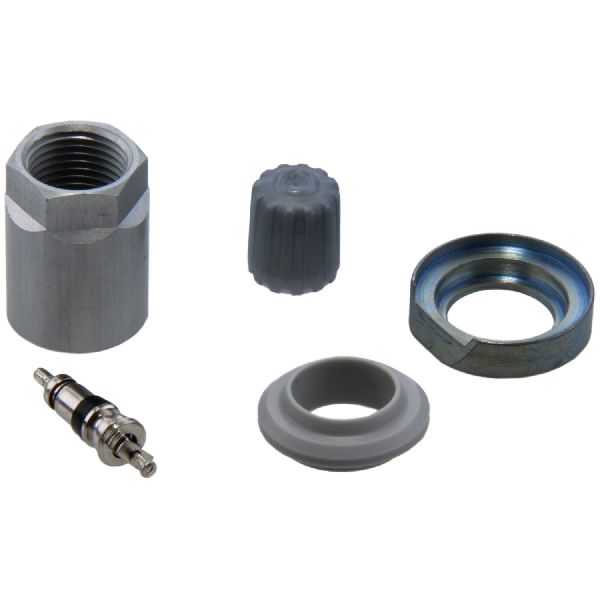
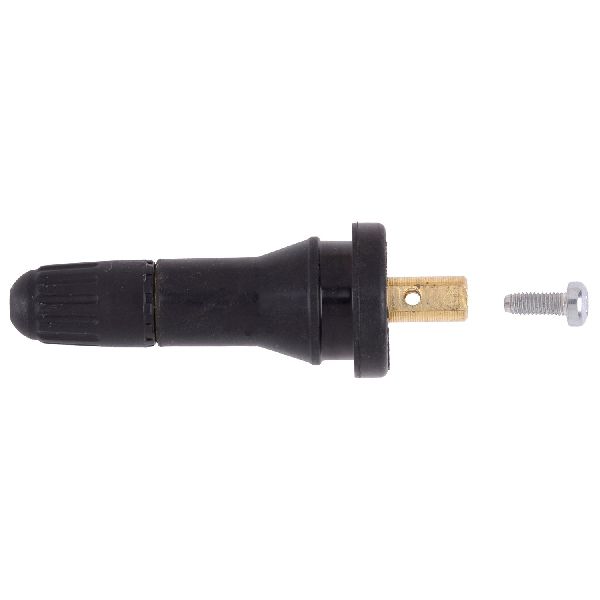
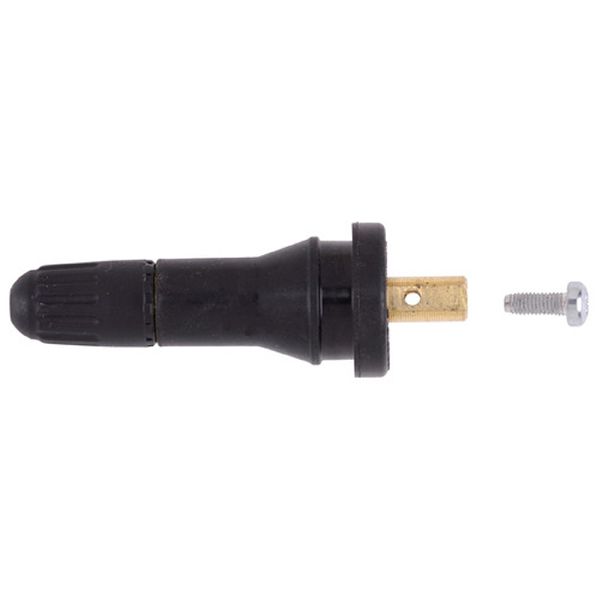
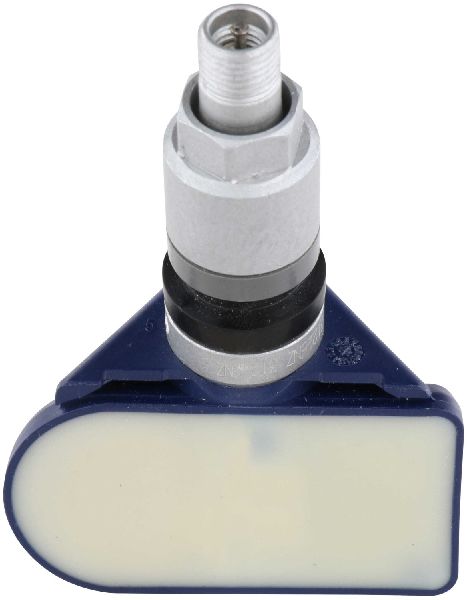
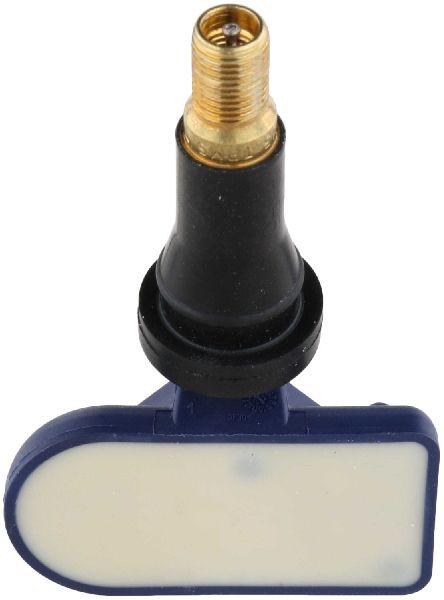
- Tire Pressure Monitoring System (TPMS) Sensor
(OEM #68313387AB (superseded by 68313387AC), 68241067AB)— This is the component that fails, usually due to its internal battery expiring after 5-10 years. The entire unit must be replaced. Part number 68241067AB is also widely cited as compatible for this model year.
Trusted brands: Mopar, Schrader, VDO, Huf, Bosch, Standard Motor Products
OEM price range: $65-$110
Aftermarket price range: $25-$60
Related Codes That Often Appear With This One
- C1501, C1502, C1504 — These codes correspond to the other three tire pressure sensors (Front Left, Front Right, Right Rear). Seeing multiple codes at once could indicate a more systemic issue, like widespread battery failure due to age or a problem with the central RF-Hub module.
Technical Service Bulletins (TSBs) & Recalls
- 68313387A$: Notes that engineering is investigating TPM lamp issues and codes including C1503-31, and warns that 2015 & 2016 TPM Sensors are not interchangeable.
- 22-002-15: While for Ram trucks, this TSB clearly defines the C1503-31 ('No Signal') and C1503-07 ('Mechanical Failure') suffixes, which are consistent across FCA vehicles.
Platform-Specific Known Issues
- A known issue documented in TSB #68313387A$ states that TPMS sensors for 2015 and 2016 models are not interchangeable, which can lead to this fault if the wrong part is installed.
- The aluminum valve stems used on this generation are prone to corrosion, especially in regions that use road salt. While this usually causes a leak, severe corrosion can damage the sensor mounting point or cause the stem to break.
- Owner forums confirm the auto-relearn procedure is effective, with many users stating the light went off after a short drive over 15 mph without any special tools. 🎬 Watch: How the TPMS auto-relearn process works while driving
Mechanic-Grade Diagnostic Values
- TPMS Sensor Battery Voltage — expected: A professional TPMS tool can read the live battery voltage from the sensor.. Failure: A low voltage reading indicates the internal battery is depleted and the sensor needs replacement. The battery is not serviceable.
- TPMS Sensor Transmission Frequency — expected: 433 MHz. Failure: The sensor not transmitting on this frequency, or interference on this frequency, will cause a fault.
- DTC Set Condition — expected: The RF-Hub module successfully receives and decodes signals from the sensor.. Failure: Code C1503 sets when the RF-Hub fails to receive or decode eight consecutive data blocks from sensor #3 while driving over 15 mph.
Hidden / Shadow Codes Worth Checking
- C1503-07: Tire Pressure Sensor (Rear Left) - Mechanical Failure. This indicates an internal hardware error within the sensor itself, such as a problem with its accelerometer or pressure sensing components. (see via Dealer-level scan tool (wiTECH) or advanced OBD-II scanner with manufacturer-specific code capabilities.)
- C1503-31: Tire Pressure Sensor (Rear Left) - No Signal. This is the most common suffix and typically means the sensor's internal battery is dead or it is otherwise unable to transmit. (see via Dealer-level scan tool (wiTECH) or advanced OBD-II scanner with manufacturer-specific code capabilities.)
- C1503-92: Tire Pressure Sensor (Rear Left) - Performance or Incorrect Operation. This may indicate the sensor is transmitting but the data is erratic or out of expected parameters. (see via Dealer-level scan tool (wiTECH) or advanced OBD-II scanner with manufacturer-specific code capabilities.)
Scan Tool Commands That Help
- wiTECH (Dealer Tool): TPM Sensor Position Parameter Update — Located under the 'Misc-Function' tab for the TPM. This routine is used to help the vehicle relearn sensor positions, especially if codes like C151D (Location Undetermined) are present after sensor replacement.
- wiTECH (Dealer Tool): RF Hub LF Antenna Verification Tests — Located under 'System Tests' for the RF Hub. This is used to diagnose the health of the low-frequency antennas that communicate with the key fobs and sensors, helping to determine if a fault lies with the RF Hub itself rather than the wheel sensor.
- JScan App (Aftermarket): Adjust TPMS Threshold / Deactivate TPMS — For advanced users, this app (with a required OBD bypass cable) can change the pressure at which the TPMS light activates. This is useful for owners with larger aftermarket tires who run lower pressures. It can also be used to disable the TPMS system entirely.
Wiring & Ground Locations
- Radio Frequency Hub (RF-Hub) Module — Located in the rear cargo area, behind the trim panel on the driver's side D-pillar.. This module is the central receiver for all TPMS sensor signals. A loose connection, corrosion, or internal failure of this module can prevent the signal from sensor #3 from being received, mimicking a bad sensor. Accessing it is necessary for advanced diagnosis if a new sensor doesn't fix the code.
- RF-Hub Connector — Plugged into the RF-Hub module at the driver's side D-pillar.. A document for FCA RF-Hubs shows key pinouts for testing: Pin A-1 (+12V), Pin A-3 (Ground), Pin A-13 (CAN-H), and Pin A-14 (CAN-L). A technician can use these to verify the module is receiving power, has a good ground, and is communicating on the CAN bus.
OEM Part Supersession History
68252493AA, 68252493AB→68313387AA -> 68313387AB -> 68313387AC— Standard part revision and improvement by the manufacturer.
Heads up: The most critical incompatibility is between model years. TSB #68313387A$ explicitly warns that 2015 and 2016 sensors are not interchangeable, even if they physically fit. Using a 2015-spec sensor on a 2016 vehicle will result in a persistent C1503 fault.
Model Year Variations Within This Range
- 2016: The TPMS sensors for the 2016 model year are specific and not interchangeable with the 2015 model year sensors, as stated in TSB #68313387A$. Installing a sensor intended for a 2015 Grand Cherokee will cause a system fault and trigger codes like C1503.
Helpful Videos
We Have This Part in Stock


The information in this article is provided for general reference and educational purposes only. Vehicle specifications, procedures, and part compatibility can vary by production date, trim level, and region. Always consult your vehicle's factory service manual and verify part numbers before purchasing or performing repairs. Safety-critical components such as airbags, seat belts, and braking systems should be installed by a qualified professional.
- Jeep GRAND CHEROKEE:
- 🎬 Helpful Videos
- 🛍️ Shop This Part
- What's Unique About the 2016-2016 Jeep GRAND CHEROKEE
- Diagnostic Flowchart
- Symptoms You May Notice
- Most Likely Causes
- Rare But Worth Checking
- Diagnosis Steps
- Parts You'll Likely Need
- Related Codes That Often Appear With This One
- Technical Service Bulletins (TSBs) & Recalls
- Platform-Specific Known Issues
- Mechanic-Grade Diagnostic Values
- Hidden / Shadow Codes Worth Checking
- Scan Tool Commands That Help
- Wiring & Ground Locations
- OEM Part Supersession History
- Model Year Variations Within This Range
- 🎟️ Get 5% Off