

C1494 on 2014-2021 Jeep Cherokee: PTU Fork Position Fault Guide
This code indicates a problem with the Power Transfer Unit (PTU), which controls the 4WD system. The most common fix is replacing the PTU's smart actuator, not the entire PTU assembly. Expect to pay a professional for the part and the required recalibration.
- Code C1494-92 means the 4WD system's Power Transfer Unit (PTU) fork is not moving correctly.
- Before agreeing to a full PTU replacement, ask your mechanic to investigate the PTU smart actuator (PN 68369691AD) and check for software updates, as per Jeep's own service bulletins.
- This is not a DIY-friendly repair. It is mechanically involved and requires a proprietary scan tool for recalibration after the part is replaced.
- Your vehicle will still be drivable in 2WD, but you will not have 4WD/AWD, which is a safety risk in poor traction conditions.
- Always check for recalls related to the PTU for your specific VIN, as Jeep has issued several for this generation of Cherokee.
What's Unique About the 2014-2021 Jeep CHEROKEE

The Jeep Cherokee (KL generation) uses a unique automatic, on-demand 4WD system with a front-axle disconnect to improve fuel economy. The Power Transfer Unit (PTU) is central to this design, but it has become a well-documented weak point. Numerous owner complaints and several Technical Service Bulletins (TSBs) focus on failures within this system, leading to the C1494 code and loss of 4WD capability. The issue is so prevalent that Jeep has issued TSBs advising technicians to replace the smart actuator instead of the entire expensive PTU assembly in many cases. Additionally, multiple recalls have been issued for PTU internal failures, such as worn input splines and improperly seated snap rings, which can cause a sudden loss of power or prevent the vehicle from staying in Park.
Diagnostic Flowchart

Tap your situation to follow the diagnostic path that matches what you're seeing on this vehicle.
Symptoms You May Notice

- "Service 4WD" or "4WD System Unavailable" message on the dashboard.
- Illuminated Malfunction Indicator Lamp (Check Engine Light).
- Complete loss of All-Wheel Drive (AWD) or 4-Wheel Drive (4WD) function.
- Vehicle may have difficulty shifting out of 4-Wheel Low (if equipped).
- Audible noise, humming, or vibration from the front of the vehicle, which may change with speed.
- A clunking sound when the transmission shifts gears.
- A binding or jerking sensation when pulling away or turning sharply before the 4WD system disengages.
- Replacing the entire PTU assembly when only the smart actuator is faulty. TSB #9100445 specifically warns against this, recommending updated diagnostic procedures that may point to replacing only the actuator.
- Replacing the PTU when the issue is in the Rear Driveline Module (RDM). In one documented case, a dealer quoted a $4,800 RDM replacement after a new PTU didn't fix the issue, but the actual problem was a much cheaper 🎬 Watch: How to distinguish between PTU and RDM drivetrain issues. hydraulic pump on the RDM.
Most Likely Causes

- Faulty PTU Smart Actuator / Motor 🔴 High Probability A manufacturer TSB (#9100445) specifically points to this part as a likely culprit, suggesting it should be replaced before the entire PTU. The actuator contains plastic components and an electric motor that can fail. One common failure mode is oil from the PTU leaking past seals and contaminating the actuator's internal electronics and motor, causing it to short out or fail.
How to confirm: A technician can use a diagnostic scan tool (wiTECH) to command the actuator and observe its response. The actuator can also be removed and inspected for oil intrusion, which is a definitive sign of failure.
Typical fix: Replace the PTU smart actuator and perform a 'PTU fork recalibration'.
Est. part cost: $250-$750 - Drivetrain Control Module (DTCM) Software Issue 🟡 Medium Probability Jeep has released several software updates for the DTCM, PTU, and Rear Driveline Module (RDM) to address incorrect operation and false codes. TSBs like 21-008-16 detail a procedure to flash these modules to resolve performance issues.
How to confirm: A dealership or qualified shop can check the current software version of the modules against the latest available versions from Jeep using a wiTECH scan tool.
Typical fix: Update the software in the DTCM, PTU, and RDM modules. This often requires a specific procedure, such as pulling certain fuses (e.g., F10 or F76) before flashing individual modules.
Est. part cost: $0-$250 - Internal PTU Mechanical Failure ⚪ Low Probability Multiple recalls (e.g., NHTSA 20V-343, 23V-302, 25V011000) have been issued for 2014-2019 models due to internal PTU issues. These include worn differential input splines or an improperly seated input shaft snap ring, which can lead to a catastrophic loss of power and/or the park function.
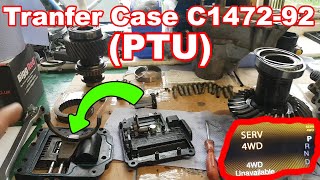
How to confirm: Diagnosis involves checking for metal shavings in the PTU fluid 🎬 See this deep dive into PTU diagnosis and internal disassembly. and inspecting internal components, which is labor-intensive. An active C1494 code that doesn't clear after an actuator replacement or software update points to internal failure.
Typical fix: Complete replacement of the Power Transfer Unit assembly.
Est. part cost: $1800-$2500 - Wiring or Connector Issues ⚪ Low Probability The wiring harness to the PTU actuator is located underneath the vehicle and is exposed to the elements, making it susceptible to corrosion, road debris damage, or loose pins.
How to confirm: Visually inspect the wiring and connectors for damage, corrosion, or loose pins. Perform a continuity and resistance test on the circuit.
Typical fix: Repair or replace the damaged section of the wiring harness or the connector.
Est. part cost: $20-$200
Rare But Worth Checking
- Weak or Failing Battery: Modern vehicles are highly sensitive to voltage. A weak battery can cause a cascade of seemingly unrelated electronic faults, including drivetrain errors. One owner reported a PTU failure diagnosis was ultimately traced back to a bad battery.
- Oil Contamination of Actuator Electronics: A specific failure pattern identified by owners involves the PTU's gear oil leaking past the actuator's seals and saturating the internal circuit board and electric motor. This is technically a failure of the actuator's seals leading to an electrical failure, but it's a distinct cause from simple mechanical wear of the actuator.
Diagnosis Steps
- Connect a professional scan tool (ideally wiTECH) to read the fault codes from the Drivetrain Control Module (DTCM).
- Confirm C1494-92 is present and note if it is 'active' or 'stored'. If active, an early TSB suggests replacing the PTU, while later TSBs advise further diagnostics. If stored, proceed with software checks.
- Check for any available software updates for the DTCM, PTU, and RDM modules. Perform updates if available, following the specific TSB procedures which may involve pulling fuses.
- Clear the codes and perform a test drive to see if the code returns. If it does, proceed with physical diagnosis.
- As per TSB #9100445, follow updated diagnostic procedures to test the PTU smart actuator. This may involve commanding the actuator with the scan tool and monitoring its position feedback.
- Raise the vehicle and visually inspect the wiring harness and electrical connector at the PTU actuator for any signs of corrosion, damage, or loose connections.
- Remove the actuator from the PTU. Inspect the actuator's electrical connector and internal housing for any signs of gear oil intrusion. Oil contamination is a common cause of failure and confirms the need for a new actuator.
- If the actuator is determined to be faulty, replace it. The original part number 68369691AD has been superseded by 68369691AE.
- After replacement, perform the 'PTU fork recalibration' or 'PTU relearn' procedure using the scan tool. This may happen automatically on the next key cycle after a software flash.
- If the actuator and wiring are good but the code persists, the issue is likely internal to the PTU. Check PTU fluid for metal shavings, which would indicate mechanical failure requiring PTU replacement.
Parts You'll Likely Need
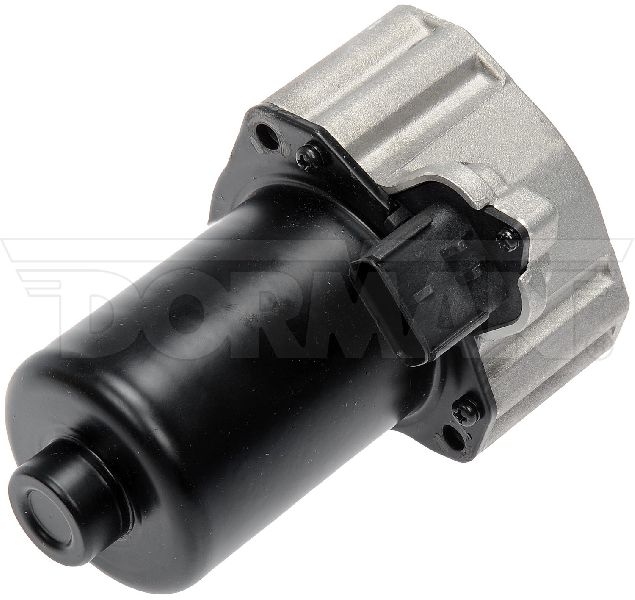
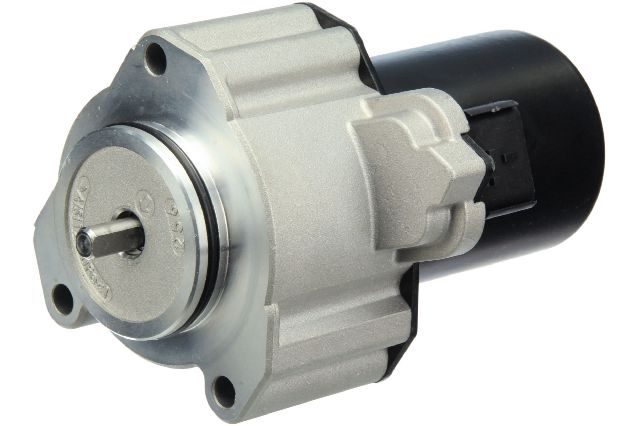
- PTU Smart Actuator
(OEM #68369691AE (supersedes 68369691AD, AC, AB, AA))— This is the most likely point of failure according to manufacturer service bulletins and is a much cheaper repair than replacing the entire PTU.
Trusted brands: Mopar
OEM price range: $250-$400
Aftermarket price range: $150-$300 - Power Transfer Unit (PTU) Assembly
(OEM #68333255AF (example for some models))— This is required if the unit has suffered internal mechanical damage, such as failed splines or gears, often related to a recall. This is a common misdiagnosis but is the correct fix in cases of severe mechanical failure.
Trusted brands: Mopar
OEM price range: $1700-$2500
Aftermarket price range: $1500-$2000
Related Codes That Often Appear With This One
- C14A7-97 — This code also relates to the PTU, and TSB #9100445 groups it with C1494-92 as a code that may be resolved by replacing the smart actuator.
- C1499-92 — Relates to the Rear Driveline Module (RDM) Motor Position. TSB #21-008-16 lists it as a code that can appear alongside C1494-92, often addressed by a software update.
- C1496-92 — Another code for PTU Motor Position. TSB #21-008-16 also lists this as a related code that can be caused by software glitches.
Technical Service Bulletins (TSBs) & Recalls
- Bulletin #9100445: Advises considering PTU smart actuator replacement (PN 68369691AD) for DTC C1494-92 before replacing the entire PTU assembly.
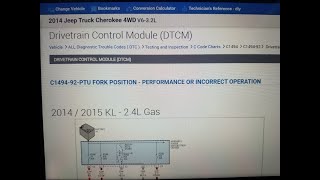
- Bulletin #21-007-16: Defines C1494-92 as 'PTU Fork Position - Performance or Incorrect Operation' and relates it to AWD not operating correctly, recommending a software flash for 2015-2016 models.
- Bulletin #21-008-16 (supersedes 21-070-15): Involves flashing the PTU, RDM, and DTCM for C1494-92 on 2014-2016 Cherokee and 2015-2016 Chrysler 200 models. It provides a diagnostic flow: if the code is active, replace the PTU; if stored, perform the software updates.
Platform-Specific Known Issues
- Recall W47 (NHTSA 20V-343): Affects 2014-2017 models for PTU input splines that can wear off, causing loss of power and park function. The remedy was a software update to engage the rear wheels and electronic park brake if spline failure occurs.
- Recall 45A (NHTSA 23V-302): Expanded the spline wear issue to more 2016-2017 models.
- Recall 01C (NHTSA 25V011000): Issued for 2017-2019 models, this recall addresses an improperly seated input shaft snap ring that can lead to internal damage and a loss of power or park function.
Mechanic-Grade Diagnostic Values
- Battery Voltage During Module Flashing — expected: Maintain between 13.2 and 13.5 volts. Failure: Dropping below 13.2V or climbing above 13.5V can interrupt or corrupt the flash procedure.
Hidden / Shadow Codes Worth Checking
- C1494-92: The '-92' suffix is a status byte defined by Chrysler/Jeep that means 'Performance or Incorrect Operation'. It indicates the module has commanded the component to perform an action, but the feedback from the component does not match the expected outcome, is out of range, or is too slow. This is more specific than a simple circuit fault. (see via A professional scan tool like wiTECH will display the code with its suffix.)
Scan Tool Commands That Help
- wiTECH: Module Flash (PTU, RDM, DTCM) — This is a primary repair step outlined in multiple TSBs (e.g., 21-008-16, 21-007-16) to correct logic errors that can falsely trigger C1494. It should be performed before replacing hardware if the code is 'stored' and not 'active'.
- wiTECH: Read DTC Status (Active/Stored) — This is a critical first diagnostic step. An early TSB (21-070-15) gives a different diagnostic path based on the status: if C1494-92 is 'active', it recommends PTU replacement; if 'stored', it recommends proceeding to software updates.
- wiTECH: PTU/RDM Relearn — After flashing the modules or replacing the actuator, a relearn procedure is necessary. This may be an explicit function in the scan tool or may occur automatically on the next key-on event, where the actuator motor can be heard cycling.
Wiring & Ground Locations
- Drivetrain Control Module (DTCM) — On 2017+ models, it is located in the trunk/cargo area, behind the passenger side interior trim panel, near the wheel well.. The DTCM is the brain of the 4WD system that sets code C1494. Checking its connections is a key diagnostic step, though physical access is difficult.
- Fuse F10 (PTU) — Located in the underhood Power Distribution Center (PDC). It is a 20-amp fuse.. TSB #21-008-16 requires pulling this fuse to isolate the PTU before flashing the RDM (Rear Driveline Module) to prevent communication errors.
- Fuse F76 (RDM) — Located in the underhood Power Distribution Center (PDC). It is a 20-amp fuse.. TSB #21-008-16 requires pulling this fuse to isolate the RDM before flashing the PTU (Power Transfer Unit) to prevent communication errors.
- PTU Actuator Connector — On the PTU smart actuator motor, located on the Power Transfer Unit itself, on the passenger side of the transaxle.. This 8-pin Deutsch DT series connector is a common point for inspection for corrosion or damage. It is also where oil contamination from a leaking PTU seal can be observed.
Real Owner Repair Stories
- YouTube user 'Fix it Angel' (2014 Jeep Cherokee, 160,000 miles) — Service 4WD light, code C1492 (likely C1494-92)
❌ Tried (didn't work) Initial diagnosis pointed to internal PTU failure.
✅ What actually fixed it The owner disassembled the entire PTU and found no internal mechanical damage. However, upon opening the actuator, he found it was completely filled with gear oil that had leaked past the gasket. The oil saturated the circuit board, causing the failure. The final fix was replacing the PTU smart actuator. - YouTube user 'Matt's Garage' (2014 Jeep Cherokee, 82,000 miles) — Service 4WD light, codes C1440-64 and C1415-92 (related to RDM)
❌ Tried (didn't work) Replaced the entire PTU assembly with a rebuilt unit, but the codes returned.
✅ What actually fixed it Took the vehicle to a dealer, who misdiagnosed it as a failed Rear Driveline Module (RDM) and quoted $5,000. The owner inspected further and found the actual problem was the hydraulic pump on the RDM. He replaced the pump and refilled the RDM's hydraulic fluid, which resolved the codes.
When the Usual Fixes Don't Work
- While C1494 points directly to the PTU fork, it can be set as a symptom of a problem in a related module. In one documented case involving RDM-related codes, replacing the PTU did not solve the issue. A dealer then recommended replacing the entire Rear Driveline Module (RDM) for $5,000. The owner discovered the true fault was a much cheaper hydraulic pump on the RDM that had failed. This demonstrates that communication errors between the DTCM, PTU, and RDM can lead to misleading codes, and a failure in one part of the AWD system can manifest as a code for another.
OEM Part Supersession History
68369691AA, 68369691AB, 68369691AC, 68369691AD→68369691AE— Component revision and improvement by the manufacturer.
Heads up: No incompatibility is noted; 68369691AE is the correct and current replacement part for all previous versions.
Model Year Variations Within This Range
- 2014-2016: TSB #21-008-16 provides a software update for the PTU, RDM, and DTCM for vehicles built on or before January 18, 2016, to fix performance issues. Vehicles built after this date have updated software from the factory.
- 2014-2017 vs 2017-2019: The cause of internal PTU failures differs by year range. 2014-2017 models were recalled for input spline wear, while 2017-2019 models were recalled for an improperly seated snap ring, indicating different internal mechanical parts or assembly processes.
- All: Vehicles can be equipped with a single-speed PTU (Active Drive I) or a two-speed PTU (Active Drive II / Active Drive Lock). These units and their corresponding actuators are not interchangeable. The correct system must be identified before ordering parts.
Helpful Videos
Used OEM Parts in Stock


New Aftermarket Parts Available


The information in this article is provided for general reference and educational purposes only. Vehicle specifications, procedures, and part compatibility can vary by production date, trim level, and region. Always consult your vehicle's factory service manual and verify part numbers before purchasing or performing repairs. Safety-critical components such as airbags, seat belts, and braking systems should be installed by a qualified professional.
- Jeep CHEROKEE:
- 🎬 Helpful Videos
- 🛍️ Shop This Part
- What's Unique About the 2014-2021 Jeep CHEROKEE
- Diagnostic Flowchart
- Symptoms You May Notice
- Most Likely Causes
- Rare But Worth Checking
- Diagnosis Steps
- Parts You'll Likely Need
- Related Codes That Often Appear With This One
- Technical Service Bulletins (TSBs) & Recalls
- Platform-Specific Known Issues
- Mechanic-Grade Diagnostic Values
- Hidden / Shadow Codes Worth Checking
- Scan Tool Commands That Help
- Wiring & Ground Locations
- Real Owner Repair Stories
- When the Usual Fixes Don't Work
- OEM Part Supersession History
- Model Year Variations Within This Range
- 🎟️ Get 5% Off