

OBD-II Code C1450: Multiple Meanings Explained
What C1450 means, why it triggers, and how to fix it. Note: This code has different meanings depending on your car's manufacturer.
- Verify your specific vehicle's code definition first, as C1450 indicates a traction control failure on Jaguars but is overwhelmingly mistaken for the P1450 EVAP code on Fords.
- Replace the EVAP purge valve (a $30-$150 part) if your Ford struggles to start immediately after refueling, as this is the primary cause of the commonly confused P1450 code.
- Inspect the ABS module and traction control motor wiring if your ABS light is illuminated, as C1450 on older Jaguars frequently points to broken internal solder joints.
- Check for Technical Service Bulletins (TSBs) before buying parts; Ford issued TSB 19-2207 and Recall 18S32, which fix the P1450 code via a 1-hour PCM software update.
What Does C1450 Mean?
Code C1450 is not a universal code; it means different things for different car brands. For Jaguar, it points to a Traction Control motor failure. For Mitsubishi, it indicates a communication error between safety modules. For Hyundai, it is simply a part number for a brake booster. Most importantly, drivers frequently misread code P1450 (a very common Ford/GM EVAP fuel vapor issue) as C1450.
Technical definition: Due to its manufacturer-specific nature, there is no single SAE/ISO definition. Common definitions include 'Traction Control Motor Circuit Failure' (Jaguar), 'ASTC-ECU System Communication Error' (Mitsubishi), and 'Front Differential Position Sensor Circuit High' (Dodge/Ram). It is overwhelmingly mistaken for P1450: 'Unable to Bleed Up Fuel Tank Vacuum' (Ford, GM). For some Hyundai models, 59110-C1450 is the OEM part number for the vacuum brake booster.
Can I Drive With C1450?
Yes, But With Caution. You can drive, but with reduced safety or potential for further damage. If C1450 indicates a disabled traction control, ABS, or 4WD system, your vehicle loses a critical safety net on slippery surfaces. If your Check Engine Light is on for the commonly confused P1450 (EVAP issue), the car is safe to drive but requires prompt repair. Ignoring P1450 causes failed emissions tests, hard starting after refueling, and eventually deforms the plastic fuel tank or damages the catalytic converter (a $1,200+ repair).
Common Causes
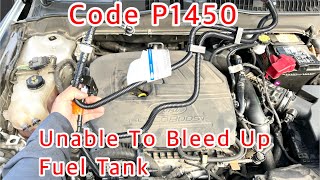
- Stuck-Open EVAP Purge Valve (for P1450) (Very Common) — This is the most frequent cause for the commonly confused P1450 code on Ford and GM vehicles. The valve gets stuck open, constantly pulling engine vacuum on the fuel tank. 🎬 Watch: Simple diagnosis and repair for the Ford P1450 code.
- Software/Calibration Issue in Control Module (for P1450) (Very Common) — For P1450 on many Fords, the fault is overly sensitive software logic in the Powertrain Control Module (PCM). The official fix requires a software update, sometimes alongside a new purge valve.
- Blocked EVAP Canister Vent Solenoid or Filter (for P1450) (Common) — The vent path that allows air into the fuel tank to equalize pressure gets clogged with dirt, debris, or spider nests, creating excessive vacuum.
- Faulty Traction Control Actuator Motor (for C1450) (Common) — For brands like Jaguar, the electric motor that helps the traction control system function fails, or its internal wiring breaks down, triggering the C1450 code.
- Faulty ABS or Transfer Case Control Module (for C1450) (Less Common) — The computer module itself fails, often due to internal broken solder joints on older vehicles. This code also frequently appears immediately after a botched DIY or professional repair of the ABS module.
- Damaged Wiring or Connectors (Less Common) — Wires leading to the traction control motor, differential position sensor, or EVAP components fray, corrode, or get chewed by rodents, causing a short or open circuit.
- Saturated Charcoal Canister (for P1450) (Rare) — Repeatedly overfilling ('topping off') the fuel tank forces liquid gasoline into the charcoal canister. This ruins its ability to store vapors and causes blockages.
- Faulty Front Differential Position Sensor (for C1450 Dodge/Ram) (Rare) — On specific 4WD Ram trucks, the sensor that monitors the front differential lock fails or shorts out, indicating a 'Circuit High' condition.
Symptoms
- Check Engine Light On — The primary symptom for the commonly confused P1450 EVAP issue.
- Difficulty Starting After Getting Gas — Excess fuel vapor floods the engine after filling the tank, making it hard to start or causing it to stall immediately (P1450). 🎬 See why your Ford might struggle to start after refueling.
- ABS and/or Traction Control Light On — The primary symptom for the actual C1450 code on brands like Jaguar and Mitsubishi, indicating safety systems are offline.
- Hissing Noise from Gas Cap Area — When the EVAP system cannot vent properly (P1450), vacuum builds in the fuel tank, causing a loud hissing sound as air rushes in when you remove the cap.
- Service 4WD Light On — On Dodge/Ram trucks, this light appears when the system detects a fault with the front axle engagement system.
- Rough or Fluctuating Idle (also visible on scanner) — A leaking purge valve (P1450) creates a constant, un-metered vacuum leak, causing the engine's idle speed to surge or run rough.
Diagnostic Flowchart
Tap your situation to follow the diagnostic path that matches what you're seeing on this code.
Common Fixes & Costs
- Replace EVAP Canister Purge Valve (for P1450) — Parts: $30-$150, Labor: $100-$250, ~0.8 hr book time (DIY)
- Reprogram Powertrain or ABS Control Module — Parts: $0, Labor: $100-$200, ~1.0 hr book time (Professional)
- Replace EVAP Canister Vent Solenoid (for P1450) — Parts: $35-$100, Labor: $95-$250, ~1.2 hr book time (Intermediate)
- Repair or Replace Traction Control Actuator/Motor (for C1450) — Parts: $150-$500, Labor: $100-$300, ~1.5 hr book time (Professional)
- Repair ABS Control Module (for C1450) — Parts: $0-$50, Labor: $150-$500, ~2.5 hr book time (Professional)
- Replace Fuel Tank Pressure Sensor (for P1450) — Parts: $100-$200, Labor: $140-$290, ~1.5 hr book time (Intermediate)
Used vs. New Parts: Buying Guide
When a used part is worth it: For a simple electronic part like an EVAP purge valve, buying a used OEM part from a reputable recycler is cost-effective for older vehicles where a new part is a high percentage of the car's value.
Donor-vehicle mileage cap: roughly under 100000 miles for the part to have meaningful remaining life.
Donor quality checklist:
- Verify the part number matches exactly, as there are many variations.
- Choose parts from vehicles with documented low mileage.
- Inspect plastic housings and connectors for cracks or brittleness.
Decision logic:
- If The part is under $75 new and readily available aftermarket. → Buy new. The small savings on a used part isn't worth the risk of premature failure and lack of warranty.
- If The vehicle is over 10 years old and the budget is tight. → A used OEM part is often a better choice than a cheap, no-name new aftermarket part.
- If The failure is part of a larger assembly (e.g., integrated hose assembly). → A new assembly is required to avoid dealing with multiple potential failure points.
Warranty tradeoff: Used parts typically come with a 30-90 day warranty. New aftermarket parts usually offer a 1-year to limited lifetime warranty. New OEM parts carry a 1-2 year warranty.
Worst-case if a used part fails: $100-$250 if a used purge valve fails shortly after installation, requiring repeat labor costs plus the price of another part.
What Happens If You Wait — Timeline
- 0-1 month: Check Engine Light (P1450) appears. Car is hard to start after refueling. A 'whoosh' sound is heard from the gas cap. (MPG impact: 0-5%% · Added cost: $0-20 in wasted fuel.)
- 1-3 months: Hard starting after fueling becomes consistent. A rough or fluctuating idle develops due to the constant vacuum leak. Fuel economy noticeably decreases. (MPG impact: 5-10%% · Added cost: $50-100 in wasted fuel.)
- 3-12 months: The constant rich mixture from the un-commanded vapor flow strains the catalytic converter. The constant vacuum puts stress on the plastic fuel tank and the in-tank fuel pump assembly. (MPG impact: 10-15%% · Added cost: $200+ in wasted fuel. Risk of catalytic converter damage ($1200+) increases significantly.)
- 12+ months: Prolonged, excessive vacuum physically deforms or cracks the plastic fuel tank. The catalytic converter is permanently damaged from prolonged overheating. (MPG impact: 15-25%% · Added cost: $500-$2800+ for fuel tank and catalytic converter replacement.)
Cost of Not Fixing It
- 0-1 month: Failed emissions test, reduced fuel economy (5-10%), and difficulty starting the vehicle after refueling. (Added cost: Negligible, other than increased fuel cost.)
- 1-6 months: A constantly open purge valve causes a persistent rich fuel mixture, leading to premature wear on the catalytic converter due to overheating. (Added cost: $1200-$2800 for catalytic converter replacement.)
- 6+ months: Prolonged, excessive vacuum from a stuck purge valve combined with a blocked vent deforms or cracks the plastic fuel tank. (Added cost: $500-$1500 for fuel tank replacement.)
Diagnosis Steps
- Identify Your Vehicle's Code Definition
Confirm what C1450 (or P1450) means for your specific vehicle. If your Check Engine Light is on, you likely have the P1450 EVAP code. If your ABS/Traction light is on, you have the C1450 Chassis code.
Tools: OBD-II Scanner, Internet Access (Beginner) - Diagnosis for P1450: Test EVAP Purge Valve
Locate the EVAP purge valve in the engine bay. Disconnect the electrical connector and the hose coming from the fuel tank side. With the engine running, feel the port on the valve. If you feel any suction, the valve is stuck open and requires replacement.
Tools: Hands, Pliers for hose clamp (Beginner) - Check for Technical Service Bulletins (TSBs)
Before replacing parts for a P1450 code, check for TSBs. For many Ford models, the official fix is a software update for the Powertrain Control Module (PCM). TSB 19-2207 and TSB 16-0055 are common examples.
Tools: Internet Access (Beginner) - Inspect the EVAP Vent System (P1450)
Locate the EVAP canister and vent solenoid near the fuel tank. Check the vent hose and filter box for blockages like dirt, mud, or spiderwebs. A clogged vent path directly causes this code.
Tools: Flashlight, Jack and Jack Stands (Intermediate) - Diagnosis for C1450: Inspect Traction Control Wiring
Visually inspect the wiring going to the traction control actuator motor, often located near the ABS module or throttle body. Look for frayed wires, corrosion, or loose connections. On older Jaguars, these wires become brittle and break.
Tools: Flashlight (Beginner) - [PRO TIP] P1450: Scan Tool Data Analysis
With the engine idling, monitor the Fuel Tank Pressure (FTP) sensor data PID. Voltage should be 2.4V to 2.8V at atmospheric pressure. Command the EVAP purge valve ON (50%). FTP voltage should drop. Command the valve OFF and unplug it. If FTP voltage stays below 2.4V or returns very slowly, it confirms a stuck-open purge valve or restricted vent path.
Tools: Advanced OBD-II Scan Tool (Advanced) - [PRO TIP] P1450: Fuel Tank Pressure Sensor Voltage Check
Turn the key to 'ON' with the engine off. Back-probe the FTP sensor signal wire. Voltage must be between 2.4 and 2.8 volts with the gas cap off. If outside this range, the sensor or its reference voltage circuit is faulty.
Tools: Multimeter, Back-probe kit, Wiring Diagram (Advanced) - Perform an EVAP System Smoke Test (P1450)
Command the vent solenoid open with a scan tool and introduce smoke into the system. Smoke should exit freely from the vent filter. If no smoke comes out, it confirms a blockage in the vent solenoid, canister, or hoses.
Tools: EVAP Smoke Machine, Advanced OBD-II Scan Tool (Advanced) - Test the Traction Control Motor and ABS Module (C1450)
Use a multimeter to check for continuity and voltage at the traction control motor connector. If the wiring is intact, the motor itself or the ABS module has failed.
Tools: Multimeter, Vehicle-Specific Wiring Diagram (Advanced) - [PRO TIP] C1450 (Jaguar): ABS Module Pinpoint Test
Disconnect the main connector at the ABS module. Check resistance between Pin 13 (Traction Control Motor) and Pin 14 (Ground). A reading of 'OL' (Open Line) indicates a broken wire or faulty motor. This differentiates a wiring issue from an internal module fault.
Tools: Multimeter, Vehicle-Specific Wiring Diagram (Advanced) - [PRO TIP] C1450 (Mitsubishi): CAN Bus Diagnostic Test
Disconnect the battery. Measure resistance between CAN High and CAN Low pins at the OBD-II port. A healthy network reads 60 Ohms. 120 Ohms indicates a break in the wire; 0 Ohms indicates a short circuit.
Tools: Multimeter, Vehicle-Specific Wiring Diagram (Advanced)
When This Code Triggers (Freeze-Frame Conditions)
- Engine Coolant Temp: 40-95°F (During a cold start, where engine temp is close to ambient air temp.)
- Fuel Level: 15-85% (The EVAP monitor will not run on a full or nearly empty tank.)
- Vehicle Speed: 45-65 mph (Steady-state cruise for several minutes is required to run the monitor.)
- Engine Load: 20-40% (Light to moderate, steady throttle input; avoiding sharp turns or large hills.)
Related Codes
- P1450 — The EVAP code overwhelmingly confused with C1450. If you have a Ford, Lincoln, or GM vehicle with a Check Engine light, this is your actual code.
- C1095 — On Jaguars, this code for the ABS pump motor circuit failure appears alongside C1450. Having both codes strongly confirms the ABS module itself is faulty.
- P0496 — The General Motors equivalent of Ford's P1450 code, indicating EVAP flow when not commanded. The cause is almost always a stuck-open EVAP purge valve.
- P04EE / P04EF — On newer Ford vehicles, these codes appear alongside P1450. They relate to EVAP temperature sensor faults and are addressed by the same TSBs covering P1450.
- P0442 — Indicates a small EVAP leak, whereas P1450 indicates an inability to vent vacuum. P1450 causes a 'whoosh' of vacuum when opening the gas cap, while P0442 prevents vacuum from building at all.
Climate & Environmental Factors
- Dusty or Dirty Conditions: Increases the likelihood of the EVAP canister vent filter becoming clogged with dirt, debris, or spiderwebs. This directly causes P1450 by restricting the system's ability to vent.
- High Humidity: High ambient humidity exacerbates problems if there is a pre-existing leak, leading to corrosion on electrical connectors or interfering with pressure readings.
- Extreme Cold: Cold temperatures make plastic and rubber components (like vacuum hoses and O-rings) brittle and susceptible to cracking, leading to vacuum leaks.
How to Talk to a Mechanic About This Code
Say this: "I have a check engine light on and my scanner shows code P1450, 'Unable to Bleed Up Fuel Tank Vacuum.' I've also noticed it's hard to start after getting gas. I'd like to schedule a diagnostic. Based on my research, the most common causes are a stuck-open purge valve, a blocked vent solenoid, or a TSB requiring a PCM update. Can you please start by testing the purge valve?"
This signals you've done your research and guides the technician toward the most likely, and often cheapest, fixes first. It prevents a costly, open-ended 'EVAP system diagnostic' and protects you from being sold unnecessary parts like a new fuel tank or charcoal canister. Mentioning the TSB shows you're aware a software update might be needed.
Avoid saying:
- 'My check engine light is on, can you fix it?'
- 'My car is acting weird after I get gas.'
- 'Just do whatever it takes to fix the code.'
Questions to ask before authorizing the repair:
- Did you test the purge valve for vacuum at idle with it unplugged? Was it leaking?
- If the purge valve is good, have you checked for blockages at the vent solenoid and its filter?
- Is there a Technical Service Bulletin (TSB) for my vehicle's VIN that requires a PCM software update for this code?
- Can you provide a written estimate that separates the cost of parts and labor?
Where to Take It: Dealer vs Independent vs Chain
- Dealer:
Recommended if you have a Ford-family vehicle and suspect a software update is needed per a TSB. Otherwise, an independent shop is more cost-effective.
Best for: Vehicles under warranty or covered by a specific recall (like Ford's 18S32)., Cases where a known Technical Service Bulletin (TSB) requires a PCM software update, as they have direct access to factory software.
Downsides: Highest labor rates., May charge a diagnostic fee even if the issue is a known TSB., Might recommend replacing more parts than necessary. (Typical cost: +50% vs. baseline) - Independent Shop:
Best fit for most scenarios, especially the common P1450 purge valve replacement. Ask first if they can perform module programming if you suspect a TSB is involved.
Best for: Out-of-warranty vehicles where the cause is likely a common part failure (e.g., EVAP purge valve, vent solenoid)., Diagnosing and repairing the Jaguar C1450 ABS/wiring issue, especially shops specializing in European cars or auto electronics.
Downsides: Quality varies greatly; look for ASE certifications and good reviews., May not have the expensive, manufacturer-specific tools to perform a PCM software flash. (Typical cost: +0% vs. baseline) - Chain Shop:
Acceptable for a straightforward P1450 purge valve swap if you've already diagnosed it yourself. AVOID for initial diagnosis of either C1450 or P1450, as misdiagnosis is likely.
Best for: Selling you a new purge valve if you are certain that is the problem.
Downsides: Technician skill and diagnostic capability can be very inconsistent., Often lack the advanced scan tools or expertise for anything beyond simple part replacement., Unlikely to be able to diagnose a Jaguar ABS module or perform a Ford PCM update. (Typical cost: -10% vs. baseline)
When to Walk Away From the Repair
If the estimated repair cost exceeds 50% of the car's private-party value, you should seriously consider selling or trading it in instead of repairing it.
- Car worth $4000, fix is $350: Fix it. A P1450 purge valve replacement is a relatively minor cost and well below the threshold.
- Car worth $5000, fix is $2800: Walk away. If the code has been ignored and now requires a new catalytic converter and fuel tank, the cost is far too high for the car's value.
- Car worth $3000, fix is $800: Borderline. If this is for a Jaguar C1450 requiring a replacement ABS module plus labor, it's a significant percentage of the car's value. Get a second opinion before proceeding.
What Scan Tool You Need for This Code
Minimum: A scanner that reads manufacturer-specific codes for both Powertrain ('P') and Chassis ('C') modules. A basic engine-only code reader misses a C1450 code entirely.
A cheap, generic reader only shows engine codes, completely missing ABS/Chassis codes like the Jaguar C1450. For the Ford P1450, a basic reader cannot show live Fuel Tank Pressure (FTP) data, which is crucial for confirming the diagnosis without guessing.
Budget: BlueDriver Pro (~$100) — Reads engine (P-codes) and ABS (C-codes), shows freeze-frame data, and graphs live data like Fuel Tank Pressure, which is essential for diagnosing the P1450 EVAP issue.
Mid-range: Foxwell NT510 Elite (~$180) — Offers brand-specific diagnostics. For Jaguar, it reads the proprietary C1450 and C1095 codes from the ABS module. For Ford, it offers bidirectional control to command the EVAP purge and vent solenoids on/off, providing definitive proof of what part failed.
Professional: Autel MaxiCOM MK808S / MK808BT (~$400-550) — Provides full bidirectional control for nearly all vehicle systems. You can command the EVAP system through its entire test cycle, activate the ABS pump motor on a Jaguar, and perform advanced service resets, making it a powerful tool for accurately diagnosing any variant of C1450/P1450.
Rent vs buy: You can borrow a scanner from stores like AutoZone for free with a refundable deposit. This is a great option for a one-time fix. However, their scanners typically only read codes and do not offer the live data or ABS capabilities needed for a full diagnosis. If you plan to do your own repairs regularly, buying a midrange tool is a worthwhile investment.
How to Clear the Code After You Fix It
- Use an OBD-II scan tool to clear the diagnostic trouble codes.
- Ensure the fuel tank is between 1/4 and 3/4 full.
- Perform a complete drive cycle to allow the EVAP readiness monitor to run.
Drive cycle (~30 minutes): A typical Ford drive cycle involves a cold start (sitting 8+ hours), idling for 2-3 minutes, followed by 10-15 minutes of steady highway driving (45-65 mph), and then some city/stop-and-go driving.
Readiness monitors affected: EVAP System Monitor, Catalyst Monitor, Oxygen Sensor Monitor
Watch out for:
- Disconnecting the battery clears the code but resets all readiness monitors to 'Not Ready', causing an immediate emissions test failure.
- The EVAP monitor requires a 'cold soak' (engine off for 8+ hours) to run its tests.
- The code returns immediately if the underlying mechanical fault (like a stuck valve) is not repaired.
Will This Fail Emissions / State Inspection?
Yes — this code typically fails an OBD-II emissions inspection.
- California: An illuminated Check Engine Light is an automatic failure. All readiness monitors must be 'Ready', with the potential exception of the EVAP monitor on some model years.
- New York: A vehicle with an illuminated Check Engine Light automatically fails the emissions inspection. After repairs, a full drive cycle must be completed to set readiness monitors.
- Texas: In the 17 counties requiring emissions testing, an illuminated Check Engine Light is an automatic failure. For model years 2001 and newer, only one readiness monitor is allowed to be 'Not Ready'.
Most Commonly Affected Vehicles
- Ford Fusion (2010-2019) — Extremely common for P1450 due to a faulty EVAP purge valve. TSB 19-2207 applies to 2013-2017 Hybrid/Energi models, requiring a new valve and PCM update.
- Ford Edge (2011-2018) — Frequently experiences P1450 from a stuck-open purge valve. The diagnostic and replacement process is similar across many Ford models.
- Ford Focus (2012-2018) — Prone to P1450. Safety Recall 18S32 was issued for this issue, involving a PCM update and potential purge valve replacement.
- Ford F-150 (2011-2020) — Commonly sets P1450. The purge valve is located on top of the intake manifold, making it highly accessible for DIY repair.
- Hyundai Sonata (2015-2019) — C1450 is not a diagnostic code here, but part of the OEM part number for the brake booster assembly (59110-C1450).
- Jaguar XJ (X308) & XK (X100) (1997-2006) — Sets C1450 for traction control motor circuit failures, almost always related to internal ABS module solder joint failures.
- Lincoln MKZ Hybrid/Energi (2013-2017) — Shares the same P1450 issue as its Ford Fusion counterpart. TSB 19-2207 calls for a canister purge valve replacement and a PCM software update.
- Dodge/Ram Ram 2500/3500 (2005-2018) — Sets C1450 for a fault in the front differential position sensor circuit, particularly on Power Wagon models with electronic lockers.
Manufacturer-Specific Notes
- Ford / Lincoln: The code people usually mean is P1450, not C1450. The number one cause is a purge valve that gets stuck open. Ford issued multiple TSBs (like 19-2207) and Safety Recall 18S32 to correct this via software updates and valve replacements.
- Jaguar: On models from the late 90s and early 2000s, the C1450 code is a secondary fault caused by the main ABS module failing. The solder joints for the pump motor on the internal circuit board crack.
- Mitsubishi: C1450 indicates a CAN bus communication error between the Active Stability and Traction Control (ASTC) ECU and the transfer case ECU. Diagnosis involves checking specific connector pins for harness integrity.
- Hyundai: C1450 is not a standard diagnostic trouble code. 59110-C1450 is the manufacturer part number for the vacuum brake booster on vehicles like the 2015-2019 Sonata.
- Dodge / Ram: On heavy-duty trucks with an electronic front differential lock, C1450 points specifically to a 'circuit high' condition for the differential's position sensor, suggesting a short to power.
Real Owner Stories
2013 Ford Fusion 2.0L with P1450
Check Engine Light came on. Car would crank but not start, or would stall, immediately after refueling. Owner had to press the accelerator to get it to start.
What they tried:
- Tried an inexpensive aftermarket purge valve from an online marketplace, which failed again after a few thousand miles.
- Purchased a higher-quality valve from a local auto parts store with a lifetime warranty.
Outcome: Replacing the EVAP purge valve located in the engine bay solved the hard-starting issue. The second, better-quality part permanently fixed the problem. The repair took less than an hour.
Lesson: For P1450 on Fords, the purge valve is the culprit. While cheap parts are tempting, a slightly more expensive OEM or name-brand aftermarket part prevents having to do the job twice.
1995 Jaguar XJR with C1450
Intermittent ABS and Traction Control lights appeared. A scan showed code C1095. After sending the ABS module for repair, the lights came on permanently and a new code, C1450, appeared.
What they tried:
- Sent the ABS module to a specialist to be resoldered for the initial C1095 code.
- After C1450 appeared post-repair, the owner inspected the wiring to the traction control motor and found the wires were too short and breaking.
Outcome: The owner spliced in new sections of wire to repair the connection to the traction control motor, resolving the C1450 code.
Lesson: On older Jaguars, C1450 is related to the ABS module or its wiring. If the code appears after an ABS module repair, brittle wiring was likely disturbed during the process. Always inspect the wiring harness carefully.
2017 Ford Focus with P1450 (Recall-Related)
The Check Engine Light for P1450 came on. The owner took the car to a dealership for the fuel tank deformation recall (18S32), which is related to this code.
What they tried:
- The dealership performed only the PCM software update part of the recall and claimed the purge valve was fine.
- The P1450 code returned a few days later. The dealership wanted to charge a diagnostic fee to re-investigate.
Outcome: The owner argued with the dealership. Per the recall notice, the procedure includes replacing the purge valve in addition to the software update. The owner resolved the issue themselves.
Lesson: If your P1450 code is related to a known recall or TSB, read the bulletin yourself. Ensure the service center performs all required steps (both software AND hardware replacement) to avoid return trips.
2011 Ford F-150 with P1450
Check Engine Light was on and the truck was very difficult to start after filling the gas tank.
What they tried:
- Instead of replacing the purge valve first, the owner removed and inspected the entire EVAP canister assembly located near the spare tire.
- Found that the vent solenoid's pre-filter box was completely clogged with dirt.
Outcome: The owner cleaned the dirt out of the filter and the EVAP canister using compressed air. After reinstalling, the hard-starting issue was resolved and the code did not return.
Lesson: While P1450 is often the purge valve, it is also caused by a blockage on the vent side. If the vehicle operates in dusty conditions, checking the vent solenoid and filter is a valid diagnostic step.
How to Prevent This Code From Triggering
- Avoid 'topping off' the fuel tank. (Every fill-up.) — Forcing extra fuel in after the pump clicks off pushes liquid gasoline into the charcoal canister. This saturates and ruins the canister, leading to blockages and EVAP codes.
- Use Top-Tier certified gasoline. (Every fill-up.) — Top-Tier fuels contain a higher concentration of detergent additives. These detergents prevent carbon deposits from forming on intake valves and fuel system components, reducing stress on emissions systems.
- Periodically inspect the EVAP vent filter/solenoid area. (Once every 1-2 years, or if driving in dusty areas.) — The EVAP vent has a filter that gets clogged with dirt, mud, or spiderwebs. A clogged vent directly causes P1450. Cleaning this area prevents the code from appearing.
- Replace the EVAP purge valve as a maintenance item on high-mileage Fords. (Every 50,000-75,000 miles.) — On many Ford models (Focus, Fusion, Edge), the purge valve is a known high-failure item. Proactively replacing this inexpensive part prevents hard starting and potential fuel tank damage.
Frequently Asked Questions
Is it safe to drive my car with a C1450 code?
Yes, but with caution. If the code is for traction control (C1450), safety systems are disabled, increasing risk on slippery roads. If it's the EVAP system (P1450), the car is mechanically safe but will fail emissions and struggle to start after refueling.
Why does my car stall or run rough after I get gas?
This is the classic symptom of the P1450 EVAP code, caused by a stuck-open purge valve. When you fill the tank, rich fuel vapors flood directly into the engine instead of being stored in the canister. This floods the engine, causing a rough idle or hard starting.
Could a software update really fix my P1450 code?
Yes. For many Ford vehicles, the manufacturer released Technical Service Bulletins (TSBs) stating the fix is reprogramming the Powertrain Control Module (PCM). This is sometimes done alongside replacing the purge valve.
I had my ABS module repaired for C1095, and now I have a C1450. What happened?
This frequently happens on older Jaguars if the repair service damaged the board or if brittle wiring broke during re-installation. C1450 points to the traction control motor circuit, which the ABS module also controls. Contact the repair service to warranty their work.
Can a bad gas cap cause a P1450 code?
No. While a loose gas cap causes large leak codes (like P0455), it does not cause the 'Unable to Bleed Up Fuel Tank Vacuum' (P1450) condition. P1450 requires a blockage or constant suction, not a leak.
How can I tell if I have code C1450 or P1450?
An OBD-II scanner shows the exact letter. 'C' codes indicate Chassis system failures (like ABS), triggering the ABS/Traction light. 'P' codes indicate Powertrain failures (like EVAP), triggering the Check Engine Light.
I replaced the purge valve for P1450 but the code came back. What now?
First, check for a TSB requiring a PCM software update for your specific VIN. If no TSB exists, inspect the EVAP canister vent solenoid and filter near the gas tank for dirt blockages.
What's the difference between a purge valve and a vent valve?
The purge valve (engine bay) controls the flow of stored fuel vapors from the canister into the engine. The vent valve (near the fuel tank) allows fresh air into the EVAP system to regulate pressure. P1450 is most often caused by a stuck-open purge valve.
Key Takeaways
- Verify your specific vehicle's code definition first, as C1450 indicates a traction control failure on Jaguars but is overwhelmingly mistaken for the P1450 EVAP code on Fords.
- Replace the EVAP purge valve (a $30-$150 part) if your Ford struggles to start immediately after refueling, as this is the primary cause of the commonly confused P1450 code.
- Inspect the ABS module and traction control motor wiring if your ABS light is illuminated, as C1450 on older Jaguars frequently points to broken internal solder joints.
- Check for Technical Service Bulletins (TSBs) before buying parts; Ford issued TSB 19-2207 and Recall 18S32, which fix the P1450 code via a 1-hour PCM software update.
Helpful Videos





The information in this article is provided for general reference and educational purposes only. Vehicle specifications, procedures, and part compatibility can vary by production date, trim level, and region. Always consult your vehicle's factory service manual and verify part numbers before purchasing or performing repairs. Safety-critical components such as airbags, seat belts, and braking systems should be installed by a qualified professional.
- 🎬 Helpful Videos
- What Does C1450 Mean?
- Can I Drive With C1450?
- Common Causes
- Symptoms
- Diagnostic Flowchart
- Common Fixes & Costs
- Used vs. New Parts: Buying Guide
- What Happens If You Wait — Timeline
- Cost of Not Fixing It
- Diagnosis Steps
- When This Code Triggers (Freeze-Frame Conditions)
- Related Codes
- Climate & Environmental Factors
- How to Talk to a Mechanic About This Code
- Where to Take It: Dealer vs Independent vs Chain
- When to Walk Away From the Repair
- What Scan Tool You Need for This Code
- How to Clear the Code After You Fix It
- Will This Fail Emissions / State Inspection?
- Most Commonly Affected Vehicles
- Manufacturer-Specific Notes
- Real Owner Stories
- 2013 Ford Fusion 2.0L with P1450
- 1995 Jaguar XJR with C1450
- 2017 Ford Focus with P1450 (Recall-Related)
- 2011 Ford F-150 with P1450
- How to Prevent This Code From Triggering
- Frequently Asked Questions
- Is it safe to drive my car with a C1450 code?
- Why does my car stall or run rough after I get gas?
- Could a software update really fix my P1450 code?
- I had my ABS module repaired for C1095, and now I have a C1450. What happened?
- Can a bad gas cap cause a P1450 code?
- How can I tell if I have code C1450 or P1450?
- I replaced the purge valve for P1450 but the code came back. What now?
- What's the difference between a purge valve and a vent valve?
- Key Takeaways
- 🎟️ Get 5% Off