

OBD-II Code C1441: Chassis System Fault
What C1441 means, why it triggers, and how to fix it
- Code C1441 indicates a critical safety failure: a loss of power brake assist on Toyotas or a sudden loss of power steering on Fords.
- Always check for Technical Service Bulletins (TSBs) first; Toyota T-SB-0037-19 fixes this code on 2015-2017 Camrys with a simple software update.
- Test your 12V battery before replacing expensive parts, as a voltage drop below 11.5V during startup triggers this code erroneously.
- Do not drive the vehicle; stopping distances increase by 2 to 5 times without brake assist, and steering becomes unmanageable at low speeds.
What Does C1441 Mean?

C1441 is a manufacturer-specific code. For Toyota, Lexus, and Scion, it signals a 'Performance Decline of Brake Function,' indicating a brake booster system failure. For Ford, it flags a failure in the Electric Power Assisted Steering (EPAS) system. For Mazda, it points to an instrument cluster communication error. For Hyundai, it indicates a 'Steering Angle Sensor Signal' fault.
Technical definition: The official SAE/ISO definition for C1441 is not standardized. Toyota defines it as: 'When the brake pedal load sensing switch and master cylinder pressure sensor are functioning normally and the brake pedal load sensing switch is judged as ON, the pressure signal from the master cylinder pressure sensor does not indicate an increase.' This means the Skid Control ECU sees the brake pedal pressed but detects no corresponding hydraulic pressure increase.
Can I Drive With C1441?
No — Do Not Drive. Driving is not recommended. This code indicates a critical fault in a primary safety system. On a Toyota or Lexus, it signifies a loss of brake assist, increasing stopping distances by 2 to 5 times and requiring extreme leg effort. On a Ford, it means a sudden loss of power steering, making the vehicle extremely difficult to control at low speeds. Continued driving poses a significant crash risk.
Common Causes

- Outdated Skid Control ECU Software (Toyota/Lexus) (Very Common) — A software glitch in the Skid Control ECU incorrectly sets the code during startup self-checks. Toyota TSB T-SB-0037-19 fixes this on affected models with a dealer software update.
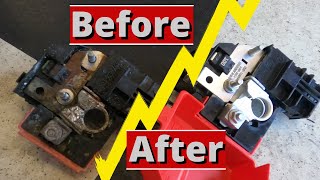
- Weak or Failing 12V Battery (Common) — Brake and stability systems perform a voltage-sensitive self-test at startup. A weak 12V battery provides inconsistent voltage, causing the ECU to erroneously trigger C1441 alongside low-voltage code C1241.
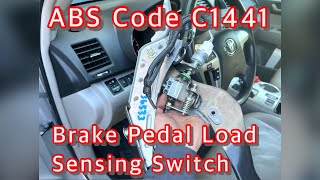
- Faulty Brake Pedal Load/Stroke Sensor (Common) — This sensor verifies brake pedal application. If it fails, the computer assumes the brakes are unresponsive, triggering the code. On models like the Toyota Highlander, this sensor is integrated into the brake pedal assembly. 🎬 Watch: How to replace the brake pedal load sensing switch.
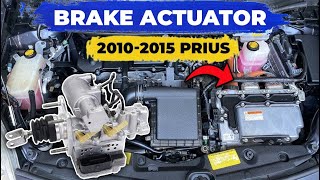
- Failing Brake Booster or Actuator Assembly (Toyota/Lexus) (Common) — The brake booster or ABS actuator fails internally, losing hydraulic pressure. This is a widespread issue on 2010-2015 Toyota Prius and early 2015 Camry models, often requiring a complete assembly replacement.
- Failed Electric Power Assisted Steering (EPAS) Rack (Ford) (Common) — Water intrusion or internal electrical failure destroys the EPAS rack on Ford Focus and C-Max models, causing an immediate loss of power steering and triggering C1441. 🎬 See how to identify a Ford electric power steering failure.
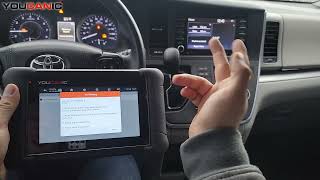
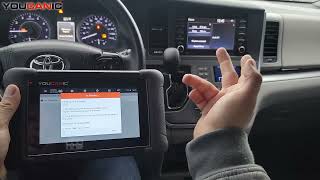
- Improper Brake Bleeding / Trapped Air (Less Common) — Air trapped in the hydraulic brake system after a fluid change causes a spongy pedal. The system detects this performance decline and triggers C1441. Modern ABS modules require a bidirectional scan tool for automated bleeding. 🎬 Watch: How to bleed ABS brakes using diagnostic software.
- Internal Master Cylinder Leak (Rare) — Master cylinder seals fail internally, preventing proper pressure buildup without external leaks. The ECU interprets this lack of pressure as a performance decline.
Symptoms

- Brake, ABS, and VSC Warning Lights — Multiple dashboard warning lights illuminate immediately to indicate a braking or stability control system failure.
- Hard or Stiff Brake Pedal (Toyota/Lexus) — The brake pedal becomes extremely hard to press, requiring significant leg effort to stop the vehicle due to a total loss of brake assist.
- Sudden Loss of Power Steering (Ford) — Steering becomes incredibly heavy and difficult to turn, accompanied by a 'Power Steering Fault' dashboard message.
- Buzzing or Grinding Noise During Braking — A loud buzzing or clicking noise, similar to ABS activation, occurs during light braking. This indicates a failing brake actuator assembly.
Diagnostic Flowchart
Tap your situation to follow the diagnostic path that matches what you're seeing on this code.
Common Fixes & Costs
- Skid Control ECU Software Update (Toyota/Lexus) — Parts: $0, Labor: $120-$200, ~1 hr book time (Professional)
- Replace 12V Battery — Parts: $150-$350, Labor: $50-$100, ~0.5 hr book time (Beginner)
- Replace Brake Pedal Load/Stroke Sensor — Parts: $50-$250, Labor: $80-$180, ~1.5 hr book time (Intermediate)
- Replace Brake Booster / Actuator Assembly (Toyota/Lexus) — Parts: $900-$2200, Labor: $400-$700, ~3.5 hr book time (Professional)
- Replace Steering Rack/EPAS Motor (Ford) — Parts: $1200-$1800, Labor: $500-$800, ~4.5 hr book time (Professional)
Used vs. New Parts: Buying Guide
When a used part is worth it: For the expensive Toyota brake actuator or Ford EPAS rack, a used part from a low-mileage donor is cost-effective on older vehicles where repair costs exceed the car's value.
Donor-vehicle mileage cap: roughly under 75000 miles for the part to have meaningful remaining life.
Donor quality checklist:
- Verify the donor vehicle's VIN to ensure it wasn't scrapped for the same failure.
- Avoid parts from rust-belt states, as corrosion destroys Ford EPAS racks.
- Match the part number exactly. Superseded part numbers indicate design improvements, making a new part a better choice.
Decision logic:
- If The cause is a known software bug or a cheap sensor. → Perform the cheaper fix first. Do not buy a major component.
- If Vehicle is under 100K miles and part is a known high-failure item. → Favor a new OEM or high-quality remanufactured part with a long warranty. The original design was flawed.
- If Vehicle is over 150K miles and budget is the primary concern. → A used part from a reputable salvage yard with a 90-day warranty is a reasonable gamble.
Warranty tradeoff: Used parts offer a 30-90 day warranty. Aftermarket remanufactured parts provide a 1-year to lifetime warranty. OEM parts carry a 12-month/12,000-mile warranty.
Worst-case if a used part fails: $800-$1500 if a used part fails after installation, covering repeat labor and a second replacement part.
What Happens If You Wait — Timeline
- 0-2 weeks: Intermittent warning lights appear at startup and disappear during driving. No noticeable change in braking or steering feel. (MPG impact: 0%% · Added cost: $0)
- 2 weeks - 3 months: Warning lights become persistent. Toyota brake pedals feel hard on cold starts. Ford steering assist fails intermittently after hot restarts. (MPG impact: 0-1%% · Added cost: $0-$50 (Risk of being stranded or needing a tow).)
- 3-6 months: The failure becomes permanent. Toyota loses brake assist completely, increasing stopping distances. Ford loses power steering assist completely. (MPG impact: 0%% · Added cost: $1500-$3500 (Cost of replacing the failed brake actuator or EPAS steering rack.))
- 6+ months (if driving continues): Secondary damage occurs. A failing Toyota actuator disables regenerative braking. A failed Ford EPAS stresses mechanical steering components. (MPG impact: 5-10% (due to disabled regenerative braking on hybrids)% · Added cost: $3000-$7000+ (Cost of primary repair plus a new hybrid battery or secondary steering component damage.))
Cost of Not Fixing It
- Immediately: For Toyota/Lexus, a hard brake pedal and significantly increased stopping distance. For Ford, a sudden loss of power steering assist. Both are extreme safety hazards. (Added cost: Potential for a major accident.)
- 1-3 months: Continued driving with a failed brake booster causes master cylinder seals to fail, sucking fluid into the booster. Continued driving with a failed EPAS stresses mechanical steering components. (Added cost: $200-$500 for a new master cylinder. Potential damage to the steering column.)
- 3+ months: Catastrophic failure of the braking or steering system. A brake booster completely filled with fluid leads to a total loss of braking. (Added cost: $2500-$7000+ for major collision repair.)
Diagnosis Steps

- Check for Technical Service Bulletins (TSBs)
Search for TSBs related to C1441 for your specific vehicle. For 2015-2017 Toyota Camrys, TSB T-SB-0037-19 resolves this with a software update. This is the mandatory first step for Toyotas.
Tools: Internet access (Beginner) - Test the 12V Battery and Charging System
Use a multimeter to check battery voltage with the engine off (minimum 12.4V) and engine running (13.5V-14.5V). Low voltage triggers C1441 and C1241.
Tools: Multimeter (Beginner) - Read Freeze Frame & Live Data
Use an advanced OBD-II scanner to read freeze frame data. If the code set at 0 mph on a Toyota, it confirms the software glitch. Monitor live data to verify the brake pedal position sensor responds smoothly.
Tools: Advanced OBD-II Scanner (Intermediate) - Inspect Brake Pedal Sensors and Wiring
Visually inspect the brake pedal position/load sensor wiring at the top of the brake pedal arm. Ensure connectors are secure and wires lack corrosion.
Tools: Flashlight (Beginner) - Check Brake Fluid Level
Verify the brake fluid reservoir is full. Top off with the specified fluid and inspect the master cylinder and wheels for leaks. No external leaks points to an internal master cylinder failure.
Tools: None (Beginner) - Test Brake Pedal Load Sensor Signal
Use a multimeter to test the brake light switch for continuity when pressed. Use a scan tool to monitor the load sensor voltage; it must increase smoothly with pedal pressure. Erratic readings confirm a bad sensor.
Tools: Multimeter, Advanced OBD-II Scanner (Advanced) - Test Skid Control ECU Power & Ground
Back-probe the Skid Control ECU connector. Verify 11-14V at the IG1 terminal with ignition ON. Check resistance between the ECU ground pin and chassis ground; it must be below 1.0 Ω.
Tools: Multimeter, Wiring Diagram (Advanced) - Perform Professional Diagnosis & ABS Bleeding
If hardware tests pass, use a manufacturer-specific scan tool (e.g., Techstream) to run active tests on the ABS pump and perform an automated ABS bleed to remove trapped air.
Tools: Bidirectional Scan Tool (Professional)
When This Code Triggers (Freeze-Frame Conditions)
- Vehicle Speed: 0 mph/kph (Sets during startup self-test. A stationary vehicle speed strongly points to the common Toyota software glitch.)
- Brake Pedal Status: Pressed (Sets when the ECU registers a pressed pedal without a corresponding hydraulic pressure rise.)
- System Voltage: < 11.5V (Sets during engine crank. A weak battery drops voltage below the brake system's self-test threshold.)
- Engine Status: Off (Ignition ON) (Sets if the brake pedal is depressed while rolling the vehicle in neutral without the engine running.)
Related Codes
- C1201 — Appears with C1441 on Toyotas. C1201 means the brake ECU received a fault signal from the engine ECU. An engine problem (like a vacuum leak) reduces vacuum to the brake booster, triggering C1441. Diagnose C1201 first.
- C1391 — On Toyota hybrids, C1391 ('Abnormal Leak in Accumulator') points directly to the brake booster/actuator assembly failing to hold hydraulic pressure. If both codes are present, the booster assembly requires replacement.
- U3000 — On Fords with EPAS failure, U3000 ('Control Module Internal Failure') is found within the Power Steering Control Module. C1441 is a secondary code. U3000 confirms the steering rack requires replacement.
- C1241 — Means 'Low or High Power Supply Voltage'. If C1241 appears with C1441, the root cause is a failing 12V battery, a bad alternator, or a corroded ground connection, not a primary brake component failure.
Climate & Environmental Factors
- High Humidity / Road Salt (Rust Belt): Water and salt penetrate Ford EPAS connectors or the steering rack housing, causing corrosion and shorting out internal electronics, leading to a sudden loss of power steering.
- Cold Weather: Low temperatures exacerbate weak 12V battery issues. A battery that starts the car in warm weather drops below the required threshold for the brake system's self-test in the cold, triggering C1441.
- Brake Fluid Hygroscopy: Brake fluid absorbs moisture from the air. High moisture content lowers the boiling point and causes internal corrosion in the ABS actuator and master cylinder, contributing to seal failure.
How to Talk to a Mechanic About This Code
Say this: "I have a C1441 code on my vehicle. Before replacing any major components, I'd like to book a diagnostic appointment. For my Toyota, please first check for relevant TSBs for a software update, test the 12V battery, and check the brake pedal load sensor. For my Ford, please check for codes in the PSCM and verify if my VIN is covered by any extended warranties for the EPAS system."
This signals you've done your research and directs the technician to the most common and cheapest fixes first, preventing a rush to replace an expensive brake booster or steering rack.
Avoid saying:
- 'My brake light is on, can you fix it?'
- 'The code says it's a brake booster, can you give me a quote?'
- 'Just do whatever it takes to fix it.'
Questions to ask before authorizing the repair:
- For a Toyota: Did you check for a software update, and have you tested the battery and brake pedal sensor to rule them out?
- For a Ford: Did you find any codes like U3000 in the power steering module, and did you check for any applicable recalls or warranty extensions?
- If you are recommending a brake booster or steering rack, can you explain how you eliminated the cheaper possibilities?
- If the fix requires an ABS bleed, do you have the bidirectional scan tool to perform the automated procedure?
- What is the warranty on the recommended parts and labor?
Where to Take It: Dealer vs Independent vs Chain
- Dealer:
Best for Toyota software updates and warranty work. A necessary choice if post-repair programming is required and independent shops lack the tools.
Best for: Toyota/Lexus vehicles where the cause is a known software glitch (TSB). Only dealers perform this flash., Vehicles under a manufacturer or extended warranty., Complex electronic programming required after a part replacement.
Downsides: Highest labor rates., May recommend expensive OEM part replacement without exploring all diagnostic avenues first. (Typical cost: +50% vs. baseline) - Independent Shop:
Best fit for most hardware-related C1441 repairs, provided the shop is well-equipped. Ask specifically if they handle ABS bleeding and calibrations.
Best for: Out-of-warranty vehicles., Diagnosing and replacing known hardware failures like a weak battery, brake pedal sensor, brake booster, or Ford EPAS rack., Owners who have a trusted mechanic with advanced diagnostic tools.
Downsides: May lack access to the latest TSBs or manufacturer-specific software for ECU flashing., Must verify they have a bidirectional scanner capable of performing an ABS bleed. (Typical cost: +0% vs. baseline) - Chain Shop:
AVOID for diagnosis. The complexity of C1441 is beyond the scope of most chain shops. Only use them for a battery replacement if you are certain it's the root cause.
Best for: Simple battery replacement if you've already diagnosed it as the cause.
Downsides: Technicians lack the advanced diagnostic training for complex chassis codes., High pressure to upsell common services rather than perform in-depth diagnosis., Unlikely to have manufacturer-specific software or high-level bidirectional scanners. (Typical cost: -10% vs. baseline)
When to Walk Away From the Repair
If the estimated repair cost exceeds 50% of the car's private-party value, seriously consider selling or scrapping the vehicle.
- Car worth $8000, fix is $3000: Borderline (37.5%). The repair is significant but worthwhile if the car is otherwise in excellent condition. Get a second opinion.
- Car worth $15000, fix is $2500: Fix it. The repair cost is well below the threshold and restores a critical safety function.
- Car worth $4000, fix is $2800: Walk away (70%). The repair cost is far too high relative to the car's value. Do not fix it.
What Scan Tool You Need for This Code
Minimum: A scanner that reads and clears Anti-lock Brake System (ABS) / Chassis trouble codes. A basic engine-only code reader will not see C1441.
A $20 engine code reader cannot communicate with the ABS, VSC, or PSCM modules where this code is stored. You will see 'No Codes Found'.
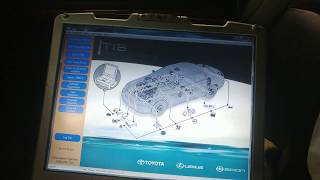
Budget: Toyota: Mini VCI Cable with Techstream Software | Ford: FORScan with ELM327 Adapter (~$30-80) — Provides dealer-level diagnostics. Reads freeze frame data, views live sensor data, reads manufacturer-specific codes, and performs calibrations. Requires a laptop.
Mid-range: Foxwell NT630 Plus / Autel MaxiCheck Pro (~$150-250) — Handheld scanners with built-in bidirectional control for ABS/SRS systems. Performs the critical 'Automated ABS Bleed' function needed after replacing a brake booster.
Professional: Autel MaxiCOM MK808 / Launch CRP129X (~$450-800) — Full-system bidirectional scanners. Offers comprehensive diagnostics, advanced live data graphing, and performs service functions including steering angle sensor resets and EPAS programming.
Rent vs buy: Auto parts stores read codes for free, but their scanners cannot perform the necessary ABS bleed or calibration functions. If your repair requires an automated bleed, you must buy a bidirectional tool or go to a shop.
How to Clear the Code After You Fix It
- Perform the specific repair (e.g., replace battery, update ECU software, replace booster).
- Use an OBD-II scan tool to clear the Diagnostic Trouble Codes from the Chassis/Brake control module.
- Start the engine and let it idle for 1-2 minutes.
- Perform a road test, including several stops from various speeds to confirm the brake pedal feels normal and warning lights remain off.
Drive cycle (~15 minutes): A specific drive cycle is not required. A 15-minute road test with mixed city/highway speeds and multiple braking events confirms if the fault condition returns.
Readiness monitors affected: This chassis code does not directly affect emissions readiness monitors., Clearing the code with a scanner resets all emissions monitors to 'Not Ready'.
Before emissions retest: drive at least 50 miles to fully set monitors.
Watch out for:
- Clearing the code without performing a repair results in the code returning immediately upon the next startup self-test.
- Forgetting that clearing a chassis code resets emissions monitors leads to a failed smog test.
Will This Fail Emissions / State Inspection?
Yes — this code typically fails an OBD-II emissions inspection.
- California: Automatic failure. An illuminated brake or ABS warning light fails the safety portion of the smog inspection. Clearing the code resets emissions readiness monitors.
- New York: Automatic failure. An illuminated red 'BRAKE' warning light is a definitive safety inspection failure.
- Texas: Automatic failure. State inspection rules explicitly state that an illuminated brake warning lamp is a reason for rejection.
Most Commonly Affected Vehicles

- Toyota Camry (2015-2017) — Highly prone to a software glitch in the Skid Control ECU, addressed by TSB T-SB-0037-19. Early 2015 models also had brake booster failures addressed by TSB T-SB-0010-15.
- Toyota Prius (2010-2015) — Notorious for brake booster and actuator assembly failures. Toyota issued Customer Support Programs ZJB and ZKK extending the warranty for these components.
- Toyota Highlander (2010-2015) — Prone to C1441 caused by a faulty brake pedal load sensing switch. On some models, this switch is integrated into the brake pedal assembly.
- Toyota Venza (2009-2015) — C1441 appears alongside communication and low voltage codes (C1241, U0129), pointing to a failing 12V battery or alternator.
- Toyota Sienna (2015-2017) — Affected by air trapped in the ABS module after improper brake fluid service. Requires a bidirectional scan tool for a proper ABS bleed.
- Toyota 4Runner (2016-Present) — C1441 appears with TRC lights. Common causes include faulty brake sensors, wiring, or moving the vehicle in neutral during startup.
- Lexus ES / GS (2013-2018) — Shares platforms with the Camry and Avalon. Recall 14V312000 addressed a faulty brake pedal load sensing switch on 2013 GS 350 models.
- Ford Focus / C-Max (2012-2015) — Known for sudden Electric Power Steering (EPAS) failure. Ford issued recall 14S18 and Customer Satisfaction Program 15N01 extending the steering gear warranty.
Manufacturer-Specific Notes
- Toyota / Lexus / Scion: Defined as 'Performance Decline of Brake Function.' The most common cause is a software glitch fixed by a dealer update. The second most common cause is a failing brake booster assembly, covered under various extended warranty programs.
- Ford: Associated with the failure of the Electric Power Assisted Steering (EPAS) system. The failure is sudden and caused by water intrusion into the steering rack electronics. Covered under extended warranty program 15N01.
- Mazda: Defined as 'CAN-LS Meter Unit Data Abnormal.' Indicates a communication problem on the low-speed network, caused by a faulty instrument cluster or wiring harness issue.
- Hyundai: Defined as 'Steering Angle Sensor - Signal Fault.' Points directly to a problem with the steering angle sensor or its circuit, critical for the Electronic Stability Control system.
Real Owner Stories
2012 Toyota Highlander with 130k miles - The Misleading 'Booster Malfunction'
ABS and brake lights turned on intermittently. The brake pedal felt completely solid on a cold start, making it impossible to push down.
Outcome: The owner replaced the load sensing switch attached to the brake pedal assembly, fixing the problem permanently.
Lesson: Do not automatically trust the generic code description. The much cheaper brake pedal load sensing switch is a common cause and must be investigated before condemning the brake booster.
2017 Toyota Sienna with 80k miles - The DIY Brake Bleed Disaster
The owner performed a DIY brake fluid change but let the master cylinder reservoir run dry, introducing air into the system. Pumping the pedal triggered C1441.
Outcome: The issue pointed to extremely trapped air in the ABS module that even a standard professional bleed couldn't remove, causing the system to detect a performance decline.
Lesson: Never let the brake fluid reservoir run dry. It introduces air that is extremely difficult to remove from the ABS module, leading to C1441 and dangerous braking performance.
2013 Ford Focus with 190k miles - The Sudden 'Steering Fault' Surprise
A 'Power Steering Fault' message appeared on startup, and the steering became completely heavy and unassisted.
Outcome: The root cause was a complete failure of the electric power steering rack. The owner replaced the entire steering rack assembly for $1500.
Lesson: On a Ford, C1441 is almost always related to the EPAS system. The failure is sudden, and complete failure of the steering rack is an expensive but common repair.
2016 Toyota 4Runner - The Alignment and Sensor Calibration Fix
Check engine and TRC lights illuminated with code C1441. The steering wheel was slightly off-center.
Outcome: The issue was resolved by performing a wheel alignment and using a scan tool to perform a 'zero point calibration' for the steering angle and yaw rate sensors.
Lesson: A bad alignment makes the stability control system think the car is turning when it isn't, triggering C1441. A zero point calibration is required after any alignment.
How to Prevent This Code From Triggering
- Change brake fluid every 2-3 years or 30,000 miles. (Every 2-3 years) — Brake fluid absorbs moisture from the air. High moisture content causes internal corrosion of expensive parts like the ABS actuator and master cylinder, leading to seal failure.
- Test and maintain the 12V battery. (Annually after 3 years of age) — A weak battery providing inconsistent voltage is a primary cause of C1441, failing the system's sensitive startup self-test.
- Avoid frequent short trips; take a longer drive weekly. (Weekly) — Short trips prevent the alternator from fully recharging the battery. A 30-minute drive maintains the battery's state of charge, ensuring it passes voltage-sensitive self-tests.
- Perform regular brake system inspections. (Annually) — A professional inspection catches small leaks in brake lines before they become catastrophic and ensures brake components move freely.
Frequently Asked Questions
What is the most common mistake when diagnosing C1441 on a Toyota?
The most common and costly mistake is immediately replacing the brake booster assembly. Technicians must first check for software update TSBs, test the 12V battery, and verify the brake pedal load sensing switch. These three issues cause the majority of C1441 codes and cost a fraction of a booster replacement.
My mechanic's scanner says C1441 means 'brake booster malfunction.' Could it be anything else?
Yes. The generic 'brake booster malfunction' description is misleading. C1441 is frequently triggered by a faulty brake pedal load sensing switch, a weak 12V battery, or outdated ECU software. Always rule out these cheaper possibilities before authorizing a booster replacement.
Can a weak battery cause code C1441?
Yes. The brake system performs a critical, voltage-sensitive self-test at startup. A weak battery provides inconsistent voltage during this check, causing the Skid Control ECU to incorrectly flag C1441. Test and replace a failing battery before pursuing expensive brake repairs.
Is it safe to drive with code C1441?
No. On a Toyota, power brake assist fails, drastically increasing the pedal effort and distance required to stop. On a Ford, power steering fails, making the car extremely difficult to steer at low speeds. Both scenarios create a high crash risk.
Can I fix code C1441 myself?
Simple checks like testing the battery and verifying brake fluid levels are DIY-friendly. However, the most common fixes—software updates, brake booster replacement, or steering rack replacement—require specialized bidirectional scan tools and safety calibrations. Stop DIY and tow the vehicle to a shop if the battery and fluid check out.
Can a bad wheel alignment cause code C1441?
It is unlikely but possible. Severe misalignment forces the driver to hold the steering wheel off-center, confusing the steering angle sensor. Because this sensor communicates with the Vehicle Stability Control system, it occasionally triggers chassis codes like C1441.
Can I just clear the C1441 code?
You can clear the code by disconnecting the battery, but it will return immediately during the next startup self-test. C1441 monitors critical safety systems that continuously self-diagnose. Clearing the code without repairing the underlying hardware or software fault is dangerous.
Key Takeaways
- Code C1441 indicates a critical safety failure: a loss of power brake assist on Toyotas or a sudden loss of power steering on Fords.
- Always check for Technical Service Bulletins (TSBs) first; Toyota T-SB-0037-19 fixes this code on 2015-2017 Camrys with a simple software update.
- Test your 12V battery before replacing expensive parts, as a voltage drop below 11.5V during startup triggers this code erroneously.
- Do not drive the vehicle; stopping distances increase by 2 to 5 times without brake assist, and steering becomes unmanageable at low speeds.
Helpful Videos

The information in this article is provided for general reference and educational purposes only. Vehicle specifications, procedures, and part compatibility can vary by production date, trim level, and region. Always consult your vehicle's factory service manual and verify part numbers before purchasing or performing repairs. Safety-critical components such as airbags, seat belts, and braking systems should be installed by a qualified professional.
- 🎬 Helpful Videos
- What Does C1441 Mean?
- Can I Drive With C1441?
- Common Causes
- Symptoms
- Diagnostic Flowchart
- Common Fixes & Costs
- Used vs. New Parts: Buying Guide
- What Happens If You Wait — Timeline
- Cost of Not Fixing It
- Diagnosis Steps
- When This Code Triggers (Freeze-Frame Conditions)
- Related Codes
- Climate & Environmental Factors
- How to Talk to a Mechanic About This Code
- Where to Take It: Dealer vs Independent vs Chain
- When to Walk Away From the Repair
- What Scan Tool You Need for This Code
- How to Clear the Code After You Fix It
- Will This Fail Emissions / State Inspection?
- Most Commonly Affected Vehicles
- Manufacturer-Specific Notes
- Real Owner Stories
- 2012 Toyota Highlander with 130k miles - The Misleading 'Booster Malfunction'
- 2017 Toyota Sienna with 80k miles - The DIY Brake Bleed Disaster
- 2013 Ford Focus with 190k miles - The Sudden 'Steering Fault' Surprise
- 2016 Toyota 4Runner - The Alignment and Sensor Calibration Fix
- How to Prevent This Code From Triggering
- Frequently Asked Questions
- What is the most common mistake when diagnosing C1441 on a Toyota?
- My mechanic's scanner says C1441 means 'brake booster malfunction.' Could it be anything else?
- Can a weak battery cause code C1441?
- Is it safe to drive with code C1441?
- Can I fix code C1441 myself?
- Can a bad wheel alignment cause code C1441?
- Can I just clear the C1441 code?
- Key Takeaways
- 🎟️ Get 5% Off