

C1433 on 2012-2014 Toyota Camry: Steering Angle Sensor Failure Causes and Fixes
On a 2012-2014 Toyota Camry, code C1433 almost always means the steering angle sensor, which is part of the spiral cable assembly (OEM Part #84307-06090), has failed internally. This is confirmed by scan tool data showing the angle stuck at -1044 or 1044 degrees. The fix is to replace the entire spiral cable assembly and perform a zero-point calibration, costing around $400-$800 at a shop.
- C1433 on a 2012-2014 Camry is a highly specific code pointing to an internal failure of the steering angle sensor.
- The most reliable diagnostic check is to view live data and see if the steering angle value is stuck at -1044 or 1044 degrees and is unresponsive.
- The correct repair is to replace the entire spiral cable assembly (OEM P/N 84307-06090), not just attempt a recalibration.
- This repair involves the airbag system and requires a scan tool for calibration, so professional service is strongly recommended.
- While cheaper aftermarket parts are available, using a high-quality OEM or equivalent part is advised for this critical safety system component due to widespread reports of poor aftermarket quality.
What's Unique About the 2012-2014 Toyota CAMRY

For this generation of Camry (and its platform mates), the C1433 code is a very specific and well-documented issue. Toyota issued a Technical Service Tip (T-TT-0277-13) highlighting that the steering angle value gets stuck at -1044 or 1044 degrees. This isn't a generic sensor fault but a known failure pattern, making diagnosis highly confident. The problem points directly to an internal failure of the sensor, which is integrated into the spiral cable assembly, also known as the clock spring. This component is a known wear item across many Toyota models.
Diagnostic Flowchart

Tap your situation to follow the diagnostic path that matches what you're seeing on this vehicle.
Symptoms You May Notice

- Vehicle Stability Control (VSC) warning light is on
- Traction Control (TRAC) or 'slippery car' icon is on
- ABS light may be on
- In some cases, advanced driver-assistance systems (ADAS) like pre-collision or lane departure may show a malfunction message.
- Replacing the ABS/VSC control module when the fault is in the sensor.
- Attempting to only calibrate the existing sensor. If the sensor has an internal fault (as C1433 implies), calibration will not fix it and the code will return immediately.
- Replacing the spiral cable with a cheap, low-quality aftermarket part. Owners on forums report that counterfeit or poor-quality parts from sites like eBay may fail quickly or not work at all, and for a critical safety component like the airbag/VSC interface, using an OEM part is strongly recommended.
Most Likely Causes

- Failed Steering Angle Sensor (Internal Failure) 🔴 High Probability This is a documented failure pattern for this vehicle, as noted in Toyota's Technical Service Tip T-TT-0277-13. The sensor is integrated into the spiral cable (clock spring) assembly, which is a known wear item across many Toyota models due to the constant flexing of its internal ribbon cable.
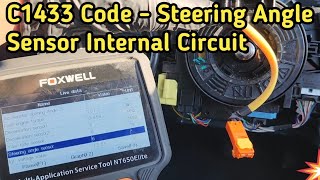
How to confirm: Use a scan tool capable of reading ABS/VSC live data (e.g., Toyota Techstream). Check the steering angle sensor value. If it is stuck at a fixed value (like -1044 or 1044) and does not change when the steering wheel is turned 🎬 See how to diagnose a stuck internal sensor circuit, the sensor has failed internally. On other Toyota platforms, also check the 'Zero Point of Steering Angle' data PID; a value stuck at -3072 is also a definitive indicator of a failed sensor.
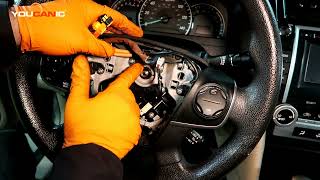
Typical fix: Replace the entire spiral cable sub-assembly (Part No. 84307-06090), which includes the steering angle sensor. After replacement, a 'Zero Point Calibration' of the new sensor must be performed using a capable scan tool.
Est. part cost: $250-$550 - Damaged Spiral Cable (Clock Spring) 🟡 Medium Probability The spiral cable can be damaged if the steering wheel is rotated excessively while the steering linkage is disconnected (e.g., during a steering rack or starter replacement). This can break the internal ribbon cable, causing the C1433 code and other failures.
How to confirm: In addition to the C1433 code, other symptoms will likely be present, such as the horn not working, steering wheel-mounted buttons (audio, cruise control) being inoperative, or an airbag warning light. If these other functions have also failed, it strongly points to a broken spiral cable.
Typical fix: Replace the spiral cable sub-assembly. This part houses the steering angle sensor and the wiring for all steering wheel-mounted controls and the airbag.
Est. part cost: $250-$550
Rare But Worth Checking
- Skid Control ECU Malfunction: This is very rare. Toyota service documentation states that if other communication codes like U0073, U0124, or U0126 are present, they should be diagnosed first. The ECU should only be considered if a new, known-good OEM steering angle sensor does not resolve the code.
Diagnosis Steps
- Connect a diagnostic scan tool that can access the ABS/VSC module's live data stream, such as Toyota's Techstream software.
- Read the fault codes. Confirm C1433 is present.
- Navigate to the live data for the Chassis or ABS system.
- Observe the 'Steering Angle Sensor' value.
- Confirm if the value is stuck at a static number (e.g., -1044, 1044) and does not change as you turn the steering wheel from lock to lock.
- If the value is stuck, the steering angle sensor has failed internally. The spiral cable assembly must be replaced.
- If the value changes but is erratic, inspect the wiring and connector between the steering column and the ABS module before condemning the sensor. Check for power and ground at the sensor connector.
- After replacing the spiral cable assembly, perform the 'Zero Point Calibration' for the steering angle sensor using the scan tool's special functions menu. While some older Toyotas allow a manual calibration by shorting pins in the OBD-II port, it is recommended to use a scan tool for this model to ensure accuracy.
- Clear all codes and test drive the vehicle, turning the steering wheel to ensure the VSC light stays off and the system is functioning.
Parts You'll Likely Need
- Spiral Cable Sub-Assembly with Sensor
(OEM #84307-06090)— This assembly contains the steering angle sensor that fails and causes code C1433. It is not sold as a separate component from the spiral cable (clock spring). This part number fits the 2012-2014 Camry and its platform mates.
Trusted brands: Toyota (OEM), Denso (Often the OEM manufacturer), Standard Motor Products (Aftermarket), Dorman (Aftermarket)
OEM price range: $250-$570
Aftermarket price range: $50-$150
Related Codes That Often Appear With This One
- U0126 — This code means 'Lost Communication With Steering Angle Sensor Module'. It can appear alongside C1433 if the sensor's failure is so severe that it stops communicating on the CAN bus entirely.
Technical Service Bulletins (TSBs) & Recalls
- T-TT-0277-13: Notes that the VSC light may come on with DTC C1433 and a steering angle value stuck at -1044 or 1044 degrees. This TSB applies to the 2012-2014 Camry, 2013 Avalon, and 2014 Corolla.
Platform-Specific Known Issues
- Toyota Technical Service Tip T-TT-0277-13 specifically calls out the 2012-2014 Camry for setting code C1433 when the steering angle sensor data becomes fixed at -1044 or 1044 degrees, confirming this is a known issue.
Mechanic-Grade Diagnostic Values
- Steering Angle Sensor Connector (E11) Power Supply Voltage — expected: 10 to 14 V. Failure: Voltage below 10V indicates a power supply issue to the sensor.
- Steering Angle Sensor Connector (E11) Ground Resistance — expected: Below 1 Ω. Failure: Resistance above 1 Ω indicates a poor ground connection (at pin E11-2).
- Steering Angle Sensor Connector (E11) CAN Bus Resistance — expected: 54 to 69 Ω. Failure: Resistance outside this range between CANH (E11-10) and CANL (E11-9) indicates a problem with the CAN wiring or termination.
- Live Data: 'Zero Point of Steering Angle' (Techstream) — expected: 0 degrees when wheels are straight, changes with steering input.. Failure: A value stuck at -3072 degrees, even if the main angle reads 0, is a known indicator of an internally failed sensor on many Toyota platforms.
Scan Tool Commands That Help
- Toyota Techstream: Zero Point Calibration (Steering Angle Sensor) — This must be performed after replacing the spiral cable/sensor assembly to teach the VSC system the new sensor's straight-ahead position. It is typically found under the ABS/VSC/TRAC utility menu. 🎬 Watch: How to perform the Zero Point Calibration
- Toyota Techstream: Reset Memory — Used to clear old calibration and fault data from the ABS/VSC module before performing a new calibration. This is often the first step in the calibration sequence.
- Toyota Techstream: Test Mode — Used to place the VSC system into a special diagnostic or calibration state, allowing the Zero Point Calibration to be performed and learned by the ECU.
Wiring & Ground Locations
- Skid Control ECU — Located behind the dashboard on the driver's side, near the steering column. Access may require removing the instrument panel lower cover and scuff plate.. This ECU receives the signal from the steering angle sensor. While rarely the cause, a poor connection or fault at the ECU could mimic a sensor failure.
- Connector E11 — The electrical connector for the steering angle sensor, located at the base of the spiral cable assembly in the steering column.. This is the primary point for testing power, ground, and CAN signals going to the sensor. A bad connection here can cause C1433 or communication codes.
- Chassis Grounds — Primary harness grounds are often located on the valve covers or attached to the chassis near the strut towers in the engine bay.. A poor or corroded chassis ground can cause unpredictable behavior in multiple electronic modules, including the Skid Control ECU, leading to spurious codes.
Real Owner Repair Stories
- Tacoma World Forum user 'duswhit' (2018 Toyota Tacoma TRD Sport) — After breaking the clock spring during a starter replacement, multiple dash lights (ABS, Airbag, etc.) and code C1433 appeared.
❌ Tried (didn't work) Replacing the spiral cable (clock spring) with an aftermarket part from eBay. This restored horn and steering wheel button functions but C1433 and the VSC/ABS lights remained., Attempting a Zero Point Calibration by shorting OBD-II pins.
✅ What actually fixed it Replacing the separate Steering Angle Sensor component. On this model, the sensor was a distinct part from the spiral cable, and the aftermarket spiral cable did not include a new sensor. Only after replacing the original sensor did the C1433 code clear. - Tundras.com Forum user '2020_Tundra' (2020 Toyota Tundra) — After replacing the steering wheel, C1433 appeared instantly. Techstream showed the steering angle value stuck at 0, but the 'Zero Point of Steering Angle' value was stuck at -3072.
❌ Tried (didn't work) Using Techstream to reset memory and clear the code; it returned immediately.
✅ What actually fixed it Another user confirmed that the 'Zero Point of Steering Angle' value being stuck at -3072 is a definitive sign of a bad sensor. The fix was to replace the steering angle sensor assembly.
When the Usual Fixes Don't Work
- While the common fix for the 2012-2014 Camry is to replace the entire spiral cable assembly (which includes the sensor), it's critical to understand why this may fail, especially with aftermarket parts. A repair story from a related Toyota platform showed that replacing only the spiral cable with a cheap aftermarket part did not resolve the C1433 code. The reason was that the aftermarket part did not include a new steering angle sensor, which was a separate, swappable component on that specific model. The final fix required installing a new sensor onto the new spiral cable. This highlights a major pitfall: if an aftermarket 'spiral cable' or 'clock spring' does not explicitly include the integrated steering angle sensor, it will not fix a C1433 code.
OEM Part Supersession History
84306-09030→84307-06090— Standard part revision and update by the manufacturer.
Model Year Variations Within This Range
- 2012-2014: Part sources indicate a potential part change for some trims, like the Camry Hybrid L, starting from December 2012 production. This aligns with the part number supersession from 84306-09030 to 84307-06090 and may indicate a minor design update.
Helpful Videos


The information in this article is provided for general reference and educational purposes only. Vehicle specifications, procedures, and part compatibility can vary by production date, trim level, and region. Always consult your vehicle's factory service manual and verify part numbers before purchasing or performing repairs. Safety-critical components such as airbags, seat belts, and braking systems should be installed by a qualified professional.
- Toyota CAMRY:
- 🎬 Helpful Videos
- What's Unique About the 2012-2014 Toyota CAMRY
- Diagnostic Flowchart
- Symptoms You May Notice
- Most Likely Causes
- Rare But Worth Checking
- Diagnosis Steps
- Parts You'll Likely Need
- Related Codes That Often Appear With This One
- Technical Service Bulletins (TSBs) & Recalls
- Platform-Specific Known Issues
- Mechanic-Grade Diagnostic Values
- Scan Tool Commands That Help
- Wiring & Ground Locations
- Real Owner Repair Stories
- When the Usual Fixes Don't Work
- OEM Part Supersession History
- Model Year Variations Within This Range
- 🎟️ Get 5% Off