

OBD-II Code C1433: Steering Angle Sensor Internal Circuit
The Ultimate Guide to Diagnosing and Fixing C1433
- Code C1433 indicates a permanent internal failure of the steering angle sensor, instantly disabling critical safety systems like VSC and ABS.
- Viewing live steering angle data on a scan tool and finding a value stuck at exactly -1044, 1044, or -3072 degrees confirms a dead sensor on Toyota and Lexus vehicles.
- Replace the faulty sensor with an OEM part, as cheap aftermarket alternatives have a near-100% failure rate during the mandatory calibration process.
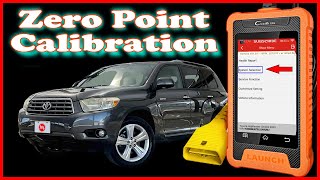
- You must perform a digital zero-point calibration using an advanced OBD-II scanner after installing the new sensor to clear the code permanently.
What Does C1433 Mean?

Code C1433 means the Skid Control ECU detected an internal electrical failure within the steering angle sensor (SAS). This sensor reports the precise angle and direction of the steering wheel to the car's safety systems. Because the computer flagged the sensor's internal circuitry as faulty, it no longer trusts the data. As a failsafe, the ECU disables crucial safety features like Vehicle Stability Control (VSC), ABS, and Pre-Collision systems that rely on this input.
Technical definition: The SAE/OBD-II definition is "Steering Angle Sensor Internal Circuit". This indicates the skid control ECU received a signal directly from the steering angle sensor's internal microprocessor reporting a malfunction, or it detected an open in the sensor's power supply circuit. This almost always points to a non-recoverable hardware fault inside the sensor unit.
Can I Drive With C1433?
Yes, But With Caution. Yes, but with extreme caution and only for a short distance to a repair facility. When code C1433 is active, your vehicle's primary active safety systems—Vehicle Stability Control (VSC) and Traction Control (TRAC)—are disabled. These systems prevent skids and loss of control by automatically applying individual brakes during an emergency maneuver or on slippery surfaces. Without them, the risk of a spinout or accident is significantly higher. This is a constant state of reduced safety, exposing you to the full cost of a potential accident.
Common Causes

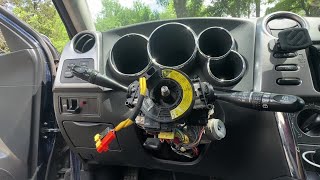
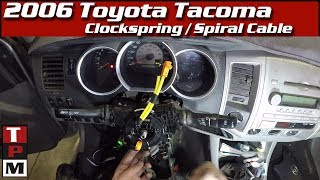
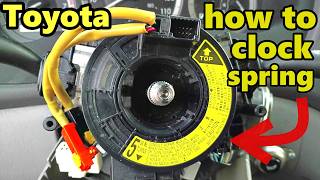
- Faulty Steering Angle Sensor (SAS) (Very Common) — The sensor's internal microprocessor or optical sensing elements have failed. This is the primary cause of C1433 and is confirmed by a frozen data reading on a scan tool. The sensor is typically integrated into the spiral cable (clock spring) assembly. 🎬 Watch: How to replace a Toyota clock spring and spiral cable.
- Damaged Spiral Cable / Clock Spring (Common) — The spiral cable is a delicate ribbon of wires that breaks from age or being over-rotated during service (like a steering rack replacement). A break in the cable's circuitry causes the integrated sensor to fail and triggers the code.
- Failed or Incompatible Aftermarket Sensor (Common) — Low-cost aftermarket spiral cable assemblies frequently fail to calibrate or trigger a C1433 code immediately after installation. Fixing this requires replacing the cheap unit with a reliable OEM part.
- Corrupted EEPROM Data (Common) — The sensor's internal memory chip (EEPROM) corrupts due to voltage spikes from improper jump-starts or battery disconnects. This corruption prevents the sensor from running its internal self-check, forcing it to report an internal fault.
- Failed Zero-Point Calibration (Less Common) — After a wheel alignment, battery disconnect, or suspension lift, the SAS must be recalibrated. If this procedure is skipped or fails, the system logs a fault. Persistent calibration failure points back to a dead sensor.
- Power Supply or Wiring Fault (Rare) — A blown fuse, damaged wiring harness, or corroded connector cuts power to the sensor. This typically sets a C1432 code first, but causes a C1433 if the sensor's internal diagnostics fail due to low voltage.
Symptoms

- TRAC, VSC, and ABS Warning Lights Illuminated — This is the primary symptom. The Traction Control, Vehicle Stability Control, and Anti-lock Braking System lights stay steadily illuminated because the ECU disabled them due to untrustworthy sensor data.
- Advanced Safety Systems Disabled — Warnings appear for the Pre-Collision System (PCS), Lane Departure Assist, Adaptive Cruise Control, or 4WD/AWD systems, as they all require accurate steering input to function.
- Steering Wheel Controls and Horn Dead — If the entire spiral cable assembly failed by breaking its internal ribbon, all electrical components on the steering wheel, including the horn and cruise control buttons, stop working.
- Steering Feels Unpredictable or Off-Center — The steering feels slightly unpredictable or the steering wheel is no longer perfectly centered when driving straight, indicating the system lost its reference point.
Diagnostic Flowchart
Tap your situation to follow the diagnostic path that matches what you're seeing on this code.
Common Fixes & Costs
- Replace Steering Angle Sensor / Spiral Cable Assembly
— Parts: $150-$450, Labor: $150-$300, ~1.5 hr book time
(Professional)
Toyota Camry (2012-2014): OEM 84307-06090 (Alt: Dorman 525-031)
Toyota Corolla (2014-2018): OEM 84308-02030 (Alt: Dorman 525-081)
Toyota Highlander (2017-2019): OEM 84307-0E050 (Alt: OEM strongly recommended) - Perform Zero-Point Calibration — Parts: $0, Labor: $100-$200, ~0.8 hr book time (DIY)
- Repair Damaged Wiring or Connector — Parts: $5-$50, Labor: $100-$300, ~1.5 hr book time (Intermediate)
- Replace Blown Fuse — Parts: $1-$5, Labor: $0-$50, ~0.1 hr book time (DIY)
- Repair Steering Angle Sensor (EEPROM Flash) — Parts: $0, Labor: $150-$300, ~2.0 hr book time (Professional)
Used vs. New Parts: Buying Guide
When a used part is worth it: A used OEM sensor from a low-mileage donor vehicle is a cost-effective alternative to a new OEM part and is significantly more reliable than a cheap aftermarket part.
Donor-vehicle mileage cap: roughly under 80000 miles for the part to have meaningful remaining life.
Donor quality checklist:
- Verify the part number is an exact match.
- Ensure the donor vehicle was not involved in a frontal collision.
- The part must be properly 'centered' and secured with a locking tab to prevent over-rotation during shipping.
Decision logic:
- If A new, non-OEM aftermarket sensor is the cheapest option → Avoid it. These parts frequently fail to calibrate, wasting time and money.
- If Budget is tight and a used OEM part is available → This is a viable option with a lower risk of failure than a cheap aftermarket part.
- If You want the highest probability of a one-time fix → Buy a new OEM part. This is the most expensive but most reliable solution.
Warranty tradeoff: Used parts offer a 30-90 day warranty. New aftermarket parts have longer warranties but questionable functionality. New OEM parts carry a 12-month manufacturer warranty.
Worst-case if a used part fails: $250-$500 if a cheap aftermarket part fails, requiring repeat labor and the purchase of a reliable OEM part.
What Happens If You Wait — Timeline
- Immediately (0-1 ignition cycle): Code C1433 sets. VSC, TRAC, and ABS warning lights illuminate. Pre-Collision and Lane Departure aids are disabled. (MPG impact: 0%% · Added cost: $0. The damage is a constant safety risk, not a progressive mechanical failure.)
- 0-6 months: Safety systems remain disabled, significantly increasing the risk of losing control in an emergency. Driving habits must adjust for the lack of safety aids. (MPG impact: 0%% · Added cost: $0. The cost remains the potential for an accident.)
- Approaching annual inspection: The vehicle fails state safety inspections in jurisdictions that check ABS/VSC warning lights, preventing legal registration renewal. (MPG impact: 0%% · Added cost: $100-$300 in potential fines or costs associated with a failed inspection.)
- 6+ months: No cumulative mechanical damage occurs. The primary consequence is the inability to pass mandatory vehicle safety inspections. (MPG impact: 0%% · Added cost: The $300-$750 repair cost becomes unavoidable to keep the vehicle legally registered.)
Cost of Not Fixing It
- Immediately: Vehicle Stability Control (VSC) and Traction Control (TRAC) are disabled. The risk of losing control in an emergency maneuver is significantly increased. (Added cost: Unquantifiable potential cost of an accident due to loss of control.)
- 0-6 months: Continued driving without active safety systems. No direct mechanical damage accumulates, but the safety risk remains constant. (Added cost: $0, aside from the ongoing safety risk.)
- 6+ months: The vehicle fails state safety inspections due to illuminated ABS/VSC warning lights, leading to fines or inability to legally register the vehicle. (Added cost: Potential fines or costs associated with failing a vehicle inspection.)
Diagnosis Steps

- Read All Fault Codes
Use an OBD-II scanner to confirm C1433. Scan all vehicle modules. Codes for power (C1432) or communication (U0126) must be addressed first, as they cause C1433 to set incorrectly.
Tools: OBD-II Scan Tool (Beginner) - Check Live Sensor Data for a Stuck Value
Using a scan tool with live data, view the 'Steering Angle' parameter. On Toyota/Lexus vehicles, a definitive sign of a failed sensor is the value frozen at -1044, 1044, -864, or -3072 degrees, regardless of steering wheel position. If you see this, replace the sensor.
Tools: Advanced OBD-II Scan Tool (Beginner) - Observe Live Data While Turning
If the value is not stuck, turn the steering wheel lock-to-lock. The angle reading must change smoothly, returning to near 0° (within +/- 5°) when the wheels are straight. A jumpy or non-responsive reading indicates a faulty sensor.
Tools: Advanced OBD-II Scan Tool (Intermediate) - Attempt a Zero-Point Calibration
If live data seems responsive but the code persists, attempt a zero-point calibration using a professional scan tool. If the calibration fails immediately and brings back C1433, the sensor is faulty.
Tools: Advanced OBD-II Scan Tool (Professional) - Inspect Fuses and Wiring Connector
Check the ABS, VSC, and ECU-IG fuses. Visually inspect the electrical connector at the steering angle sensor for pushed-out pins, corrosion, or damaged wires. Unplug and re-plug the connector to ensure it is seated.
Tools: Owner's Manual, Flashlight (Beginner) - [ADVANCED] Verify Power, Ground, and Signal Voltages
Using a multimeter, back-probe the sensor's connector. Verify 10-14 volts between the power and ground pins with the ignition ON. For digital sensors, use an oscilloscope to verify the square wave signal changes smoothly as the wheel turns. A flat line confirms internal electronic failure.
Tools: Digital Multimeter, Oscilloscope, Wiring Diagram (Advanced)
When This Code Triggers (Freeze-Frame Conditions)
- Ignition Voltage: 9.5-17.4V (The fault is detected within milliseconds of the ignition turning on (KOEO) or just after the engine starts (KOER). The ECU checks the sensor's internal status immediately.)
- Vehicle Speed: 0 mph (The internal circuit fault check is a primary self-test that runs before the vehicle moves. It does not depend on vehicle speed or engine RPM.)
- Steering Angle Sensor Status: Internal Error Signal Received (The ECU receives a specific error message directly from the sensor's microprocessor, indicating a non-recoverable hardware fault.)
Related Codes
- C1432 — C1432 means 'Power Source Voltage Malfunction'. Diagnose C1432 first. If the sensor lacks proper voltage (10-14V), it incorrectly reports an internal failure.
- U0126 — U0126 means 'Lost Communication With Steering Angle Sensor Module'. Diagnose U0126 first by checking CAN bus wiring, as no communication prevents any signals from being received.
- C1336 — C1336 means 'Zero Point Calibration Undone'. It often appears with C1433 after battery disconnects. A comprehensive zero-point calibration is required to fix this.
- C1290 — C1290 is for 'Steering Angle Sensor Zero Point Malfunction'. While C1433 points to hardware failure, C1290 suggests the sensor works but lost its 'straight-ahead' reference point.
Climate & Environmental Factors
- Extreme Cold/Heat/Humidity: There is no strong evidence linking C1433 directly to climate conditions. Failures are primarily attributed to internal electronic degradation, physical damage from over-rotation, or corrupted memory.
How to Talk to a Mechanic About This Code
Say this: "I have a C1433 code and my VSC/ABS lights are on. I'd like to schedule a diagnostic. Can you please check the live data from the steering angle sensor to see if it's stuck at a fixed value, like 1044 or -3072? I want to confirm an internal sensor failure before authorizing a replacement."
This directs the technician to the most efficient diagnostic step (checking live data), prevents them from wasting time on unrelated checks, and shows you're an informed customer.
Avoid saying:
- 'My traction control light is on, can you just fix it?'
- 'I think I need a wheel alignment.'
- 'Just do whatever it takes to get the lights off.'
Questions to ask before authorizing the repair:
- Did the live data show a stuck, non-responsive value from the steering angle sensor?
- Does your repair quote include replacing the entire spiral cable assembly, or just the sensor?
- Does the price include the mandatory zero-point calibration with a scan tool after installation?
- Are you planning to use an OEM part, or a new aftermarket part?
Where to Take It: Dealer vs Independent vs Chain
- Dealer:
A strong, reliable choice. They have the exact tools to perform the part replacement and the mandatory calibration correctly.
Best for: Vehicles under warranty., Complex, brand-specific issues requiring Techstream software., Guaranteed access to OEM parts and procedures.
Downsides: Highest labor rates and part markups., Less flexible on repair options. (Typical cost: +50% vs. baseline) - Independent Shop:
Excellent choice, IF they are properly equipped. You must ask if they have a scan tool that can perform a 'Steering Angle Sensor Zero-Point Calibration' for your specific vehicle.
Best for: Out-of-warranty vehicles where cost is a factor., Building a long-term relationship with a trusted mechanic.
Downsides: May not have manufacturer-specific tools required for calibration. (Typical cost: +0% vs. baseline) - Chain Shop:
AVOID. This repair requires specific diagnostic equipment and careful work around the airbag system. It is outside the typical expertise of a quick-lube or tire chain.
Best for: Simple, routine maintenance like oil changes and tires.
Downsides: Technician skill varies dramatically., Least likely to have the advanced scan tools required for a C1433 repair. (Typical cost: -10% vs. baseline)
When to Walk Away From the Repair
If the estimated repair cost exceeds 40-50% of the car's Kelley Blue Book (KBB) private-party value, pause and consider your options.
- Car worth $4000, fix is $650: Fix it. The repair cost is well below the 50% threshold and restores critical safety features.
- Car worth $1500, fix is $650: Walk away. The repair cost is nearly half the vehicle's value. It doesn't make financial sense to proceed.
- Car worth $15000, fix is $650: Fix it without question. This is a routine cost of ownership for a vehicle of this value.
What Scan Tool You Need for This Code
Minimum: An OBD-II scanner that reads ABS/VSC codes and displays live data for the Steering Angle Sensor.
A basic $20 code reader only checks engine codes and cannot see C1433. To diagnose this issue, you MUST view live steering angle data. To complete the repair yourself, you need a scanner with bidirectional control to perform the zero-point calibration.
Budget: BlueDriver Pro Scan Tool (~$100) — Reads ABS/VSC codes and views live steering angle data for diagnosis. It does NOT support the steering angle sensor calibration needed after the repair.
Mid-range: Foxwell NT510 Elite / NT650 (~$150) — The sweet spot for DIY. It reads C1433, displays live steering angle data, and performs the Steering Angle Sensor (SAS) zero-point calibration.
Professional: Autel MaxiCOM MK808S (~$450) — Provides full professional capabilities. It graphs live data and has a dedicated service function for SAS calibration that walks you through the process step-by-step.
Rent vs buy: Renting is not a viable option. Auto parts store scanners cannot perform the mandatory zero-point calibration. If you plan to do the repair yourself, you must buy a capable mid-range scanner.
How to Clear the Code After You Fix It
- Replace the faulty steering angle sensor/spiral cable assembly.
- Reconnect the battery.
- Use an advanced OBD-II scan tool to perform the mandatory 'Zero-Point Calibration'.
- Clear all fault codes from the ABS/VSC module.
Drive cycle (~10 minutes): Drive the vehicle straight for at least 5 seconds at 25 mph or more. Perform several turns left and right. The VSC/ABS lights should remain off.
Readiness monitors affected: This chassis code does not affect emissions readiness monitors. However, disconnecting the battery resets all emissions monitors.
Before emissions retest: drive at least 50 miles to fully set monitors.
Watch out for:
- Forgetting to perform the zero-point calibration causes the code to return immediately.
- Using a cheap aftermarket sensor that fails to calibrate.
- Clearing the code without fixing the internal fault results in the code returning on the next ignition cycle.
Will This Fail Emissions / State Inspection?
Yes — this code typically fails an OBD-II emissions inspection.
- California: Smog stations will not run the test if any warning light, including the ABS/VSC light, is illuminated.
- New York: The NYS inspection includes a check of the ABS warning lights. An illuminated ABS/VSC light is grounds for automatic failure.
- Texas: The Texas safety inspection checks braking system warning lamps. An illuminated ABS light causes the vehicle to fail.
Most Commonly Affected Vehicles
- Toyota Camry (2012-2014) — A Technical Service Tip (T-TT-0277-13) was issued for the sensor value getting stuck at 1044 or -1044 degrees. Requires OEM part 84307-06090.
- Toyota Corolla (2014-2018) — Very common failure. The C1433 code appears with the angle value stuck at -1044 degrees, confirming internal sensor failure.
- Toyota Highlander (2017-2019) — This code appears alongside C1203, disabling the VSC and 4WD systems, often after major repairs like a transmission replacement.
- Toyota Tacoma (2016-2023) — Commonly appears after installing a lift kit or after repairs where the steering column was over-rotated. Calibration requires Techstream software.
- Toyota Tundra (2014-2021) — Appears with the angle value stuck at -3072. Cheap aftermarket sensors for this model frequently fail to calibrate.
- Toyota Avalon (2013-2013) — Included in Toyota's Technical Service Tip T-TT-0277-13 for a stuck angle reading of 1044 or -1044 degrees.
- Toyota Prius (2008-2014) — A common indicator of steering angle sensor failure, often referencing part number 89245-74010.
- Lexus RX350 (2010-2017) — Prone to the C1433 code after major service like an engine replacement. Dealers charge up to $280 just for the zero-point calibration.
Manufacturer-Specific Notes
- Toyota / Lexus: A well-documented failure pattern exists where the steering angle sensor data gets stuck at exactly -1044, 1044, or -3072 degrees. This is a definitive sign of internal sensor failure requiring replacement.
- Toyota / Lexus: Toyota issued Technical Service Tip T-TT-0277-13 for the 2012-2014 Camry, 2014 Corolla, and 2013 Avalon, acknowledging the C1433 code accompanied by a stuck angle reading.
- Toyota: On trucks like the Tacoma, installing a suspension lift kit alters steering geometry and triggers C1433. Successful calibration requires manufacturer-specific Techstream software.
Real Owner Stories
2018 Toyota Tacoma TRD Sport after DIY Starter Replacement
During a starter replacement, the owner mistakenly let the steering column rotate freely, destroying the internal clock spring ribbon. This caused the airbag and ABS lights to illuminate, and all steering wheel buttons died.
Outcome: The owner deduced the steering angle sensor itself was also damaged. They installed a new OEM steering angle sensor, resolving the C1433 code and turning off all dashboard warning lights.
Lesson: Over-rotating the steering wheel damages both the clock spring and the steering angle sensor. Even if replacing the clock spring restores button functions, a persistent C1433 code points to a hard failure of the sensor itself.
2020 Toyota Tundra after Steering Wheel Swap
After disconnecting the battery to replace the steering wheel, the owner got a C1433 code. A scan tool showed the 'Zero Point of Steering Angle' value frozen at -3072.
Outcome: The used OEM sensor calibrated successfully with Techstream, and the codes cleared. Live data immediately showed a responsive angle reading.
Lesson: A stuck live data value like -3072 is a definitive sign of internal sensor failure. Cheap aftermarket sensors frequently fail to calibrate, wasting time and money. A used OEM part is a more reliable solution.
2017 Toyota 4Runner with Lift Kit after Steering Rack Replacement
A lifted 4Runner had its steering rack replaced. Immediately after, the VSC and power steering lights came on with code C1433. Live data showed the steering angle stuck at -864 degrees.
Outcome: The dealership diagnosed a failed steering angle sensor, damaged during the steering rack replacement when the column was not secured. The repair required a complete replacement of the spiral cable assembly.
Lesson: Code C1433 appearing immediately after a major steering repair strongly suggests the spiral cable was damaged by over-rotation. A scan tool refusing to attempt calibration confirms a hard electrical fault.
2018 Toyota Corolla with Corrupted EEPROM
A 2018 Corolla showed a C1433 code, disabling the Pre-Collision system. A scan tool confirmed the steering angle value was stuck.
Outcome: After reinstalling the repaired original sensor, all warning lights went out. Live data showed the steering angle responding correctly.
Lesson: C1433 is sometimes caused by corrupted data on the sensor's memory chip rather than physical hardware failure. This requires highly specialized EEPROM programming knowledge and is not a standard DIY repair.
How to Prevent This Code From Triggering
- Secure the steering wheel before service. (During any steering, suspension, or alignment work.) — Locking the steering wheel straight prevents the shaft from spinning freely, which instantly snaps the delicate ribbon cable inside the clock spring.
- Use proper battery disconnect procedures. (When replacing or jump-starting the battery.) — Voltage spikes from improper jump-starting corrupt the sensor's internal memory (EEPROM), triggering a C1433 fault.
- Center the new sensor during installation. (During part replacement.) — New spiral cables include a locking tab to keep them centered. Removing this tab before installation causes the cable to break on the first full turn of the wheel.
- Perform zero-point calibration after alignment. (After every wheel alignment.) — Changing alignment requires resetting the steering angle sensor's 'zero point'. Skipping this causes the system to flag an internal fault if readings fall out of spec.
Frequently Asked Questions
Can I just clear the C1433 code?
You can clear the code with a scan tool, but because C1433 indicates a hard internal fault, it returns immediately upon the next ignition cycle.
I replaced my clock spring but the C1433 code is still on. Why?
First, inexpensive aftermarket clock springs often contain incompatible sensors. Second, you must perform a mandatory 'zero-point calibration' with an advanced scan tool after installation so the system recognizes the new center position.
Can a bad wheel alignment cause a C1433 code?
A bad alignment will not cause a C1433 internal fault. However, an alignment procedure requires a zero-point calibration afterward; skipping this sets a calibration code like C1290, but not C1433.
Can a lift kit cause a C1433 code?
Yes, installing a suspension lift kit alters steering geometry and pushes sensor readings outside expected ranges. You must perform a proper zero-point calibration, often requiring dealer-level software like Techstream, to resolve faults after lifting a vehicle.
My horn and steering wheel buttons work, can the sensor still be bad?
Yes. The spiral cable contains multiple separate electrical circuits. It is very common for the dedicated steering angle sensor circuit to fail while the horn and buttons continue to function perfectly.
Can I use a cheap aftermarket sensor from Amazon or eBay?
It is highly discouraged. Cheap, non-OEM steering angle sensors frequently fail to calibrate or are defective out of the box, requiring you to purchase an OEM part anyway.
What is the 'paperclip method' for zero-point calibration?
This is a DIY trick for older Toyota models involving shorting OBD-II pins. It is ineffective for a C1433 internal fault and is not the correct procedure for modern vehicles, which require a diagnostic scan tool.
Is it safe to replace the steering angle sensor myself?
This is an advanced repair requiring the removal of the explosive airbag module. You must also perfectly center the new sensor and perform a digital zero-point calibration afterward. Due to the safety risks and required tools, professional installation is strongly recommended.
Key Takeaways
- Code C1433 indicates a permanent internal failure of the steering angle sensor, instantly disabling critical safety systems like VSC and ABS.
- Viewing live steering angle data on a scan tool and finding a value stuck at exactly -1044, 1044, or -3072 degrees confirms a dead sensor on Toyota and Lexus vehicles.
- Replace the faulty sensor with an OEM part, as cheap aftermarket alternatives have a near-100% failure rate during the mandatory calibration process.
- You must perform a digital zero-point calibration using an advanced OBD-II scanner after installing the new sensor to clear the code permanently.
Helpful Videos


The information in this article is provided for general reference and educational purposes only. Vehicle specifications, procedures, and part compatibility can vary by production date, trim level, and region. Always consult your vehicle's factory service manual and verify part numbers before purchasing or performing repairs. Safety-critical components such as airbags, seat belts, and braking systems should be installed by a qualified professional.
- 🎬 Helpful Videos
- What Does C1433 Mean?
- Can I Drive With C1433?
- Common Causes
- Symptoms
- Diagnostic Flowchart
- Common Fixes & Costs
- Used vs. New Parts: Buying Guide
- What Happens If You Wait — Timeline
- Cost of Not Fixing It
- Diagnosis Steps
- When This Code Triggers (Freeze-Frame Conditions)
- Related Codes
- Climate & Environmental Factors
- How to Talk to a Mechanic About This Code
- Where to Take It: Dealer vs Independent vs Chain
- When to Walk Away From the Repair
- What Scan Tool You Need for This Code
- How to Clear the Code After You Fix It
- Will This Fail Emissions / State Inspection?
- Most Commonly Affected Vehicles
- Manufacturer-Specific Notes
- Real Owner Stories
- 2018 Toyota Tacoma TRD Sport after DIY Starter Replacement
- 2020 Toyota Tundra after Steering Wheel Swap
- 2017 Toyota 4Runner with Lift Kit after Steering Rack Replacement
- 2018 Toyota Corolla with Corrupted EEPROM
- How to Prevent This Code From Triggering
- Frequently Asked Questions
- Can I just clear the C1433 code?
- I replaced my clock spring but the C1433 code is still on. Why?
- Can a bad wheel alignment cause a C1433 code?
- Can a lift kit cause a C1433 code?
- My horn and steering wheel buttons work, can the sensor still be bad?
- Can I use a cheap aftermarket sensor from Amazon or eBay?
- What is the 'paperclip method' for zero-point calibration?
- Is it safe to replace the steering angle sensor myself?
- Key Takeaways
- 🎟️ Get 5% Off