

OBD-II Code C1415: Right Rear Wheel Speed Sensor Malfunction
What C1415 means, why it triggers, and how to fix it
- Code C1415 isolates the fault to the right rear wheel speed sensor circuit, but rust buildup or wiring damage causes the issue just as often as a dead sensor.
- Driving with C1415 disables ABS and traction control, increasing wet braking distances by up to 37%.
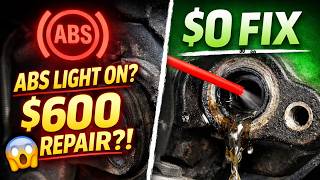
- Perform the $15 'zero-cost' fix first: remove the 10mm sensor bolt and scrub the hub mounting surface and tone ring with a wire brush and brake cleaner.
- Replacing the right rear sensor costs between $130 and $300 at a shop, but cleaning the mounting surface takes 30 minutes and costs only the price of brake cleaner.
- Verify your vehicle's specific code definition, as C1415 indicates a broken brake light switch on some Fords or a seat belt circuit short on specific Toyotas.
What Does C1415 Mean?

Code C1415 signifies the ABS control module detected a fault in the right rear (RH) wheel speed sensor circuit. This sensor provides real-time rotational speed data for the right rear wheel. When this signal is lost, erratic, or mismatched against the other wheels, the computer immediately disables the ABS, TCS, and VSC systems and triggers dashboard warning lights.
Technical definition: The SAE/OBD-II definition for C1415 is 'Rear Speed Sensor RH Output Malfunction.' The ABS module sets this code when it detects specific electrical or signal faults. On Toyota models, it triggers if an open circuit occurs 255 times, signal noise is detected 75 times within 5 seconds above 12 mph, or noise occurs once per rotor rotation for 15 consecutive seconds.
Can I Drive With C1415?
Yes, But With Caution. Yes, but drive with increased caution. Your Anti-lock Braking System (ABS), Traction Control (TCS), and Vehicle Stability Control (VSC) are disabled. Normal hydraulic brakes remain functional, but wheels will lock up during a hard stop. A lack of ABS increases braking distance by 14% on dry surfaces and up to 37% on wet surfaces. Double your following distance and avoid aggressive driving until repaired.
Common Causes

- Rust Buildup on Sensor Mounting Surface (Very Common) — Rust and grime accumulate on the hub or steering knuckle where the sensor mounts. This buildup physically pushes the sensor away from the tone ring, increasing the 'air gap' and weakening the signal until it becomes unreadable.
- Faulty Right Rear Wheel Speed Sensor (Very Common) — Internal electronic components fail due to age, thermal stress, and constant vibration, resulting in a weak, intermittent, or completely absent signal.
- Damaged or Corroded Wiring/Connector (Common) — Road debris severs wires, suspension movement causes chafing, and moisture creates corrosion in the connector pins, interrupting the signal.
- Damaged or Debris-Covered Tone Ring (Common) — The sensor reads a toothed or magnetic tone ring rotating with the wheel. If this ring cracks, loses teeth, or gets obscured by metallic brake dust 🎬 Watch: How to clean your magnetic tone ring in minutes., the sensor cannot generate a clean signal.
- Failed Wheel Hub Bearing Assembly (Less Common) — Many modern vehicles integrate the tone ring into the wheel hub bearing assembly. A failing bearing develops excessive play, damaging the integrated ring or causing its distance from the sensor to fluctuate wildly.
- Incorrect Wheel Bearing Installation (Less Common) — Wheel bearings with integrated magnetic encoders are directional. Pressing the bearing into the hub backward faces the magnetic ring away from the sensor, causing an immediate C1415 code.
- Low Battery Voltage or Failing Alternator (Rare) — A weak battery or faulty alternator creates unstable voltage. The sensitive ABS module misinterprets these voltage drops as sensor faults.
- Magnetic Interference (Rare) — Using magnetic tools near active MRE-type sensors disrupts the reading or damages the sensor. Placing a magnetic pickup tool or parts tray on the hub causes a temporary fault.
- Faulty ABS/VSC Control Module (Very Rare) — The control module processing the signal fails internally. This expensive component is the culprit only after exhaustively ruling out the sensor, wiring, and tone ring.
Symptoms

- ABS Light On — The Anti-lock Braking System warning light illuminates permanently on the instrument cluster.
- Traction Control (TCS/VSC) Light On — The traction control and vehicle stability control lights illuminate, as these systems require accurate wheel speed data.
- Disabled ABS and Traction Control — Wheels lock and skid during emergency braking. Drive wheels spin freely when accelerating on slippery surfaces because traction control cannot intervene.
- Chassis Stabilization / Drivetrain Malfunction Warnings — BMW and similar luxury brands trigger 'Chassis Stabilization Malfunction' or 'Drivetrain Malfunction' messages and engage a reduced-power limp mode.
- Erratic Speedometer Behavior (Rare) — Vehicles calculating speed from rear wheel sensors display an incorrect speedometer reading or drop to zero intermittently.
Diagnostic Flowchart
Tap your situation to follow the diagnostic path that matches what you're seeing on this code.
Common Fixes & Costs

- Clean Sensor Mounting Surface and Tone Ring — Parts: $0-$15, Labor: $50-$100, ~0.5 hr book time (DIY)
- Replace Right Rear Wheel Speed Sensor
— Parts: $40-$150, Labor: $90-$150, ~1.0 hr book time
(DIY)
Toyota Sienna (2011-2020): OEM Corresponds to 89545-XXXXX (Right Side of 89546-08020 for AWD) (Alt: Holstein 2ABS2511, TRQ ABS2825, Standard Motor Products ALS2322)
Toyota Highlander (2008-2019): OEM 89545-0E020 (Alt: Delphi SS20860, Bosch 0986594555, Denso 5S8684, VEMO V70-72-0408)
Toyota Tacoma (2005-2015): OEM Corresponds to 89542-XXXXX (Right Side of 89543-04020) (Alt: Dorman 970-034, SKP SK970331, Delphi SS10471) - Repair Damaged Wiring or Connector Pigtail — Parts: $10-$40, Labor: $120-$280, ~1.5 hr book time (Intermediate)
- Replace Rear Wheel Hub Bearing Assembly (includes tone ring)
— Parts: $120-$350, Labor: $180-$450, ~2.5 hr book time
(Intermediate)
Toyota Sienna (2011-2020): OEM AWD: 42410-08020, FWD: 42450-08030 (Alt: MOOG 512482, Timken HA590378, Carquest 91-481000)
Toyota Highlander (2008-2019): OEM Corresponds to 42460-0E040 / 42460-0E030 (Alt: Timken HA590283, SKF BR930733, Mevotech H512392)
Toyota Tacoma (2005-2015): OEM 4WD/Prerunner Right: 42450-04010 (Alt: TRQ BHA52876, Detroit Axle 512294, WJB WA512294) - Replace ABS/VSC Control Module — Parts: $1000-$1800, Labor: $150-$250, ~1.5 hr book time (Professional)
Used vs. New Parts: Buying Guide
When a used part is worth it: Buy a used OEM sensor from a reputable salvage yard for older, high-mileage vehicles. Never buy a used wheel hub bearing assembly due to unknown wear and high risk of premature failure.
Donor-vehicle mileage cap: roughly under 60000 miles for the part to have meaningful remaining life.
Donor quality checklist:
- Verify the donor vehicle avoided rear-end or side collisions.
- Ensure an exact part number match.
- Ask for a warranty (30-90 days is common for used parts).
- Avoid parts from the Rust Belt to prevent corrosion issues.
Decision logic:
- If The part is a complete wheel hub bearing assembly. → Buy new. Labor is significant, and used bearings fail prematurely.
- If The part is a standalone wheel speed sensor and the vehicle is over 10 years old. → Used OEM is acceptable, but new aftermarket parts offer better warranties for similar prices.
- If The vehicle is a luxury or European brand (e.g., BMW, Audi). → Buy new OEM or high-quality OEM-supplier (Bosch, VDO) parts, as these systems reject cheap aftermarket electronics.
Warranty tradeoff: Used parts typically have a 30-90 day warranty that covers the part only, not labor. New aftermarket parts often come with a 1-year to limited lifetime warranty. New OEM parts carry a 1-year warranty.
Worst-case if a used part fails: $200-$500 if a used part fails after installation, as you will have to pay for the labor a second time.
What Happens If You Wait — Timeline
- 0-1 month: Code sets and ABS/TCS lights illuminate. Safety systems are disabled, but normal hydraulic braking feels unchanged. (MPG impact: 0-5%% · Added cost: $0)
- 1-4 months: Hybrids experience a drop in fuel economy due to disabled regenerative braking. Vehicles relying on the sensor for transmission data experience hard shifts. (MPG impact: 5-15%% · Added cost: $50-$150 in wasted fuel.)
- 4-12 months (if caused by bad bearing): If caused by a bad bearing, humming progresses to loud grinding. Wheel wobble accelerates tire wear and damages the brake caliper. (MPG impact: 10-20%% · Added cost: $300-$800 (cost of a new tire and potential brake components, in addition to the now-mandatory hub replacement).)
- 12+ months (if caused by bad bearing): Catastrophic wheel bearing failure. The hub assembly separates from the vehicle, causing wheel detachment, loss of control, and severe suspension damage. (MPG impact: N/A% · Added cost: $2,500 - $7,000+ (cost of accident repairs, towing, and replacement of multiple suspension components).)
Cost of Not Fixing It
- Immediate: Loss of ABS, traction control, and stability control. Increases risk of wheel lock-up and skidding during emergency braking or on slippery surfaces. (Added cost: Potential cost of an accident.)
- Short-Term (Weeks to Months): Inaccurate speedometer readings lead to speeding tickets. Continued driving causes uneven tire wear if a bad wheel bearing is the root cause. (Added cost: $50 - $500+)
- Long-Term (6+ Months): Ignoring a failing wheel bearing leads to catastrophic failure where the wheel hub separates from the vehicle. Faulty wheel speed signals also cause erratic shifting and premature transmission wear. (Added cost: $1500 - $5000+)
Diagnosis Steps

- Read and Verify the Code
Use an ABS-capable OBD-II scanner to confirm C1415 is active. If C1416 (Left Rear) is also present, suspect a shared wiring issue or a faulty ABS module.
Tools: OBD-II Scanner (ABS/Chassis capable) (Beginner) - Check Live Data with a Scanner
Monitor the 'RR Wheel Speed' PID using a live-data scanner. Spin the right rear wheel by hand. The speed must register smoothly and match the left rear wheel. A reading of 0 mph or erratic jumping confirms an active fault.
Tools: Advanced OBD-II Scanner (with Live Data) (Intermediate) - Visual Inspection of Sensor, Wiring, and Connector
Safely raise and support the vehicle. Trace the right rear wheel speed sensor wire harness. Look for cut wires, melted plastic, suspension rub marks, and corroded connector pins.
Tools: Jack, Jack Stands, Flashlight (Beginner) - Inspect Tone Ring and Clean Mounting Surface (Pro Tip)
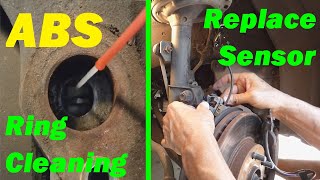
Remove the wheel and the 10mm sensor bolt. Inspect the tone ring for cracks, missing teeth, or metallic dust. Meticulously clean the hub mounting surface with a wire brush. Rust buildup here increases the air gap and weakens the signal.
Tools: Wire Brush, Brake Cleaner, Basic Hand Tools (Intermediate) - Check for Wheel Bearing Play
Grasp the supported tire at 12 and 6 o'clock and rock it back and forth. Noticeable play or a grinding noise when spinning indicates a bad wheel bearing, which destroys the integrated tone ring.
Tools: Jack, Jack Stands (Intermediate) - Active Sensor Voltage Test
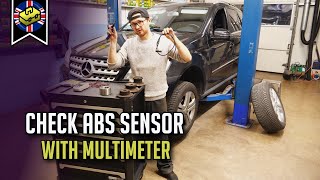
For modern 2 or 3-wire active sensors, do NOT use a resistance test. Disconnect the sensor, turn the key ON (engine OFF), and probe the harness terminals. Verify a 5V or 12V reference voltage and a good ground. Missing voltage indicates a wiring or ABS module fault.
Tools: Multimeter, Back-Probes, Vehicle-Specific Wiring Diagram (Advanced) - Passive Sensor Resistance Test
For older 2-wire passive sensors, disconnect the sensor and measure resistance across its pins. A good sensor reads 1000-2500 Ohms (check exact specs). Infinite resistance (Open Loop) or near-zero resistance confirms a failed sensor.
Tools: Multimeter, Vehicle-Specific Repair Manual (Advanced) - Check Wiring Continuity to ABS Module
Disconnect the sensor and the ABS module connectors. Measure continuity on the signal and ground wires between them. Resistance must be under 1.0 Ohm. Test resistance between each wire and chassis ground to rule out shorts (must be >10 kOhms).
Tools: Multimeter, Vehicle-Specific Wiring Diagram (Advanced) - Waveform Analysis with an Oscilloscope (Professional)
Connect an oscilloscope to the sensor's signal and ground wires. A good active sensor produces a clean digital square wave. Missing pulses indicate a damaged tone ring tooth, while low amplitude confirms excessive air gap or corrosion.
Tools: Oscilloscope, Breakout Leads or Back-Probes (Professional)
When This Code Triggers (Freeze-Frame Conditions)
- Vehicle Speed: 12-40 mph (20-65 km/h) (Sets during city or highway driving when the module expects a consistent signal but receives erratic or no data from the right rear sensor.)
- System Voltage: 11-14V (Normal operating voltage. Low voltage causes false codes, but C1415 is rarely voltage-related unless other electrical symptoms exist.)
- Brake Pedal Status: Off (The fault typically triggers during steady driving, as the ABS module continuously monitors all four wheels regardless of braking.)
- Engine RPM: 1000-2500 RPM (Correlates with steady-state driving when the fault is logged, providing context for the vehicle's state.)
Related Codes
- C1416 — Identical fault for the Left Rear (LH) wheel speed sensor. If C1415 and C1416 appear simultaneously, suspect a shared wiring harness, common ground, or faulty ABS module rather than two simultaneously failed sensors.
- C1223 — A generic 'ABS Control System Malfunction' code. Treat C1415 as the specific diagnostic target. C1223 simply indicates the ABS module recognizes a fault exists.
- P0500 — Generic 'Vehicle Speed Sensor Malfunction'. If the speedometer dies alongside C1415, the right rear sensor circuit is the prime suspect, as the vehicle derives speed data from it.
- U0415 — Network communication code for 'Invalid Data Received From ABS Module'. Confirms the ABS module cannot broadcast reliable wheel speed data to the ECU or Transmission Control Module.
Climate & Environmental Factors
- Rust Belt / High Humidity: High humidity and road salt cause aggressive corrosion. 'Rust jacking' on the hub pushes the sensor away from the tone ring, increasing the air gap. External tone rings swell, crack, or contact the sensor directly.
- Cold Weather: Extreme cold makes plastic wiring insulation brittle. Constant suspension movement cracks this insulation, allowing moisture to penetrate and short the circuit.
How to Talk to a Mechanic About This Code
Say this: "I have an ABS light on and my scanner shows a C1415 code for the right rear wheel speed sensor circuit. I'd like to book a diagnostic appointment. Please check the wiring, tone ring, and rust on the sensor mount before recommending a new sensor."
Signals you understand the problem isn't always a bad sensor. Directs the technician to perform a thorough diagnosis rather than firing the parts cannon.
Avoid saying:
- 'My ABS light is on, can you fix it?'
- 'Just replace the right rear speed sensor.'
- 'I have a C1415, just do whatever it takes to fix it.'
Questions to ask before authorizing the repair:
- What was the specific point of failure? Was it the sensor, the wiring, the tone ring, or something else?
- Did you check the live data from the sensor? What did it show?
- If the sensor needs replacement, what is the warranty on the new part and your labor?
- If it's a wiring repair, how will you ensure the connection is sealed against moisture?
Where to Take It: Dealer vs Independent vs Chain
- Dealer:
A safe but expensive choice. Recommended if you suspect a manufacturer-specific quirk or if the vehicle is still under warranty.
Best for: Vehicles under warranty, Complex cases where manufacturer-specific quirks are involved (e.g., on some Fords or Jeeps where C1415 means something else), When previous repairs at other shops have failed
Downsides: Highest labor rates, Prefers replacing entire assemblies (like a hub) rather than a smaller component (Typical cost: +50% vs. baseline) - Independent Shop:
Best fit for most situations. A good independent shop handles this common repair effectively and more affordably than a dealer.
Best for: Most out-of-warranty vehicles, Standard C1415 diagnosis and repair (sensor, wiring, hub cleaning), Building a long-term relationship with a trusted mechanic
Downsides: Diagnostic capabilities vary widely; check for ASE certifications and good reviews. (Typical cost: +0% vs. baseline) - Chain Shop:
Use with caution. Acceptable for a simple sensor swap, but AVOID for initial diagnosis, as they default to replacing parts without investigating mechanical causes like rust or debris.
Best for: Simple, straightforward sensor replacement if you have already diagnosed the issue yourself.
Downsides: Technician skill varies greatly., Lacks advanced diagnostic tools for complex wiring or module issues., High pressure to upsell services like brake fluid flushes or other unrelated items. (Typical cost: -10% vs. baseline)
When to Walk Away From the Repair
If the estimated repair cost exceeds 40-50% of the car's private-party value, pause and consider alternatives.
- Car worth $4000, fix is $750: Fix it. The repair cost is well below the threshold.
- Car worth $3000, fix is $1800: Walk away. The repair cost is over 50% of the car's value and points to a major issue (e.g., ABS module).
- Car worth $8000, fix is $3500: Borderline. This implies a very expensive repair like an ABS module plus other work. Get a second opinion before proceeding.
What Scan Tool You Need for This Code
Minimum: A scanner capable of reading ABS fault codes and viewing live wheel speed sensor data.
A $20 OBD-II reader only accesses engine 'P' codes. You need a tool that communicates with the ABS module to see chassis 'C' codes and live wheel speed data.
Budget: BlueDriver Pro (~$99) — Connects via Bluetooth. Reads ABS codes and displays live data for all wheel speed sensors.
Mid-range: Foxwell NT510 Elite / Autel AutoLink AL619 (~$150) — Handheld unit offering dedicated ABS/SRS diagnostics and live data graphing.
Professional: Autel MaxiCOM MK808 / Foxwell NT630 Plus (~$450-600) — Provides full system diagnostics, bi-directional controls to test ABS solenoids, and ABS brake bleeding functions.
Rent vs buy: Auto parts stores lend basic readers that cannot read ABS codes. Buying a budget Bluetooth scanner is cheaper than a single shop diagnostic fee.
How to Clear the Code After You Fix It
- Use an ABS-capable OBD-II scan tool to clear the fault memory.
- Perform a specific drive cycle to allow the ABS module to confirm the repair.
Drive cycle (~5 minutes): Drive the vehicle at 19 mph (30 km/h) or more for at least 30 seconds. On Toyota/Lexus models, this extinguishes the ABS light if the repair was successful. Other makes require a 5-10 minute drive with turns for the system to self-test.
Readiness monitors affected: Not applicable for emissions. A C1415 code does not directly affect emissions readiness monitors like the Catalyst or O2 sensor monitors.
Watch out for:
- Disconnecting the battery does not clear ABS codes on modern vehicles.
- The light will not turn off immediately after part replacement; the drive cycle must be completed for the system to verify the fix.
Will This Fail Emissions / State Inspection?
No — by itself this code doesn't fail OBD inspection (but it can keep readiness monitors from setting, which causes a separate fail).
- California: An illuminated ABS light does NOT fail a California smog check, as the test focuses strictly on emissions.
- New York: An illuminated ABS warning light causes an immediate failure during the annual New York safety inspection.
- Texas: The ABS light alone does not fail a Texas safety inspection, but the vehicle will fail if the underlying fault degrades the base hydraulic braking performance test.
Most Commonly Affected Vehicles
- Toyota Sienna (2011-2020) — Extremely common. Often occurs after suspension work or an accident, indicating damaged wiring or incorrect aftermarket hubs.
- Toyota Highlander (2008-2019) — Frequently affected. The diagnostic procedure is heavily documented in Toyota technical service bulletins.
- Toyota Tacoma (2005-2015) — A known issue frequently caused by stretching or tearing the wiring harness during off-road use or lift kit installation.
- Lexus RX Series (RX350, RX450h) (2004-2015) — Shares the Toyota ABS/VSC architecture, making it highly susceptible to identical sensor and wiring failures.
- Ford F-150 / Explorer (2004-2020) — On specific Ford models, C1415 indicates a 'Stop Lamp Switch Circuit Failure' or 'Incorrect Module Configuration' rather than a wheel speed sensor.
- Honda Civic / CR-V (2006-2015) — Severe rust jacking on the steering knuckle pushes the sensor out of alignment, increasing the air gap without the sensor actually failing.
- Kia / Hyundai Sorento / Sonata (2011-2016) — The wiring pigtail near the sensor fails frequently due to wire fatigue. Kia issued service campaign SC148 for 2011-2015 Sorentos to seal the sensor housing against water.
- BMW 3-Series (E90, F30) / X3 (F25) (2006-2019) — Corrosion swells the reluctor ring on the axle shaft, causing it to physically contact and destroy the wheel speed sensor, triggering limp mode.
Manufacturer-Specific Notes
- Toyota/Lexus: On specific models, C1415 means 'RF Seat Belt Pre-Tensioner Circuit Short.' Use a scanner capable of identifying whether the ABS or SRS system triggered the code.
- Ford: C1415 indicates 'Stop Lamp Switch Circuit Failure' or 'Incorrect Module Configuration.' A faulty brake light switch confuses the ABS module into setting this fault.
- Jeep: On hybrid models, C1415 means 'F-CAN Malfunction (BUS-OFF (Motor Control Module))', indicating a communication network failure rather than a wheel speed sensor issue.
- Kia: Voluntary Service Campaign SC148 for 2011-2015 Sorento 2WD models involves applying silicone sealant to the rear wheel speed sensor housing to prevent water intrusion.
- BMW: TSB SIB 33 01 26 links wheel speed sensor faults directly to water ingress and corrosion within the rear wheel bearing, requiring replacement of both rear bearings.
Real Owner Stories
2021 Toyota Tacoma with intermittent C1415
ABS, pre-collision, and brake warning lights illuminated periodically at 15-30 mph. Code reader confirmed C1415.
Outcome: Removing the brake drums revealed debris and burnt grease on the tone ring. Cleaning it resolved the code completely.
Lesson: Intermittent low-speed faults often stem from debris inside the brake assembly. Thorough cleaning is a zero-cost fix.
2012 Toyota Sienna with C1415 after body shop repair
C1415 appeared above 19 mph immediately after a body shop installed a new wheel hub assembly.
Outcome: The new aftermarket hub was faulty and provided an unclean signal. Replacing it with an OEM hub fixed the issue.
Lesson: New parts fail. If a code appears immediately after a repair, suspect an incorrect part, faulty new part, or installation error.
2016 Toyota Tacoma with C1415 after installing a lift kit
ABS and Traction Control lights illuminated immediately after installing a suspension lift kit.
Outcome: The ABS sensor wire was stretched and torn when the spindle dropped. Soldering the wire fixed the issue.
Lesson: ABS wiring is highly vulnerable during suspension work. Always unbolt the sensor wire brackets before dropping a spindle or axle.
How to Prevent This Code From Triggering
- Perform periodic brake cleaning (Every 15,000-30,000 miles or during every brake service) — Removes brake dust and road grime from the tone ring and sensor tip, preventing signal obstruction and corrosion.
- Apply dielectric grease to sensor connectors (Whenever the connector is unplugged for service) — Blocks moisture and prevents corrosion on electrical pins, a primary cause of signal loss in wet climates.
- Inspect and secure wiring harnesses (During tire rotations or underbody inspections) — Ensures the ABS wire is secured in factory clips and not rubbing against suspension components or tires.
- Address failing wheel bearings promptly (As soon as grinding or humming noises appear) — Prevents excessive play from damaging the integrated magnetic tone ring or destroying the ABS sensor.
Frequently Asked Questions
Can I fix a C1415 code myself?
Yes, replacing the sensor or cleaning the mounting area requires only basic hand tools. However, accurate diagnosis to avoid replacing good parts requires a multimeter or an advanced scanner.
Will clearing the code fix the problem?
No. The warning lights return as soon as the ABS module runs its self-test and detects the fault again. On many Toyotas, you must drive over 19 mph for 30 seconds for the light to turn off after a successful repair.
What is the most common misdiagnosis for C1415?
The most common mistake is replacing the sensor without cleaning the mounting surface. A wire brush and brake cleaner often fix the problem by restoring the correct air gap between the sensor and tone ring.
My mechanic replaced the sensor, but the light is still on. What's next?
If a quality new sensor didn't fix it, the issue lies in the wiring, tone ring, or ABS module. Inspect the wiring harness for breaks and test for continuity to the ABS module. Verify the correct aftermarket part was installed, as quality varies.
Can a weak battery cause a C1415 code?
Yes. Low system voltage from a failing battery or alternator causes electronic modules to malfunction and store false codes. Test the battery and charging system before diagnosing the ABS fault if you experience slow cranking or dim lights.
What is a tone ring and can it be cleaned?
A tone ring is a notched or magnetized ring that spins with the wheel, allowing the sensor to calculate speed. It must be cleaned with brake cleaner and a wire brush to remove metallic dust that interferes with the sensor's reading.
What is the difference between an active and a passive wheel speed sensor?
Passive sensors are simple magnetic coils found on older cars that generate AC voltage and are tested for resistance (1000-2500 ohms). Active sensors are powered by the car (5V or 12V) and produce a digital square-wave signal. Active sensors must be tested by checking for power and observing the output signal, never with a resistance test.
Why did my ABS, Traction Control, and Brake lights all come on at once?
These safety systems rely on accurate data from all four wheel speed sensors. When the computer loses the right rear signal, it cannot calculate traction interventions safely. As a fail-safe, it disables all related systems and illuminates their warning lights.
Key Takeaways
- Code C1415 isolates the fault to the right rear wheel speed sensor circuit, but rust buildup or wiring damage causes the issue just as often as a dead sensor.
- Driving with C1415 disables ABS and traction control, increasing wet braking distances by up to 37%.
- Perform the $15 'zero-cost' fix first: remove the 10mm sensor bolt and scrub the hub mounting surface and tone ring with a wire brush and brake cleaner.
- Replacing the right rear sensor costs between $130 and $300 at a shop, but cleaning the mounting surface takes 30 minutes and costs only the price of brake cleaner.
- Verify your vehicle's specific code definition, as C1415 indicates a broken brake light switch on some Fords or a seat belt circuit short on specific Toyotas.
Helpful Videos

The information in this article is provided for general reference and educational purposes only. Vehicle specifications, procedures, and part compatibility can vary by production date, trim level, and region. Always consult your vehicle's factory service manual and verify part numbers before purchasing or performing repairs. Safety-critical components such as airbags, seat belts, and braking systems should be installed by a qualified professional.
- 🎬 Helpful Videos
- What Does C1415 Mean?
- Can I Drive With C1415?
- Common Causes
- Symptoms
- Diagnostic Flowchart
- Common Fixes & Costs
- Used vs. New Parts: Buying Guide
- What Happens If You Wait — Timeline
- Cost of Not Fixing It
- Diagnosis Steps
- When This Code Triggers (Freeze-Frame Conditions)
- Related Codes
- Climate & Environmental Factors
- How to Talk to a Mechanic About This Code
- Where to Take It: Dealer vs Independent vs Chain
- When to Walk Away From the Repair
- What Scan Tool You Need for This Code
- How to Clear the Code After You Fix It
- Will This Fail Emissions / State Inspection?
- Most Commonly Affected Vehicles
- Manufacturer-Specific Notes
- Real Owner Stories
- 2021 Toyota Tacoma with intermittent C1415
- 2012 Toyota Sienna with C1415 after body shop repair
- 2016 Toyota Tacoma with C1415 after installing a lift kit
- How to Prevent This Code From Triggering
- Frequently Asked Questions
- Can I fix a C1415 code myself?
- Will clearing the code fix the problem?
- What is the most common misdiagnosis for C1415?
- My mechanic replaced the sensor, but the light is still on. What's next?
- Can a weak battery cause a C1415 code?
- What is a tone ring and can it be cleaned?
- What is the difference between an active and a passive wheel speed sensor?
- Why did my ABS, Traction Control, and Brake lights all come on at once?
- Key Takeaways
- 🎟️ Get 5% Off