

C1391 on 2010 Lexus RX450H: Accumulator Leak and Brake Failure Explained
Code C1391 on a 2010 Lexus RX450H indicates a critical internal leak in the brake booster/actuator assembly. This is a known issue requiring the replacement of the entire unit, an expensive repair costing over $2,500 at a dealership. Do not drive the vehicle until it is repaired, as it can lead to sudden and complete brake failure.
- C1391 is a critical safety code indicating a failure in the brake actuator assembly.
- The most common symptom, besides warning lights, is a frequent buzzing/pumping noise from the engine bay, cycling every 8-30 seconds.
- The repair is not suitable for DIY. It requires replacing the entire brake actuator assembly and specialized bleeding/calibration procedures using Toyota's Techstream software.
- This is a known issue for this model, confirmed by Lexus TSBs and a now-expired Warranty Enhancement Program (20LE03).
- Do not operate the vehicle. Have it towed to a qualified repair shop, preferably one specializing in Toyota/Lexus hybrids.
What's Unique About the 2010-2010 Lexus RX450H

The RX450H, being a hybrid, uses a sophisticated electronically controlled brake system (ECB) instead of a traditional vacuum brake booster. This system uses an electric pump to generate and store hydraulic pressure for both power assist and regenerative braking functions. The brake booster, master cylinder, pump, and accumulator are all integrated into a single, complex 'Brake Actuator Assembly'. While highly efficient, this design means a failure in one sub-component, like an internal seal, requires the replacement of the entire expensive assembly.
Diagnostic Flowchart

Tap your situation to follow the diagnostic path that matches what you're seeing on this vehicle.
Generation note: This issue is not isolated to the 2010 model. TSB L-SB-0033-20 covers the 2010-2012 RX450H. Furthermore, Lexus and Toyota have issued similar warranty enhancement programs for other models and years, including the Toyota Highlander Hybrid (2008-2010), and later model year Lexus ES300h and NX300h vehicles, for the same set of DTCs (C1391, C1252, C1256, C1253), indicating a persistent design issue across various hybrid platforms.
Symptoms You May Notice
- Brake, ABS, and TRAC warning lights illuminated on the dashboard.
- "Check VSC" or "Check Brake System" message displayed.
- A frequent buzzing or humming noise from the engine bay, cycling on and off as frequently as every 8 to 30 seconds, even when the brake pedal is not being pressed. 🎬 Listen to the specific buzzing sound of a failing pump here. This is the pump constantly trying to repressurize the system.
- A change in brake pedal feel, potentially feeling soft, 'spongy', or unusually hard.
- Increased stopping distance or delayed brake response.
- A chirping or "seal barking" sound when the brake pedal is pressed or released, which can be a precursor to failure.
- Replacing only the brake booster pump or master cylinder. On this vehicle, these are integrated into one assembly and are not typically serviced separately.
- Assuming the issue is just air in the brake lines. While bleeding the brakes is part of the replacement procedure, simply bleeding an old, failing unit will not fix the internal leak.
- Replacing only the accumulator. Some forum members have reported replacing just the accumulator only to have the C1391 code return, necessitating the replacement of the full actuator assembly.
Most Likely Causes

- Internal Failure of the Brake Actuator Assembly 🔴 High Probability As documented in Lexus Technical Service Bulletins L-SB-0033-20 and warranty enhancement program 20LE03, this model is prone to small internal brake fluid leaks within the brake booster assembly due to seal degradation over time. This is a widely acknowledged failure point for Toyota/Lexus electronically controlled brake systems of this era. Some owners and mechanics theorize that infrequent brake fluid changes may contribute to internal corrosion and seal failure.
How to confirm: The presence of code C1391, often accompanied by C1252, C1253, or C1256, is the primary confirmation. A technician can use a scan tool like Techstream to monitor accumulator pressure sensor voltage; a rapid pressure drop without brake application confirms an internal leak. A functional system should hold pressure for an extended period, while a failing one may lose pressure in under a minute.
Typical fix: The entire Brake Actuator Assembly (which includes the booster, pump, and master cylinder) must be replaced. Attempting to replace individual components like just the accumulator or pump is not the recommended procedure and often fails to resolve the issue.
Est. part cost: $1150-$1600
Rare But Worth Checking
- Failing 12V Auxiliary Battery: While the primary cause is almost always the actuator, some owners have noted that a weak 12V battery can cause various spurious electronic faults and warning lights. It's a simple and relatively inexpensive check to perform before committing to a major repair.
- External Brake Fluid Leak: While the TSBs point to an internal leak, the factory diagnostic procedure includes checking for any external leaks in the brake lines or at the wheel cylinders. This is far less common for this specific code but must be ruled out.
Diagnosis Steps
- Confirm the presence of code C1391 (and any other related codes like C1252, C1253, C1256) using an OBD-II scanner capable of reading chassis codes.
- Listen for the brake pump in the engine bay with the vehicle on (READY). If it cycles on and off every 8-30 seconds without the brakes being applied, it's a strong sign of a pressure leak.
- Use a diagnostic tool like Techstream to monitor the 'Accumulator Pressure Sensor' value in the Data List. Observe the pressure voltage drop with the pump off. A rapid decrease confirms a leak. A healthy system should maintain pressure between approximately 3.2-4.0V. A failing system will see the voltage drop to the pump restart threshold (around 3.15V) in under a minute.
- Visually inspect all brake lines, calipers, and connections for any signs of external fluid leaks to rule out a simpler cause.
- Check the 12V auxiliary battery's health to rule it out as a source of electrical issues.
- If no external leaks are found and the battery is healthy, the diagnosis is confirmed as an internal failure of the Brake Actuator Assembly, as per Lexus TSBs #L-SB-0033-20 and warranty program #20LE03.
Parts You'll Likely Need

- Brake Actuator Assembly
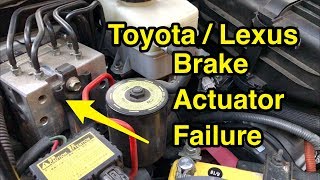
(OEM #44050-48320)— This is the complete unit that fails internally, causing code C1391. It includes the ABS pump, master cylinder, and accumulator. Replacement is the only definitive fix. 🎬 Watch this step-by-step walkthrough on how to fix code C1391. The original part number may have been 44510-48080, which was superseded by 44050-48320.
Trusted brands: Lexus/Toyota (OEM)
OEM price range: $1150-$1600
Aftermarket price range: $350-$950 (Used or Remanufactured)
Related Codes That Often Appear With This One
- C1252 — Brake Booster Pump Motor On Time Abnormally Long. This code is triggered because the pump has to run excessively to compensate for the pressure loss from the leak that C1391 detects.
- C1253 — Brake Booster Pump Motor Relay Malfunction. The constant cycling of the pump motor can put stress on its control relay, leading to this code.
- C1256 — Accumulator Low Pressure. This is a direct result of the leak indicated by C1391; the system cannot maintain its target pressure.
Technical Service Bulletins (TSBs) & Recalls

- L-SB-0033-20: Confirms that warning lights and DTCs C1391, C1252, C1256, or C1253 may be caused by a small internal brake fluid leak in the brake booster assembly with master cylinder for 2010-2012 RX450H models.
- 20LE03: A Customer Support Program bulletin detailing the warranty extension for the Brake Booster and Brake Booster Pump Assemblies due to internal malfunctions verified by codes C1391, C1252, C1256, or C1253.
Platform-Specific Known Issues
- Lexus Warranty Enhancement Program 20LE03 (Formerly ZE1): Lexus acknowledged this widespread issue by issuing a warranty enhancement program (20LE03) for the 2010-2012 RX450H. This was not a recall. It extended coverage for this specific failure to 10 years or 150,000 miles from the date of first use. The primary coverage period ended on December 31, 2021, so most vehicles are no longer covered unless they fall within the secondary 10-year/150k mile window.
- High Dealership Repair Costs: Owners on forums like ClubLexus consistently report dealership repair quotes ranging from $3,200 to over $4,300 for this repair after the warranty enhancement expired.
- Failure Mileage: This failure can occur at various mileages, but forum reports show it is common around and just over the 100,000-mile mark, often conveniently after the standard powertrain or hybrid system warranty has expired.
Mechanic-Grade Diagnostic Values
- Accumulator Pressure Sensor Voltage (ACC PRESS SENS) — expected: 3.2V to 4.0V when the pump is stopped and pressure is stable.. Failure: A steady drop in voltage while the system is at rest. The pump motor will restart when voltage drops to approximately 3.15V. On a failing unit, this drop can occur in less than 30-60 seconds.
Hidden / Shadow Codes Worth Checking
- C1391/69 (Detail Code 591): The main code C1391 can be accompanied by a 2-digit sub-code (69) and a 3-digit detail code (591). Detail code 591 specifically points to 'Accumulation performance is deteriorated' due to factors like improper internal sealing, a drop in gas pressure, or valve leaks within the actuator assembly. (see via These detailed codes are visible using dealer-level diagnostic tools like Toyota Techstream or equivalent advanced scanners.)
Scan Tool Commands That Help
- Toyota Techstream: Chassis / ABS/VSC/TRC / Utility / Air Bleeding — This is a mandatory, multi-step procedure after replacing the brake actuator assembly. It has specific sub-routines like 'Usual air bleeding' for regular service and 'ABS actuator has been replaced' for use after installing a new unit. Failure to use this utility will result in incomplete bleeding and an unsafe brake system.
- Toyota Techstream: Chassis / ABS/VSC/TRC / Utility / ECB Utility / Zero Down — This function is used to release all high pressure from the accumulator, returning the fluid to the reservoir. It is a required first step before servicing or replacing the brake actuator to ensure safety.
- Toyota Techstream: Chassis / ABS/VSC/TRC / Utility / ECB Utility / Linear Valve Offset — This calibration must be performed after replacing the brake actuator or stroke sensor. It learns the characteristics of the new linear solenoid valves. The 'Reset Memory' function must be used before this calibration when a new actuator is installed.
- Toyota Techstream: Chassis / ABS/VSC/TRC / Utility / ECB Utility / ECB Invalid — This temporarily disables the electronic brake control system, allowing for manual bleeding of the front brakes in a traditional two-person process.
Wiring & Ground Locations
- Brake Actuator Assembly (includes Skid Control ECU) — Located in the right rear of the engine compartment. It is the large assembly with multiple metal brake lines and a large electrical connector attached.. This is the component that fails internally, causing code C1391. All diagnostic steps and the ultimate repair are focused on this unit.
- Skid Control ECU Ground Points — The Skid Control ECU is integrated into the Brake Actuator Assembly. Its primary ground connections are crucial for proper operation. While specific ground point designators (e.g., 'Gxxx') for the ECU itself are part of the internal assembly, the entire unit relies on a clean chassis ground.. While rare for this specific code (which usually indicates a mechanical leak), a poor ground connection to the actuator assembly could theoretically cause erratic behavior or false codes. Verifying the main harness connector and chassis ground is a valid, though secondary, diagnostic step.
Real Owner Repair Stories
- YouTube channel 'JVFIX' (2011 Lexus RX450h) — ABS lights on, code C1391 stored. Brake pump cycling on every 30 seconds. Scan tool data showed accumulator pressure dropping rapidly.
❌ Tried (didn't work) Replacing only the accumulator with a new part from the dealership did not fix the problem. The code returned and the pressure leak continued.
✅ What actually fixed it The entire brake actuator assembly was replaced with a used unit from a 2020 model with a matching part number. After installation and performing the 'Linear Valve Offset' calibration with a scan tool, the pressure held steady and all warning lights were extinguished.
OEM Part Supersession History
44510-48080→44050-48320— This is a common supersession for this component. Manufacturers often update part numbers due to design revisions, supplier changes, or consolidation.
Heads up: The parts are considered interchangeable, with 44050-48320 being the correct service part. When sourcing used parts, ensuring the main part number matches is critical.
Helpful Videos

We Have This Part in Stock



The information in this article is provided for general reference and educational purposes only. Vehicle specifications, procedures, and part compatibility can vary by production date, trim level, and region. Always consult your vehicle's factory service manual and verify part numbers before purchasing or performing repairs. Safety-critical components such as airbags, seat belts, and braking systems should be installed by a qualified professional.
- Lexus RX450H:
- 🎬 Helpful Videos
- 🛍️ Shop This Part
- What's Unique About the 2010-2010 Lexus RX450H
- Diagnostic Flowchart
- Symptoms You May Notice
- Most Likely Causes
- Rare But Worth Checking
- Diagnosis Steps
- Parts You'll Likely Need
- Related Codes That Often Appear With This One
- Technical Service Bulletins (TSBs) & Recalls
- Platform-Specific Known Issues
- Mechanic-Grade Diagnostic Values
- Hidden / Shadow Codes Worth Checking
- Scan Tool Commands That Help
- Wiring & Ground Locations
- Real Owner Repair Stories
- OEM Part Supersession History
- 🎟️ Get 5% Off