

C1391 on 2011-2015 Lexus RX HYBRID: Accumulator Leak Causes and Fixes
Code C1391 on a 2011-2015 Lexus RX Hybrid almost always means the brake actuator assembly has an internal leak and needs to be replaced. This is a critical safety issue and a very expensive repair, often costing over $3,200 at a dealership. Lexus has offered a Customer Support Program (21LE02) that extends the warranty for this specific part, which may cover the repair at no cost.
- C1391 is a critical brake system code indicating a potentially dangerous failure; do not drive the vehicle.
- The cause is almost always a failed brake actuator assembly, an expensive part.
- Before paying for repairs, ALWAYS contact a Lexus dealer with your VIN to check for coverage under Customer Support Program 21LE02 or other applicable warranties.
What's Unique About the 2011-2015 Lexus RX HYBRID

Lexus and Toyota hybrids use a sophisticated Electronically Controlled Braking (ECB) system instead of a traditional vacuum brake booster. This system is highly effective but complex. The integrated brake actuator assembly is a known common failure point across many Toyota and Lexus hybrid models, not just the RX but also the Highlander Hybrid, Prius, CT200h, and HS250h. Due to the prevalence of this issue, Lexus has issued several Customer Support Programs (warranty extensions) for this specific component, which may cover the cost of repair even outside the standard warranty period.
Diagnostic Flowchart
Tap your situation to follow the diagnostic path that matches what you're seeing on this vehicle.
Symptoms You May Notice
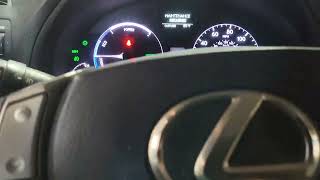
- Multiple warning lights on the dashboard, including BRAKE, ABS, TRAC, and VSC.
- A "Check VSC" message on the multi-information display.
- A buzzing or humming noise from the engine bay that cycles on and off frequently (every 8-30 seconds), even when the brake pedal is not being pressed. 🎬 Watch: Hear the specific buzzing sound of a failing pump. This is the sound of the pump constantly trying to repressurize the system.
- A soft, spongy, or inconsistent brake pedal feel, sometimes described as going to the floor.
- Increased stopping distance.
- A hissing sound of pressure escaping after the car is turned off.
- Replacing only the brake booster pump or accumulator
- Replacing individual ABS sensors
- Assuming it's a simple brake fluid top-off issue
- Mistaking the pump noise for a normal hybrid system sound
Most Likely Causes

- Internal Failure of the Brake Actuator Assembly 🔴 High Probability The integrated design of the brake actuator in Toyota/Lexus hybrid models has a history of internal seals failing over time, leading to pressure loss. This is a well-documented issue acknowledged by Lexus through multiple TSBs and warranty extensions. Some forum members suggest that infrequent brake fluid changes may contribute to premature failure by allowing moisture to corrode internal components.
How to confirm: A mechanic will use a diagnostic tool like Techstream to monitor the accumulator pressure sensor data. In a healthy system, the pressure sensor voltage should hold steady between 3.2-4.0V. If the pressure drops rapidly without brake application (e.g., the pump cycles every 30 seconds or less), it confirms an internal leak. The diagnostic procedure also involves checking for external fluid leaks; if none are found, the fault is internal to the actuator.
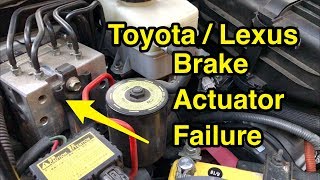
Typical fix: Complete replacement of the brake booster and master cylinder assembly, also known as the brake actuator assembly. After replacement, the system must be bled and calibrated using a specialized scan tool like Techstream. 🎬 Watch: A detailed walkthrough of the brake actuator replacement process.
Est. part cost: $1200-$2500
Rare But Worth Checking
- External Brake Fluid Leak: While the code usually points to an internal failure, the diagnostic procedure always begins with checking for external leaks from brake lines or calipers. An external leak would also cause a pressure drop, but the fix would be a line or caliper replacement, not the expensive actuator.
- Faulty Brake Skid Control ECU: In very rare cases, the computer that monitors the pressure sensor could be at fault, misinterpreting the data. However, this is highly unlikely compared to the mechanical failure of the actuator itself. The diagnostic procedure in the service manual lists this as a possibility but directs replacement of the actuator if active tests pass and no external leaks are found.
Diagnosis Steps
- Verify the presence of code C1391 and any other related codes (C1252, C1253, C1256) using a capable OBD-II scanner. 🎬 See a mechanic diagnose code C1391 and explain the fix.
- Listen for the brake pump in the engine bay with the car on (READY). If it cycles on and off frequently (e.g., every 30-60 seconds or less) without the brakes being applied, it's a strong indicator of a leak.
- Visually inspect all brake lines, hoses, and calipers for any signs of external brake fluid leaks.
- If no external leaks are found, connect a professional diagnostic tool (like Toyota Techstream) to monitor the 'Accumulator Pressure Sensor' voltage/pressure reading.
- Observe the pressure data. In a healthy system, the pressure should hold steady for a long time with a voltage between 3.2-4.0V. If the pressure drops quickly, it confirms an internal leak in the actuator assembly.
- If the diagnosis confirms an internal leak, the brake actuator assembly must be replaced.
Parts You'll Likely Need

- Brake Actuator Assembly
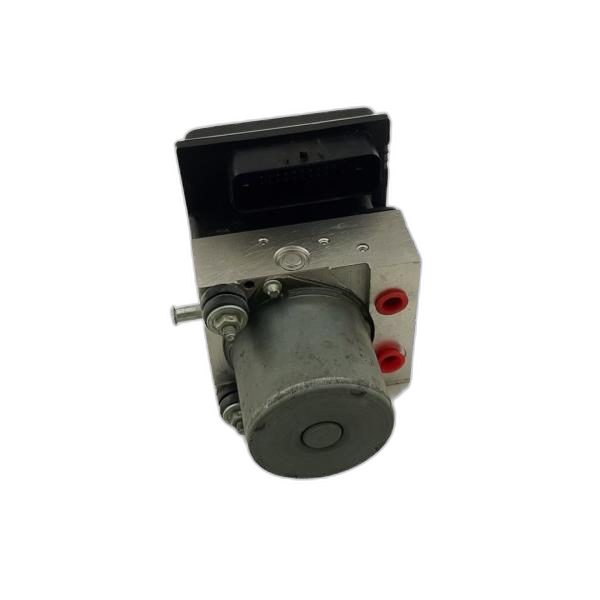
(OEM #44050-48320)— This is the complete unit that fails internally, causing the C1391 code. The entire assembly, which includes the pump, accumulator, and master cylinder, must be replaced as a single unit. Note: Part number 44050-48320 is a compatible replacement for the earlier 44510-48080 part number found on some vehicles.
Trusted brands: Lexus (OEM)
OEM price range: $1300-$2500
Aftermarket price range: $350-$600 (Used or Remanufactured, use with caution)
Related Codes That Often Appear With This One
- C1252 — This code indicates a Brake Booster Pump Motor Malfunction, which is often triggered alongside C1391 as the pump runs excessively to compensate for the leak.
- C1253 — This code points to a problem with the Brake Booster Pump Motor Relay. It can be set when the system detects issues with the pump's electrical circuit, which is stressed by the constant cycling from the leak.
- C1256 — This code indicates low pressure in the accumulator. It is a direct companion to C1391, as the 'abnormal leak' (C1391) is the cause of the 'low pressure' (C1256).
Technical Service Bulletins (TSBs) & Recalls
- L-SB-0033-20: Specifically for 2010-2012 RX 450h models, this TSB states that codes C1391, C1252, C1256, or C1253 may be caused by a small internal brake fluid leak inside the brake booster assembly with master cylinder, and provides the repair procedure.
- 20LE03: A Customer Support Program related to the brake booster assembly, which uses DTCs C1391, C1252, C1256 or C1253 for verification of the internal malfunction.
- 21LE02: A Customer Support Program specifically covering the Brake Booster and Pump Assemblies for 2013-2015 RX 450h vehicles that exhibit codes like C1391. It provides Primary Coverage until May 31, 2023, and Secondary Coverage for 10 years/150,000 miles.
Platform-Specific Known Issues
- Lexus has acknowledged this common failure by issuing Customer Support Program (CSP) 21LE02 for certain 2013-2015 RX 450h vehicles. This program extended the warranty for the Brake Booster and Pump Assemblies. The Primary Coverage ended on May 31, 2023, but a Secondary Coverage is applicable for 10 years or 150,000 miles from the date of first use, whichever comes first. It is critical to contact a Lexus dealer with your VIN to see if your vehicle is covered under this or any other active program, as the repair could be performed at no cost.
- A separate CSP (related to TSB L-SB-0033-20) covered the 2010-2012 RX 450h for the same issue, but this program has likely expired.
- Owners on forums report dealer quotes for this repair ranging from $3,200 to over $4,300. In one case, a 2010 RX450h owner was quoted $3,700 but Lexus offered to contribute $1,000 towards the repair after the owner contacted corporate, even though the vehicle was out of warranty.
Mechanic-Grade Diagnostic Values

- Accumulator Pressure Sensor Voltage — expected: 3.2V to 4.0V (or 3.0V to 4.3V) with the pump motor stopped and no braking applied.. Failure: Voltage drops rapidly without brake application, often falling below 3.2V in under 30 seconds, forcing the pump to cycle frequently.
- DTC INF Code Detection Trigger — expected: Accumulator pressure sensor input reduction rate stays within a specified, slow range while the pump is off.. Failure: The 'Accumulator pressure sensor input reduction rate exceeds the specification before braking and while the pump motor is not operating', triggering INF Code 351.
Hidden / Shadow Codes Worth Checking
- C1391/69 (INF 351): This is a more detailed version of the C1391 code. The '/69' is a sub-code, and the INF 351 specifies that the failure is due to the accumulator pressure reduction rate exceeding the allowed specification while the pump is off. (see via Toyota Techstream or a similarly advanced diagnostic scanner that can read manufacturer-specific sub-codes and INF data.)
Scan Tool Commands That Help
- Toyota Techstream: Air Bleeding (Actuator Replacement) — This is a mandatory, multi-step procedure required after installing a new brake actuator assembly. It electronically cycles the pump and solenoids to purge all air from the complex internal passages.
- Toyota Techstream: Linear Valve Offset Calibration — This is a mandatory calibration required after replacing the actuator. It learns the zero point of the new linear solenoid valves. Skipping this step will set code C1345 and leave the VSC system inoperative.
- Toyota Techstream: Active Test (Solenoid) — During diagnosis, a technician can use this function to individually command solenoids like SMC1, SMC2, SLRRR, and SLRRL to verify their mechanical and electrical operation, helping to rule out a solenoid-specific fault.
- Toyota Techstream: Accumulator Zero Down — This is a critical safety procedure to be performed *before* disassembling the brake system. It electronically releases the high pressure stored in the accumulator to prevent injury from high-pressure brake fluid spray.
Wiring & Ground Locations
- Brake Actuator Assembly — Located in the right rear of the engine compartment.. This is the physical location of the entire component that fails and must be replaced. Knowing its location is essential for inspection and replacement.
- Skid Control ECU Ground — The Skid Control ECU is integrated into the Brake Actuator Assembly. Its ground points are critical for proper function. Service manuals show ground point diagrams under identifiers like 'AB1' and 'Db1'.. A poor ground connection to the ECU can cause erratic behavior and potentially mimic sensor failures. Verifying ground integrity is a key step in advanced electrical diagnosis.
Real Owner Repair Stories
- YouTube channel 'JVFIX LLC' (2011 Lexus RX450h) — ABS light on, code C1391, pump cycling every 30 seconds.
❌ Tried (didn't work) Replacing only the accumulator (the round component on top) with a new one from the dealership did not fix the problem.
✅ What actually fixed it The entire ABS unit (brake actuator assembly) was replaced with a used unit from a 2020 model that had a matching part number. After installation and performing the calibration with Techstream, the pump cycling stopped and the code was resolved. - ClubLexus user (2013 Lexus RX450h, 110,000 miles) — Check ABS light, code C1391.
❌ Tried (didn't work) Dealer diagnosis cleared the warning lights temporarily, but the underlying fault remained.
✅ What actually fixed it The owner was recommended to replace the entire actuator and accumulator assembly for a quoted price of over $4,300. The story confirms the high cost and commonality of the failure on a 2013 model.
OEM Part Supersession History
44510-48080→44050-48320— Part has been updated or revised by the manufacturer. The new part is the correct service replacement.
Heads up: The parts are generally considered cross-compatible, with 44050-48320 being the later, correct replacement for an older 44510-48080 unit.
Model Year Variations Within This Range
- 2010-2012 vs 2013-2015: The primary difference for owners is the specific Lexus Customer Support Program (CSP) that applies. 2010-2012 models were covered under a program related to TSB L-SB-0033-20, which is likely expired. 2013-2015 models were covered by CSP 21LE02, which has a secondary coverage period of 10 years/150,000 miles. The underlying mechanical failure and repair procedure are the same.
Helpful Videos

We Have This Part in Stock




The information in this article is provided for general reference and educational purposes only. Vehicle specifications, procedures, and part compatibility can vary by production date, trim level, and region. Always consult your vehicle's factory service manual and verify part numbers before purchasing or performing repairs. Safety-critical components such as airbags, seat belts, and braking systems should be installed by a qualified professional.
- Lexus RX HYBRID:
- 🎬 Helpful Videos
- 🛍️ Shop This Part
- What's Unique About the 2011-2015 Lexus RX HYBRID
- Diagnostic Flowchart
- Symptoms You May Notice
- Most Likely Causes
- Rare But Worth Checking
- Diagnosis Steps
- Parts You'll Likely Need
- Related Codes That Often Appear With This One
- Technical Service Bulletins (TSBs) & Recalls
- Platform-Specific Known Issues
- Mechanic-Grade Diagnostic Values
- Hidden / Shadow Codes Worth Checking
- Scan Tool Commands That Help
- Wiring & Ground Locations
- Real Owner Repair Stories
- OEM Part Supersession History
- Model Year Variations Within This Range
- 🎟️ Get 5% Off