

OBD-II Code C1265: ABS Module Solenoid/Circuit Failure
The Ultimate Guide to What C1265 Means, Why It Triggers, and How to Fix It for Good
- On GM vehicles from 1999-2007, code C1265 almost always indicates a cracked solder joint inside the Electronic Brake Control Module (EBCM), requiring a $150-$300 mail-in rebuild.
- Before replacing any parts, spend 15 minutes cleaning the main EBCM ground wire located on the driver-side frame rail to bare metal, as corrosion here mimics a dead module.
- Do not pay a shop $1,500 or more to replace the entire ABS hydraulic unit (BPMV) for this code; the electronic module unbolts with 6 Torx screws without opening the brake lines.
- If you drive a Toyota or Lexus, ignore GM-specific advice; C1265 means a 'Vacuum Sensor Malfunction' and requires testing the brake booster sensor for a 5-volt reference signal.
What Does C1265 Mean?

Code C1265 indicates the Electronic Brake Control Module (EBCM) detected an electrical fault in the Anti-lock Braking System. On most General Motors vehicles, this points to a malfunction in the left rear wheel's brake pressure solenoid valve circuit. The EBCM shuts down the ABS and Traction Control systems as a safety precaution, illuminating dashboard warning lights.
Technical definition: For General Motors, C1265 is defined as "Left Rear Inlet Valve Solenoid Malfunction." The code triggers when the EBCM commands the solenoid driver to activate, but the control circuit's actual state does not match the commanded state for 0.03 seconds, indicating an open or short circuit. For Toyota and Lexus, C1265 means "Vacuum Sensor Malfunction" related to the brake booster.
Can I Drive With C1265?
Yes, But With Caution. Yes, but drive with extreme caution. Your primary hydraulic brakes still function, but the Anti-lock Braking System (ABS) and Traction/Stability Control are disabled. Your wheels will lock up during a panic stop, causing a skid and removing steering control. On wet surfaces, stopping distances increase by 20% or more. Repair the system immediately to restore these critical safety features.
Common Causes

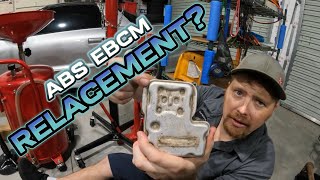
- Internal failure of the Electronic Brake Control Module (EBCM) (Very Common) — Vibration and heat cause solder joints on the EBCM's 🎬 See this walkthrough on replacing a faulty ABS control module internal circuit board to crack, creating an open circuit. This is the primary cause on GM vehicles.
- Poor or corroded EBCM ground connection (Common) — The EBCM relies on a clean ground connection to the vehicle's frame. Corrosion here causes erratic voltage and false codes.
- Corroded ABS reluctor ring (BMW) (Common) — The toothed metal reluctor ring on the axle rusts and expands, physically striking and destroying the wheel speed sensor.
- Damaged wiring or corroded connector at the EBCM (Less Common) — Moisture and road salt corrode the main wiring harness connector pins, interrupting the signal to the module.
- Faulty ignition switch (C5 Corvette) (Less Common) — A worn ignition switch supplies intermittent low voltage to the EBCM, causing the module to malfunction and set false codes.
- Blown ABS fuse(s) (Less Common) — A blown high-amperage ABS fuse cuts power to the module, logging codes as the system shuts down.
- Incorrectly installed wheel bearing (Less Common) — Installing a directional wheel bearing backward prevents the magnetic encoder from reading wheel speed, disabling the ABS.
- Low system voltage (Rare) — A dying battery or failing alternator drops voltage below the EBCM's 10-volt operating threshold, causing unpredictable behavior.
- Failure of the Brake Pressure Modulator Valve (BPMV) (Rare) — The solenoid's internal coil fails electrically, or the valve physically sticks due to contaminated brake fluid.
- Steering Angle Sensor requires calibration (Rare) — Losing calibration after an alignment confuses the stability control system, contributing to dashboard warning lights.
Symptoms

- ABS warning light is on — The primary symptom. The light illuminates and stays on while the fault is active.
- Traction Control (TCS) or Stability Control light is on — A fault in the ABS system automatically disables integrated traction and stability systems, triggering their warning lights.
- "Service ABS System" message on dashboard — Most vehicles display a text-based warning on the driver information center.
- No ABS function during hard braking — During a panic stop, you lose the characteristic pulsing brake pedal. Wheels lock up and tires skid.
- Unintended ABS activation — A failing module activates the ABS at low speeds on dry pavement, causing a pulsing pedal and grinding noise.
- Brake pedal feels hard or unresponsive (also visible on scanner) — A malfunctioning ABS module interferes with hydraulic pressure, making the brake pedal stiff.
Common Fixes & Costs
- Repair/Rebuild the Electronic Brake Control Module (EBCM) — Parts: $150-$300 (mail-in service), Labor: $0 (DIY) or $100-$250 (Shop), ~1.5 hr book time (DIY)
- Clean and Repair EBCM Ground Connection — Parts: $0-$10, Labor: $0 (DIY) or $50-$150 (Shop), ~0.8 hr book time (DIY)
- Replace Faulty Wheel Speed Sensor or Wiring — Parts: $40-$150, Labor: $100-$250, ~1.2 hr book time (DIY)
- Replace Faulty Ignition Switch — Parts: $50-$200, Labor: $150-$300, ~2.0 hr book time (Intermediate)
- Replace the entire ABS Module Assembly (EBCM + BPMV) — Parts: $800-$2,500, Labor: $200-$400, ~2.5 hr book time (Professional)
Used vs. New Parts: Buying Guide
When a used part is worth it: For models where rebuild services are unavailable (like the 1997-2000 C5 Corvette), a used EBCM from a reputable salvage yard is the only option.
Donor-vehicle mileage cap: roughly under 100000 miles for the part to have meaningful remaining life.
Donor quality checklist:
- Match the part number exactly. EBCMs are specific to year, model, and option packages.
- Verify the donor vehicle's VIN; some modules are VIN-locked and require reprogramming.
- Ensure the seller provides at least a 30-day warranty.
Decision logic:
- If A reputable rebuild service with a lifetime warranty is available. → Choose the rebuild service. It is more reliable than a used part and cheaper than a new one.
- If The module is for a 1997-2000 C5 Corvette. → Buy a tested, functional used part.
- If A new OEM part is available and affordable. → Consider a new part, but be aware it contains the same original design flaws.
Warranty tradeoff: Used parts have a 30-90 day part-only warranty. Rebuild services offer a lifetime warranty. New OEM parts carry a 1-3 year warranty.
Worst-case if a used part fails: $200-$500 if a used part fails, requiring repeat labor costs and another replacement.
What Happens If You Wait — Timeline
- 0-1 month: ABS, Traction Control, and Brake warning lights illuminate. Systems are disabled, but base braking remains normal. (MPG impact: 0%% · Added cost: $0)
- Immediate to 3+ months: If the EBCM shorts, the ABS pump motor runs continuously with the vehicle off, draining the battery. (MPG impact: 0%% · Added cost: $150-$250 (new battery))
- Hours to days after Stage 2 begins: The continuously running ABS pump motor overheats and burns out. The pump motor is permanently destroyed. (MPG impact: 0%% · Added cost: $500-$1100 (ABS hydraulic unit replacement))
- Any time while driving: Driver encounters a panic braking situation. Without ABS, wheels lock up, causing a skid and loss of steering control. (MPG impact: 0%% · Added cost: $500-$15,000+ (Accident repairs))
Cost of Not Fixing It
- Immediate: Loss of ABS, traction control, and stability control. Increased risk of skidding and longer stopping distances. (Added cost: N/A)
- 1-3 months: If the fault causes the ABS pump to run continuously, it drains the battery and burns out the pump motor. (Added cost: $200-$500 (new battery and tow))
- 3+ months: Continued driving without ABS increases the cumulative risk of an accident where ABS prevents loss of control. (Added cost: $500-$15,000+ (Accident repairs))
Diagnosis Steps

- Read Codes with an ABS-Capable Scanner
Use a scan tool that accesses the ABS module. Confirm C1265 is present and record any other codes.
Tools: ABS-capable OBD-II Scan Tool (Beginner) - Inspect and Clean the EBCM Ground
Locate the main EBCM ground wire bolted to the frame rail. Disconnect the battery, unbolt the wire, and use a wire brush to clean the terminal and frame to bare metal. Re-secure tightly.
Tools: Socket/Wrench Set, Wire Brush, Sandpaper (Beginner) - Check ABS Fuses and System Voltage
Inspect all fuses related to the EBCM and ABS. Check battery voltage engine-off (>12.4V) and engine-on (13.7-14.7V). Voltage drops below 10V trigger false codes.
Tools: Owner's Manual, Multimeter, Fuse Puller (Beginner) - Inspect EBCM Connector and Wiring Harness
Disconnect the large electrical connector from the EBCM. Inspect for green/white corrosion, bent pins, or water intrusion. Examine the harness for chafing.
Tools: Flashlight (Intermediate) - [PRO TIP] Test Solenoid Resistance at the BPMV (GM)
Remove the EBCM (6 Torx T-20 screws, no brake lines). Measure resistance between the two BPMV pins for the left rear inlet solenoid. A good reading is 4-20 Ohms. 'OL' indicates an open circuit.
Tools: Multimeter, Torx T-20 Socket Set, Service Manual (Advanced) - [PRO TIP] Check for Shorts in the BPMV (GM)
Place one multimeter probe on the solenoid's power pin and the other on the BPMV metal case. The reading must be 'OL'. Low resistance indicates an internal short, requiring BPMV replacement.
Tools: Multimeter, Service Manual (Advanced) - [PRO TIP] Perform Scan Tool Automated Test
Use a bidirectional scan tool to command the left rear solenoid on and off. Listen for a click from the valve body. No click confirms a driver failure inside the EBCM.
Tools: Bidirectional Scan Tool (Advanced) - [PRO TIP] Analyze Live Data PIDs
Monitor the four wheel speed sensor PIDs while driving straight. All four must read identically. Erratic readings indicate a sensor, ring, or wiring issue.
Tools: Advanced Scan Tool (Advanced) - [PRO TIP] Test Vacuum Sensor Voltage (Toyota/Lexus)
For Toyota/Lexus, back-probe the brake booster vacuum sensor connector. The reference wire requires 4.75V-5.25V. The signal wire voltage must change as vacuum is applied.
Tools: Multimeter, Vacuum Pump/Gauge, Service Manual (Advanced) - Send EBCM for Professional Repair
If external wiring, grounds, and BPMV resistance check out, the EBCM failed internally. Remove the module and send it to an electronics rebuilder.
Tools: Torx Socket Set, Basic Hand Tools (Intermediate)
When This Code Triggers (Freeze-Frame Conditions)
- System Voltage: > 10V (The EBCM requires a minimum voltage to run self-tests; low voltage from a bad battery sets false codes.)
- Vehicle Speed: > 10 mph (The ABS module continuously runs self-checks once the vehicle is in motion.)
- Commanded State vs. Actual State: Mismatch for > 0.03 seconds (The EBCM commanded the solenoid to activate, but its internal monitoring circuit did not see the expected voltage change.)
- Ignition Status: ON (The code sets during an ignition cycle when the fault is detected and clears after 100 consecutive fault-free drive cycles.)
Related Codes
- C0265 — Indicates an 'EBCM Relay Circuit' fault. On GM vehicles, it shares the exact same internal EBCM failure as C1265 and requires the same rebuild.
- C1214 — Points to a fault in the main solenoid relay contact. Having C1214 and C1265 together confirms an internal EBCM failure requiring a rebuild.
- C1255 — A generic 'EBCM Internal Malfunction' code. C1265 is more specific, but the fix (EBCM repair) is identical.
- C1286 — Indicates a 'Brake Lining Wear Circuit' fault. Set as a secondary code if the ABS motor pack piston is not in its home position when the system disables.
Climate & Environmental Factors
- High Humidity / Road Salt: Accelerates corrosion of the main EBCM ground connection on the frame rail, causing intermittent faults and false codes.
- Heat Cycling & Vibration: Causes micro-fractures in the EBCM's internal circuit board solder joints over thousands of engine cycles, leading to open circuits.
- Cold Weather: Thermal contraction separates weakened solder joints inside the EBCM. The ABS light often appears on cold startups and disappears as the vehicle warms up.
How to Talk to a Mechanic About This Code
Say this: "I have a C1265 code on my [Vehicle Make/Model] and the ABS light is on. Please start by inspecting the EBCM ground on the frame rail and testing the electronic module before quoting a full replacement of the hydraulic unit."
Directs the technician to the cheapest fix first (ground wire) and prevents an immediate, expensive quote to replace the entire ABS assembly.
Avoid saying:
- 'My ABS light is on, can you fix it?'
- 'Just do whatever it takes to get the light off.'
Questions to ask before authorizing the repair:
- Did you inspect and clean the main EBCM ground connection?
- Did you test the solenoid resistance on the BPMV pins to rule out a failure in the hydraulic unit?
- Is the recommended fix to rebuild my existing module or replace it?
- What is the warranty on the repair?
Where to Take It: Dealer vs Independent vs Chain
- Dealer:
Use only if the vehicle is under warranty or requires proprietary programming.
Best for: Vehicles under warranty, Complex cases requiring VIN-specific programming of a new module
Downsides: Highest cost, often 1.5-2x the labor rate of an independent shop., Likely to recommend replacing the entire ABS assembly rather than rebuilding the electronic module. (Typical cost: +75% vs. baseline) - Independent Shop:
Best fit. An experienced independent mechanic performs the correct diagnosis, handles EBCM removal, and works with a rebuild service.
Best for: Out-of-warranty vehicles., Diagnosing common failures like the GM EBCM issue., Shops experienced with mail-out rebuild services.
Downsides: Quality varies; look for ASE certifications., May lack tools to program a brand new module. (Typical cost: +0% vs. baseline) - Chain Shop:
AVOID. High risk of misdiagnosis and paying for a complete ABS assembly replacement instead of a simple module rebuild.
Best for: Simple jobs like oil changes.
Downsides: Technicians lack specialized diagnostic experience for module-level faults., High pressure to upsell unnecessary services., Unwilling to use mail-out rebuild services. (Typical cost: +20% vs. baseline)
When to Walk Away From the Repair
If the estimated repair cost exceeds 50% of the car's private-party value, consider selling or trading in the vehicle.
- Car worth $4000, fix is $250: Fix it. An EBCM rebuild is a small fraction of the car's value.
- Car worth $4000, fix is $2200: Walk away. A full ABS assembly replacement quote exceeds 50% of the car's value. Get a second opinion for a module rebuild.
- Car worth $2500, fix is $1800: Walk away. The repair cost is 72% of the vehicle's value.
What Scan Tool You Need for This Code

Minimum: A scanner that reads and clears Anti-lock Brake System (ABS) codes. A basic $20 engine-only code reader will NOT see code C1265.
A standard OBD-II scanner only communicates with the Engine Control Module. C1265 is stored in the Electronic Brake Control Module.
Budget: Autel AutoLink AL619 (~$80) — Reads and clears codes from the ABS module, correctly identifying C1265.
Mid-range: Foxwell NT510 Elite (~$180) — Provides live data from ABS sensors and bidirectional control to run the 'Automated Test' commanding the solenoids.
Professional: Autel MaxiCOM MK808S (~$450) — Offers full bidirectional control and performs the automated ABS bleed procedure required if the hydraulic unit is replaced.
Rent vs buy: Auto parts stores loan scanners for free, but you must specifically request an ABS-capable scanner. Buy a budget pick if you diagnose multiple vehicles.
How to Clear the Code After You Fix It
- Reconnect the repaired EBCM and its electrical connectors.
- Reconnect the vehicle's battery.
- Use an ABS-capable scan tool to clear the C1265 fault code.
- Perform the 'Automated Test' function with the scan tool to verify solenoid function.
- If the hydraulic unit was replaced, perform the automated ABS bleed procedure with the scan tool.
Drive cycle (~20 minutes): Start the vehicle, drive over 10 mph, make several stops, and turn the ignition off. The system self-tests upon startup and initial movement. If the fault does not reappear, the repair is successful.
Readiness monitors affected: Not applicable for emissions readiness, ABS system has its own internal readiness state
Watch out for:
- Using a basic $20 OBD-II scanner that cannot access the ABS module to clear the code.
- Failing to perform the ABS automated bleed procedure after replacing the hydraulic unit, resulting in a spongy brake pedal.
- The code returning immediately, indicating a faulty rebuild or a missed external wiring issue.
Will This Fail Emissions / State Inspection?
Yes — this code typically fails an OBD-II emissions inspection.
- California: An illuminated ABS light fails the safety portion of the inspection.
- New York: A vehicle fails the annual safety inspection if the ABS warning light is illuminated.
- Texas: An illuminated ABS light does NOT cause a failure. The inspector checks service brakes, but ABS status is not a failure criterion.
Most Commonly Affected Vehicles
- Chevrolet Silverado, Tahoe, Suburban, Avalanche (1999-2007) — These vehicles use the Kelsey Hayes 325 ABS module, notorious for internal solder joint failure. The ground is on the driver-side frame rail.
- GMC Sierra, Yukon, Yukon XL (1999-2007) — GMC counterparts share the identical Kelsey Hayes 325 ABS module failure and repair procedure.
- Chevrolet Corvette (C5) (1997-2004) — The 1997-2000 EBCM is non-serviceable and requires a used unit. The 2001-2004 EBCM is widely repairable.
- Chevrolet S-10, Blazer (1998-2005) — These use Kelsey Hayes ABS modules prone to internal electronic failure, often causing the ABS pump to run constantly.
- BMW 1-Series (E81, E87), 3-Series (E90, E92) (2004-2013) — ABS/DSC lights are caused by corrosion of the driveshaft's reluctor ring expanding and damaging the wheel speed sensor.
- Toyota / Lexus Land Cruiser, various trucks/SUVs (1998-2015) — C1265 indicates a 'Vacuum Sensor Malfunction' related to the brake booster, requiring voltage output testing.
- Ford Mondeo, Fusion, Edge (2015-2023) — A cascade of ABS/ESC warnings traces back to a single faulty ABS wheel speed sensor or its wiring.
Manufacturer-Specific Notes
- General Motors: C1265 almost always signifies internal EBCM failure. The electronic module unbolts for repair without opening hydraulic brake lines. Always check the frame ground first.
- Toyota / Lexus: C1265 means 'Vacuum Sensor Malfunction.' Diagnosis involves checking the brake booster sensor for a 4.75-5.25V reference voltage.
- BMW: ABS/DSC warning lights are frequently caused by the driveshaft's reluctor ring rusting and destroying the wheel speed sensor, not a module failure.
- Chevrolet Corvette (C5): The EBCM on 1997-2000 models is non-serviceable, requiring expensive replacement with a used part. The 2001-2004 EBCM is easily rebuilt.
Real Owner Stories
2002 Chevy Tahoe with intermittent ABS lights
The owner experienced intermittent ABS and Brake lights that disappeared while driving but returned after parking.
What they tried:
- A mechanic checked the main EBCM ground connection on the frame rail.
- Finding the ground secure, they diagnosed an internal failure of the EBCM.
Outcome: The mechanic removed the EBCM and sent it to a specialty repair service. Reinstalling the rebuilt module permanently cleared the codes and warning lights.
Lesson: For intermittent ABS lights on 1999-2007 GM trucks, the EBCM is the primary failure point. A professional rebuild is the most cost-effective solution.
2002 C5 Corvette with C1265 returning after rebuild
The car showed ABS codes including C1214. The owner sent the EBCM to an online repair service for a $150 rebuild.
What they tried:
- The owner reinstalled the rebuilt module, but code C1265 appeared immediately and would not clear.
- The owner shipped the module back to the rebuilder.
Outcome: The repair service identified a separate, unrepairable logic fault and provided a different refurbished unit for an additional fee, resolving the issue.
Lesson: A code returning immediately after a rebuild indicates a failed repair or a secondary module fault. Always verify the rebuilder's warranty policy before shipping.
2000 Ford Expedition with constantly running ABS pump
The ABS pump ran continuously, even with the ignition off, draining the battery.
What they tried:
- The owner pulled the 30A ABS fuse to stop the pump and prevent battery drain.
- They removed the EBCM, opened the casing, and re-soldered a failed relay pin on the circuit board.
Outcome: Reinstalling the self-repaired module stopped the pump from running constantly and restored ABS function for $0 in parts.
Lesson: A constantly running ABS pump requires immediately pulling the ABS fuse to prevent motor burnout. The root cause is a shorted relay inside the EBCM.
How to Prevent This Code From Triggering
- Flush brake fluid (Every 24,000-36,000 miles or 2-3 years) — Brake fluid absorbs moisture, causing internal corrosion of the delicate solenoid valves inside the ABS hydraulic unit.
- Apply protective coating to the EBCM ground point (Whenever the connection is serviced) — Coating the cleaned frame ground with dielectric grease or fluid film seals it from moisture and road salt, preventing corrosion.
- Clean the underbody and EBCM area (Seasonally, especially after winter) — Washing away road salt and debris prevents corrosive buildup that degrades the module's connector, wiring, and ground points.
- Use dielectric grease on electrical connectors (Whenever connectors are disconnected) — Dielectric grease on the EBCM's main connector seal blocks moisture, preventing pin corrosion and false codes.
Frequently Asked Questions
Is it safe to drive with code C1265?
While your normal brakes will still stop the car, it is not fully safe. You will not have anti-lock brakes (ABS), traction control, or stability control. In an emergency stop, your wheels will lock, causing you to skid and lose steering control.
Will C1265 cause my car to fail a safety inspection?
Yes. In jurisdictions with vehicle safety inspections, an illuminated ABS warning light is an automatic failure. You must repair the issue to pass.
I sent my EBCM for repair, but the C1265 code came back. What now?
This usually means the repair failed or the module has a secondary fault. Contact the rebuilder immediately to utilize their warranty. Less commonly, an external wiring short or a rare failure in the BPMV valve block was missed during initial diagnosis.
What's the most common misdiagnosis for C1265?
On GM vehicles, the biggest mistake is replacing the expensive ABS hydraulic unit (BPMV) when the problem is actually the cheaper, bolt-on electronic module (EBCM). Another common error is failing to check the main EBCM frame ground first.
Can I fix code C1265 myself?
Yes, this is a manageable DIY job. On GM vehicles, you simply remove the EBCM by taking out several Torx screws and unplugging the electrical connectors, without disconnecting any brake lines. You then mail the module to a repair service.
What does it mean if the ABS pump runs constantly?
A constantly running ABS pump, even with the key off, indicates a shorted relay inside the EBCM. This will quickly drain your battery and burn out the pump motor. Pull the 30A-60A ABS pump fuse immediately to prevent damage.
Why is rebuilding my module better than buying a new one?
Rebuilding is significantly cheaper and often permanently fixes the original factory design flaw by using upgraded components. Rebuilders typically provide a lifetime warranty. A new or used OEM module contains the same original defect and will likely fail again.
Can a bad ignition switch really cause an ABS code?
Yes, on specific vehicles like the C5 Corvette, a worn ignition switch provides low voltage to the EBCM. The sensitive module interprets this voltage drop as an internal fault and triggers C1265. Investigate the ignition switch if you experience other random electrical glitches.
Key Takeaways
- On GM vehicles from 1999-2007, code C1265 almost always indicates a cracked solder joint inside the Electronic Brake Control Module (EBCM), requiring a $150-$300 mail-in rebuild.
- Before replacing any parts, spend 15 minutes cleaning the main EBCM ground wire located on the driver-side frame rail to bare metal, as corrosion here mimics a dead module.
- Do not pay a shop $1,500 or more to replace the entire ABS hydraulic unit (BPMV) for this code; the electronic module unbolts with 6 Torx screws without opening the brake lines.
- If you drive a Toyota or Lexus, ignore GM-specific advice; C1265 means a 'Vacuum Sensor Malfunction' and requires testing the brake booster sensor for a 5-volt reference signal.
Helpful Videos





The information in this article is provided for general reference and educational purposes only. Vehicle specifications, procedures, and part compatibility can vary by production date, trim level, and region. Always consult your vehicle's factory service manual and verify part numbers before purchasing or performing repairs. Safety-critical components such as airbags, seat belts, and braking systems should be installed by a qualified professional.
- 🎬 Helpful Videos
- What Does C1265 Mean?
- Can I Drive With C1265?
- Common Causes
- Symptoms
- Common Fixes & Costs
- Used vs. New Parts: Buying Guide
- What Happens If You Wait — Timeline
- Cost of Not Fixing It
- Diagnosis Steps
- When This Code Triggers (Freeze-Frame Conditions)
- Related Codes
- Climate & Environmental Factors
- How to Talk to a Mechanic About This Code
- Where to Take It: Dealer vs Independent vs Chain
- When to Walk Away From the Repair
- What Scan Tool You Need for This Code
- How to Clear the Code After You Fix It
- Will This Fail Emissions / State Inspection?
- Most Commonly Affected Vehicles
- Manufacturer-Specific Notes
- Real Owner Stories
- 2002 Chevy Tahoe with intermittent ABS lights
- 2002 C5 Corvette with C1265 returning after rebuild
- 2000 Ford Expedition with constantly running ABS pump
- How to Prevent This Code From Triggering
- Frequently Asked Questions
- Is it safe to drive with code C1265?
- Will C1265 cause my car to fail a safety inspection?
- I sent my EBCM for repair, but the C1265 code came back. What now?
- What's the most common misdiagnosis for C1265?
- Can I fix code C1265 myself?
- What does it mean if the ABS pump runs constantly?
- Why is rebuilding my module better than buying a new one?
- Can a bad ignition switch really cause an ABS code?
- Key Takeaways
- 🎟️ Get 5% Off