

C1256 on 2006-2010 Toyota Highlander: Accumulator Low Pressure Causes and Fixes
Code C1256 on a 2006-2010 Toyota Highlander, especially Hybrid models, almost always indicates a failed brake actuator assembly due to an internal pressure leak. This is a critical safety issue acknowledged by Toyota in service bulletins, requiring immediate professional repair. The fix is a costly replacement of the entire ABS actuator/pump unit, and attempting to use used or remanufactured parts is strongly discouraged due to high failure rates.
- Code C1256 is a critical safety fault indicating a problem with the brake actuator's ability to hold pressure.
- Do not drive the vehicle. There is a significant risk of reduced braking performance or outright brake failure.
- The cause is almost certainly a failed brake actuator assembly, a known issue for this vehicle.
- Repair requires replacing the entire actuator assembly, which is an expensive part.
- This is not a DIY-friendly repair. It must be performed by a professional with the correct scan tool to properly bleed the brake system afterward.
What's Unique About the 2006-2010 Toyota HIGHLANDER
This issue is a well-documented, widespread problem for this platform, particularly affecting Highlander Hybrid models. Toyota issued a Customer Support Program (ZKC) and Technical Service Bulletins (TSBs) acknowledging that a small internal brake fluid leak within the brake actuator assembly is the common cause. Unlike many other vehicles where ABS issues might stem from wheel speed sensors, on the Highlander, C1256 almost exclusively points to the expensive and complex actuator assembly itself. This is a known weak point also shared with the contemporary Toyota Prius and Lexus RX400h, which use a similar braking system.
Diagnostic Flowchart
Tap your situation to follow the diagnostic path that matches what you're seeing on this vehicle.
Generation note: This range covers two Highlander generations: the first generation (XU20, 2006-2007) and the second generation (XU40, 2008-2010). The brake actuator failure is a known issue on both, particularly the hybrid models. Toyota issued separate TSBs and part numbers for these generations. T-SB-0032-16 applies to 2006-2007 models, while T-SB-0064-19 applies to 2008-2010 models. It is crucial to use the correct part number for your specific model year and VIN.
Symptoms You May Notice
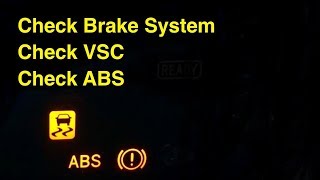
- ABS, Brake, VSC, and/or TRAC warning lights illuminated on the dashboard.
- "Check VSC" message displayed.
- Weak, soft, hard, or ineffective brake pedal.
- A loud, persistent buzzing or beeping alarm from the engine bay, indicating a critical pressure loss.
- Brake pump motor running frequently (e.g., every 15-30 seconds) even when the brakes are not being used. This is a classic early symptom. 🎬 Watch: Hear the specific buzzing sound of a failing pump.
- On Hybrid models, regenerative braking is disabled, which can negatively impact hybrid battery charging.
- Replacing only the brake booster or master cylinder. On these vehicles, the problematic component is the integrated actuator assembly, which includes the booster function, pump, and accumulator. Replacing other individual components will not resolve a C1256 code caused by an internal leak.
- Attempting to fix the issue with a standard brake fluid flush. While a flush is part of the replacement procedure, it will not fix the internal mechanical leak causing the pressure loss.
- Blaming a weak 12V battery. While a failing 12V battery can cause numerous electronic issues, and is required to be healthy for proper diagnosis and bleeding, it is not the root cause of the C1256 pressure leak.
Most Likely Causes
- Internal Leak in Brake Actuator Assembly 🔴 High Probability This is a known design flaw acknowledged by Toyota in multiple Technical Service Bulletins (TSBs) and a Customer Support Program (ZKC). Over time, internal seals within the integrated actuator/pump/module assembly fail, causing a slow but persistent loss of stored hydraulic pressure that the pump cannot overcome.
How to confirm: A professional technician will use a diagnostic scan tool (like Toyota Techstream) to confirm code C1256 and its common companions (C1252, C1253, C1391). The primary confirmation is listening for the pump motor cycling excessively (every 15-30 seconds) with the vehicle on and brakes untouched. Monitoring accumulator pressure sensor data with a scan tool will show a rapid pressure drop after the pump stops.
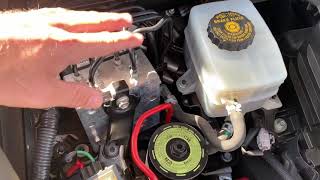
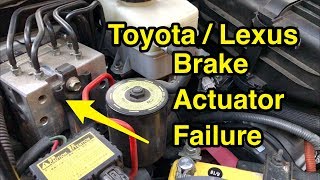
Typical fix: Complete replacement of the brake actuator assembly 🎬 See this step-by-step walkthrough of the actuator replacement process. with a new OEM part. This part is a single, integrated unit containing the pump, accumulator, and control module. Repair shops and owner forums strongly advise against using used or remanufactured units due to a very high rate of premature failure.
Est. part cost: $1200-$2200
Rare But Worth Checking
- Failing Brake Actuator Pump Motor Relay: While much less common than an internal leak, a failing relay can prevent the pump from running, leading to low pressure. This is a much cheaper part to replace and should be checked during diagnosis, especially if the pump does not run at all.
- Wiring Harness or Connector Issue: Damage to the wiring or a corroded connector at the brake actuator can interrupt power to the pump motor or signals from the pressure sensor. This is worth inspecting before condemning the expensive actuator, especially if there is evidence of rodent damage.
- Failed Brake Actuator Pump Motor: In some cases, the electric pump motor itself can burn out, often from the strain of constantly cycling due to an internal leak. A blown fuse for the pump can be a clue. Some DIYers have attempted to replace just the motor, but this is not a standard repair and does not fix the underlying leak.
Diagnosis Steps
- Connect a professional-grade OBD-II scanner capable of reading ABS/VSC module codes, such as Toyota Techstream.
- Confirm the presence of C1256 and look for related codes like C1391, C1252, or C1253, as specified in Toyota's TSBs.
- With the vehicle in the 'Ready' state (for Hybrids) or 'On' (for non-hybrids), listen for the brake actuator pump in the engine bay. If it runs every 15-30 seconds without the brakes being applied, this is the most definitive symptom of a failed actuator.
- If the pump does not run at all, inspect the pump motor relay and its circuit before condemning the actuator.
- Visually inspect the wiring harness and connectors to the actuator assembly for any signs of damage, corrosion, or rodent activity.
- Check the brake fluid level. While the leak is internal to the actuator, a low fluid level from another issue would also be a safety concern.
- Using the scan tool's live data function, monitor the 'Accumulator Pressure Sensor' voltage/pressure. Observe if the pressure drops quickly after the pump cycles off.
- If the pump cycles constantly and the related codes are present, the diagnosis is a failed brake actuator assembly requiring replacement.
Parts You'll Likely Need
- Brake Actuator Assembly
(OEM #44050-48191 (for 2006-2007 Hybrid); 44050-48320 (for 2008-2010 Hybrid))— This is the component that fails internally, causing the low pressure condition. It is sold as a complete assembly. Part number 44050-48191 (which supersedes 44050-48190) is for 2006-2007 Highlander Hybrid models. Part number 44050-48320 is specified for 2008-2010 Highlander Hybrid models in T-SB-0064-19. Always verify with VIN.
Trusted brands: Toyota (OEM)
OEM price range: $1200-$2200
Aftermarket price range: $450-$950 (Used/Remanufactured - Not Recommended)
Related Codes That Often Appear With This One
- C1391 — Stands for "Abnormal Leak of Accumulator Pressure". This code directly corroborates C1256 and is almost always present with it, confirming the system has detected a pressure leak.
- C1252 — Means "Pump Motor On Time Abnormally Long". The system sets this code when it detects the pump has to run excessively to build pressure, which is a direct symptom of a leak.
- C1253 — Indicates a "Pump Motor Relay Malfunction". This can appear alongside the other codes if the relay is failing under the strain of the constantly running pump, or if it is the primary fault.
Technical Service Bulletins (TSBs) & Recalls
- T-SB-0064-19: For 2008-2010 Highlander Hybrids, confirms that C1256 and related codes are caused by an internal brake fluid leak in the actuator and provides the replacement procedure and part number (44050-48320).
- T-SB-0032-16: The equivalent bulletin for 2006-2007 Highlander HV models, also confirming the same failure mode and instructing replacement of the actuator assembly.
Platform-Specific Known Issues
- Toyota issued Technical Service Bulletin T-SB-0064-19 for 2008-2010 Highlander Hybrids and T-SB-0032-16 for 2006-2007 models. Both state that codes C1256, C1391, C1252, or C1253 may be caused by a small internal brake fluid leak inside the brake actuator and instruct technicians to replace the assembly.
- Toyota also initiated a Customer Support Program (ZKC) which extended the warranty coverage for this specific failure on 2008-2010 models. Primary coverage ended Dec 31, 2020, with secondary coverage for 10 years/150,000 miles. Many owners now find their vehicles are outside this window.
- Owner complaints filed with the NHTSA describe sudden brake weakness and the appearance of multiple warning lights, corroborating the TSB. One owner of a 2008 model reported, "VSC warning lights came on, and the brakes became weak and unsafe. A repair shop confirmed the issue with codes C1252, C1256, and C1391."
- The repair is known to be extremely expensive at dealerships, with quotes often ranging from $2800 to over $3500.
Mechanic-Grade Diagnostic Values
- Accumulator Pressure Sensor Live Data (Techstream) — expected: 3.58 to 5.0 V. Failure: Voltage is constant regardless of pump operation, or drops rapidly after the pump stops.
- Pump Motor Power Supply — expected: Battery Voltage (approx. 12V) at the large pins of the actuator connector.. Failure: No voltage indicates a blown fuse (typically a 30A or 40A fuse in the engine bay fuse box) or a wiring issue between the fuse box and the actuator.
- Pump Motor Ground — expected: Near 0 ohms continuity to a known good chassis ground.. Failure: High resistance or an open circuit (O.L.) indicates a bad ground connection, which can prevent the pump from operating.
Scan Tool Commands That Help
- Toyota Techstream: Air Bleeding (Utility) — This is a mandatory procedure after replacing the brake actuator assembly. The software provides step-by-step instructions to electronically bleed the system. There are specific sub-procedures depending on whether the actuator was replaced or just the lines were opened.
- Toyota Techstream: Data List — Used to monitor live data from the ABS system, most importantly the 'ACC Press Sens' (Accumulator Pressure Sensor) voltage. This allows a technician to watch the pressure build as the pump runs and see how quickly it leaks down, confirming an internal leak.
- Toyota Techstream: Active Test — Can be used to command the ABS pump motor to run. This helps verify if the motor and its relay are functional, separate from the automatic pressure control.
Wiring & Ground Locations
- Skid Control ECU — The Skid Control ECU is integrated within the brake actuator assembly itself. It is not a separate, standalone module.. This confirms that replacing the brake actuator assembly also replaces the control module that is logging the C1256 code.
- ABS Actuator Main Connector — The large electrical connector on the brake actuator assembly in the engine bay.. This is the primary point for testing power, ground, and sensor signals going to and from the actuator. The two large-gauge pins are for the pump motor power supply, and the other two large pins are for ground.
- ABS Fuses (ABS NO. 1, ABS NO. 2) — Located in the engine compartment fuse box.. These high-amperage fuses (e.g., 30A and 50A) supply power to the pump motor and control module. A burned-out pump motor can sometimes blow these fuses.
Real Owner Repair Stories
- YouTube user Thomas B 503 (2008 Toyota Highlander Hybrid) — All brake-related warning lights on the dash, an annoying beeping noise, and a hard-to-push brake pedal. The pump motor was cycling frequently.
❌ Tried (didn't work) Bleeding the brakes, Changing the relays
✅ What actually fixed it The owner replaced the entire brake actuator assembly with a used unit from a salvage yard for $200. After installation, he used Toyota Techstream software to perform the electronic brake bleeding procedure, which successfully cleared all the warning lights and restored normal brake function. - Reddit user deepminds (2008 Toyota Prius (similar system)) — C1256 code with the pump motor running for 10 seconds and off for 15 seconds. Eventually, the dash lights and a constant buzzer came on.
✅ What actually fixed it The owner performed a DIY replacement using a used actuator from a low-mileage wrecked vehicle. He emphasized the necessity of using Toyota Techstream software for the post-replacement brake bleed procedure, which he noted was easy to follow with the software's step-by-step guide.
OEM Part Supersession History
44050-48190→44050-48191— This is the updated, revised part for the 2006-2007 Highlander Hybrid, intended to address the internal leak failure.
Heads up: Using a salvaged part with the original 44050-48190 part number carries a high risk of the same failure occurring, as it has the original design flaw. It is strongly recommended to use the new, superseded part number.
Model Year Variations Within This Range
- 2006-2007: These first-generation (XU20) models use brake actuator part number 44050-48191 (which supersedes 44050-48190).
- 2008-2010: These second-generation (XU40) models use brake actuator part number 44050-48320, as specified in TSB T-SB-0064-19.
Helpful Videos
We Have This Part in Stock



The information in this article is provided for general reference and educational purposes only. Vehicle specifications, procedures, and part compatibility can vary by production date, trim level, and region. Always consult your vehicle's factory service manual and verify part numbers before purchasing or performing repairs. Safety-critical components such as airbags, seat belts, and braking systems should be installed by a qualified professional.
- Toyota HIGHLANDER:
- 🎬 Helpful Videos
- 🛍️ Shop This Part
- What's Unique About the 2006-2010 Toyota HIGHLANDER
- Diagnostic Flowchart
- Symptoms You May Notice
- Most Likely Causes
- Rare But Worth Checking
- Diagnosis Steps
- Parts You'll Likely Need
- Related Codes That Often Appear With This One
- Technical Service Bulletins (TSBs) & Recalls
- Platform-Specific Known Issues
- Mechanic-Grade Diagnostic Values
- Scan Tool Commands That Help
- Wiring & Ground Locations
- Real Owner Repair Stories
- OEM Part Supersession History
- Model Year Variations Within This Range
- 🎟️ Get 5% Off