

C1256 on 2007-2014 Toyota Camry: Accumulator Low Pressure Causes and Fixes
Code C1256 on a 2007-2014 Toyota Camry almost always means the brake actuator assembly has failed due to an internal leak. This is a critical safety issue requiring immediate attention. The repair is notoriously expensive, with a new OEM part costing over $1,800, though Toyota did offer a warranty extension program for this part. Driving is not recommended.
- C1256 is a critical safety code indicating a failure in the brake actuator assembly.
- Do not drive the vehicle. There is a real risk of reduced braking power or complete brake failure.
- The most common symptoms are a combination of dashboard warning lights (ABS, VSC, Brake) and a frequent buzzing sound from the engine bay.
- The fix is to replace the entire brake actuator assembly, which is an expensive part.
- This repair is not considered DIY-friendly. It requires special procedures, including a scan tool-assisted brake bleed, to be completed safely and correctly.
What's Unique About the 2007-2014 Toyota CAMRY

The 2007-2014 Camry, particularly the Hybrid models, uses an electronically controlled brake (ECB) system, or brake-by-wire. Unlike conventional systems that rely purely on hydraulic pressure from your foot, this system uses a pump, accumulator, and actuator to provide braking power and to manage regenerative braking. This complex assembly is a known, widespread, and very expensive failure point. Toyota acknowledged the issue by issuing multiple Technical Service Bulletins and a Customer Support Program (ZKK/24TE01) which extended the warranty for this specific failure due to 'certain internal malfunctions of the Brake Booster Assembly'.
Diagnostic Flowchart

Tap your situation to follow the diagnostic path that matches what you're seeing on this vehicle.
Generation note: This issue affects both the XV40 (2007-2011) and the XV50 (2012-2014) generations of the Toyota Camry, especially the Hybrid models. Toyota has issued separate TSBs for both generations (T-SB-0041-14 for XV40 and T-SB-0130-19 for XV50), indicating a similar failure of the brake actuator/booster assembly. Toyota also initiated a Warranty Enhancement Program (ZKK) covering these models for this issue for 10 years or 150,000 miles.
Symptoms You May Notice

- ABS, Brake, TRAC, and/or VSC warning lights on the dashboard.
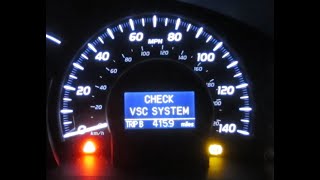
- "Check VSC System" message displayed.
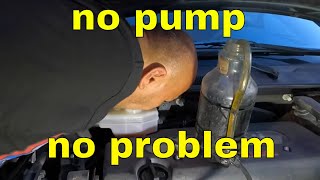
- A continuous or frequently repeating buzzing/ringing sound from the engine bay, cycling every 15-30 seconds 🎬 Watch: Hear the buzzing sound of a failing pump motor. even with the car off. This is the pump motor running constantly to compensate for the pressure leak.
- A hard-to-press brake pedal, sometimes with delayed braking response.
- A long, persistent beeping or alarm sound when pressing the brake pedal.
- Noticeably weaker braking performance or complete brake failure.
- For hybrid models, regenerative braking is disabled, which can negatively impact fuel economy and hybrid battery charging.
- Replacing only the master cylinder
- Replacing wheel speed sensors
- Attempting to bleed the brakes without the proper scan tool procedure, which can lead to a 'gurgling' sound and damage to the new pump.
- Assuming a used actuator from a junkyard will work. Many of these are already faulty or fail shortly after installation, leading to repeated repairs.
Most Likely Causes
- Internal Failure of the Brake Actuator Assembly 🔴 High Probability As documented by Toyota TSBs T-SB-0130-19 and T-SB-0041-14, these units are prone to developing small internal brake fluid leaks over time, which prevents the accumulator from holding pressure. This is a well-known design flaw acknowledged by Toyota through warranty extensions.
How to confirm: Listen for the brake pump motor under the hood cycling on and off every 15-30 seconds, even when the brakes are not being used. A professional scan tool (like Toyota Techstream) can monitor the accumulator pressure sensor voltage; on a healthy system, the pump should turn on around 2.9V and off around 4.2V. A rapid drop in voltage/pressure after the pump stops confirms a leak. A voltage drop of more than 0.55V in 30 seconds after the pump stops is a definitive failure indicator.
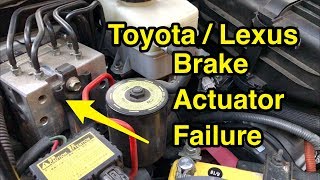
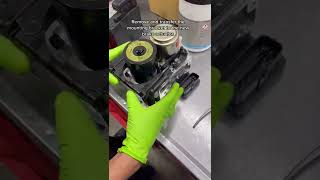
Typical fix: The entire brake actuator and pump assembly must be replaced. The system must then be bled using a specific, multi-step utility in a Toyota-compatible scan tool. Simply clearing the codes will not work. Due to high failure rates of used parts, only a new OEM part is recommended. 🎬 See this step-by-step guide for replacing the actuator assembly.
Est. part cost: $1200-$2500
Rare But Worth Checking
- Wiring Harness or Connector Issue: While possible, this is far less common than the actuator failing internally. A visual inspection of the wiring and connectors to the brake actuator assembly for damage or corrosion is a wise first step before replacing the expensive unit. One owner on an electric vehicle forum suggested this as a preliminary check.
- Failing 12V Auxiliary Battery: A weak 12V battery can cause a variety of confusing electronic issues in modern cars. One forum user on PriusChat noted that a weak battery caused errors during the ABS bleeding process with their scan tool, complicating the diagnosis and preventing the procedure from completing successfully. While not the root cause of C1256, a healthy battery is crucial for proper diagnosis and repair.
Diagnosis Steps
- Confirm the presence of C1256 and any related codes (C1391, C1252) using an OBD-II scanner capable of reading ABS/Chassis codes.
- Turn the vehicle to the 'ON' or 'READY' position without starting the engine. Listen for a buzzing or pump sound from the engine bay. If it cycles on every 15-30 seconds, it's a strong sign of actuator failure.
- Check the brake fluid level in the reservoir. A low level could indicate an external leak, but C1256 is typically caused by an internal leak where the fluid level does not drop.
- Inspect the brake actuator assembly and all brake lines for any visible signs of fluid leaks.
- If a professional scan tool (like Toyota Techstream) is available, navigate to the 'Data List' for the ABS/VSC/TRAC system and monitor the 'Accumulator Sensor' value. Depress the brake pedal 4-5 times to cycle the pump. After the pump stops, wait 30 seconds and observe the voltage drop. A drop of less than 0.55V is normal; a larger drop confirms an internal leak.
- If the pump runs constantly and pressure does not build, or if it drops rapidly, the brake actuator assembly is faulty and requires replacement.
Parts You'll Likely Need

- Brake Actuator Assembly
(OEM #44050-30660 (supercedes 44050-30300 for 2007-2011 Hybrid), 44050-06080 (Non-Hybrid), 47050-33112 (2013-2014 Hybrid))— This is the component that fails internally, causing the low accumulator pressure. The pump, accumulator, and control module are integrated into this single, non-serviceable unit. Part numbers vary by year and model (Hybrid vs. Non-Hybrid).
Trusted brands: Toyota (OEM)
OEM price range: $1200-$2500
Aftermarket price range: $350-$950 (Used or Remanufactured - strongly discouraged due to high failure rates and potential for damage during installation if done improperly)
Related Codes That Often Appear With This One
- C1391 — This code means 'Abnormal Leak of Accumulator Pressure' and is a direct result of the same internal leak that causes C1256. They frequently appear together and are listed in the same TSBs.
- C1252 — This code means 'Brake Booster Pump Motor On Time Abnormally Long'. It sets because the pump has to run constantly to try and compensate for the pressure loss from the leak, which is the root cause of C1256.
- C1253 — This code indicates a 'Hydro-Booster Pump Motor Relay Malfunction'. It can be triggered alongside the other codes as the entire system is under stress from the constant pump operation.
- C1345 — This code for 'Linear Solenoid Valve Offset Learning Undone' often appears after a failed attempt to replace the actuator. It means the required post-installation calibration with a scan tool has not been completed or has failed, which can happen with a faulty replacement unit.
Technical Service Bulletins (TSBs) & Recalls

- T-SB-0130-19: Addresses brake/ABS/TRAC lights with codes C1391, C1252, C1256, or C1253 on 2012-2014 Camry Hybrids due to an internal leak in the brake booster assembly.
- T-SB-0041-14 Rev: Addresses the same set of warning lights and codes on 2007-2011 Camry Hybrids, citing an internal brake fluid leak inside the brake actuator.
Platform-Specific Known Issues
- Toyota issued a Warranty Enhancement Program (Customer Support Program ZKK) for this failure on 2012-2014 Camry Hybrids and 2013-2015 Avalon Hybrids. It extended coverage to 10 years or 150,000 miles.
- Toyota has issued Technical Service Bulletins for this exact problem. T-SB-0041-14 Rev applies to 2007-2011 Camry Hybrids, and T-SB-0130-19 applies to 2012-2014 Camry Hybrids. Both state the cause is a 'small internal brake fluid leak' inside the actuator/booster assembly.
- An owner of a 2009 Camry reported complete brake failure associated with codes C1256 and C1391, highlighting the critical safety nature of this fault (NHTSA ODI #10510557).
- On Hybrid models, this failure also disables regenerative braking. This can lead to the high-voltage hybrid battery becoming overly discharged if driving continues, potentially causing additional fault codes like P0A80 (Replace Hybrid Battery Pack).
Mechanic-Grade Diagnostic Values
- Accumulator Pressure Sensor Voltage (Techstream Data List) — expected: 2.90 to 4.20 V. Failure: A voltage drop of more than 0.55 V within 30 seconds after the pump motor stops indicates an internal leak.
- Brake Booster Pump Motor Resistance — expected: Below 1 Ω between terminals BM1 and BM2. Below 10 Ω between BM1 and GND1, and between BM2 and GND2.. Failure: Readings outside of these specifications indicate a faulty pump motor within the assembly.
Hidden / Shadow Codes Worth Checking
- INF Code 341: This is a detailed sub-code for C1256, specifically indicating a 'Significant drop in accumulator pressure continues'. It helps confirm the issue is a persistent leak rather than a temporary pressure drop from frequent braking. (see via Toyota Techstream or a compatible high-level scan tool in the ABS/VSC/TRAC system data.)
Scan Tool Commands That Help
- Toyota Techstream: Chassis / ABS/VSC/TRAC / Utility / Reset Memory — This must be performed after replacing the brake actuator assembly to clear the stored calibration data for the old unit before calibrating the new one.
- Toyota Techstream: Chassis / ABS/VSC/TRAC / Utility / ECB Utility / Linear Valve Offset — This is a mandatory calibration procedure after installing a new brake actuator. It learns the characteristics of the new linear solenoid valves. Failure to perform this will result in code C1345 and improper brake function.
- Toyota Techstream: Chassis / ABS/VSC/TRAC / Active Test — Allows a technician to individually command solenoids to check for function and to monitor wheel cylinder pressure sensor readings to help diagnose internal leaks.
Wiring & Ground Locations
- Brake Actuator Assembly Connector — On the brake actuator assembly, located in the right front of the engine compartment.. This is the main electrical connection for the entire assembly, including the pump motor, pressure sensor, and ECU. Corrosion or damage here can cause a loss of signal or power, mimicking component failure.
- GND1 / GND2 — These are ground terminals within the brake actuator's main connector. For a 2009 Camry Hybrid, these are pins 4 (GND1) and 3 (GND2) on connector A49.. A poor ground connection can cause erratic operation of the pump motor and sensors, potentially leading to pressure-related codes. Resistance checks are performed using these pins.
Real Owner Repair Stories
- YouTube user 'All Tsab' (2007 Toyota Camry Hybrid) — Multiple warning lights on the dash including 'Check VSC System', ABS, and brake lights. Scan tool showed codes C1252, C1256, and C1391.
❌ Tried (didn't work) The video directly proceeds to replacement, as the combination of codes is a classic sign of actuator failure.
✅ What actually fixed it The entire brake actuator assembly was replaced with a new unit. The video details the process of disconnecting the battery, removing the old actuator, installing the new one, and reconnecting the brake lines. - Reddit user in r/Toyota (2009 Toyota Prius (similar system)) — Sudden appearance of VSC, Brake, and ABS lights, accompanied by an extremely hard brake pedal and loss of braking power. The brake actuator motor stopped running completely.
❌ Tried (didn't work) Swapping the brake relay in the engine bay fuse box had no effect.
✅ What actually fixed it Replacement of the brake actuator with a used unit, followed by a proper ABS bleeding procedure using a scan tool. The user emphasized that removing the cowl provides much better access and that the job is very time-consuming but doable for a DIYer.
OEM Part Supersession History
44050-30300→44050-30660— Internal design revision to improve reliability and address the leak issue.
Heads up: Part 44050-30300 was specified for 2007-2011 Camry Hybrid models. The superseding part 44050-30660 is the correct replacement.
Model Year Variations Within This Range
- 2007-2011 (XV40): This generation uses the 2.4L 2AZ-FXE hybrid engine. The primary brake actuator part number was 44050-30300, which is now superseded by 44050-30660.
- 2012-2014 (XV50): This generation introduced a major body and interior restyle and used a 2.5L engine. The brake actuator assembly is a different part number (e.g., 47050-33112 for the hybrid) and is addressed by a separate TSB (T-SB-0130-19), though the failure mode is identical to the earlier generation.
Helpful Videos
We Have This Part in Stock



The information in this article is provided for general reference and educational purposes only. Vehicle specifications, procedures, and part compatibility can vary by production date, trim level, and region. Always consult your vehicle's factory service manual and verify part numbers before purchasing or performing repairs. Safety-critical components such as airbags, seat belts, and braking systems should be installed by a qualified professional.
- Toyota CAMRY:
- 🎬 Helpful Videos
- 🛍️ Shop This Part
- What's Unique About the 2007-2014 Toyota CAMRY
- Diagnostic Flowchart
- Symptoms You May Notice
- Most Likely Causes
- Rare But Worth Checking
- Diagnosis Steps
- Parts You'll Likely Need
- Related Codes That Often Appear With This One
- Technical Service Bulletins (TSBs) & Recalls
- Platform-Specific Known Issues
- Mechanic-Grade Diagnostic Values
- Hidden / Shadow Codes Worth Checking
- Scan Tool Commands That Help
- Wiring & Ground Locations
- Real Owner Repair Stories
- OEM Part Supersession History
- Model Year Variations Within This Range
- 🎟️ Get 5% Off