

C1256 on 2010 Lexus RX450H: Accumulator Low Pressure Causes and Fixes
Code C1256 on a 2010 Lexus RX450H means the brake system's accumulator has low pressure, almost always caused by a failing brake booster and actuator assembly. This is a critical safety issue requiring immediate professional repair, which can cost between $2,000 and $4,000. Driving is not recommended as ABS, traction control, and regenerative braking are disabled.
- C1256 is a critical safety code on your 2010 RX450H. Do not drive the vehicle until it is repaired.
- The cause is almost certainly a failed brake booster and actuator assembly, a known issue for this model confirmed by Lexus.
- The repair involves replacing the entire actuator and pump assembly, followed by a complex bleeding procedure using specialized software like Toyota Techstream.
- Check with a Lexus dealer regarding any potential goodwill assistance or remaining coverage under the secondary terms of Customer Support Program 20LE03 (10 years/150,000 miles).
- This is an expensive repair; however, only use new OEM parts for safety and reliability. Using used or remanufactured units is a significant gamble.
What's Unique About the 2010-2010 Lexus RX450H

The 2010 RX450H, like many Toyota and Lexus hybrids of its era, uses a sophisticated brake-by-wire system to seamlessly blend regenerative and hydraulic braking. The failure of the brake booster/actuator assembly that causes code C1256 is a widely recognized issue across these platforms. Lexus acknowledged this problem by issuing Technical Service Bulletins (TSBs) and a Customer Support Program (20LE03) to extend warranty coverage for this specific component due to internal malfunctions. When this system fails, regenerative braking is disabled, which can negatively impact the charging of the main hybrid battery over time.
Diagnostic Flowchart
Tap your situation to follow the diagnostic path that matches what you're seeing on this vehicle.
Symptoms You May Notice
- Brake, ABS, and/or TRAC warning lights illuminated on the dashboard.
- "Check VSC" message displayed.
- A loud or persistent buzzing or beeping noise from the engine bay (specifically the driver's side). This is the pump motor running every 15-30 seconds to compensate for the pressure leak, even when the car is in 'Ready' mode with the brake pedal untouched.
- A hard or unresponsive brake pedal, sometimes described as feeling like it has no power assist.
- Delayed braking response or a sudden increase in stopping distance.
- A long, continuous buzzer or alarm sound from the cabin, indicating a critical brake system failure.
- Replacing only the brake booster pump. The failure is typically an internal leak in the actuator assembly, which contains the accumulator. While the pump is replaced as part of the assembly, replacing it alone will not solve the pressure leak.
- Assuming a simple brake fluid flush will fix the issue. While regular fluid changes are crucial for longevity, once the internal leak starts and code C1256 is set, a flush will not repair the failed component.
Most Likely Causes

- Failing Brake Booster and Actuator Assembly 🔴 High Probability As documented in Lexus TSB L-SB-0033-20 and Customer Support Program 20LE03, this component is prone to developing small internal brake fluid leaks, leading to a loss of accumulator pressure. This is a known wear item on many Toyota/Lexus hybrids from this era.
How to confirm: A technician will use a professional scan tool like Toyota Techstream to confirm code C1256, often found with C1391, C1252, or C1253. They can monitor the accumulator pressure sensor voltage in the live data stream; a rapid drop in pressure (e.g., from 3.6V down to 3.2V in under a minute) when the pump is not running confirms the internal leak. A service manual diagnostic procedure specifies that the voltage change should be less than 0.2V over a 30-second period with the pump off. The sound of the pump cycling on and off every few seconds is also a strong indicator.
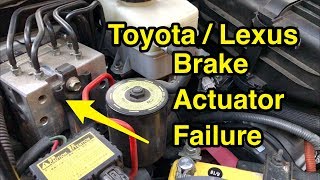
Typical fix: Replace the entire brake booster and actuator assembly, along with the brake booster pump, as a complete unit. 🎬 See this walkthrough of the brake actuator replacement process. Due to the integrated nature of the pump, accumulator, and control module, replacing individual parts is not recommended and often fails to solve the root cause. The repair must be followed by a specific, multi-step brake fluid bleeding and system calibration procedure using Techstream software. 🎬 Watch: How to perform the computer-controlled hydraulic brake bleed.
Est. part cost: $1200-$2500
Rare But Worth Checking
- Failing Auxiliary (12V) Battery: A weak 12V battery can cause low voltage to the Skid Control ECU, which can sometimes trigger a C1256 code along with other voltage-related codes like C1241. A Prius owner on PriusChat noted that a weak 12V battery prevented them from completing the brake bleed procedure with a scan tool, highlighting the importance of battery health. Always check the battery health early in the diagnosis to avoid misdiagnosing a much more expensive part.
Diagnosis Steps
- Connect a professional OBD-II scanner capable of reading ABS codes (like Toyota Techstream) to the DLC3 port.
- Check for stored DTCs. Confirm the presence of C1256 and any accompanying codes like C1391, C1252, or C1253.
- Check the health and voltage of the 12V auxiliary battery to rule out low-voltage issues, which can cause erroneous codes.
- Using the scan tool's live data function, monitor the accumulator pressure sensor reading. A normal reading should be between 3.58V and 5.0V. Observe if the pressure drops quickly after the pump motor stops; a drop of more than 0.2V in 30 seconds indicates a leak.
- Listen for the brake booster pump in the engine bay with the car in 'Ready' mode. If it runs every few seconds or minutes even when the brakes are not being applied, it's a strong sign of a leak.
- If an internal leak is confirmed by a rapid pressure drop and frequent pump cycling, the diagnosis is a failed brake booster and actuator assembly requiring replacement.
Parts You'll Likely Need
- Brake Actuator Assembly
(OEM #44050-48320)— This is the complete unit that fails internally, causing the low accumulator pressure. It includes the brake booster, master cylinder, and control module. Some sources show this part number superseding older ones like 44510-48080. Always confirm with a dealer using your VIN.
Trusted brands: Lexus (OEM)
OEM price range: $1300-$2500
Aftermarket price range: $700-$1200 (Used/Remanufactured - High Risk) - Brake Booster Pump Kit
(OEM #47070-48060)— This pump is specified by Lexus to be replaced along with the actuator assembly as a complete repair under TSB L-SB-0033-20. It is responsible for generating the pressure stored in the accumulator.
Trusted brands: Lexus (OEM), Aisin
OEM price range: $700-$900
Aftermarket price range: $450-$650
Related Codes That Often Appear With This One
- C1391 — This code means 'Abnormal Leak in Accumulator' and directly points to the same internal failure within the brake actuator assembly. It is the most common companion code to C1256.
- C1252 — This code means 'Brake Booster Pump Motor On Time Abnormally Long'. It sets because the pump has to run constantly to try and compensate for the pressure being lost from the internal leak.
- C1253 — This code indicates a 'Pump Motor Relay Malfunction'. It can be triggered by the pump motor being overworked due to the constant running caused by the pressure leak.
Technical Service Bulletins (TSBs) & Recalls
- 20LE03: Customer Support Program for Brake Booster and Brake Booster Pump Assemblies on 2010-2012 RX 450h.
- L-SB-0033-20: Documents the symptoms (ABS lights) and cause (internal leak in brake booster assembly) associated with codes C1256, C1391, C1252, and C1253, and mandates replacement of both the actuator and pump.
Platform-Specific Known Issues
- Lexus issued Customer Support Program 20LE03 specifically for 2010-2012 RX450h models for this exact issue. It extended the warranty coverage for the Brake Booster and Brake Booster Pump Assemblies. Primary coverage ended on December 31, 2021, but secondary coverage lasts for 10 years or 150,000 miles from the date of first use. It is worth checking with a dealer for eligibility.
- TSB L-SB-0033-20 also details this condition, noting that a small internal brake fluid leak inside the brake booster assembly is the cause and instructs dealers to replace both the actuator and pump assemblies if codes C1256, C1391, C1252, or C1253 are present.
- Owners on ClubLexus report dealers quoting as high as $3700-$4800 for the repair out of warranty, though some have received goodwill assistance from Lexus corporate, especially if the vehicle is just outside the warranty extension period.
Mechanic-Grade Diagnostic Values
- Accumulator Pressure Sensor Voltage (Live Data) — expected: 3.58V to 5.0V. Failure: Voltage drop of more than 0.2V within 30 seconds after the pump stops, indicating a leak.
- Skid Control ECU Power and Ground (at connector A19) — expected: Pin 46 (IG1) to Body Ground: 10V to 14V with Ignition ON. Pins 1 (GND2) and 32 (GND1) to Body Ground: Below 1 Ω.. Failure: Voltage below 10V or resistance above 1 Ω indicates a power supply or ground issue with the ECU.
- CAN Bus Resistance (at connector A19) — expected: 54 to 69 Ω between Pin 11 (CANH) and Pin 25 (CANL) with ignition off.. Failure: Readings outside this range indicate a problem on the CAN bus communication lines to the ECU.
Hidden / Shadow Codes Worth Checking
- Detail Code (INF): Toyota/Lexus systems often store a more specific 'Detail Code' (or INF code) along with the main DTC. For example, a similar system on a Prius stores detail code 141 with C1256. This code can provide more granular information about the nature of the accumulator pressure fault but requires a high-level scanner like Techstream to view. (see via Toyota Techstream software under the ABS/VSC/TRAC module's DTC screen.)
Scan Tool Commands That Help

- Toyota Techstream: Air Bleeding Utility — This is mandatory after replacing the brake actuator. Navigate to 'Chassis / ABS/VSC/TRAC / Utility / Air Bleeding'. It has specific sub-routines, including one for when the 'Actuator has been removed' to ensure all air is purged from the new component.
- Toyota Techstream: Reset Memory / Zero Point Calibration — After actuator replacement, old calibration data must be cleared using 'Chassis / ABS/VSC/TRAC / Utility / Reset Memory'. This must be followed by performing 'Zero Point Calibration of Yaw Rate and Acceleration Sensor' and 'Linear Valve Offset Learning' to make the new hardware work correctly with the vehicle's VSC system.
- Toyota Techstream: Active Test - [Perform Actuator Pattern] — During the air bleeding process, this active test can be used to forcefully cycle the internal valves of the actuator to dislodge and purge stubborn air pockets.
- Toyota Techstream: Zero Down Accumulator Pressure / ECB Invalid — These utilities are used to safely depressurize the high-pressure accumulator before service and to put the system in a state that allows for manual bleeding of the front brakes.
Wiring & Ground Locations
- Skid Control ECU (Brake Actuator Assembly) — Located in the right rear of the engine compartment. The control unit itself is integrated into the actuator assembly.. This is the central component that stores the code. All diagnostic tests for power, ground, and sensor inputs are performed at its connectors.
- Skid Control ECU Connector A19 — The main electrical connector on the Skid Control ECU/Brake Actuator assembly.. This is where a technician would perform electrical tests. Key pins include Pin 46 (IG1 Power), Pin 1 (GND2), Pin 32 (GND1), Pin 11 (CANH), and Pin 25 (CANL).
Real Owner Repair Stories
- YouTube user 'Andres Mobile Mechanic' (2011 Lexus RX450h) — ABS light on with code C1391 (Abnormal Leak in Accumulator). Pump was cycling every 30 seconds. Live data showed pressure dropping from its peak to 3.15V in under 30 seconds.
❌ Tried (didn't work) Replaced the accumulator with a brand new part from the Lexus dealership. This did not fix the problem; the pressure leak and code persisted.
✅ What actually fixed it Replaced the entire ABS actuator/booster assembly with a used unit sourced from a 2020 model that had a matching part number. This resolved the rapid pressure drop and cleared the code.
When the Usual Fixes Don't Work
- While the root cause is low accumulator pressure, simply replacing the accumulator itself may not be sufficient. A real-world repair on a 2011 RX450h showed that even a brand-new OEM accumulator failed to fix the C1391 code (often seen with C1256). The problem was only resolved by replacing the entire brake actuator assembly. This suggests the internal leak or malfunction may be within the actuator's valve body or control unit, not just the accumulator pressure vessel, reinforcing why Lexus specifies replacing the entire assembly.
OEM Part Supersession History
44510-48080→44050-48320— Part was updated by the manufacturer. The new part number is the current replacement for a wide range of model years.
Heads up: The part 44050-48320 is reported to be backward compatible with vehicles that originally came with 44510-48080. Some vendors list it as fitting all 2010-2022 RX450h models, but VIN confirmation with a dealer is always the safest practice.
Helpful Videos

We Have This Part in Stock



The information in this article is provided for general reference and educational purposes only. Vehicle specifications, procedures, and part compatibility can vary by production date, trim level, and region. Always consult your vehicle's factory service manual and verify part numbers before purchasing or performing repairs. Safety-critical components such as airbags, seat belts, and braking systems should be installed by a qualified professional.
- Lexus RX450H:
- 🎬 Helpful Videos
- 🛍️ Shop This Part
- What's Unique About the 2010-2010 Lexus RX450H
- Diagnostic Flowchart
- Symptoms You May Notice
- Most Likely Causes
- Rare But Worth Checking
- Diagnosis Steps
- Parts You'll Likely Need
- Related Codes That Often Appear With This One
- Technical Service Bulletins (TSBs) & Recalls
- Platform-Specific Known Issues
- Mechanic-Grade Diagnostic Values
- Hidden / Shadow Codes Worth Checking
- Scan Tool Commands That Help
- Wiring & Ground Locations
- Real Owner Repair Stories
- When the Usual Fixes Don't Work
- OEM Part Supersession History
- 🎟️ Get 5% Off