

C1256 on 2007-2014 Lexus LS460: Accumulator Low Pressure Causes and Fixes
On a 2007-2014 Lexus LS460, code C1256 almost always means the brake actuator assembly is failing due to an internal leak. This is a very expensive repair, often costing $2,500-$4,500 at a dealership, but sourcing the part yourself can reduce the cost significantly. Lexus has acknowledged this widespread issue through multiple TSBs and a Warranty Enhancement Program, which has now expired for most vehicles.
- Code C1256 on a 2007-2014 LS460 means 'Accumulator Low Pressure' and is a critical safety issue.
- The cause is almost certainly a failed brake actuator assembly due to a well-known internal leak.
- Do not drive the vehicle. It has compromised braking and disabled safety systems.
- The repair is complex, requiring replacement of the actuator and a specific electronic bleeding and calibration procedure with Toyota's Techstream software.
- Lexus acknowledged the problem with a warranty extension (ZLG), but it has expired for most vehicles.
What's Unique About the 2007-2014 Lexus LS460

The 2007-2014 Lexus LS460 uses a sophisticated and complex electro-hydraulic brake system (EHBC) instead of a traditional vacuum booster. This system provides advanced control for ABS and Vehicle Stability Control (VSC) but is known for a common and costly failure of the brake actuator assembly. The internal seals within the actuator degrade over time, causing micro-leaks that the system cannot overcome. This failure is so prevalent that Lexus has issued multiple Technical Service Bulletins (TSBs) and a Customer Support Program (23LE04 for 2013-2017 models) acknowledging the issue, which often presents with code C1256.
Diagnostic Flowchart

Tap your situation to follow the diagnostic path that matches what you're seeing on this vehicle.
Symptoms You May Notice

- Multiple dashboard warning lights: 'BRAKE', 'ABS', 'VSC', and a master warning light.
- Warning messages on the display, such as 'Brake Malfunction' or 'Check VSC System'.
- A loud, continuous buzzing or beeping alarm from the dashboard, indicating a critical pressure loss.
- The electric pump motor in the engine bay runs excessively, sometimes every 15-30 seconds, even when the car is idle. 🎬 Listen to the specific buzzing sound of a failing pump.
- Unusual noises from the engine bay, like a 'squawk' or 'bark' when pressing or releasing the brakes.
- Changes in brake pedal feel, such as a spongy, hard, pulsating, or delayed response.
- Warped Brake Rotors
- Bad Brake Pads
- Failing Master Cylinder (alone)
Most Likely Causes

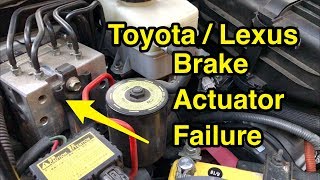
- Failing Brake Actuator Assembly 🔴 High Probability The design is susceptible to internal brake fluid leaks within the accumulator section, causing a loss of pressure. This is a widely documented failure on this platform, acknowledged by Lexus in TSBs L-SB-0009-23 and L-SB-0016-16. The internal leak is not visible externally, and the brake fluid reservoir level will remain normal.
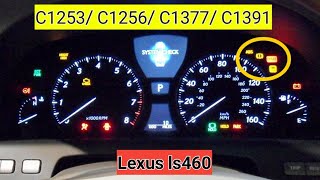
How to confirm: Scan the vehicle for codes. C1256, almost always accompanied by C1391 (Abnormal Leak in Accumulator), and often C1252 (Pump Motor On Time Abnormally Long) or C1253 (Pump Motor Relay Malfunction), strongly indicates actuator failure. A technician can use Techstream to monitor accumulator pressure live data; a rapid drop in pressure with the pump off confirms an internal leak.
Typical fix: Replace the entire brake actuator assembly. Due to the integrated nature of the pump, accumulator, and control module, replacing the whole unit is the standard and recommended repair.
Est. part cost: $1000-$2200
Rare But Worth Checking
- ABS Pump Motor Relay or Fuse: A faulty relay or fuse can prevent the pump from running to build pressure, triggering a C1256 code. One owner on a YouTube comment thread reported that their issue was resolved by replacing an ABS relay located inside the main junction box, a much cheaper fix than the full actuator assembly. This is worth checking before condemning the expensive actuator. 🎬 Watch this guide on troubleshooting ABS codes and relay issues.
- Poor Electrical Ground: A bad ground connection for the ABS module can cause a variety of communication errors and fault codes, including those related to pressure. A visual inspection and cleaning of the main chassis and transmission grounds is a worthwhile diagnostic step.
- Improper Brake Bleeding Procedure: If the code appears immediately after brake service, it may be due to an incorrect bleeding procedure. The system can fail to build pressure if the specific Techstream-guided steps are not followed, which can mimic a hardware failure and even set code C1256. One owner on ClubLexus detailed how they triggered C1256 by using the wrong utility in Techstream and resolved it by running the 'Actuator Replaced' bleeding sequence.
Diagnosis Steps
- Confirm the presence of multiple brake-related warning lights on the dashboard.
- Scan the Brake/Chassis control module for Diagnostic Trouble Codes (DTCs) using an OBD-II scanner capable of reading C-codes.
- Note if C1256 is present, especially if accompanied by C1391, C1252, or C1253.
- Listen for the ABS pump motor in the engine bay with the car in 'Ready' mode. If it runs frequently (e.g., every 15-30 seconds) even when the brakes are not being used, it's a strong sign of a leak.
- Check the fuses and relays related to the ABS system in the engine bay fuse box to rule out a simple electrical issue.
- If codes point to actuator failure, confirm with a professional diagnosis before ordering parts. A shop can use Techstream software to perform active tests on the pump and monitor accumulator pressure sensor data to definitively condemn the actuator.
- The service manual diagnostic for C1391 involves clearing codes and seeing if it returns without driving; if it does, the actuator is condemned.
Parts You'll Likely Need
- Brake Actuator Assembly
(OEM #44050-50110)— This is the component that fails internally, causing the low pressure condition and triggering code C1256. The entire assembly must be replaced. Part numbers have been superseded over time; earlier models used parts like 44050-50090, which were later replaced by updated versions such as 44050-50110 or 44050-50170.
Trusted brands: Lexus (OEM)
OEM price range: $1100-$2200
Aftermarket price range: $600-$1200
Related Codes That Often Appear With This One
- C1391 — C1391 indicates an 'Abnormal Leak in Accumulator'. This is the direct cause (the leak), while C1256 is the resulting symptom (low pressure). They almost always appear together for this issue.
- C1252 — C1252 means the 'Brake Booster Pump Motor On Time Abnormally Long'. This happens because the pump is running constantly to compensate for the pressure loss from the internal leak.
- C1253 — C1253 indicates a 'Brake Booster Pump Motor Relay Malfunction'. The system may set this code when the pump runs excessively, potentially overheating the relay circuit or if the relay itself fails.
- C1345 — C1345 means 'Linear Solenoid Valve Offset Learning Undone'. This code often appears after a failed attempt to replace or calibrate the actuator, indicating the system could not complete its necessary self-checks, sometimes due to underlying low pressure from C1256.
Technical Service Bulletins (TSBs) & Recalls
- L-SB-0009-23: Addresses brake/ABS/TRAC lights with codes C1391, C1252, C1256, or C1253 on 2013-2017 models, identifying the cause as an internal brake fluid leak in the actuator and requiring replacement of the actuator and pump assemblies.
- L-SB-0016-16: Similar to the above, this TSB covers 2007-2013 LS460s (among other Lexus models) for the same set of codes, pointing to an internal leak in the brake actuator and specifying replacement.
- POL16-01 (ZLG Program): Details the Warranty Enhancement Program for the brake actuator on 2007-2012 LS460s, extending coverage to 10 years / 150,000 miles.
Platform-Specific Known Issues
- Lexus issued a Warranty Enhancement Program (ZLG) for this issue on 2007-2012 models, which extended coverage to 10 years or 150,000 miles, but it has since expired for all vehicles based on age. A separate program (23LE04) was issued for 2013-2017 models.
- The brake actuator is known to fail at relatively low mileage, sometimes under 100,000 miles.
- Replacement requires a specific, multi-step brake bleeding procedure using Techstream software. The 'actuator replaced' utility must be used, followed by a 'linear valve offset calibration'. Failure to perform this correctly can result in a non-functional system or immediate failure of the new part.
Mechanic-Grade Diagnostic Values
- Accumulator Pressure Sensor Voltage Drop (via Techstream Data List) — expected: Voltage drop should be 0.2 V or less over a 30-second period with the pump motor stopped and brakes not applied.. Failure: A voltage drop greater than 0.2 V in 30 seconds indicates an internal fluid leak in the actuator assembly.
- Brake Actuator Pump Motor Bench Test — expected: The pump motor should operate when battery voltage is applied directly to its terminals.. Failure: If the motor does not run, it is faulty. Connect positive lead to terminal 2 (BM1) or 3 (BM2) and negative lead to terminal 1 (GND1) or 6 (GND2) on the actuator connector.
- CAN Bus Resistance at Skid Control ECU Connector — expected: 54 to 69 Ω. Failure: A reading outside this range indicates a problem with the CAN communication wiring. Measure between terminals 11 (CANH) and 25 (CANL) of the A19 connector with the ignition off.
Hidden / Shadow Codes Worth Checking
- Diagnostic Hierarchy: While not a hidden code, the official diagnostic procedure is hierarchical. If C1256 is present with C1252 (Pump Motor On Time Abnormally Long), C1253 (Pump Motor Relay Malfunction), or C1391 (Abnormal Leak in Accumulator), the procedure requires troubleshooting those codes *first*. C1256 is often the resulting symptom of the faults indicated by the other codes. (see via Standard on any scanner that can read Lexus chassis codes, but the diagnostic priority is noted in the service manual.)
Scan Tool Commands That Help
- Techstream: Air Bleeding (Actuator Replaced) — This is the mandatory, multi-step utility to use after replacing the brake actuator. It guides the technician through a specific sequence of bleeding individual calipers and the accumulator. Using other bleeding utilities like 'Adjust Fluid Only' after replacement can fail to build pressure and set codes C1256 and C1345.
- Techstream: Zero Down Accumulator Pressure — This function is part of the actuator replacement and bleeding procedure. It safely depressurizes the high-pressure accumulator. Performing this step incorrectly or at the wrong time can prevent the pump from re-pressurizing the system, leading to a persistent C1256 code.
- Techstream: Linear Solenoid Valve Offset Learning — This calibration must be performed after the actuator is replaced and the system is successfully bled. It allows the ECU to learn the characteristics of the new solenoid valves. Failure to complete this step will result in code C1345 and leave the ABS/VSC system inoperative.
- Techstream: Reset Memory — This is a required step in the bleeding and calibration process, used to clear learned values and stored offsets before performing the new linear solenoid valve learning.
Wiring & Ground Locations
- Skid Control ECU / Brake Actuator — Located in the left rear of the engine compartment.. This is the main component assembly that houses the pump, accumulator, and control unit. All relevant connectors and ground points are located on this assembly.
- A19 Connector (Skid Control ECU) — The main electrical connector on the brake actuator assembly.. This connector is the primary interface for all power, ground, and communication signals. Checking for power at pin 46 (IG1) and ground at pins 32 (GND1) and 1 (GND2) is a key diagnostic step.
- ABS MTR 2 Relay & ABS MTR 2 Fuse (50A) — Located in the engine room junction block (fuse box), typically on the right side of the engine compartment.. These components provide power to the accumulator pump motor. A failure of the relay or fuse will prevent the pump from running, directly causing accumulator low pressure and code C1256.
Real Owner Repair Stories
- ClubLexus user 'LS400_96' (2008 Lexus LS460 w/ 65k miles) — Multiple brake warning lights, harsh braking, and a long list of codes including C1256 and C1391.
❌ Tried (didn't work) Replaced the original actuator with a used unit., Attempted to bleed/reset the system with a low battery, causing issues., After installing the used part, the pump would not run, and new codes C1253 (Pump Motor Relay) and C1256 appeared, while C1345 (Linear Solenoid Offset) could not be cleared.
✅ What actually fixed it The user's final resolution was not posted in the thread, but the experience serves as a critical cautionary tale. Another user advised that the inability to perform the 'Linear Solenoid Valve Offset' calibration after a properly executed 'actuator replaced' bleed procedure indicates a faulty (junk) replacement actuator 99% of the time. The story highlights the risks of using unreliable VCI cables for Techstream and the necessity of following the exact electronic procedures. - YouTube user 'Car Experience 72' (2007 Lexus LS460) — ABS, Traction, and Parking Brake lights on. Beeping alarm sound. Codes C1365 (Accumulator Pressure Sensor Malfunction) and C1312 (Short in Main Relay 1 Circuit).
❌ Tried (didn't work) Initially suspecting the ABS actuator itself.
✅ What actually fixed it The mechanic determined the fault was not the main actuator assembly. He explains that when codes like 'Abnormal Leak' (C1391) or 'Accumulator Low Pressure' (C1256) appear alone, the actuator is the problem. However, when other electrical codes like 'Main Relay' or 'Pressure Sensor Malfunction' appear, the issue is often in the engine bay fuse box. In this case, the fuse box itself was faulty, likely due to a previous improper modification (bypassing headlight wiring). Replacing the fuse box resolved the issue.
OEM Part Supersession History
44050-50090, 44050-50130→04003-45450 (per ZLG warranty), later 44050-50110— Revisions to address internal failures and noise complaints.
Heads up: While later parts supersede earlier ones, it's critical to verify the correct part for the specific VIN.44510-50070, 44050-50110→44050-50170 (recommended in TSBs for noise issues)— Revisions to address a 'squawk' or 'bark' noise from the actuator.44050-50110 (Previous for 2013-2017)→04003-45450 (New part number listed in TSB L-SB-0009-23 from 2023)— Latest part revision from Lexus to address the internal leak failure.
Heads up: This indicates a kit or remanufactured unit supplied by Toyota/Lexus as the official current repair part.
Model Year Variations Within This Range
- 2007-2012: These models were originally equipped with brake actuators like P/N 44050-50090 or 44050-50130.
- 2013-2017: These facelift models were originally equipped with actuators like P/N 44510-50070 or 44050-50110. While the failure mode is the same, the original part numbers differ from earlier years.
Helpful Videos
We Have This Part in Stock


The information in this article is provided for general reference and educational purposes only. Vehicle specifications, procedures, and part compatibility can vary by production date, trim level, and region. Always consult your vehicle's factory service manual and verify part numbers before purchasing or performing repairs. Safety-critical components such as airbags, seat belts, and braking systems should be installed by a qualified professional.
- Lexus LS460:
- 🎬 Helpful Videos
- 🛍️ Shop This Part
- What's Unique About the 2007-2014 Lexus LS460
- Diagnostic Flowchart
- Symptoms You May Notice
- Most Likely Causes
- Rare But Worth Checking
- Diagnosis Steps
- Parts You'll Likely Need
- Related Codes That Often Appear With This One
- Technical Service Bulletins (TSBs) & Recalls
- Platform-Specific Known Issues
- Mechanic-Grade Diagnostic Values
- Hidden / Shadow Codes Worth Checking
- Scan Tool Commands That Help
- Wiring & Ground Locations
- Real Owner Repair Stories
- OEM Part Supersession History
- Model Year Variations Within This Range
- 🎟️ Get 5% Off