

C1253 on 2012-2016 Toyota Prius V: Brake Booster Pump Failure Guide
Code C1253 on a 2012-2016 Prius V almost always indicates a failure of the brake booster and master cylinder assembly. This is a known issue confirmed by Toyota TSBs and is a very expensive, safety-critical repair, often costing between $2,100 and $3,500. The failure is due to a well-documented internal leak within the integrated actuator assembly.
- Code C1253 on a Prius V is a critical brake system warning, almost always pointing to a failed brake booster and master cylinder assembly.
- This is a known issue documented by Toyota in multiple Technical Service Bulletins.
- The vehicle is not safe to drive. You risk a severe loss of braking power.
- The repair is very expensive, typically costing over $2,000, because the entire integrated brake actuator assembly must be replaced.
- This is not a DIY-friendly repair; it requires specialized tools and procedures to bleed the brake system electronically after part replacement.
What's Unique About the 2012-2016 Toyota PRIUS V

Unlike cars with traditional vacuum brake boosters, the Prius V uses an advanced electro-hydraulic brake (ECB) system. This system relies on an electric pump and an accumulator to provide braking power. While efficient, the entire brake booster, pump, and master cylinder are integrated into one expensive assembly. This specific assembly is known to fail due to internal leaks, which is why Toyota has issued multiple Technical Service Bulletins (TSBs) and a now-expired Customer Support Program (ZJB/ZKK) for this exact problem.
Diagnostic Flowchart
Tap your situation to follow the diagnostic path that matches what you're seeing on this vehicle.
Symptoms You May Notice

- Multiple warning lights on the dashboard, including the main "Brake" light (red), ABS light (amber), and TRAC/VSC (slip indicator) light.
- A "Check VSC" message on the multi-function display.
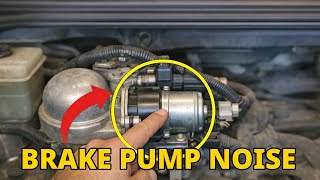
- A frequent buzzing or whirring noise from the engine bay, cycling every 15-30 seconds, even when not braking, as the pump struggles to maintain pressure. 🎬 Watch: Hear the specific buzzing noise caused by internal leaks.
- A loud, constant, high-pitched beeping or alarm from inside the cabin, indicating critical brake pressure loss.
- A hard or stiff brake pedal that requires significantly more effort to press.
- Reduced braking performance and longer stopping distances.
- Replacing only the ABS pump or accumulator. On the Prius V, the pump, accumulator, master cylinder, and electronic controls are one integrated assembly. The TSBs and overwhelming owner complaints confirm that the entire unit is typically required to fix the internal leak that causes these codes.
Most Likely Causes

- Internal Failure of the Brake Booster and Master Cylinder Assembly 🔴 High Probability Toyota has issued multiple TSBs (T-SB-0013-23, T-SB-0115-20, T-SB-0024-19) explicitly stating that a small internal brake fluid leak within this assembly is the primary cause for codes C1253, C1252, C1256, and C1391. This is a widely acknowledged design flaw for this generation.
How to confirm: Diagnosis involves using a professional scan tool like Toyota Techstream to read the codes and their sub-codes (INF codes). The presence of C1253 along with C1252, C1256, and/or C1391 is a very strong indicator of assembly failure, as outlined in Toyota's own service bulletins. Listening for the pump running excessively is another key confirmation.
Typical fix: The entire brake booster and master cylinder assembly must be replaced. This is a single, integrated unit. After installation, the brake system must be electronically bled using a scan tool.
Est. part cost: $1200-$1900
Rare But Worth Checking
- Failed ABS Motor Relay: While the C1253 code directly points to the motor relay circuit, the relay itself is rarely the root cause. The constant cycling from the failing pump assembly often burns out the relay. However, if C1253 appears alone, testing the ABS MTR 1 and ABS MTR 2 relays in the under-hood fuse box is a valid, inexpensive diagnostic step before condemning the entire booster assembly.
- Wiring Harness or Connector Issue: An open or short in the wiring between the Skid Control ECU and the brake actuator assembly could trigger this code. This is uncommon but should be investigated if a new actuator assembly does not resolve the issue, as it can prevent the new part from receiving power.
Diagnosis Steps
- Connect a professional OBD-II scanner capable of reading Toyota-specific chassis codes (like Toyota Techstream or a high-level Autel/Topdon scanner).
- Confirm the presence of C1253 and check for accompanying codes like C1252, C1256, and C1391. The combination of these codes strongly points to the brake booster assembly failure.
- Check for detailed INF (sub-codes) for C1253 using a capable scanner. For example, INF 321 indicates an open in the motor circuit, while 322 indicates a short.
- Listen for the brake pump. If it runs every few seconds, even without the brake pedal being pressed, this indicates a significant internal pressure leak.
- Using the scanner's active test functions, command the 'ECB Motor Relay' ON and OFF to verify its function and listen for the relay click.
- As a preliminary check, inspect the ABS MTR 1 and ABS MTR 2 relays and the associated fuses (ABS-1, ABS-2) in the under-hood fuse box.
- Visually inspect the wiring harness and connectors going to the brake actuator assembly for any signs of damage or corrosion. Check for continuity between the relay block and the actuator connector pins BM1 and BM2.
- If the codes, symptoms, and TSBs align, the diagnosis is a failed brake booster and master cylinder assembly.
- Replacement of the assembly is required, followed by a mandatory electronic brake bleeding procedure using a compatible scan tool. The procedure is often listed as "Actuator has been replaced" in the scan tool's utility menu. 🎬 Watch: How to perform the mandatory electronic brake bleed procedure.
Parts You'll Likely Need

- Brake Booster and Master Cylinder Assembly
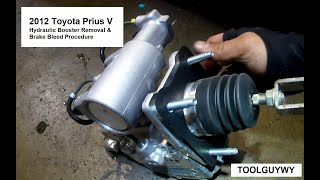
(OEM #47050-47110 (superseded by 47050-47111, then 47050-47112))— This is the complete assembly that fails due to an internal leak, as documented by Toyota TSBs. It includes the master cylinder, pump, and accumulator required to fix the issue. Using the latest superseded part number is recommended. 🎬 See this step-by-step walkthrough of the booster replacement process.
Trusted brands: Toyota (Genuine OEM)
OEM price range: $1350-$1950
Aftermarket price range: Not generally available or recommended due to safety criticality and system complexity.
Related Codes That Often Appear With This One
- C1252 — Indicates the brake booster pump motor has been running for an abnormally long time, which is a direct symptom of the system leak.
- C1256 — Indicates low pressure in the accumulator, another direct result of the internal leak preventing the system from holding pressure.
- C1391 — Specifically indicates an abnormal leak in the accumulator, which is the root cause described in the Toyota TSBs.
Technical Service Bulletins (TSBs) & Recalls
- T-SB-0013-23: Notes that C1253 and other codes may be stored due to a small brake fluid leak inside the brake booster.
- T-SB-0115-20: Identifies an internal brake fluid leak in the brake booster assembly with master cylinder as the cause for C1253 and related codes.
- T-SB-0024-19: Corroborates the other TSBs, pointing to an internal leak in the brake booster assembly as the cause for the cluster of brake system codes.
Platform-Specific Known Issues
- Official Toyota Technical Service Bulletins (TSBs): Toyota has issued multiple TSBs for the 2012-2016 Prius family, including the Prius V. T-SB-0013-23, T-SB-0115-20, and T-SB-0024-19 all state that codes C1253, C1252, C1256, and C1391 can be caused by a small internal brake fluid leak inside the brake booster assembly with master cylinder.
- Expired Customer Support Program (ZJB / ZKK): Toyota previously offered a warranty enhancement (Customer Support Program ZJB/ZKK) that extended coverage for this specific failure. The secondary coverage was for 10 years from the date of first use or 150,000 miles. For all 2012-2016 models, this program is now expired. Owners experiencing this failure today will have to cover the full cost of the repair.
- Owner Complaint Confirmation: An owner of a 2013 model reported codes C1252, C1253, and C1256, and their mechanic concluded the brake booster pump assembly accumulator was faulty, aligning with the TSBs.
- Dealer Diagnosis Confirmation: An owner of a 2012 model with the same three codes received a dealer diagnosis that the brake booster and ABS pump needed to be replaced, confirming the standard repair procedure.
Mechanic-Grade Diagnostic Values
- ABS MTR & ABS MTR 2 Relay Coil Resistance — expected: 10 kΩ or higher (between terminals 3 and 5, relay removed). Failure: Resistance lower than 10 kΩ indicates a shorted relay.
- ABS MTR & ABS MTR 2 Relay Contact Resistance — expected: Below 1 Ω (between terminals 3 and 5 with battery voltage applied to terminals 1 and 2). Failure: High resistance indicates pitted or failed contacts inside the relay.
- Accumulator Pressure Sensor Voltage (Data List) — expected: 2.90 to 4.20 V (Key on, brake pedal not depressed). Failure: Voltage outside this range, or a rapid drop in voltage (e.g., more than 0.55V in 30 seconds at rest) indicates a leak.
- Voltage at ABS Motor Relay Socket — expected: 10 to 14 V (at terminal 5 of the relay socket in the engine room fuse block). Failure: Low or no voltage indicates a problem with the power supply to the relay, possibly a fusible link.
Hidden / Shadow Codes Worth Checking
- INF 321: The motor drive monitor remained OFF for 0.2 seconds or more after a motor ON request. This points to an open circuit in the motor or its monitor circuit. (see via Toyota Techstream or equivalent advanced scanner in the DTC Freeze Frame Data.)
- INF 322: The motor drive monitor remained ON for 2 seconds or more after a motor OFF request. This points to a short in the motor circuit or a stuck relay. (see via Toyota Techstream or equivalent advanced scanner in the DTC Freeze Frame Data.)
- INF 323: The Skid Control ECU detected an internal motor drive logical inconsistency for 2 seconds or more, pointing to an internal ECU fault. (see via Toyota Techstream or equivalent advanced scanner in the DTC Freeze Frame Data.)
- INF 324-329: These codes indicate an open circuit in one or more of the three internal motor relays within the Skid Control ECU itself, indicating a failure of the ECU/actuator assembly. (see via Toyota Techstream or equivalent advanced scanner in the DTC Freeze Frame Data.)
Scan Tool Commands That Help

- Toyota Techstream: Active Test: ECB Motor Relay — Use this to manually command the ABS pump motor relay ON and OFF. This helps verify if the relay itself is functional and if the command from the ECU is being sent.
- Toyota Techstream: Utility: Actuator has been replaced — This is a mandatory, extended brake bleeding procedure that must be performed after replacing the brake actuator assembly. It cycles all solenoids and the pump to remove all air from the new unit. Failure to perform this will result in a non-functional brake system.
- Toyota Techstream: Utility: Zero Point Calibration — After the actuator replacement and bleed procedure, the yaw rate and deceleration sensor zero points must be calibrated. This is often the final step to extinguish all warning lights.
Wiring & Ground Locations
- Skid Control ECU — Located behind the driver's side of the dashboard, near the steering column.. This ECU is integrated into the brake booster/actuator assembly. The entire unit is replaced as one. Knowing its location helps in accessing the connectors for testing.
- A37 Connector — The main electrical connector on the brake actuator assembly.. This is the primary connector to inspect for corrosion or damage. Pins BM1 and BM2 within this connector carry power to the pump motor from the relays.
- Engine Room R/B — The main fuse and relay box in the left side of the engine compartment.. This box contains the critical ABS MTR 1 and ABS MTR 2 relays, as well as the ABS-1 and ABS-2 main fuses that supply power to the motor circuit.
Real Owner Repair Stories
- PriusChat Forum User (2013 Prius JDM (75k miles)) — Multiple brake warning lights (ABS, VSC, TRAC), alarm beeping, soft brake pedal requiring pumping to stop. Codes C1252, C1253, C1256, C1365 were present.
❌ Tried (didn't work) The mechanic initially hit the motor with a hammer, which temporarily resolved the issue, indicating a likely motor brush problem.
✅ What actually fixed it The user's mechanic diagnosed an abnormal leak in the brake booster itself after observing the pump running sporadically even when idle. The implied fix, based on the diagnosis, is the replacement of the entire brake booster/actuator assembly. - YouTube User (2010-2015 generation Prius) — Codes C1391, C1256, C1252, C1253. Pump running every few seconds.
❌ Tried (didn't work) The user replaced the entire brake booster and accumulator assembly but the problem persisted immediately after installation.
✅ What actually fixed it The user realized the issue was not the part itself, but that an "official bleed" using Toyota Techstream was required. The video concludes with the user about to perform the electronic bleed, identifying it as the missing step.
OEM Part Supersession History
47050-47110→47050-47111, then 47050-47112— Standard part revision by the manufacturer, likely for reliability improvements or minor manufacturing changes.
Heads up: The latest part number (47050-47112) should be used for all repairs. While older stock may be available, it is best practice to use the most current revision. Fitment is confirmed for 2012-2014 Prius V models.
Helpful Videos
We Have This Part in Stock



The information in this article is provided for general reference and educational purposes only. Vehicle specifications, procedures, and part compatibility can vary by production date, trim level, and region. Always consult your vehicle's factory service manual and verify part numbers before purchasing or performing repairs. Safety-critical components such as airbags, seat belts, and braking systems should be installed by a qualified professional.
- Toyota PRIUS V:
- 🎬 Helpful Videos
- 🛍️ Shop This Part
- What's Unique About the 2012-2016 Toyota PRIUS V
- Diagnostic Flowchart
- Symptoms You May Notice
- Most Likely Causes
- Rare But Worth Checking
- Diagnosis Steps
- Parts You'll Likely Need
- Related Codes That Often Appear With This One
- Technical Service Bulletins (TSBs) & Recalls
- Platform-Specific Known Issues
- Mechanic-Grade Diagnostic Values
- Hidden / Shadow Codes Worth Checking
- Scan Tool Commands That Help
- Wiring & Ground Locations
- Real Owner Repair Stories
- OEM Part Supersession History
- 🎟️ Get 5% Off