

C1253 on 2004-2011 Toyota Prius: Brake Actuator Failure Causes and Fixes
Code C1253 on a 2004-2011 Prius almost always indicates a failure of the brake actuator and pump assembly. This is a critical safety issue requiring immediate attention. The root cause is typically an internal leak causing the pump to overwork and fault the motor relay circuit. Expect a repair cost of $1,500 to $3,600, as the entire unit typically needs replacement.
- Code C1253 on a 2004-2011 Prius is a critical brake system warning that should be addressed immediately.
- The problem is almost certainly a failed brake actuator assembly, a known weak point on these vehicles.
- This is an expensive repair, often costing between $1,500 and $3,500.
- Due to the complexity of the brake-by-wire system and the need for a scan-tool-assisted brake bleed, this repair should be performed by a qualified professional.
- Always check for the presence of related codes like C1252, C1256, and C1391, which further confirm the diagnosis of a failed actuator.
What's Unique About the 2004-2011 Toyota PRIUS

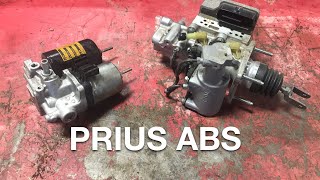
The 2004-2011 Toyota Prius uses a sophisticated brake-by-wire system that blends regenerative braking (to charge the hybrid battery) and traditional hydraulic braking. This system relies on an electric pump and a complex actuator assembly rather than a conventional vacuum brake booster. This assembly is a known high-failure item, leading Toyota to issue Technical Service Bulletins (TSBs) and a Warranty Enhancement Program (ZG1 for Gen 2) due to the frequency of the problem. The issue was so widespread that a defect petition was filed with the NHTSA to investigate the matter further.
Diagnostic Flowchart

Tap your situation to follow the diagnostic path that matches what you're seeing on this vehicle.
Generation note: This range covers two Prius generations: the 2nd generation (2004-2009) and the first two years of the 3rd generation (2010-2011). The brake actuator failure is a known issue on both generations, but the specific part numbers for the actuator assembly are different. The repair procedure also differs slightly, as the actuator is located under the inverter on the Gen 2, requiring more disassembly.
Symptoms You May Notice

- Multiple warning lights on the dashboard, including ABS, Brake (!), VSC, and TRAC. [T-SB-0024-19, T-SB-0079-18_Rev]
- A "Check VSC" message on the multi-function display. [T-SB-0032-16]
- A loud, repetitive buzzing or groaning noise from the engine bay, occurring every few seconds as the pump tries to build pressure.
- A hard brake pedal or noticeable change in braking performance, sometimes feeling spongy or requiring more effort.
- A loud, continuous beeping alarm inside the cabin in severe failure cases.
- Replacing only the ABS motor relays. While inexpensive, this usually doesn't fix the underlying problem of a failing actuator which will quickly burn out the new relays.
- Replacing a single component like the master cylinder or accumulator. On the Prius, these are integrated into the main actuator assembly, and the failure is typically internal to the unit, requiring a full replacement.
- Assuming a successful repair after just swapping the part. The repair is incomplete and may not resolve the codes without the proper electronic bleeding and calibration procedure using a tool like Techstream.
Most Likely Causes

- Internal Failure of the Brake Actuator / Booster Assembly 🔴 High Probability As documented in multiple Toyota TSBs, the assembly is prone to small internal brake fluid leaks, which cause the pump to run excessively to maintain pressure, eventually leading to component failure and triggering code C1253. [T-SB-0024-19, T-SB-0079-18_Rev, T-SB-0032-16] This is a well-documented failure pattern discussed extensively by owners.
How to confirm: A mechanic will listen for the pump motor running too frequently (every 5-20 seconds). Using a diagnostic tool like Toyota Techstream, they can monitor accumulator pressure and see it drop rapidly after the pump shuts off, confirming an internal leak. The presence of codes C1252 (Pump Motor On Time Abnormally Long), C1256 (Accumulator Low Pressure), or C1391 (Abnormal Leak in Accumulator) alongside C1253 strongly points to this failure.
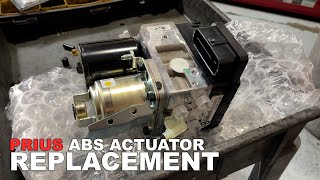
Typical fix: Complete replacement of the brake actuator and pump assembly. This is followed by a complex, multi-step brake bleeding procedure using a specialized scan tool like Techstream to initialize and calibrate the new unit.
Est. part cost: $1200-$2200 for OEM, $400-$800 for used or remanufactured units. - Failed ABS Motor Relay ⚪ Low Probability While the code directly names the relay circuit, the relay itself is rarely the primary point of failure. It usually fails as a consequence of the actuator/pump overworking it. However, it is an inexpensive part to check first.
How to confirm: Swap the 'ABS MTR 1' and 'ABS MTR 2' relays in the under-hood fuse box with known good relays from another circuit. If the code disappears and the pump functions normally, the relay was the issue.
Typical fix: Replace the faulty relay. However, if the new relay also fails, the root cause is almost certainly the actuator assembly drawing too much current.
Est. part cost: $15-$50
Rare But Worth Checking
- Wiring Harness or Connector Issue: Damage to the wiring between the Skid Control ECU and the brake actuator can cause this code. A user on PriusChat reported a persistent C1253 after multiple actuator replacements, pointing towards a potential wiring issue as the final culprit. A visual inspection and continuity check of the harness is warranted if a new actuator doesn't solve the problem.
- Failed Skid Control ECU: In very rare cases, the computer that controls the brake system can fail internally. This should only be considered after the actuator, relays, and wiring have been definitively ruled out. The diagnostic procedure in the service manual suggests replacing the ECU as a final step if all other components and wiring check out.
Diagnosis Steps
- Scan the ABS/VSC system for all stored trouble codes. Note if C1252, C1256, or C1391 are present with C1253, as this combination strongly indicates actuator failure.
- Listen to the engine bay with the car in the 'Ready' state. A buzzing/pumping noise every 5-30 seconds indicates the pump is cycling too often to maintain pressure.
- Check the 'ABS MTR 1' and 'ABS MTR 2' relays in the under-hood fuse box. Swap them with identical relays from non-critical systems (like the horn) as a quick, no-cost test.
- Inspect the main ABS fuses (often large 30A or 50A fuses) in the same fuse box, as a failing pump motor can blow them.
- Inspect the wiring harness and connectors going to the brake actuator assembly for any visible damage, corrosion, or loose connections.
- Using an advanced scan tool (like Toyota Techstream), perform an active test on the motor relay and monitor the accumulator pressure sensor data. A rapid drop in pressure after the pump shuts off confirms an internal leak.
- If a new actuator is installed and C1253 persists, follow the service manual's detailed diagnostic tree to check for continuity and shorts in the wiring harness between the actuator and the Skid Control ECU.
- If all other steps point to the actuator, it is condemned as faulty.
Parts You'll Likely Need
- Brake Actuator Assembly (Gen 2)
(OEM #44500-47141)— This is the primary point of failure for the 2006-2009 Gen 2 Prius. It supersedes part number 44500-47140. Note that the number stamped on the physical part may be different (e.g., 44510-47051), but the orderable part number is 44500-47141.
Trusted brands: Toyota (OEM), Dorman (Remanufactured), Used (from salvage yards)
OEM price range: $1200-$2200
Aftermarket price range: $700-$1500 - Brake Booster Pump Assembly (Gen 3)
(OEM #47070-47060)— This is the equivalent part for the 2010-2015 Gen 3 Prius. It is also referred to as the Brake Booster with Master Cylinder assembly.
Trusted brands: Toyota (OEM)
OEM price range: $550-$800
Aftermarket price range: $400-$600 - Brake Actuator Assembly (Early Gen 2)
(OEM #44500-47091)— This part is for the 2004-2005 Prius (up to 11/2005 production). It supersedes 44500-47090.
Trusted brands: Toyota (OEM)
OEM price range: $1300-$1800
Aftermarket price range: $600-$1200
Related Codes That Often Appear With This One
- C1252 — Indicates the brake booster pump motor has been running for an abnormally long time, which is a direct symptom of the actuator failing to hold pressure. [T-SB-0024-19, 23, 32]
- C1256 — This code means there is low pressure in the accumulator, which is also caused by the internal leak in the actuator assembly. [T-SB-0079-18_Rev, 23, 28]
- C1391 — This code indicates an abnormal leak in the accumulator, directly pointing to the most common root cause of the entire system failure. [T-SB-0032-16, 23, 45]
- C1319 — An owner complaint documented this code appearing with C1252 and C1253, indicating a general ABS system failure. [ODI #11476873]
Technical Service Bulletins (TSBs) & Recalls
- T-SB-0024-19: Notes that C1391, C1252, C1256, and C1253 may be stored due to a small internal brake fluid leak inside the brake booster assembly with master cylinder.
- T-SB-0079-18_Rev: Repeats the information from the above TSB, linking C1252, C1253, C1256, and C1391 to an internal brake fluid leak in the brake booster assembly.
- T-SB-0032-16: Connects C1391, C1252, C1253 or C1256 with a small internal brake fluid leak inside the brake actuator.
Platform-Specific Known Issues
- Due to the high rate of failure, Toyota issued Warranty Enhancement Program ZG1 for the 2004-2009 Prius. This extended the warranty on the Brake Actuator Assembly. Primary coverage lasted until Dec 31, 2017, with secondary coverage for 10 years or 150,000 miles from the date of first use. This program has now expired for all affected model years, but it serves as official acknowledgment of the widespread issue.
- An owner on PriusChat reported being quoted ~$3600 by a dealer for the repair on a 2007 model, and even after the repair was performed, the warning lights remained on, indicating a possible misdiagnosis or incomplete repair procedure.
- The physical location of the actuator on the Gen 2 (2004-2009) is under the hybrid system's inverter, which must be removed or shifted aside for access, adding complexity and labor time to the job.
Mechanic-Grade Diagnostic Values
- Accumulator Pressure Sensor Voltage (Live Data) — expected: 3.2 to 4.0 V with the pump motor stopped.. Failure: Voltage drops rapidly after the pump stops, indicating an internal leak.
- Brake Actuator Motor Resistance (Gen 2) — expected: Approximately 33 Ω between terminal BM1 or BM2 and terminal MTT.. Failure: Readings significantly outside this range suggest a faulty motor winding.
- Brake Booster Pump Motor Resistance (Gen 3) — expected: 950 to 1050 Ω between terminals BM1/BM2 and MTT (A46-1).. Failure: An open or shorted reading indicates a failed pump motor.
- ABS Motor Relay Coil Resistance — expected: 10 kΩ or higher (no continuity) between terminals 3 and 5.. Failure: Continuity when not energized indicates a stuck relay.
- ABS Motor Relay Switched Resistance — expected: Below 1 Ω between terminals 3 and 5 when battery voltage is applied to terminals 1 and 2.. Failure: High resistance when energized indicates pitted or failed contacts.
- Skid Control ECU Power Supply Voltage — expected: 11 to 14 V at pins MRI1 (A58-1) and MRI2 (A58-2) to body ground.. Failure: Low or no voltage indicates a problem with the power supply circuit or fuses.
Hidden / Shadow Codes Worth Checking
- INF 132, 133, 134, 136, 137, 138, 140 (Gen 2): These are detailed sub-codes (INF codes) for C1253 that provide more specific information about the nature of the motor relay circuit fault. For example, INF 138 indicates the Skid Control ECU detected that the motor monitor (MTT) input is 3.5V or more for at least 2 seconds when both motor relays are commanded off. (see via These codes are stored in the Freeze Frame Data (FFD) and can be read using Toyota Techstream software or a compatible advanced scan tool.)
- INF 321, 322, 323, 324, 325, 326, 327, 328, 329 (Gen 3): These are detailed sub-codes for C1253 on the Gen 3 platform, pointing to specific failures like the motor drive monitor remaining off (321), remaining on (322), or open circuits in specific internal relays (324-329). (see via Accessible via the ABS/VSC/TRC module's DTC details using Toyota Techstream or a similar professional-level scan tool.)
Scan Tool Commands That Help
- Toyota Techstream: Active Test: ABS Motor Relay — This command allows the technician to manually turn the ABS motor relays on and off to listen for an operational click and check the circuit's response, helping to isolate a faulty relay from a wiring or ECU issue.
- Toyota Techstream: Utility: Air Bleeding — This is a mandatory procedure after replacing the brake actuator or pump. The user selects "ABS actuator has been replaced" and follows a guided, multi-step process to bleed air from the entire system, including the new component.
- Toyota Techstream: Utility: Reset Memory — This function is used to clear stored calibration data from the Skid Control ECU before performing a new calibration. It is a required first step before the Linear Valve Offset procedure.
- Toyota Techstream: Utility: Linear Valve Offset Calibration — This procedure is required after replacing the actuator or clearing the ECU's memory. It calibrates the neutral position of the linear solenoid valves within the actuator. The process involves the car being stationary, in Park, with the parking brake released.
- Toyota Techstream: Test Mode: Yaw Rate and Acceleration Sensor Zero Point Calibration — After performing the Reset Memory and Linear Valve Offset, the yaw rate and G-sensor must also be calibrated to ensure the Vehicle Stability Control (VSC) system functions correctly.
Wiring & Ground Locations
- A2 (Gen 2) — The main electrical connector on the Brake Actuator Assembly itself, under the inverter.. This is the primary connection point for the pump motor and its monitor circuit. Technicians test for continuity to ground at pins 31 (GND1) and 32 (GND2) and for continuity between pin 33 (MTT) on this connector and the corresponding pin at the Skid Control ECU.
- S7 (Gen 2) — A connector for the Skid Control ECU.. Pin S7-29 (MTT) is the motor monitor circuit input to the ECU. A continuity check between this pin and pin A2-33 on the actuator connector is a key step in diagnosing a wiring harness fault.
- A46 / A47 (Gen 3) — The electrical connectors on the Brake Booster with Accumulator Pump Assembly.. These connectors house the motor power (BM1, BM2), ground (GND1, GND2), and motor monitor (MTT) circuits. Resistance checks are performed directly at these connector pins to test the pump assembly.
- Engine Room R/B — The main fuse and relay box in the engine compartment.. This box contains the critical ABS MTR 1 and ABS MTR 2 relays, as well as the 30A ABS-1 and ABS-2 fuses that protect the motor circuit. These are the first components to check for a C1253 fault.
Real Owner Repair Stories
- PriusChat user 'Joseph Grab' (2008 Toyota Prius Model Three) — BRAKE, (!), VSC, and ABS lights on with code C1253 that would not clear.
❌ Tried (didn't work) Replaced the ABS actuator with a known-good unit from another working Prius., Swapped the ABS MTR relays with known-good units from the same working Prius., Checked and replaced related fuses (Fuse 35).
✅ What actually fixed it The user suspected the final cause was a wiring harness or connector issue, as both the actuator and relays were proven to be good. The problem began after the engine was dropped and repositioned to replace a motor mount, suggesting a wire was likely damaged during that process. The user concluded the wiring diagnosis was beyond their ability. - PriusChat user 'Hamza Mughal' (2007 Toyota Prius Base) — Persistent C1253 code and continuous ABS pump operation.
❌ Tried (didn't work) Replacing the ABS actuator with a used part., Replacing the ABS actuator a second time with another used part., Replacing the ABS actuator a third time with a brand new Toyota OEM part., Replacing both ABS motor relays.
✅ What actually fixed it The issue was diagnosed as a wiring harness or connector problem after retrieving a hidden INF code 138. This sub-code indicated a specific voltage anomaly on the motor monitor circuit that was not caused by the actuator or relays, pointing directly to the harness as the remaining point of failure. - PriusChat user 'yi3o8' (2006 Toyota Prius Model Four) — C1253 code.
❌ Tried (didn't work) The user did not specify what other parts were tried.
✅ What actually fixed it The problem was a bad fusible link. This is a high-current fuse, often bolted in place within the fuse box, that protects the entire ABS motor circuit.
When the Usual Fixes Don't Work
- In multiple documented cases, replacing the brake actuator—even with a new OEM part—did not resolve the C1253 code. Further diagnosis using advanced tools like Techstream revealed hidden INF sub-codes (e.g., INF 138) that pointed specifically to a wiring harness fault between the Skid Control ECU and the actuator. This highlights that while the actuator is the most common cause, it is critical to perform continuity and voltage checks on the harness if a new part does not fix the issue, especially if the vehicle has a history of other major engine-bay repairs where the harness could have been disturbed.
Model Year Variations Within This Range
- 2004-2009 (Gen 2): The brake system uses a separate Skid Control ECU and Brake Actuator Assembly. The actuator is known to fail from internal leaks. The replacement procedure is more involved as the actuator is located under the main hybrid inverter, which must be removed for access.
- 2010-2011 (Gen 3): The Skid Control ECU and ABS actuator are integrated into a single unit, referred to as the Brake Booster with Master Cylinder Assembly. The accumulator and pump are a separate assembly. While the failure mode is similar (internal leak causing pump over-cycle), the parts are physically different and not interchangeable with Gen 2.
Helpful Videos


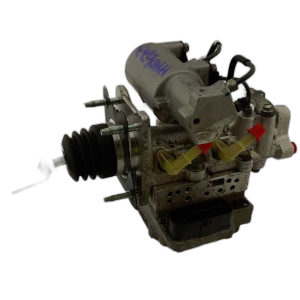
We Have This Part in Stock



The information in this article is provided for general reference and educational purposes only. Vehicle specifications, procedures, and part compatibility can vary by production date, trim level, and region. Always consult your vehicle's factory service manual and verify part numbers before purchasing or performing repairs. Safety-critical components such as airbags, seat belts, and braking systems should be installed by a qualified professional.
- Toyota PRIUS:
- 🎬 Helpful Videos
- 🛍️ Shop This Part
- What's Unique About the 2004-2011 Toyota PRIUS
- Diagnostic Flowchart
- Symptoms You May Notice
- Most Likely Causes
- Rare But Worth Checking
- Diagnosis Steps
- Parts You'll Likely Need
- Related Codes That Often Appear With This One
- Technical Service Bulletins (TSBs) & Recalls
- Platform-Specific Known Issues
- Mechanic-Grade Diagnostic Values
- Hidden / Shadow Codes Worth Checking
- Scan Tool Commands That Help
- Wiring & Ground Locations
- Real Owner Repair Stories
- When the Usual Fixes Don't Work
- Model Year Variations Within This Range
- 🎟️ Get 5% Off