

C1252 on 2007-2014 Toyota Camry: Brake Actuator Failure Causes and Fixes
Code C1252 on a 2007-2014 Toyota Camry, especially the hybrid model, almost always indicates a failing brake actuator assembly. This is a well-documented, widespread issue, often covered by Toyota's Technical Service Bulletins (TSBs) and a Customer Support Program (ZKK) for certain years. This is a critical safety repair; expect costs to range from $1,500 to over $3,000 for parts and labor at a professional shop.
- Code C1252 on a 2007-2014 Camry is a critical safety issue and almost always means the brake actuator assembly has failed internally.
- Do not drive the vehicle. There is a significant risk of brake failure.
- This is not a DIY-friendly repair. It is expensive and requires special tools and procedures for brake bleeding.
- Check if your vehicle, especially if it's a Hybrid, was covered under Toyota's Customer Support Program (ZKK) or any other warranty extension, although these programs may now be expired.
- The most common fix is a complete replacement of the brake actuator assembly.
What's Unique About the 2007-2014 Toyota CAMRY

This issue is particularly prevalent on Toyota hybrids of this era, including the Camry Hybrid, Prius, and Highlander Hybrid. The problem was so widespread that Toyota issued multiple TSBs and a Customer Support Program (ZKK) to address the failing brake booster and pump assemblies on specific models and years. The failure isn't just a simple leak; it's an internal malfunction within a complex, expensive, and integrated component, making it a well-documented and unfortunately common major repair for these vehicles.
Diagnostic Flowchart

Tap your situation to follow the diagnostic path that matches what you're seeing on this vehicle.
Generation note: This issue affects both the XV40 (2007-2011) and XV50 (2012-2014) generations of the Toyota Camry, particularly the hybrid models. TSBs and customer support programs have been issued covering vehicles in both generations.
Symptoms You May Notice

- Multiple warning lights on the dashboard: ABS, Brake, TRAC, and/or VSC.
- "Check VSC System" message on the display.
- A continuous or frequent high-pitched beeping or buzzing noise from the engine bay (the ABS pump), which can occur every few seconds, even when the car is off. 🎬 Listen to the specific buzzing sound of a failing actuator.
- A hard or stiff brake pedal that requires excessive force to stop the vehicle.
- The ABS pump motor can be heard running constantly or for long periods after the car is started.
- A sudden loss of braking effectiveness, where the pedal feels 'dead' at the top of its travel.
- Replacing only the brake booster or master cylinder. On these Camry models, the problematic components (pump, accumulator, controller) are part of a single integrated brake actuator assembly. Replacing other parts of the brake system will not solve this internal failure.
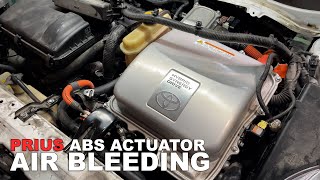
- Attempting a traditional brake bleed. The system requires a specific, multi-step bleeding procedure using Toyota's Techstream software or equivalent to properly purge air from the new actuator. Failure to do so will result in a spongy pedal and persistent warning lights. 🎬 See how to use Techstream for the mandatory bleeding procedure.
Most Likely Causes

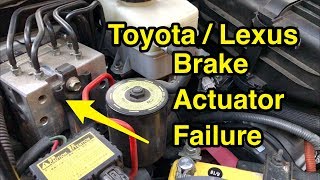
- Internal Failure of the Brake Actuator Assembly 🔴 High Probability As documented in Toyota TSBs T-SB-0130-19 and T-SB-0041-14 Rev, these models are prone to small internal brake fluid leaks within the actuator, causing the pump to run excessively to maintain pressure. This is a known design flaw affecting a large number of Toyota hybrid vehicles from this era.
How to confirm: A professional technician will use a scan tool like Toyota Techstream to monitor accumulator pressure. A steady drop in pressure when the brakes are not being used confirms an internal leak. The presence of codes C1256 ('Accumulator Low Pressure') and/or C1391 ('Accumulator Leak Malfunction') alongside C1252 is a strong confirmation of this specific failure.
Typical fix: Complete replacement of the brake actuator assembly (which includes the pump, accumulator, and ECU), followed by a scan tool-assisted brake bleeding procedure.
Est. part cost: $1200-$2500
Rare But Worth Checking
- Failing ABS Pump Motor Relay: A stuck or failing relay could theoretically cause the motor to run continuously. This is much less common than the actuator failure but is a relatively inexpensive part to check or replace as a diagnostic step. Code C1253 often points to a relay issue.
- Wiring Harness or Connector Issue: Damage to the wiring providing power and ground to the pump motor could cause it to run improperly or report false data. This is more likely if the vehicle has been in a front-end collision, as the harness can be compromised.
Diagnosis Steps
- Verify the 12V battery and charging system are in good health. Low voltage can cause myriad electrical issues.
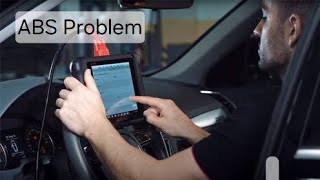
- Use a professional-grade scan tool (ideally Toyota Techstream) to read all codes from the ABS/VSC system. Note the presence of C1252, C1256, C1391, or C1253.
- Listen for the ABS pump motor in the engine bay. If it is running constantly or cycling on and off every few seconds without the brake being applied, it's a strong sign of failure.
- Check the brake fluid level. While the leak is usually internal, any external leaks should be ruled out.
- Using a scan tool with live data capability (like Toyota Techstream), monitor the 'Accumulator Pressure Sensor' value. The pressure should hold steady. If it drops consistently over a 30-90 second period without the brakes being applied, it confirms an internal leak as described in TSB-0041-14.
- If pressure holds but the code persists, inspect the pump motor relay and the wiring harness to the actuator for any damage or corrosion, especially if the vehicle has a history of front-end damage.
Parts You'll Likely Need
- Brake Actuator Assembly
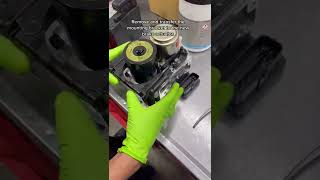
(OEM #44050-30660 (supercedes 44050-30300 for 2007-2011 models), 04003-44830 (service part number for some models), 04009-05133 (for 2012 models))— This is the complete unit that fails internally, causing the code. It includes the ABS pump, accumulator, and control module, and is replaced as a single assembly. 🎬 Watch this step-by-step guide on replacing the ABS actuator.
Trusted brands: Toyota (OEM), Aisin (often the original equipment manufacturer)
OEM price range: $1800-$2500
Aftermarket price range: $1200-$1800
Related Codes That Often Appear With This One
- C1256 — C1256 means 'Accumulator Low Pressure'. This code is triggered because the internal leak in the actuator prevents the system from holding the pressure generated by the pump. It is the most common companion code to C1252.
- C1391 — C1391 means 'Accumulator Leak Malfunction'. This is another code that directly points to the system's inability to hold pressure, almost always due to the same internal actuator failure.
- C1253 — C1253 indicates a 'Pump Motor Relay Malfunction'. It often appears with the other codes as the entire system is under stress from the constant operation, or it can indicate a primary electrical fault.
Technical Service Bulletins (TSBs) & Recalls

- T-SB-0130-19: Notes that for 2012-2014 Camry Hybrids, codes C1391, C1252, C1256, or C1253 may be caused by a small internal brake fluid leak.
- T-SB-0041-14 Rev: States that for 2007-2011 Camry Hybrids, the same set of codes can be caused by an internal brake fluid leak inside the brake actuator.
- Customer Support Program ZKK: An official program extending warranty coverage for this specific failure on certain 2012-2014 Camry Hybrid vehicles.
Platform-Specific Known Issues
- Customer Support Program ZKK (2012-2014 Camry Hybrid): Toyota launched Customer Support Program ZKK for certain 2012-2014 Camry Hybrids (and 2013-2015 Avalon Hybrids) due to internal malfunctions of the Brake Booster and Brake Booster Pump Assemblies. The program provided extended coverage for the repair. The primary coverage was offered until March 31, 2021, regardless of mileage, with secondary coverage lasting for 10 years from the date of first use or 150,000 miles, whichever came first. This program was an acknowledgment of the high failure rate.
- TSB T-SB-0041-14 Rev (2007-2011 Camry Hybrid): This Technical Service Bulletin addresses 2007-2011 Camry Hybrids exhibiting codes C1391, C1252, C1253, or C1256. It explicitly states the cause is likely a 'small internal brake fluid leak inside the brake actuator' and provides the procedure for replacement.
- TSB T-SB-0130-19 (2012-2014 Camry Hybrid): This TSB covers the next generation of Camry Hybrids (2012-2014) and identifies the same set of codes (C1391, C1252, C1256, C1253) as being caused by an internal leak in the 'brake booster assembly with master cylinder,' instructing technicians on the replacement procedure.
Mechanic-Grade Diagnostic Values
- Skid Control ECU CAN Bus Resistance — expected: 54 to 69 Ω. Failure: A reading outside this range indicates a problem on the CAN communication line or within an ECU.
- Skid Control ECU Ground Pin Resistance — expected: Below 1 Ω. Failure: A reading higher than 1 Ω indicates a poor ground connection, which can cause erratic ECU behavior.
- Skid Control ECU Power Pin Voltage (IG1) — expected: 10 to 14 V. Failure: Voltage below 10V or no voltage indicates a power supply issue to the ECU.
- Accumulator Pressure Sensor Voltage (via Techstream Data List) — expected: 3.58 to 5 V. Failure: A value that is constant regardless of pump operation may indicate a faulty pressure sensor.
- Pump Motor Harness Resistance — expected: Below 2 Ω. Failure: A higher resistance reading suggests a problem in the pump motor's wiring or the motor itself.
Hidden / Shadow Codes Worth Checking
- C1252/52: Some service manuals list the code with a two-digit detail code, such as '/52'. While not a 'hidden' code, it indicates that dealer-level scan tools like Techstream can provide more specific fault information than standard readers. The combination of C1252, C1256, and C1391 is the most powerful indicator, effectively acting as a specific signature for internal actuator failure. (see via Toyota Techstream or equivalent professional-grade scan tool.)
Scan Tool Commands That Help
- Toyota Techstream: Zero Down — This utility must be run before servicing or replacing the brake actuator. It safely relieves the high pressure stored in the accumulator, preventing injury or damage.
- Toyota Techstream: Air Bleeding — This is a mandatory procedure after replacing the brake actuator or opening the hydraulic system. It has special modes like 'Usual air bleeding' for fluid flushes and 'Actuator has been removed' for new part installation. Failure to use this utility will result in incomplete bleeding and a dangerous lack of brake performance.
- Toyota Techstream: Linear Valve Offset Learning — This calibration must be performed after the new actuator is installed and the system is bled. It teaches the ECU the characteristics of the new solenoid valves.
Wiring & Ground Locations
- A19, A78, A79 — These are the connector designators for the Skid Control ECU, which is part of the brake actuator assembly in the engine compartment.. For electrical diagnosis, technicians must test power, ground, and CAN bus signals at these specific connectors. For example, pins A19-32 and A19-1 are ground pins that should have less than 1 Ω resistance to the chassis.
- ABS MAIN NO.1, NO.2, NO.3 — These are fuses located in the engine compartment fuse box.. These fuses supply power to the electronically controlled brake system. A blown fuse should be ruled out before condemning the expensive actuator assembly.
Real Owner Repair Stories
- 2CarPros Forum User (2018 Toyota Landcruiser (similar system)) — Codes C1252 and C1256 with ABS light on.
❌ Tried (didn't work) Replaced the ABS brake booster and master cylinder assembly with new OEM parts.
✅ What actually fixed it The problem returned after one month. The pump motor on the new OEM assembly failed, and a leak noise was audible. This highlights the possibility of receiving a defective replacement part and the importance of verifying the repair, as the final fix was to address the faulty new part. - YouTube user 'David Jad' (2010-2015 Toyota Prius (similar system)) — Constant beeping noise, multiple brake warning lights, and codes C1252, C1253, and C1256.
❌ Tried (didn't work) Just replacing one component (e.g., only the actuator or only the pump).
✅ What actually fixed it The user states that if you have this specific combination of three codes, you must replace both the brake booster/actuator AND the brake pump assembly together. Critically, they warn that the part number must exactly match the vehicle's year range, as parts from different years (e.g., 2011 vs 2012) are not interchangeable despite looking similar.
OEM Part Supersession History
44050-30300→44050-30660— Part update or revision by the manufacturer.
Heads up: Using the old part number may result in installing an outdated design. Always use the latest superseded part number.Varies by year→Varies by year— Significant design changes between model year groups.
Heads up: Actuator assemblies for different year ranges (e.g., 2007-2011 vs. 2012-2014) are not interchangeable. The part number must be verified using the vehicle's VIN to ensure compatibility, as a physically similar but incorrect part will not function.
Model Year Variations Within This Range
- 2007-2014: The specific ECU connector identifier and pinout can vary based on the vehicle's configuration (e.g., LHD with CVT vs. other models). Service manuals show different connector IDs like A19, A78, and A79 for the same component, making it essential to use the correct wiring diagram for the specific vehicle being serviced.
Helpful Videos
We Have This Part in Stock



The information in this article is provided for general reference and educational purposes only. Vehicle specifications, procedures, and part compatibility can vary by production date, trim level, and region. Always consult your vehicle's factory service manual and verify part numbers before purchasing or performing repairs. Safety-critical components such as airbags, seat belts, and braking systems should be installed by a qualified professional.
- Toyota CAMRY:
- 🎬 Helpful Videos
- 🛍️ Shop This Part
- What's Unique About the 2007-2014 Toyota CAMRY
- Diagnostic Flowchart
- Symptoms You May Notice
- Most Likely Causes
- Rare But Worth Checking
- Diagnosis Steps
- Parts You'll Likely Need
- Related Codes That Often Appear With This One
- Technical Service Bulletins (TSBs) & Recalls
- Platform-Specific Known Issues
- Mechanic-Grade Diagnostic Values
- Hidden / Shadow Codes Worth Checking
- Scan Tool Commands That Help
- Wiring & Ground Locations
- Real Owner Repair Stories
- OEM Part Supersession History
- Model Year Variations Within This Range
- 🎟️ Get 5% Off