

OBD-II Code C1237: Wheel Speed Sensor Signal Fault
The Ultimate 2026 Guide to Diagnosing and Fixing C1237
- Code C1237 disables your ABS and traction control by flagging a missing wheel speed sensor signal, increasing emergency stopping distances by up to 20% on wet roads.
- Inspect the sensor wiring harness and the tone ring first; damaged wires or a cracked $15 tone ring cause this code just as often as a failed sensor.
- Never replace a wheel speed sensor on a 2011-2016 Hyundai or Kia for this code without testing the ABS module, as C1237 on these vehicles usually indicates a $2,000 internal hydraulic failure.
- Diagnose the exact faulty wheel by using an OBD-II scanner with live data capabilities (costing $100+) to monitor all four wheel speeds simultaneously while driving at 15 mph.
What Does C1237 Mean?

Code C1237 indicates the vehicle's Anti-lock Brake System (ABS) control module lost the signal from one of the wheel speed sensors. The vehicle's computer requires precise rotational speed data from each wheel to operate the ABS, traction control, and stability control systems.
Technical definition: The SAE/ISO definition for code C1237 is 'Speed Wheel Rear Input Signal Missing' or 'Speed Sensor Rotor Faulty'. The ABS module detects a missing or implausible signal from a wheel speed sensor. On Ford trucks, it specifically flags the rear differential sensor. 🎬 See how to replace the rear differential ABS sensor on Ford trucks. On 2011-2016 Hyundai/Kia models, it indicates a 'Primary Pressure Sensor Signal' fault inside the hydraulic control unit.
Can I Drive With C1237?
Yes, But With Caution. Yes, but your primary safety systems—Anti-lock Brakes (ABS), Traction Control (TCS), and Electronic Stability Control (ESC)—are disabled. Your conventional brakes function normally, but the wheels will lock up and skid during hard braking, increasing stopping distances and causing a loss of steering control on wet or slippery surfaces. Get the vehicle inspected immediately to avoid accidents.
Common Causes

- Defective Wheel Speed Sensor (Very Common) — The sensor's internal electronics fail from age, constant vibration, and exposure to extreme heat and moisture.
- Damaged Wiring or Connectors (Common) — The exposed wiring harness breaks, corrodes, or gets pinched by road debris, ice buildup, or careless suspension work.
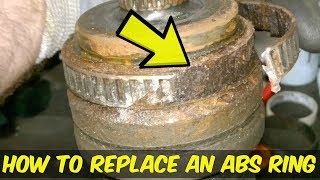
- Dirty or Damaged Tone Ring (Common) — The sensor reads a toothed magnetic ring (tone/reluctor ring) on the axle. If this ring cracks, loses teeth, or swells from rust, it destroys the sensor's signal. 🎬 Watch this walkthrough on how to replace a damaged reluctor ring.
- Worn or Loose Wheel Bearing (Less Common) — A failing wheel bearing introduces excessive play in the hub. This alters the critical air gap between the sensor and tone ring, causing signal dropouts during cornering.
- Mismatched or Improperly Sized Tires (Less Common) — Using tires of different sizes or vastly different tread depths forces wheels to rotate at different speeds. The ABS module interprets this constant speed variance as a sensor fault.
- Low or Unstable Battery Voltage (Uncommon) — The ABS module requires stable voltage. A failing battery or alternator triggers voltage drops that force the module to set false sensor codes. Always fix code C1241 first if present.
- Faulty ABS Control Module (Rare) — The ABS module itself fails internally. If all sensors, wiring, and tone rings test perfectly, the module requires replacement.
Symptoms

- ABS and Traction Control Lights On — The ABS, TCS, and ESC warning lights illuminate simultaneously on the dashboard and remain on.
- Braking Instability in Emergencies — During a hard stop or on slippery surfaces, the wheels lock up and skid because anti-lock functionality is disabled.
- Speedometer Malfunction or Failure — If the vehicle pulls speed data from the faulty wheel sensor, the speedometer behaves erratically, drops to zero, or stops working entirely.
- Cruise Control Inoperative — The vehicle automatically disables the cruise control system when it detects a critical ABS fault.
- False ABS Activation at Low Speeds — A weak signal forces the ABS to activate unnecessarily at speeds under 10 mph, causing a pulsing or grinding sensation in the brake pedal.
Diagnostic Flowchart

Tap your situation to follow the diagnostic path that matches what you're seeing on this code.
Used vs. New Parts: Buying Guide
When a used part is worth it: Never buy a used wheel speed sensor. Only buy used if replacing an expensive integrated hub assembly or ABS control module on a strict budget.
Donor-vehicle mileage cap: roughly under 60000 miles for the part to have meaningful remaining life.
Donor quality checklist:
- Verify the part number matches exactly.
- Ensure the donor vehicle was not scrapped for a brake system failure.
- Check for corrosion on the part and its electrical pins.
Decision logic:
- If The part is a simple bolt-on wheel speed sensor → Buy a new OEM or high-quality aftermarket part. Used sensors fail too quickly to justify the $10 savings.
- If The part is an expensive ABS module ($1,000+) → Buy a used part from a reputable salvage yard with a 90-day warranty.
Warranty tradeoff: Used parts carry a 30-90 day warranty. New aftermarket parts offer 1-year to lifetime warranties. New OEM parts carry a 12-month warranty.
Worst-case if a used part fails: $300 if a used hub fails shortly after installation, requiring repeat labor and a new part.
What Happens If You Wait — Timeline
- Immediate: ABS, Traction Control, and Stability Control disable. No other symptoms occur in normal driving. (MPG impact: 0%% · Added cost: $0)
- 1 week - 3 months: The automatic transmission exhibits harsh shifting or hesitation as it receives illogical speed data. Cruise control remains inoperative. (MPG impact: 5-15%% · Added cost: $50 - $200 in wasted fuel.)
- 3 - 8 months: Sustained erratic shifting stresses transmission clutches. In rust-prone areas, the faulty sensor seizes into the steering knuckle, doubling future labor costs. (MPG impact: 5-15%% · Added cost: $200 - $500 (Increased labor for seized part removal).)
- 8+ months: Continued harsh shifting destroys transmission clutch packs, requiring a rebuild. The primary safety risk of having no ABS in an emergency remains critical. (Added cost: $1,500 - $4,000+ (Transmission rebuild).)
Cost of Not Fixing It
- Immediate: Total loss of ABS, Traction Control, and Stability Control, drastically increasing the risk of an accident on wet roads. (Added cost: N/A)
- 1-6 months: Incorrect shift commands cause harsh transmission shifting, reducing fuel economy and wearing out internal solenoids. (Added cost: $500 - $1,500)
- 6+ months: Severe internal transmission damage requiring a complete rebuild. Seized sensors increase labor costs exponentially. (Added cost: $2,000 - $4,000+)
Related Codes
- C1230 — On Ford vehicles, C1230 indicates a hard electrical short or open in the rear sensor circuit. Diagnose and fix C1230 first, as it causes C1237.
- P0500 — A generic powertrain code for 'Vehicle Speed Sensor Malfunction'. The ABS module triggers this because it cannot send speed data to the engine. Fixing C1237 resolves P0500.
- C1201 — An 'Engine Control System Malfunction' code. The engine computer sets this when the ABS module reports a fault. It disables cruise control until C1237 is fixed.
- C1241 — Indicates 'Low or High Battery Voltage'. Unstable voltage forces the ABS module to malfunction and flag false sensor codes. Fix the voltage issue first.
Climate & Environmental Factors
- Cold Weather / Snow and Ice: Packed snow and ice physically block the sensor's view of the tone ring. Extreme cold makes wiring insulation brittle, causing it to crack and short out when exposed to melting slush.
- Road Salt / High Humidity: Road salt accelerates corrosion, destroying wiring connectors and causing tone rings to rust, swell, and crack. This is the primary cause of C1237 in coastal and northern regions.
How to Talk to a Mechanic About This Code
Say this: "I have an ABS light on and my scanner shows code C1237. Please check the live data from all wheel speed sensors to identify the faulting wheel, and visually inspect that wheel's sensor, wiring, and tone ring."
This directs the mechanic to perform a logical diagnostic process using live data rather than blindly replacing parts, saving you money on misdiagnosis.
Avoid saying:
- 'Just fix whatever's wrong'
- 'My ABS light is on, can you look at it?'
- 'My brakes feel weird'
Questions to ask before authorizing the repair:
- Which specific wheel showed a fault on the live data stream?
- Did you test the sensor's resistance, or just read the code?
- What is the physical condition of the wiring and the tone ring for that wheel?
- For my Hyundai/Kia, have you confirmed this isn't the internal HECU pressure sensor fault?
Where to Take It: Dealer vs Independent vs Chain
- Dealer:
Best for: Vehicles under warranty, Hyundai/Kia models requiring ABS module (HECU) replacement, Complex diagnostics on German vehicles with known tone ring issues
Downsides: Highest labor rates, Routinely recommends expensive module replacements over simple wiring repairs (Typical cost: +50% vs. baseline) - Independent Shop:
The best fit for most C1237 scenarios, offering a balance of expertise and value. Use a dealer for the specific Hyundai/Kia HECU issue.
Best for: Out-of-warranty vehicles, Straightforward sensor or hub assembly replacements, Wiring harness repairs
Downsides: Diagnostic equipment quality varies; ensure they have a bidirectional scanner with live data. (Typical cost: +0% vs. baseline) - Chain Shop:
Avoid for initial diagnosis. Acceptable only if you already know it requires a simple bolt-on sensor swap.
Best for: Simple, obvious fixes like a physically smashed sensor.
Downsides: Technicians lack experience for complex issues like intermittent wiring faults or corroded tone rings., High pressure to upsell unnecessary brake jobs. (Typical cost: -10% vs. baseline)
When to Walk Away From the Repair
If the estimated repair cost exceeds 40% of the car's private-party value, seriously consider selling the car as-is.
- Car worth $4000, fix is $200: Fix it. A standard wheel speed sensor replacement is routine and well below the threshold.
- Car worth $6000, fix is $500: Fix it. This is typical for a wheel bearing/hub assembly replacement and makes economic sense.
- Car worth $5000, fix is $2500: Walk away. This repair cost, typical for an ABS control module replacement on a Hyundai/Kia, equals 50% of the car's value.
What Scan Tool You Need for This Code
Minimum: A scanner that reads ABS/Chassis (C-codes) and displays a live data stream for individual wheel speed sensors.
A basic $20 code reader only sees engine codes (P-codes) and cannot detect C1237. Without live data, you cannot pinpoint which of the four sensors is faulty.
Budget: BlueDriver Pro Scan Tool (~$99) — Connects to a smartphone app to read/clear ABS codes and display live data graphing for all wheel speed sensors.
Mid-range: Foxwell NT530 Plus (~$180) — Offers bidirectional controls to perform active tests on the ABS module and includes ABS bleeding functions necessary after replacing a module.
Professional: Autel MaxiCOM MK808BT Pro (~$550) — Provides OE-level diagnostics, wireless connectivity, and advanced bidirectional controls for comprehensive testing of the entire ABS hydraulic system.
Rent vs buy: AutoZone's free code reading service rarely shows live data. Buy the BlueDriver if you plan to diagnose this yourself to avoid wasting money on the wrong sensor.
How to Clear the Code After You Fix It
- Use an OBD-II scan tool to clear C1237 from the ABS module.
- Turn the ignition off, then start the vehicle.
- Drive the vehicle above 20 mph for 5 minutes to allow the ABS module to run its self-test.
Drive cycle (~10 minutes): Drive the vehicle for at least 5 minutes at a speed above 20 mph (32 km/h). Perform at least one firm brake application to confirm the repair and extinguish the warning light.
Readiness monitors affected: None. This is a chassis code and does not affect emissions readiness monitors.
Watch out for:
- Disconnecting the battery does not clear ABS codes on modern vehicles.
- If the underlying fault remains, the code returns the moment the vehicle exceeds 15 mph.
- Basic $20 code readers only clear engine codes and cannot erase C1237 from the ABS module.
Will This Fail Emissions / State Inspection?
No — by itself this code doesn't fail OBD inspection (but it can keep readiness monitors from setting, which causes a separate fail).
- California: An ABS light does not fail the emissions smog check, but technicians may refuse to inspect the vehicle due to safety liability.
- New York: An illuminated ABS warning light causes an automatic failure during the annual safety inspection.
- Texas: An ABS light does NOT fail the annual safety inspection, provided the standard hydraulic brakes stop the vehicle within the required distance.
Most Commonly Affected Vehicles
- Ford F-150, F-250, E-Series Vans (2004-2015) — Extremely common. Usually relates to the single speed sensor on the rear differential (OSS) or a melted wiring harness near the exhaust.
- Toyota / Scion / Subaru Camry, Auris, 86/FR-S/BRZ (2007-2018) — Highly sensitive to mismatched tire sizes. Frequently triggers C1237 immediately after a tire rotation if tread depths vary.
- BMW 3 Series (E90), 5 Series, X3, X5 (2000-2015) — Rear reluctor rings suffer severe corrosion, swelling until they physically strike and destroy the wheel speed sensor.
- Chevrolet/GM Silverado, Sierra (1999-2007) — Caused by corrosion in the wiring harness connectors at the wheel or a faulty ground wire at the main EBCM.
- Volkswagen / Audi Golf, Passat, A4, A6 (2001-2017) — Rear sensors seize into the knuckle due to corrosion, making removal difficult. Wiring harness routing causes chafing.
- Mercedes-Benz C-Class, E-Class (1998-2014) — Prone to reluctor ring corrosion and cracking, identical to the issues faced by BMW models.
- Hyundai / Kia Sonata, Optima, Tucson (2011-2016) — CAUTION: C1237 on these vehicles means 'Primary Pressure Sensor Signal' fault, requiring a $2,000 replacement of the ABS hydraulic unit (HECU).
- Peugeot / Renault 307, 308, Megane, Scenic (2003-2015) — Typically points to a rear wheel speed sensor circuit fault caused by wiring damage near the rear axle beam.
Manufacturer-Specific Notes
- Ford: Trucks use a single sensor on the rear differential. The signal travels to the PCM, then to the ABS module via the CAN bus. A fault can be the sensor, PCM wiring, or the CAN bus itself.
- Toyota: Code C1237 triggers automatically if the vehicle drives over 19 mph for 60 seconds with tires of different sizes or vastly different tread depths.
- Hyundai / Kia: C1237 indicates a 'Primary Pressure Sensor Signal' fault inside the hydraulic brake unit (HECU), NOT a wheel speed sensor. Diagnosis requires checking internal brake pressure with a pro scanner.
- Subaru / Toyota (86/BRZ): The code appears intermittently during hard cornering as an early warning sign of a failing wheel bearing causing hub flex.
Real Owner Stories
2008 Ford F-150 with 280,000 km
ABS light illuminated intermittently. Codes C1230 and C1237 pointed to the rear speed sensor.
What they tried:
- Replaced the rear ABS sensor on the differential, but the codes returned.
- Traced the wiring harness from the sensor forward and found a melted section near the exhaust.
Outcome: Splicing in a new section of wiring harness resolved the issue.
Lesson: On Ford trucks with a single rear differential sensor, thoroughly inspect the entire wiring harness for heat damage or chafing before replacing the sensor.
2013 Hyundai Sonata Hybrid
Intermittent 'Check Brake' warning caused the brake pedal to go to the floor. Scanner showed code C1237.
What they tried:
- Mechanic tested wheel speed sensors, which passed. Cleared codes, but the problem returned.
- Dealership quoted $5,800 to replace the Hydraulic Electronic Control Unit (HECU).
Outcome: The confirmed fix was replacing the ABS hydraulic unit. On these models, C1237 points to an internal pressure sensor failure, not a wheel sensor.
Lesson: For 2011-2016 Hyundai/Kia vehicles, C1237 is a misdiagnosis trap. It indicates an internal ABS pressure sensor fault requiring a costly HECU replacement.
BMW E90 (3-Series) at 100k+ miles
ABS, DSC, and Brake warning lights illuminated. Scanner showed a rear wheel speed sensor plausibility fault.
What they tried:
- Replaced the rear wheel speed sensor, but the code returned immediately upon driving.
Outcome: The reluctor ring on the driveshaft had rusted, swelled, and cracked, destroying the new sensor. The fix required a new sensor and pressing a new reluctor ring onto the cleaned driveshaft.
Lesson: On rust-belt BMWs and Mercedes, always inspect the tone ring for swelling or cracks. A bad ring will instantly destroy a brand new sensor.
2016 Toyota Camry after tire rotation
Traction control activated at 20 mph immediately after a DIY tire rotation, cutting engine power. Scanner showed C1237.
What they tried:
- Inspected wiring for crush damage and found none.
- Realized the front and rear tires had significantly different tread depths due to replacing only two tires the previous year.
Outcome: Moving the tires back to their original axles resolved the code. The ABS system interpreted the rotational speed difference as a sensor fault.
Lesson: Sensitive ABS systems trigger C1237 if tire sizes or tread depths are mismatched between axles. Suspect this if the code appears right after a tire rotation.
How to Prevent This Code From Triggering
- Apply dielectric grease to sensor connectors (Whenever connectors are disconnected) — Dielectric grease blocks moisture and oxygen from reaching the metal pins, preventing the corrosion that causes signal loss.
- Clean sensor mounting surface during brake service (Every brake pad or rotor replacement) — Scraping rust off the steering knuckle maintains the correct air gap between the sensor and tone ring, preventing false ABS activation.
- Inspect wiring harnesses for secure mounting (During every oil change or tire rotation) — Ensures plastic clips hold the wiring away from moving suspension parts, preventing abrasion and short circuits.
Frequently Asked Questions
Can I fix code C1237 myself?
Yes, replacing a bolt-on wheel speed sensor or cleaning a tone ring requires only basic hand tools. Diagnosing circuit faults requires a multimeter and wiring diagram. Leave wheel bearing or ABS module replacements to professionals.
The code appeared after I hit a pothole. What should I check first?
Start with a close visual inspection of the wiring harness for the wheel on the side of the impact. Look for stretched wires, pinched conduits, or a physically smashed sensor. A severe impact also shatters tone rings.
How do I find out which wheel sensor is bad?
Use an OBD-II scanner with live data capabilities to monitor the speed readings from each wheel while driving at 15 mph. The sensor showing zero, erratic jumps, or a significantly different speed is the faulty one. Alternatively, test each sensor's resistance with a multimeter to find the outlier.
Will clearing the code make it go away?
No, clearing the code only turns the light off temporarily. The ABS module runs a self-test on the next drive cycle and immediately triggers the code again if the mechanical or electrical fault remains.
My ABS light came on right after getting new tires. Is that related?
Yes, technicians frequently damage sensors or pinch wiring harnesses during tire installations. Installing tires of different sizes or significantly different tread depths also triggers this code on sensitive systems. Return to the shop and demand they inspect their work.
What are common misdiagnosis pitfalls for C1237?
The most common mistake is replacing the sensor without inspecting the tone ring for cracks or rust buildup. Another major pitfall is ignoring a worn wheel bearing that causes signal dropouts only during turns. Finally, replacing a wheel sensor on a Hyundai/Kia when the code actually indicates a failed $2,000 ABS hydraulic unit.
Can low battery voltage cause a C1237 code?
Yes, the ABS control unit requires a stable 12-14 volts to operate correctly. A failing battery or alternator causes voltage drops that force the module to generate false sensor codes. Always fix battery or charging system codes (like C1241) before diagnosing C1237.
Key Takeaways
- Code C1237 disables your ABS and traction control by flagging a missing wheel speed sensor signal, increasing emergency stopping distances by up to 20% on wet roads.
- Inspect the sensor wiring harness and the tone ring first; damaged wires or a cracked $15 tone ring cause this code just as often as a failed sensor.
- Never replace a wheel speed sensor on a 2011-2016 Hyundai or Kia for this code without testing the ABS module, as C1237 on these vehicles usually indicates a $2,000 internal hydraulic failure.
- Diagnose the exact faulty wheel by using an OBD-II scanner with live data capabilities (costing $100+) to monitor all four wheel speeds simultaneously while driving at 15 mph.
Helpful Videos


The information in this article is provided for general reference and educational purposes only. Vehicle specifications, procedures, and part compatibility can vary by production date, trim level, and region. Always consult your vehicle's factory service manual and verify part numbers before purchasing or performing repairs. Safety-critical components such as airbags, seat belts, and braking systems should be installed by a qualified professional.
- 🎬 Helpful Videos
- What Does C1237 Mean?
- Can I Drive With C1237?
- Common Causes
- Symptoms
- Diagnostic Flowchart
- Used vs. New Parts: Buying Guide
- What Happens If You Wait — Timeline
- Cost of Not Fixing It
- Related Codes
- Climate & Environmental Factors
- How to Talk to a Mechanic About This Code
- Where to Take It: Dealer vs Independent vs Chain
- When to Walk Away From the Repair
- What Scan Tool You Need for This Code
- How to Clear the Code After You Fix It
- Will This Fail Emissions / State Inspection?
- Most Commonly Affected Vehicles
- Manufacturer-Specific Notes
- Real Owner Stories
- 2008 Ford F-150 with 280,000 km
- 2013 Hyundai Sonata Hybrid
- BMW E90 (3-Series) at 100k+ miles
- 2016 Toyota Camry after tire rotation
- How to Prevent This Code From Triggering
- Frequently Asked Questions
- Can I fix code C1237 myself?
- The code appeared after I hit a pothole. What should I check first?
- How do I find out which wheel sensor is bad?
- Will clearing the code make it go away?
- My ABS light came on right after getting new tires. Is that related?
- What are common misdiagnosis pitfalls for C1237?
- Can low battery voltage cause a C1237 code?
- Key Takeaways
- 🎟️ Get 5% Off