

OBD-II Code C1236: Wheel Speed Sensor Input Signal Missing
What C1236 means, why it triggers, and how to fix it
- Code C1236 disables your ABS and traction control by indicating a lost signal from a specific wheel speed sensor, increasing wet stopping distances by up to 50%.
- Inspect the ABS tone ring first; a rusted, cracked, or missing ring on the CV axle is the leading cause of this code on 2001-2012 Ford, Mercury, and Mazda SUVs.
- Do not buy parts until you view live ABS data on an OBD-II scanner while driving at 15 mph to pinpoint exactly which wheel is dropping the signal.
- On 2011-2015 Hyundai Sonata Hybrids, C1236 is not a wheel speed issue; it indicates a critical 'High Pressure Accumulator' failure requiring immediate hydraulic brake system repair.
What Does C1236 Mean?

Code C1236 means the ABS control module lost the signal from a specific wheel speed sensor (typically the left rear). This sensor reports wheel rotational speed. Without this data, the computer disables anti-lock braking, traction control, and stability control, illuminating dashboard warning lights.
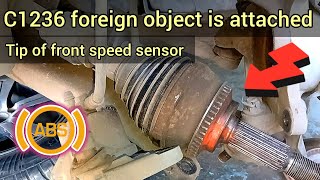
Technical definition: C1236 indicates 'Left Rear Wheel Speed Sensor Input Signal Missing'. On some Toyota models, it reads 'Foreign Object is Attached on Tip of Front Speed Sensor LH'. The code sets when the ABS module loses the sensor's square wave signal after the vehicle exceeds 12-15 mph.
Can I Drive With C1236?
Yes, But With Caution. Yes, but your ABS and Traction/Stability Control are disabled. Standard hydraulic brakes still function, but exercise extreme caution. Without ABS, wheels lock during hard braking, increasing stopping distances by up to 50% on wet surfaces and causing loss of steering control. Repair immediately to restore safety functions.
Common Causes

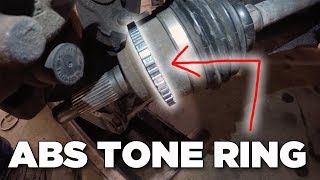
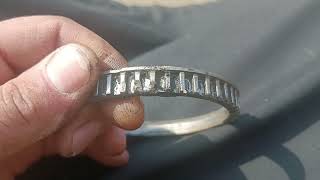
- Damaged, Rusted, or Cracked ABS Tone Ring (Very Common) — The tone ring is a toothed wheel the sensor reads. Located on the axle shaft or wheel hub, it is highly susceptible to rust. Rust causes the ring to swell, crack, or break off entirely, leaving the sensor with no signal.
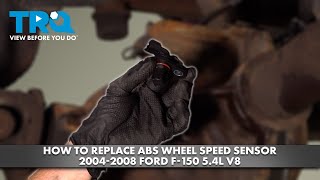
- Failed Wheel Speed Sensor (Common) — The sensor fails internally from age, heat cycles, and vibration. Its exposed location near the wheel makes it a frequent failure point.
- Wiring Harness or Connector Damage (Common) — Wires stretch, chafe against suspension parts, or sever from road debris. Connectors corrode or fill with water, causing an open or shorted circuit.
- Metallic Debris or Rust Buildup (Common) — The sensor tip is magnetic and attracts metallic brake dust, obstructing its view of the tone ring. Rust buildup on the hub's mounting surface also pushes the sensor away, increasing the air gap and weakening the signal.
- Failing Wheel Hub Bearing (Less Common) — A worn wheel bearing introduces excessive play in the hub assembly. This wobble alters the critical air gap between the sensor and tone ring, causing an erratic signal.
- Improper Previous Repairs (Uncommon) — Mistakes during a brake or bearing job trigger this code. Installing a magnetic encoder wheel bearing backward results in no signal.
- Faulty ABS Control Module (Rare) — The sensor, tone ring, and wiring function perfectly, but the ABS module fails internally and cannot process the incoming signal.
Symptoms
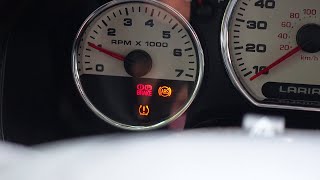
- ABS and Traction Control Lights Illuminated — The ABS and Traction/Stability Control warning lights illuminate and remain on.
- Disabled ABS and Stability Systems — During a hard stop, wheels lock up and skid. The brake pedal will not pulsate. On slippery surfaces, wheels spin freely without traction control intervention.
- Erratic Brake Pedal Pulsation at Low Speeds — A cracked tone ring sends a noisy signal, tricking the ABS module into thinking a wheel is locking up during slow braking. The ABS pump activates unnecessarily, pulsating the pedal.
Common Fixes & Costs

- Replace ABS Tone Ring — Parts: $20-$60, Labor: $150-$300, ~1.5 hr book time (Intermediate)
- Replace Wheel Speed Sensor — Parts: $40-$150, Labor: $100-$150, ~1.2 hr book time (DIY)
- Replace Wheel Hub Assembly — Parts: $150-$450, Labor: $200-$400, ~2 hr book time (Intermediate)
- Repair Wiring Harness or Connector — Parts: $10-$50, Labor: $125-$350, ~2.5 hr book time (Professional)
- Replace ABS Control Module — Parts: $300-$900, Labor: $150-$300, ~1.5 hr book time (Professional)
Used vs. New Parts: Buying Guide

When a used part is worth it: For a bolt-on wheel hub assembly on an older, high-mileage vehicle, a used part from a reputable salvage yard is a cost-effective option when the budget is tight.
Donor-vehicle mileage cap: roughly under 80000 miles for the part to have meaningful remaining life.
Donor quality checklist:
- Verify the part came from a vehicle of the same year and model without major collision damage.
- For hub assemblies, check for play or roughness in the bearing before purchase.
- Avoid parts from regions with heavy road salt use due to corrosion.
Decision logic:
- If The part is an electronic sensor → Buy new. Used sensors have an unknown history and fail with age and heat cycles.
- If The part is a wheel hub assembly on a vehicle with >100K miles → Strongly consider new. The bearing is a wear item, and a used part has limited life left.
- If The part is an ABS tone ring → Always buy new. They are inexpensive, and the labor to install them is significant.
Warranty tradeoff: Used parts offer a 30-90 day warranty. New aftermarket parts come with a 1-year to limited lifetime warranty. New OEM parts provide the best guarantee of fit and function.
Worst-case if a used part fails: $300-$600 if a used hub assembly fails shortly after installation, requiring you to pay labor twice.
Cost of Not Fixing It
- Immediate: Loss of ABS and Traction/Stability Control. Increased risk of wheel lock-up and skidding during emergency braking or adverse weather. (Added cost: Cost of accident deductible or full vehicle replacement.)
- 1-6 months: If caused by a failing wheel bearing, continued driving leads to complete bearing failure, damaging the hub and steering knuckle. (Added cost: $500-$1500+)
- 6+ months: Continued driving on a severely failed wheel bearing leads to wheel separation from the vehicle, causing a total loss of control. (Added cost: Total vehicle loss and extreme safety risk.)
Diagnosis Steps

- Confirm Code and View Live Data
Use an OBD-II scanner to confirm C1236. View the live data stream for all four wheel speed sensors while driving straight at 10 mph. The faulty sensor will read 0 mph or drop out erratically.
Tools: OBD-II Scanner with ABS Live Data (Beginner) - Perform a Visual Inspection
Raise the vehicle and remove the affected wheel. Look for a cracked, rusted, or missing tone ring on the axle shaft. Examine the sensor for physical damage or metallic debris on its tip. Trace the wiring harness for cuts or chafing.
Tools: Jack, Jack Stands, Flashlight (Beginner) - Clean Sensor and Mounting Surface
Remove the sensor bolt and pull it from the hub. Clean metallic shavings from the magnetic tip. Use a wire brush to clean rust off the sensor's mounting surface on the hub to restore the correct air gap.
Tools: Socket set, Brake Cleaner, Wire Brush (Intermediate) - Check for Wheel Bearing Play
Grasp the tire at the 12 and 6 o'clock positions and rock it back and forth. Noticeable play or a grinding noise when spinning the hub indicates a worn wheel bearing, which alters the sensor air gap.
Tools: None (Intermediate) - Test Sensor Electronically
Disconnect the sensor. For a 2-wire passive sensor, check resistance (typically 1,500-2,500 Ω). Spin the hub; it should generate >400mV AC. For a 3-wire active sensor, verify 5V or 12V reference voltage at the harness with the key on.
Tools: Multimeter, Back-probe Pins (Advanced) - Test Wiring Integrity
If the sensor tests good, disconnect the sensor and ABS module connectors. Check for continuity (less than 5 ohms) on both wires. Test resistance between each wire and chassis ground to ensure no short exists ('OL' reading).
Tools: Multimeter, Wiring Diagram (Advanced) - Verify the Repair
Clear the ABS codes. Test drive above 15 mph to allow the ABS module to run its self-test. Confirm the warning lights remain off and live data shows accurate speeds.
Tools: OBD-II Scanner (Beginner)
When This Code Triggers (Freeze-Frame Conditions)
- Vehicle Speed: 15-45 mph (The code sets once the vehicle exceeds a speed threshold (12-15 mph) where the ABS module expects a valid signal from all wheels.)
- Wheel Speed Mismatch: >15% difference (Freeze frame shows the faulty wheel speed sensor reading 0 mph or a value significantly different from the other three wheels.)
- ABS/Traction Control Status: Disabled/Inactive (The data shows the ABS and Traction/Stability Control systems commanded off due to the fault.)
Related Codes
- C1235 — The identical 'signal missing' code for the right rear wheel. On vehicles with a single sensor on the rear differential, both codes appear simultaneously.
- C1233 / C1234 — These codes indicate the same 'signal missing' fault but for the front wheels (C1233 Left Front, C1234 Right Front).
- C1175 — A Ford-specific code for 'Left Rear Speed Sensor Input Circuit Fault'. Paired with C1236, it confirms an electrical problem rather than a mechanical tone ring failure.
- C0200 - C0215 — Generic SAE codes for wheel speed sensor circuit faults. If present with C1236, it reinforces that the problem is electrical.
Climate & Environmental Factors
- Road Salt and Humidity: Salt and moisture cause aggressive corrosion. This rusts the tone ring, causing it to swell and crack. It also corrodes the sensor body, wiring harness connectors, and the sensor mounting pad on the hub, increasing the air gap.
- Extreme Heat: Prolonged exposure to extreme heat contributes to the internal electronic failure of the wheel speed sensor or causes plastic wiring insulation to become brittle and crack.
How to Clear the Code After You Fix It
- Use an OBD-II scan tool with ABS capabilities to clear the code.
- Perform a test drive exceeding 15-20 mph to allow the system to self-test.
- Do not disconnect the battery, as this will not reliably clear ABS codes.
Drive cycle (~10 minutes): After clearing the code, drive in a straight line, accelerating over 20 mph. The ABS light extinguishes after the module confirms valid signals from all wheel speed sensors.
Readiness monitors affected: None. An ABS fault does not affect emissions-related readiness monitors.
Watch out for:
- Using a basic engine code reader that cannot access the ABS module.
- The code returns immediately if the root cause (bad sensor, tone ring, or wiring) is not fixed.
- Forgetting to clear the code after repair; the light stays on until manually erased.
Will This Fail Emissions / State Inspection?
No — by itself this code doesn't fail OBD inspection (but it can keep readiness monitors from setting, which causes a separate fail).
- California: An illuminated ABS light does not fail the smog check. However, for a vehicle requiring a 'Brake and Lamp' inspection, a non-functional ABS system is a failure.
- New York: An illuminated ABS warning light is grounds for failure of the annual safety inspection.
- Texas: An illuminated ABS light is NOT a cause for rejection in the annual safety inspection. However, the primary red 'BRAKE' warning light being on is a failure.
Most Commonly Affected Vehicles
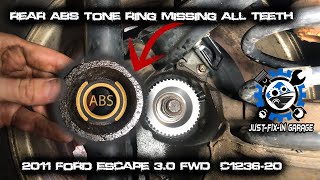
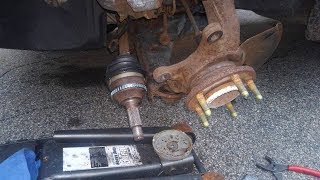
- Ford Escape / Mercury Mariner / Mazda Tribute (2001-2012) — Extremely common for the rear ABS tone ring to rust, crack, and fall off the CV axle shaft. The OEM part number is 7L8Z-2C182-A. 🎬 Watch this 30-minute fix for a Ford Escape tone ring.
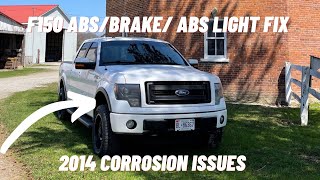
- Ford F-150 (2004-2014) — Issues are common with both the individual wheel speed sensors and the tone ring, which is integrated into the sealed wheel hub assembly.
- Ford F-250 / F-350 Super Duty (2005-2007) — Often caused by the single speed sensor on the rear differential. 🎬 Watch: How to replace the differential speed sensor on Mountaineers. Loose differential carrier bearing bolts create metallic debris that interferes with the sensor.
- Ford Fusion (2006-2012) — A known issue is rust buildup on the sensor's mounting pad, which pushes the sensor away from the tone ring, increasing the air gap.
- Ford Explorer / Mercury Mountaineer (2002-2005) — TSB 03-26-3 addresses C1235 and C1236 appearing together, pointing to a failure of the single, shared speed sensor on the rear differential.
- Honda Civic (2006-2011) — Often caused by rust jacking under the sensor mount. A common misdiagnosis occurs after installing the magnetic encoder wheel bearing backward.
- Hyundai Sonata Hybrid (2011-2015) — CRITICAL: On these hybrids, C1236 indicates a 'High Pressure Accumulator Low Pressure Error' within the electronic/hydraulic brake system, not a wheel speed issue.
- Toyota Corolla / Highlander (2003-2013) — The code definition specifies 'Foreign Object is Attached on Tip of Sensor'. Metallic brake dust accumulates on the magnetic sensor tip, requiring cleaning. 🎬 See how to clean debris from a Toyota speed sensor.
Manufacturer-Specific Notes
- Ford / Mercury: On older SUVs with a solid rear axle (2002-2005 Explorer), codes C1235 and C1236 set together and point to a single speed sensor on the rear differential housing.
- Toyota / Lexus: The code definition includes 'Foreign Object is Attached on Tip of Sensor', a built-in hint that metallic brake dust accumulation is the primary cause.
- General Motors: On some GM platforms, C1236 defines as 'Low System Voltage', pointing to a power supply issue at the Electronic Brake Control Module (EBCM), not a wheel sensor.
- Hyundai / Kia: On 2011-2015 Sonata Hybrids, C1236 means 'High Pressure Accumulator Low Pressure Error', pointing to a fault in the electro-hydraulic braking system.
- Mazda: On models sharing Ford platforms (Tribute, Mazda3), the ABS tone ring is integral to the rear wheel hub. A failed tone ring requires replacing the entire hub assembly.
Real Owner Stories
2011 Ford Escape FWD
ABS light came on. Scan showed C1236-20: Left Rear Wheel Speed Sensor Input Signal Missing.
What they tried:
- Performed a visual inspection of the left rear wheel area.
- Compared the left rear to the right rear and noticed the toothed tone ring was completely missing from the left side axle.
Outcome: The rusted tone ring cracked and fell off the CV axle shaft. The owner pressed a new tone ring (Ford P/N 7L8Z-2C182-A) onto the axle after removing the axle nut. The 30-minute repair resolved the code.
Lesson: Always perform a visual inspection first on Ford Escapes. A missing or cracked tone ring is the most common cause of C1236 and is easily confirmed before buying parts.
2008 Ford Edge
ABS and Traction Control lights appeared after washing the car. Scan showed C1175 (Circuit Fault) and C1236 (Signal Missing).
What they tried:
- Suspected water entered the connector during the car wash.
- Disconnected the left rear wheel speed sensor, dried the connector, and applied dielectric grease.
Outcome: Cleaning and drying the connector resolved the short circuit caused by water intrusion, clearing both codes without replacing the sensor.
Lesson: If the code appears immediately after a car wash or heavy rain, check for water in the sensor's electrical connector. Drying it and applying dielectric grease prevents unnecessary part replacement.
2014 Hyundai Sonata Hybrid
ABS and brake warning lights on. The brake pedal felt like ABS was activating constantly, with very little braking power. Scan showed C1236.
What they tried:
- Researched the code specifically for the Sonata Hybrid platform.
Outcome: On this specific vehicle, C1236 indicates a 'High Pressure Accumulator Low Pressure Error' in the electro-hydraulic brake system. The owner took it to the dealer for a critical brake pressure unit repair.
Lesson: Always verify the code definition for your exact make and model. On hybrids, C1236 often indicates a critical hydraulic brake failure, not a simple wheel sensor issue.
2012 Toyota Prius
Intermittent VSC and ABS lights with code C1236 for 'debris on tip of sensor'.
What they tried:
- Cleaned the original sensor and tone ring. Code returned.
- Replaced the sensor. Code returned.
- Performed a wiggle test on the wiring harness while watching live data.
Outcome: Found a subtle break inside the wiring insulation near a wheel well clamp. The intermittent connection caused the signal dropout. Repairing the wire fixed the code.
Lesson: An intermittent code not fixed by a new sensor points to wiring. A 'wiggle test' while watching live data is the best way to find hidden wire breaks.
Frequently Asked Questions
Is it safe to drive with code C1236?
The vehicle is driveable, but not safe. Your anti-lock brakes and stability control are disabled, increasing stopping distances by up to 50% in wet conditions. Repair it promptly to restore emergency handling.
Can I pass a state inspection with the ABS light on?
This depends on your local jurisdiction. In states like Texas, an ABS light alone passes, but in New York, it is an automatic failure. Check your specific state regulations.
What is the most common mistake when fixing C1236?
Replacing the wheel speed sensor without inspecting the tone ring or testing the wiring. On Ford Escapes, a cracked tone ring is the actual culprit 90% of the time. Always perform a visual inspection first.
I replaced the sensor, but the light is still on. What's next?
Re-inspect the tone ring for hairline cracks you missed. Check the wheel bearing for play, and perform a continuity test on the wiring harness between the sensor and the ABS module.
Can I replace just the ABS tone ring?
Yes, on older vehicles like the Ford Escape, the tone ring is a separate $20 part pressed onto the axle shaft. However, on most modern cars, the tone ring is permanently integrated into the wheel hub assembly.
Why does my mechanic say I need a whole new wheel hub?
On many modern vehicles, the tone ring and magnetic encoder are built directly into the sealed wheel hub bearing. If the internal ring fails, the entire hub assembly must be replaced.
The ABS light came on after hitting a pothole. Could that cause C1236?
Yes. A sharp impact from a pothole easily cracks an already rusted, brittle tone ring. It also severs fragile sensor wiring or damages the sensor itself.
Key Takeaways
- Code C1236 disables your ABS and traction control by indicating a lost signal from a specific wheel speed sensor, increasing wet stopping distances by up to 50%.
- Inspect the ABS tone ring first; a rusted, cracked, or missing ring on the CV axle is the leading cause of this code on 2001-2012 Ford, Mercury, and Mazda SUVs.
- Do not buy parts until you view live ABS data on an OBD-II scanner while driving at 15 mph to pinpoint exactly which wheel is dropping the signal.
- On 2011-2015 Hyundai Sonata Hybrids, C1236 is not a wheel speed issue; it indicates a critical 'High Pressure Accumulator' failure requiring immediate hydraulic brake system repair.
Helpful Videos

The information in this article is provided for general reference and educational purposes only. Vehicle specifications, procedures, and part compatibility can vary by production date, trim level, and region. Always consult your vehicle's factory service manual and verify part numbers before purchasing or performing repairs. Safety-critical components such as airbags, seat belts, and braking systems should be installed by a qualified professional.
- 🎬 Helpful Videos
- What Does C1236 Mean?
- Can I Drive With C1236?
- Common Causes
- Symptoms
- Common Fixes & Costs
- Used vs. New Parts: Buying Guide
- Cost of Not Fixing It
- Diagnosis Steps
- When This Code Triggers (Freeze-Frame Conditions)
- Related Codes
- Climate & Environmental Factors
- How to Clear the Code After You Fix It
- Will This Fail Emissions / State Inspection?
- Most Commonly Affected Vehicles
- Manufacturer-Specific Notes
- Real Owner Stories
- 2011 Ford Escape FWD
- 2008 Ford Edge
- 2014 Hyundai Sonata Hybrid
- 2012 Toyota Prius
- Frequently Asked Questions
- Is it safe to drive with code C1236?
- Can I pass a state inspection with the ABS light on?
- What is the most common mistake when fixing C1236?
- I replaced the sensor, but the light is still on. What's next?
- Can I replace just the ABS tone ring?
- Why does my mechanic say I need a whole new wheel hub?
- The ABS light came on after hitting a pothole. Could that cause C1236?
- Key Takeaways
- 🎟️ Get 5% Off