

Ultimate C1223 OBD-II Code Guide: ABS Malfunction In-Depth
The Definitive Resource to Diagnose and Fix Trouble Code C1223
- Code C1223 disables your vehicle's Anti-lock Braking System (ABS), Traction Control, and Stability Control, increasing the risk of skidding during emergency stops.
- On Toyota and Lexus vehicles, a $30 faulty brake light switch (code C1249) or low battery voltage (code C1241) frequently triggers this code, rather than a failed ABS component.
- On General Motors vehicles, C1223 specifically indicates a dead left wheel speed sensor, requiring a $150-$300 sensor or hub replacement.
- Owners of 2006-2018 Hyundai and Kia models must immediately check their VIN for NHTSA safety recalls, as a C1223 code indicates an ABS module short circuit that poses a severe fire risk.
What Does C1223 Mean?

Trouble code C1223 indicates the vehicle's main computer detected a malfunction within the Anti-lock Braking System (ABS). The exact meaning is manufacturer-specific. For General Motors, it means the 'Left Front (or Rear) Wheel Speed Sensor Input Signal is 0'. For Toyota and Lexus, it acts as a generic 'ABS Control System Malfunction' master code pointing to underlying issues like a faulty brake light switch or low voltage. For other manufacturers, it indicates a 'Lamp Brake Warning Output Circuit Failure'. This fault always illuminates the ABS warning light and disables traction and stability control.
Technical definition: The SAE/ISO definition for C1223 is manufacturer-specific. On General Motors vehicles, it is defined as 'Left Front (or Rear) Wheel Speed Sensor Input Signal is 0'. On Toyota/Lexus, it is a generic 'ABS Control System Malfunction' triggered by the VSC system. On other makes, it is defined as 'Lamp Brake Warning Output Circuit Failure', pointing to an electrical fault in the dashboard's brake warning indicator circuit managed by the Body Control Module (BCM).
Can I Drive With C1223?
yes_but_caution_advised. You can drive with code C1223 because standard hydraulic brakes still function, but caution is mandatory. The Anti-lock Braking System (ABS), Traction Control (TCS), and Vehicle Stability Control (VSC) are disabled, significantly increasing the risk of wheel lock-up and skidding on wet or icy roads. On specific Toyota models (like the RAV4), a failing ABS actuator triggers this code and causes brakes to drag or apply unexpectedly, creating an immediate safety hazard. Diagnose and repair the vehicle promptly to restore critical safety systems and prevent secondary brake wear.
Common Causes


- Faulty Brake Light Switch (Toyota/Lexus) (Very Common) — On Toyota and Lexus models, a failing brake light switch sends an incorrect signal to the ABS module, triggering C1223. This is an inexpensive, frequently misdiagnosed cause that usually sets code C1249 simultaneously.
- Defective Wheel Speed Sensor (Very Common) — Wheel speed sensors sit exposed at the wheel hub and fail frequently due to road salt, metallic debris, and heat cycling. A dead sensor stops sending speed data to the ABS module, immediately triggering the code.
- Damaged or Corroded Wiring/Connectors (Common) — Wiring to the wheel speed sensor flexes with the suspension and is vulnerable to road debris. Broken wires or corroded connectors at the sensor or ABS module create open or short circuits.
- Low Battery Voltage or Charging System Issue (Common) — The ABS module requires stable voltage. A weak battery or failing alternator dropping system voltage below 10.5V starves the module, triggering C1223 and often C1241.
- Contaminated or Damaged ABS Tone Ring (Less Common) — The toothed or magnetic ring read by the wheel speed sensor cracks, rusts, or loses teeth over time. This distorts the magnetic field, preventing the sensor from generating an accurate speed signal.
- Failing ABS Control Module/EBCM (Less Common) — The electronic module controlling the ABS system fails internally due to broken solder joints or failed transistors. On recalled Hyundai/Kia models, internal short circuits cause this failure and pose a fire risk.
- Electrical Supply Issues (Fuses, Relays, Grounds) (Rare) — A blown ABS fuse, faulty relay, or heavily corroded main ground strap interrupts power or communication to the ABS module, causing the system to register a fault.
Symptoms
- ABS Warning Light On — The primary symptom. The amber ABS light on the dashboard illuminates and stays on.
- Traction Control (TCS/VSC) Light On — Traction and stability control systems rely on wheel speed sensors. When ABS fails, these systems are disabled, illuminating their respective warning lights.
- Wheels Lock Up Under Hard Braking — Without functional ABS, the wheels lock and cause the vehicle to skid during panic stops, particularly on wet or loose surfaces.
- Unintended Braking or Loss of Power (Toyota Specific) — On specific Toyota models (e.g., RAV4), a failing ABS actuator associated with C1223 causes the brakes to drag, making the vehicle feel sluggish and severely impacting fuel economy.
- Brake Warning Light Inoperative — If the code indicates a 'Lamp Brake Warning Output Circuit Failure', the main red 'BRAKE' warning light stays on, flickers, or fails to illuminate when the parking brake is applied.
Diagnostic Flowchart
Tap your situation to follow the diagnostic path that matches what you're seeing on this code.
Common Fixes & Costs
- Replace Brake Light Switch
— Parts: $20-$75, Labor: $50-$120, ~0.6 hr book time
(DIY)
: OEM
: OEM - Replace Wheel Speed Sensor
— Parts: $40-$150, Labor: $100-$180, ~1.2 hr book time
(DIY)
: OEM
: OEM - Repair Damaged Wiring or Connector
— Parts: $10-$50, Labor: $120-$250, ~2.0 hr book time
(Intermediate)
: OEM - Clean or Replace ABS Tone Ring
— Parts: $20-$120 (Ring), $150-$400 (Hub), Labor: $150-$300, ~2.5 hr book time
(Intermediate)
: OEM - Replace/Rebuild ABS Control Module
— Parts: $800-$1500 (New), $250-$600 (Rebuilt), Labor: $150-$300, ~2.0 hr book time
(Professional)
: OEM
: OEM
DIY vs Professional
- Replace Brake Light Switch — Beginner: True
- Replace Wheel Speed Sensor — Beginner: True
- Repair Damaged Wiring — Beginner: False
- Replace ABS Control Module — Beginner: False
Used vs. New Parts: Buying Guide
When a used part is worth it: For a wheel speed sensor, a used OEM part from a low-mileage, accident-free vehicle provides better reliability than a low-quality aftermarket part. For ABS modules, rebuilt units are superior to used.
Donor-vehicle mileage cap: roughly under 80000 miles for the part to have meaningful remaining life.
Donor quality checklist:
- Verify the donor vehicle was not from the 'Salt Belt' to avoid corrosion.
- Match the part number exactly.
- Ensure the part includes a 30-90 day warranty.
Decision logic:
- If The part is a simple 2-wire passive sensor and budget is tight → A tested used OEM part or a reputable aftermarket brand (e.g., NTK, Standard Motor Products) is acceptable.
- If The vehicle has advanced safety systems (e.g., Hill Hold, ADAS) → Buy a new OEM or premium aftermarket active sensor to ensure system integrity.
- If The part is the ABS control module → Purchase a rebuilt original module. It avoids VIN programming issues common with used modules and corrects factory defects.
Warranty tradeoff: Used parts offer a 30-90 day functional warranty. Aftermarket new parts provide a 1-year to limited lifetime warranty. OEM new parts generally include a 12-month warranty.
Worst-case if a used part fails: $100-$250 for repeat labor if a cheap aftermarket sensor fails shortly after installation.
What Happens If You Wait — Timeline
- 0-1 month: ABS, Traction Control, and Stability Control warning lights illuminate. Systems are disabled. Standard hydraulic brakes function normally. The vehicle fails safety inspections. (MPG impact: 0%% · Added cost: $0, unless an accident occurs due to lack of ABS.)
- 1-3 months: On specific models (e.g., Toyota RAV4), a faulty ABS actuator causes intermittent brake drag, feeling like a loss of engine power. Fuel consumption increases. (MPG impact: 2-5%% · Added cost: $50-$150 in wasted fuel and accelerated brake pad wear.)
- 3-6 months: Sustained brake drag causes excessive heat, leading to premature wear of brake pads and warped brake rotors. The 'loss of power' symptom becomes severe. (MPG impact: 5-10%% · Added cost: $300-$700 for replacement of pads and rotors.)
- 6+ months / Catastrophic Failure: On recalled Hyundai/Kia models, the internal short circuit in the ABS module sparks an engine compartment fire. On models with severe brake drag, calipers seize, requiring a full brake system overhaul. (MPG impact: N/A% · Added cost: $1000+ for caliper repairs, or total vehicle loss in case of fire.)
Cost of Not Fixing It
- 0-1 month: Significantly increased risk of wheel lock-up and skidding in an emergency stop. The vehicle fails mandatory safety inspections. (Added cost: Negligible, unless an accident occurs.)
- 1-6 months: On certain Toyota models, a faulty ABS actuator causes severe brake drag, leading to accelerated wear of brake pads and rotors and reduced fuel economy. (Added cost: $300-$700 for premature brake pad and rotor replacement.)
- 6+ months: On specific recalled Hyundai models, the internal short circuit in the ABS module sparks an engine compartment fire. (Added cost: Total vehicle loss.)
Diagnosis Steps

- Read All Trouble Codes
Use an ABS-capable OBD-II scanner. Confirm C1223 is present and check for accompanying codes. Codes like C1241 (voltage) or C1249 (brake switch) dictate the entire diagnostic path and prevent expensive misdiagnoses.
Tools: ABS-capable OBD-II Scanner (Beginner) - Test the Brake Light Switch (Toyota/Lexus)
If code C1249 is present alongside C1223, the brake light switch is the primary suspect. Have an assistant press the brake pedal while you observe the brake lights. If they fail to illuminate or flicker, replace the switch.
Tools: Assistant (Beginner) - Check Battery and Charging System
If code C1241 is present, test the electrical system. Use a multimeter to check battery voltage (engine off); it should be ~12.6V. Start the engine; a healthy alternator outputs 13.7V-14.7V. Low voltage triggers C1223.
Tools: Multimeter (Beginner) - Live Data Analysis
Use your scanner to view the live data stream for all four wheel speed sensors. Drive slowly in a straight line. A sensor that reads 0 mph, is erratic, or lags behind the others indicates a failure in that specific wheel's circuit.
Tools: ABS-capable OBD-II Scanner (Beginner) - Visual Inspection of Affected Wheel
Safely raise the vehicle. Inspect the wheel speed sensor identified in Step 4. Look for frayed wires, melted insulation, or corroded connectors. Inspect the ABS tone ring on the axle for rust, debris, or missing teeth.
Tools: Jack, Jack Stands, Flashlight (Beginner) - Test Wheel Speed Sensor with a Multimeter
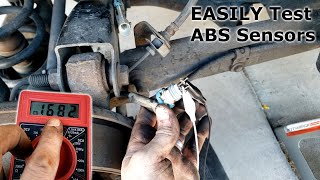
Disconnect the sensor. For a passive (2-wire) sensor, measure resistance (Ω). A good sensor reads 800-2500 Ω; Open Loop (OL) means it's dead. Switch to AC Volts (mV) and spin the wheel; you should see >100mV AC.
Tools: Multimeter, Service Manual (Intermediate) - Check for Signal at the ABS Module
If the sensor tests good at the wheel but the scanner shows 0 mph, test the wiring harness. Perform a continuity check on the wires between the sensor connector and the main ABS module connector to find the break.
Tools: Multimeter, Wiring Diagram (Advanced) - Diagnose the ABS/BCM Module
If a clean signal reaches the module but the code persists, the module is faulty. Verify the module's main power and ground connections. If the code definition is for the brake lamp circuit, use a bidirectional scanner to command the brake light on/off to test the BCM.
Tools: Advanced Scan Tool, Multimeter, Service Manual (Advanced)
When This Code Triggers (Freeze-Frame Conditions)
- Vehicle Speed: 5-25 mph (Occurs during light acceleration or deceleration when the ABS module runs its self-test.)
- Wheel Speed (Affected Wheel): 0 mph (The ABS module detects a zero signal from one sensor while other wheels report active speed.)
- System Voltage: < 10.5V (Occurs during engine cranking or with a failing alternator, frequently setting code C1241 alongside C1223.)
- Brake Pedal Status: Off or On (Sets during normal driving (pedal off) for sensor issues, or during braking (pedal on) for brake light switch circuit faults.)
Related Codes
- C1241 — Indicates 'Low or High Battery Positive Voltage'. An unstable voltage supply (dropping below ~10.5V) makes the ABS module behave erratically and set C1223. Always diagnose C1241 first by testing the battery and alternator.
- C1249 — Indicates an 'Open Stop Lamp Switch Circuit' on Toyota/Lexus models. A failing brake light switch sends conflicting signals to the ABS module. Replacing the switch resolves both codes.
- C0210, C0215 — These are specific wheel speed sensor codes (e.g., C0210 is Right Rear). Having C1223 alongside multiple sensor codes points to a central issue like a failing ABS module or bad ground, rather than multiple simultaneous sensor failures.
- C1224, C1225, C1226 — These specify a 'Lamp Brake Warning Output Circuit Failure'. C1224 is an Open Circuit, C1225 is a Short to Battery, and C1226 is a Short to Ground. They pinpoint the exact electrical failure in the dashboard warning light circuit.
Climate & Environmental Factors
- Road Salt & Humidity: In the 'Salt Belt', salt and moisture accelerate corrosion on wiring connectors, ground points, and the sensor itself. This increases electrical resistance, leading to signal loss.
- Cold Weather & Ice: In freezing temperatures, packed snow and ice physically block the sensor from reading the tone ring, causing a temporary fault that clears after thawing.
- Temperature Fluctuations: Rapid temperature changes cause wires and connectors to expand and contract, worsening marginal connections and triggering intermittent faults.
How to Talk to a Mechanic About This Code
Say this: "I have an ABS light on and my scanner shows code C1223. I'd like to schedule a diagnostic. Based on my vehicle's make, I'd like you to start by viewing the live data from all wheel speed sensors. If it's a Toyota, please specifically check for codes C1249 or C1241, as a faulty brake light switch or low voltage is a common trigger."
This signals you are an informed consumer. It directs the technician to the most common and cost-effective diagnostic starting points, preventing them from immediately suggesting an expensive ABS module replacement.
Avoid saying:
- 'My ABS light is on, can you fix it?'
- 'Just replace the C1223 part.'
- 'Do whatever you think is best.'
Questions to ask before authorizing the repair:
- What did the live data from the wheel speed sensors show? Was one reading zero or erratically?
- If you are recommending a new sensor, did you test the wiring and connector between the sensor and the module first?
- If you are recommending an ABS module replacement, did you verify it has proper power, ground, and is receiving a good signal from the sensor?
- What is the warranty on the recommended parts and labor?
Where to Take It: Dealer vs Independent vs Chain
- Dealer:
Recommended only for warranty or recall work. For out-of-warranty repairs, start with an independent shop.
Best for: Vehicles under warranty., Hyundai/Kia vehicles to check for and perform safety recalls related to ABS module fire risk., Complex repairs requiring module programming that an independent shop cannot perform.
Downsides: Highest labor rates and part costs., May replace an entire expensive assembly rather than diagnose a cheaper component within it. (Typical cost: +50% vs. baseline) - Independent Shop:
Best fit for most C1223 repairs. A good independent shop handles over 90% of the potential causes efficiently and affordably.
Best for: Out-of-warranty vehicles where cost is a factor., Diagnosing and replacing common failures like wheel speed sensors, wiring, or a brake light switch., Sourcing and installing rebuilt or used ABS modules as a cost-effective alternative to new.
Downsides: Diagnostic skill varies; ensure the shop has an advanced scanner capable of reading ABS live data., May lack specific tools to program a new ABS module for all makes/models. (Typical cost: +0% vs. baseline) - Chain Shop:
AVOID for C1223 diagnosis. Acceptable only if a trusted independent shop has already confirmed the problem is a simple wheel speed sensor replacement.
Best for: Getting a free initial code scan (if their scanners read ABS codes).
Downsides: Technician skill varies widely., Less likely to perform in-depth electrical diagnostics; defaults to replacing parts without confirming the root cause., Not equipped for module programming or complex ABS issues. (Typical cost: -10% vs. baseline)
When to Walk Away From the Repair
If the estimated repair cost for the C1223 fault exceeds 50% of your car's private-party value, consider selling or trading it in.
- Car worth $5000, fix is $300: Fix it. This is a low-cost repair (e.g., wheel speed sensor or brake light switch) and is well below the threshold.
- Car worth $4000, fix is $2200: Walk away. The repair (likely a new dealer-installed ABS module) costs more than half the car's value. It is not a sound investment.
- Car worth $8000, fix is $800: Borderline. This likely represents a rebuilt ABS module from an independent shop. Get a second opinion, but it's worth fixing if the rest of the car is in good shape.
What Scan Tool You Need for This Code
Minimum: A scanner that reads ABS trouble codes and displays LIVE DATA for all four wheel speed sensors. A basic engine-only code reader is useless for this code.
A cheap, engine-only code reader cannot see the C1223 code. To diagnose this properly, you must view the live speed signal from each wheel to identify the failing circuit.
Budget: BlueDriver Pro or Foxwell NT630 Plus (~$99) — Reads and clears ABS codes and graphs live wheel speed sensor data, sufficient for diagnosing a bad sensor or wiring.
Mid-range: Autel MaxiCheck Pro or Innova 5610 (~$199) — Adds bidirectional control to perform an 'ABS Bleed'. This is essential if you replace the ABS module, as it cycles the internal pump to remove trapped air.
Professional: Autel MaxiSys MS906Pro or XTOOL D7 (~$450-1200) — Provides dealer-level diagnostics, including bidirectional controls and the ability to perform VIN programming for a replacement ABS module.
Rent vs buy: Auto parts stores scan for ABS codes for free, but they do not allow you to view live data while driving. For a proper diagnosis, you must own or borrow a scanner with live data capability.
How to Clear the Code After You Fix It
- Use an ABS-capable OBD-II scan tool to erase the fault codes.
- Perform a drive cycle to allow the ABS module to self-test and confirm the repair.
Drive cycle (~10 minutes): Start the engine and drive the vehicle in a straight line, accelerating over 20 mph. This allows the ABS module to run its self-test. Driving for a few minutes confirms the light stays off.
Readiness monitors affected: None, if cleared with a scan tool., All emissions monitors, if the battery was disconnected.
Before emissions retest: drive at least 100 miles to fully set monitors.
Watch out for:
- The code returns immediately upon the next drive cycle if the root cause is not repaired.
- Disconnecting the battery does not reliably clear ABS codes and resets all emissions monitors, causing an automatic emissions test failure.
Will This Fail Emissions / State Inspection?
No — by itself this code doesn't fail OBD inspection (but it can keep readiness monitors from setting, which causes a separate fail).
- California: An illuminated ABS light is an automatic failure for the state's mandatory vehicle safety inspection.
- New York: Currently, an illuminated ABS light is an advisory and not grounds for inspection failure, though legislation is pending to change this.
- Texas: An illuminated ABS light does NOT cause a safety inspection failure. However, an illuminated red 'BRAKE' warning light will.
Most Commonly Affected Vehicles
- Toyota RAV4, Highlander, 4Runner, Sequoia (2001-2012) — Frequently triggered by a faulty brake light switch (with C1249) or low battery voltage (with C1241). On RAV4s, a failing ABS actuator assembly causes severe brake drag.
- Lexus IS, RX, GX, ES Models (2002-2015) — Similar to Toyota, often caused by a failed brake light switch or low voltage. On IS models, a failed wheel speed sensor is the primary culprit.
- Chevrolet / GMC Silverado, Sierra, Impala, Monte Carlo (1997-2007) — GM defines this code specifically as a wheel speed sensor signal reading zero. The cause is almost always a failed wheel speed sensor (part of the hub assembly) or its wiring harness.
- Hyundai Sonata, Santa Fe, Elantra, Tucson (2006-2018) — Many models are subject to major safety recalls for the ABS module, which short circuits and causes engine fires. Owners must verify their VIN is not under an open recall.
- Ford F-150, Edge, Fiesta (2004-2014) — Caused by a faulty wheel speed sensor or damage to the sensor's wiring harness routed along the frame. Rebuilt ABS modules are a cost-effective alternative to expensive new units.
- Subaru Outback, Forester, Legacy (2005-2014) — Commonly traced to a damaged wheel speed sensor wire near the suspension where it flexes, or a failed sensor.
Manufacturer-Specific Notes
- Toyota/Lexus: C1223 acts as a generic placeholder code. The real issue is frequently a faulty brake light switch (C1249) or a voltage problem (C1241). Diagnose accompanying codes before replacing ABS components.
- General Motors (Chevrolet/GMC): GM defines C1223 strictly as 'Left Rear (or Front) Wheel Speed Sensor Input Signal Is Zero'. The issue is almost always the sensor/hub assembly or its dedicated wiring.
- Hyundai/Kia: A massive safety recall affects many 2006-2018 models. The ABS module leaks internally, causing an electrical short that leads to an engine fire. Check for open NHTSA recalls immediately.
Real Owner Stories
2006 Toyota RAV4 with Intermittent ABS/VSC/TRAC Lights
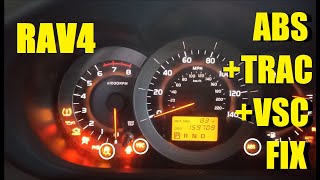
The ABS, TRAC, and VSC lights illuminated simultaneously while driving. The lights stayed on until the car was shut off, reappearing randomly on subsequent drives.
Outcome: The owner replaced the $30 brake light switch located on the brake pedal. After clearing the codes, the issue was resolved permanently.
Lesson: On Toyota vehicles, C1223 and C1241 are often 'ghost codes' triggered by a faulty brake light switch (C1249). Always diagnose and fix the C1249 code first.
Toyota RAV4 Losing Power, Brakes Locking Up
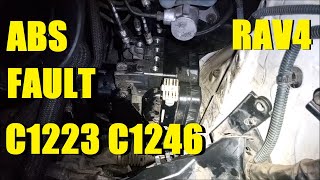
The vehicle gradually lost power while driving and struggled to move. After sitting, it drove normally until the issue returned. Codes present were C1223 (ABS Fault) and C1246 (Master Cylinder Pressure Sensor).
Outcome: Following the factory service manual, the owner replaced the entire ABS module/actuator assembly with a used unit. This fixed the brake dragging and cleared the codes.
Lesson: A C1223 code combined with a pressure sensor code (C1246) on Toyotas manifests as a 'loss of power' caused by the ABS unit incorrectly applying the brakes. This requires ABS actuator replacement.
2018 Hyundai Santa Fe Sport with ABS Light
The ABS warning light illuminated. A scan showed code C1223, indicating a general ABS system malfunction.
Outcome: The vehicle was covered under Hyundai Safety Recall 237 (ABS module short circuit fire risk). The dealer replaced the ABS multi-fuse and inspected the module free of charge.
Lesson: For 2006-2018 Hyundai and Kia models, a C1223 code requires an immediate recall check. The manufacturer covers repairs for this severe fire risk defect.
How to Prevent This Code From Triggering
- Change Brake Fluid (Every 2 years or 24,000 miles) — Brake fluid absorbs moisture from the air. This moisture causes internal corrosion of the sensitive valves and solenoids inside the expensive ABS module, leading to premature failure.
- Perform an ABS-Specific Brake Bleed (During every brake fluid change) — Standard brake bleeding leaves old fluid trapped inside the ABS modulator. Using a bidirectional scan tool to activate the ABS pump during bleeding flushes out all contaminated fluid.
- Apply Dielectric Grease to Connectors (During any brake or suspension work) — Applying a thin layer of dielectric grease to the seals and pins of wheel speed sensor connectors blocks moisture and prevents the corrosion that causes signal dropouts.
- Maintain a Healthy Battery & Charging System (Test annually) — The ABS module is highly sensitive to voltage drops. A weak battery or failing alternator triggers fault codes like C1223 and C1241. Clean battery terminals regularly.
Frequently Asked Questions
Can I just clear the C1223 code and keep driving?
You can clear the code, but it returns immediately when the ABS module runs its self-test. Clearing the code does not fix the underlying problem. Your ABS and traction control remain disabled until you perform a proper repair.
Will a C1223 code cause my car to fail an inspection?
Yes. In virtually all regions with mandatory vehicle safety inspections, an illuminated ABS warning light on the dashboard results in an automatic failure.
My brakes feel fine. Is fixing this code urgent?
While normal braking feels fine, the anti-lock function is disabled, preventing you from steering during a panic stop. This is a critical safety feature. Repair it promptly to ensure your vehicle is safe in all driving conditions.
What is the most common misdiagnosis for C1223?
On Toyota and Lexus vehicles, mechanics often misdiagnose C1223 as a failed ABS module when the actual cause is a cheap, faulty brake light switch. If code C1249 is also present, always test and replace the brake light switch first.
My scanner showed C1223 but also a code for another wheel. What does that mean?
Having speed sensor codes for multiple wheels simultaneously (e.g., C1223 and C0210) strongly suggests a centralized problem rather than multiple failed sensors. Focus your diagnosis on the ABS control module, a bad system ground, or a significant power supply issue.
Why did my traction control and VSC lights come on with the ABS light?
The Anti-lock Braking System (ABS), Traction Control System (TCS), and Vehicle Stability Control (VSC) all rely on the same wheel speed sensors. When the main ABS module detects a critical fault, it disables all related safety systems as a precaution. This causes all three warning lights to illuminate simultaneously.
Is it better to replace my ABS module or have it rebuilt?
Rebuilding an ABS module costs $250-$600, which is significantly cheaper than buying a new $800-$1500 unit from the dealer. Reputable rebuilders correct common factory failure points, making the rebuilt unit highly reliable. Rebuilt modules also retain your vehicle's original programming, saving you an extra trip to the dealer.
What happens if I don't fix my ABS system?
Driving long-term without ABS leaves you operating the vehicle without a key safety feature, increasing your risk of an accident. In an emergency, your wheels lock up, leading to a loss of steering control and longer stopping distances. On specific Toyota models, ignoring this code leads to severe brake drag and premature pad wear.
Key Takeaways
- Code C1223 disables your vehicle's Anti-lock Braking System (ABS), Traction Control, and Stability Control, increasing the risk of skidding during emergency stops.
- On Toyota and Lexus vehicles, a $30 faulty brake light switch (code C1249) or low battery voltage (code C1241) frequently triggers this code, rather than a failed ABS component.
- On General Motors vehicles, C1223 specifically indicates a dead left wheel speed sensor, requiring a $150-$300 sensor or hub replacement.
- Owners of 2006-2018 Hyundai and Kia models must immediately check their VIN for NHTSA safety recalls, as a C1223 code indicates an ABS module short circuit that poses a severe fire risk.
Helpful Videos

The information in this article is provided for general reference and educational purposes only. Vehicle specifications, procedures, and part compatibility can vary by production date, trim level, and region. Always consult your vehicle's factory service manual and verify part numbers before purchasing or performing repairs. Safety-critical components such as airbags, seat belts, and braking systems should be installed by a qualified professional.
- 🎬 Helpful Videos
- What Does C1223 Mean?
- Can I Drive With C1223?
- Common Causes
- Symptoms
- Diagnostic Flowchart
- Common Fixes & Costs
- DIY vs Professional
- Used vs. New Parts: Buying Guide
- What Happens If You Wait — Timeline
- Cost of Not Fixing It
- Diagnosis Steps
- When This Code Triggers (Freeze-Frame Conditions)
- Related Codes
- Climate & Environmental Factors
- How to Talk to a Mechanic About This Code
- Where to Take It: Dealer vs Independent vs Chain
- When to Walk Away From the Repair
- What Scan Tool You Need for This Code
- How to Clear the Code After You Fix It
- Will This Fail Emissions / State Inspection?
- Most Commonly Affected Vehicles
- Manufacturer-Specific Notes
- Real Owner Stories
- 2006 Toyota RAV4 with Intermittent ABS/VSC/TRAC Lights
- Toyota RAV4 Losing Power, Brakes Locking Up
- 2018 Hyundai Santa Fe Sport with ABS Light
- How to Prevent This Code From Triggering
- Frequently Asked Questions
- Can I just clear the C1223 code and keep driving?
- Will a C1223 code cause my car to fail an inspection?
- My brakes feel fine. Is fixing this code urgent?
- What is the most common misdiagnosis for C1223?
- My scanner showed C1223 but also a code for another wheel. What does that mean?
- Why did my traction control and VSC lights come on with the ABS light?
- Is it better to replace my ABS module or have it rebuilt?
- What happens if I don't fix my ABS system?
- Key Takeaways
- 🎟️ Get 5% Off