

OBD-II Code C1209: A Comprehensive Guide to Diagnosis and Repair
What C1209 means, why it triggers, and how to fix it like a pro
- C1209 is not a universal code; verify your manufacturer's specific definition before replacing parts, as it means 'Rear Right Wheel Speed Sensor' on a Hyundai but 'ABS Inlet Valve Coil' on a Ford.
- For Hyundai and Kia vehicles, replacing the rear right wheel speed sensor (a $20-$150 part) or the integrated wheel hub assembly fixes this code 80% of the time.
- Do not install aftermarket Hyundai/Kia sensors without testing polarity; reversed pins in cheap replacement parts cause the C1209 code to return immediately.
- Driving with C1209 disables your ABS and Electronic Stability Control, increasing stopping distances on loose surfaces by over 20% and risking a loss of steering during panic stops.
- Diagnose the wiring harness for continuity and shorts (aiming for less than 1 ohm) before condemning a $1,500+ ABS control module.
What Does C1209 Mean?

C1209 is a manufacturer-specific chassis trouble code indicating a malfunction within the Anti-lock Braking System (ABS). Its meaning is not universal and varies critically between automakers. For a majority of Hyundai, Kia, and some Nissan vehicles, it signifies an 'Open or Short' circuit fault related to the rear right (RR) wheel speed sensor. Conversely, for many Ford, Lincoln, and Mercury vehicles, it points to a 'Rear Inlet Valve Coil Circuit Short to Ground' within the ABS hydraulic unit itself. Other manufacturers, like Chevrolet and GMC, use C1209 for entirely unrelated issues such as a 'Barometric Pressure Circuit Intermittent'. Correctly identifying the specific definition for your vehicle with an advanced scan tool is the mandatory first step of any diagnosis.
Technical definition: The technical definition of C1209 depends entirely on the vehicle manufacturer. For Hyundai and Kia, it is "Wheel Speed Sensor Rear-RH Open/Short". The ABS control module (HECU) monitors the sensor's current and sets this code if it falls outside the specified range (typically 7mA to 14mA) for 200 milliseconds. For Ford Motor Company, the definition is "ABS Inlet Valve Coil Rear Circuit Short To Ground", indicating the module detects a short circuit in the solenoid coil controlling rear wheel brake pressure. Always verify the exact definition using a scan tool capable of reading manufacturer-specific chassis codes.
Can I Drive With C1209?

Yes, But With Caution. Yes, but with significant caution. Your primary hydraulic brakes function for normal stops, but your Anti-lock Braking System (ABS), Traction Control (TCS), and Electronic Stability Control (ESC) are disabled. In a panic stop, your wheels will lock up, preventing steering and increasing stopping distance on loose surfaces by over 20%. The primary danger is the loss of steering control during a lock-up, which increases the risk of a skid or single-vehicle accident. This fault does not cause progressive mechanical damage to other components, but the safety systems remain offline until the code is fixed.
Common Causes

- Faulty Rear Right Wheel Speed Sensor (Very Common) — This is the primary cause for Hyundai and Kia models. The active hall-effect sensor fails internally, creating an open or short in its signal circuit.
- Damaged or Corroded Wiring/Connectors (Common) — The wiring harness leading to the wheel speed sensor is exposed to the elements. Road debris, moisture intrusion causing connector corrosion, chafing against suspension components, or rodent damage creates an open or short circuit.
- Damaged or Contaminated ABS Tone Ring (Common) — The tone ring (or reluctor ring) is a toothed or magnetic ring the sensor reads. If it cracks, loses teeth, or gets covered in thick rust or metallic debris, it produces an erratic signal the ABS module interprets as a fault.
- Faulty ABS Hydraulic Unit / Control Module (Less Common) — On Ford vehicles, a shorted rear inlet valve coil inside the ABS hydraulic control unit (HCU) is the primary suspect. On other makes, this is a possible cause only after ruling out the sensor and wiring.
- Failing Wheel Bearing (Rare) — Excessive play or 'wobble' in a worn-out wheel bearing changes the air gap between the sensor and the tone ring. This variation causes a weak or inconsistent signal, leading to an intermittent fault code.
- Incorrectly Installed or Wrong Part (Rare) — If the code appears after a repair, the new part is likely incorrect or installed improperly. Common mistakes include installing a magnetic wheel bearing backwards (facing away from the sensor) or using aftermarket Hyundai/Kia sensors with reversed connector pin polarity.
- Low Battery Voltage or Poor Grounds (Rare) — A weak battery or a corroded main ground connection for the ABS module causes unpredictable electronic behavior, triggering false diagnostic trouble codes under low-voltage conditions.
Symptoms
- ABS, Traction Control, and Stability Control Lights On — The ABS, TCS, and ESC systems depend on wheel speed sensors. When the ABS module detects a fault, it disables these safety features and illuminates their respective warning lights on the dashboard.
- Normal Braking Unaffected — Your standard hydraulic braking system operates normally for routine stops. The brake pedal feels identical to normal operation.
- Brake Pedal Pulsation or ABS Activation at Low Speeds — A failing sensor or damaged tone ring sends an erratic signal at very low speeds. The ABS module misinterprets this as a wheel locking up and briefly activates the ABS pump, causing a grinding noise or pedal pulsation just before stopping.
Diagnostic Flowchart
Tap your situation to follow the diagnostic path that matches what you're seeing on this code.
Common Fixes & Costs
- Replace Rear Right Wheel Speed Sensor
— Parts: $20-$150, Labor: $100-$150, ~1 hr book time
(DIY)
Hyundai Santa Fe (2011-2018): OEM 95681-2S500 or 95681-4Z000 (Alt: Standard Motor Products ALS1974, Duralast ABSB10498)
Hyundai Elantra (2008-2013): OEM 59930-2H300 or 95680-2L000 (Alt: TRQ BSA12737, Mando 25A5035) - Replace Wheel Hub Assembly
— Parts: $100-$350, Labor: $150-$300, ~2 hr book time
(Intermediate)
Kia Soul (2014-2019): OEM 52730-B2100 or 52730-K0000 (Alt: MOOG 512495, Detroit Axle 512495) - Repair Damaged Wiring or Connector — Parts: $10-$50, Labor: $150-$300, ~1.5 hr book time (Intermediate)
- Replace ABS Control Module/Hydraulic Unit — Parts: $800-$2000, Labor: $200-$400, ~2.5 hr book time (Professional)
- Clean ABS Module Ground Connection — Parts: $0-$10, Labor: $50-$100, ~0.5 hr book time (DIY)
DIY vs Professional
- Replace Rear Right Wheel Speed Sensor — Beginner:
Tools: Jack, jack stands, lug wrench, socket set (10mm/12mm), trim removal tools, torque wrench. - Replace Wheel Hub Assembly — Beginner:
Tools: Socket set, breaker bar, large axle nut socket (e.g., 32mm), heavy hammer, slide hammer or hub puller tool, torque wrench. - Repair Damaged Wiring or Connector — Beginner:
Tools: Digital multimeter, wire strippers, crimpers, heat shrink tubing, soldering iron, vehicle-specific wiring diagram. - Replace ABS Control Module/Hydraulic Unit — Beginner:
Tools: Socket set, line wrenches, scan tool with ABS bleeding function, vehicle-specific programming tool.
Used vs. New Parts: Buying Guide
When a used part is worth it: Buying used parts is strongly discouraged. A standalone wheel speed sensor is an inexpensive electronic part where new aftermarket options are cheap. A wheel hub assembly contains a wear-item bearing; a used part has unknown remaining life and carries high risk.
Donor-vehicle mileage cap: roughly under 10000 miles for the part to have meaningful remaining life.
Donor quality checklist:
- Only consider from a verified, very low-mileage wreck.
- Avoid parts from any vehicle in a rust-belt region.
- Part number must be an exact match.
Decision logic:
- If The required part is a standalone wheel speed sensor → Buy new. The cost savings of a used sensor ($10-$20) are negligible and not worth the risk of premature failure.
- If The required part is a complete wheel hub assembly → Buy new. The labor to replace a hub is significant ($150+). Installing a used hub with a worn bearing means paying that labor cost again soon.
- If The vehicle is very old and has low value → A used part is a last-resort budget option, but only if you accept the high risk of it failing shortly after installation.
Warranty tradeoff: Used parts typically have a 30-day warranty at best. New aftermarket parts often come with a 1-year to limited lifetime warranty. New OEM parts carry a 12-month warranty.
Worst-case if a used part fails: $200-$400 if a used hub assembly fails after the warranty period, requiring a new part plus full labor costs a second time.
What Happens If You Wait — Timeline
- Immediate: ABS, Traction Control, and Stability Control warning lights illuminate. The associated safety systems are immediately disabled. (MPG impact: 0%% · Added cost: $0)
- 0-2 months: The vehicle is driven with disabled safety systems, posing an increased risk of loss of control in panic stops or on slick surfaces. The base hydraulic brakes continue to function normally. (MPG impact: 0%% · Added cost: Potential cost of an accident due to loss of ABS/ESC functionality.)
- 2-6 months: If the root cause is a failing wheel bearing, audible grinding or humming noises develop and worsen. Continued driving leads to excessive heat and damage to the wheel hub or steering knuckle. (MPG impact: 0-2%% · Added cost: $250-$700 if a failing bearing damages the hub/knuckle, turning a sensor/bearing job into a more expensive repair.)
- At next state inspection: The vehicle fails its annual safety inspection in most states due to the illuminated ABS warning light, preventing legal registration renewal until repaired. (MPG impact: 0%% · Added cost: $150-$1500+ (cost of the required repair) plus any re-inspection fees or fines.)
Cost of Not Fixing It
- Immediate: Loss of ABS, Traction Control, and Stability Control. Increased risk of skidding and loss of control in emergency braking or poor weather conditions. (Added cost: Potential cost of an accident, including insurance deductible, increased premiums, or total loss of vehicle.)
- 1-6 months: If the fault causes unwanted low-speed ABS activation, it leads to slightly accelerated wear on rear brake pads and rotors. (Added cost: $50-$150 in premature brake wear.)
- At Next State Inspection: Guaranteed failure of the vehicle's safety inspection in most states that require one, preventing registration renewal. (Added cost: Cost of the required repair, plus potential fines for expired registration and the cost of a re-inspection.)
Diagnosis Steps
- Confirm the Code and Manufacturer-Specific Definition
Use an advanced OBD-II scanner capable of reading Chassis (C-prefix) codes. Confirm C1209 is present and identify the specific definition for your vehicle's make and model (e.g., 'Wheel Speed Sensor Rear-RH' vs. 'ABS Inlet Valve Coil'). This definition dictates the entire diagnostic path.
Tools: Advanced OBD-II Scanner (Beginner) - Analyze Live Data
Access the live data stream for the ABS module. View the wheel speed readings for all four wheels while driving slowly. A C1209 code related to a speed sensor shows the rear right wheel speed as 0 or erratic, while the other three wheels report a plausible speed, isolating the fault to that corner.
Tools: Advanced OBD-II Scanner (Intermediate) - Visual Inspection of Sensor, Wiring, and Tone Ring
Safely lift and support the vehicle. Visually inspect the rear right wheel speed sensor, its wiring harness, and all connectors back to the chassis. Look for chewed wires, chafing, melting, or green/white corrosion in connector pins. Inspect the tone ring for cracks, missing teeth, or heavy rust buildup.
Tools: Jack, Jack Stands, Flashlight (Beginner) - Test the Wiring Circuit for Continuity and Shorts
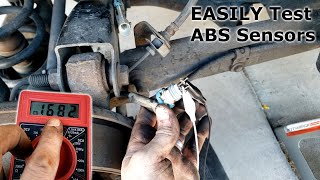
Disconnect the harness from the wheel speed sensor and the ABS control module. Use a digital multimeter to check for continuity on both wires in the harness between the two connectors (must be less than 1 ohm). Check for a short to ground by testing for continuity between each wire and a clean chassis ground. An ideal reading is OL (Open Line).
Tools: Digital Multimeter, Vehicle-Specific Wiring Diagram (Advanced) - Test Sensor Current Draw (Hyundai/Kia)
Set your multimeter to the milliamps (mA) setting. With the sensor connected and the ignition on, back-probe the signal wire. A healthy Hyundai/Kia active sensor draws a current that toggles between approximately 7mA and 14mA as the wheel is slowly spun. A reading of 0mA or a static value indicates a faulty sensor.
Tools: Digital Multimeter with mA function, Back-probe kit (Advanced) - Test the ABS Valve Coil (Ford Definition)
If the code is 'ABS Inlet Valve Coil Rear Circuit Short To Ground', disconnect the main harness from the ABS module. Identify the pins for the rear inlet valve coil. Measure the resistance across these two pins; it must match the manufacturer's spec (typically 5-30 ohms). Measure resistance from each pin to chassis ground; a reading near 0 ohms indicates an internal short requiring module replacement.
Tools: Digital Multimeter, Vehicle-Specific Wiring Diagram (Advanced) - Check ABS Module Power and Grounds
Before condemning an expensive ABS module, verify it has proper power and ground. Locate the main power and ground pins at the module's connector. Check for battery voltage at the power pins and for excellent continuity (less than 0.5 ohms) between the ground pins and the chassis.
Tools: Digital Multimeter, Vehicle-Specific Wiring Diagram (Intermediate) - Test Passive Sensor Resistance (Older Vehicles)
If your vehicle uses an older 2-wire passive sensor, test its internal coil resistance. Disconnect the sensor and set your multimeter to Ohms (Ω). A typical good sensor reads between 800-2500 Ω. A reading of OL indicates an open circuit, while a reading near 0 Ω indicates a short.
Tools: Digital Multimeter, Service Manual (Advanced) - Advanced Sensor Analysis (Oscilloscope Test)
Back-probe the sensor's signal wire with an oscilloscope. As you spin the wheel, a healthy active sensor produces a clean digital square wave switching between a low voltage (approx. 0.7V) and a high voltage (approx. 1.4V). A flat line or deformed waveform confirms a bad sensor or tone ring.
Tools: Oscilloscope, Back-probe kit (Professional) - Test Barometric Pressure Sensor (GM Definition)
If your GM vehicle defines C1209 as a 'Barometric Pressure Circuit Intermittent' fault, locate the BARO sensor. With the key on, engine off, back-probe the signal wire. The voltage must correlate with your altitude (e.g., ~4.6V at sea level). Check the 5V reference and ground circuits. A fluctuating voltage points to a faulty sensor.
Tools: Digital Multimeter, Vehicle-Specific Wiring Diagram (Advanced)
When This Code Triggers (Freeze-Frame Conditions)
- Vehicle Speed (Faulty Wheel): 0 MPH (The ABS module sees no rotation from the RR wheel.)
- Vehicle Speed (Other Wheels): > 10 MPH (The code is set when other wheels report speed, creating a mismatch.)
- Fault Duration: 200ms (The speed mismatch must persist for a fraction of a second to be considered a hard fault.)
- ABS/TCS/ESC Warning Lights: ON (The warning lights are commanded on the moment the fault is confirmed.)
Related Codes
- C1206 — Indicates a fault with the Rear Left Wheel Speed Sensor. Seeing C1206 and C1209 together points to a shared wiring harness issue, a single event that damaged both sensor wires, or rodent damage.
- C1200 — Points to the Front Left Wheel Speed Sensor circuit. The diagnostic process is identical to a sensor-related C1209, but performed on the front left wheel.
- C1203 — Points to the Front Right Wheel Speed Sensor circuit. The presence of any of these codes alongside C1209 confirms the problem is within the wheel speed monitoring system.
- C1616 — On Hyundai/Kia, this means 'CAN Bus Error - HECU'. It appears with a wheel speed sensor code if the ABS module (HECU) is failing or has a major communication problem.
Climate & Environmental Factors
- Road Salt and De-Icing Chemicals: In 'salt belt' regions, de-icing agents dramatically accelerate corrosion. This destroys the pins inside the sensor connector, eats through wire insulation causing a short, or causes the tone ring to rust and delaminate.
- High Humidity / Coastal Regions: High humidity and salty air in coastal areas lead to moisture intrusion into the sensor housing, causing corrosion and signal failure, a known issue documented in Kia TSB SC148.
- Snow, Ice, and Slush Buildup: Packed snow and ice physically block the wheel speed sensor or cover the tone ring, preventing the sensor from getting a reading. This resolves itself once the ice melts.
- Freeze-Thaw Cycles: Temperature swings allow moisture to seep into wiring connectors. When this moisture freezes, it expands and compromises the electrical connection, causing an intermittent open or short circuit.
How to Talk to a Mechanic About This Code
Say this: "I have a C1209 code on my [Make, Model]. My research indicates this is likely a rear-right wheel speed sensor circuit fault. I'd like to schedule a diagnostic to confirm. Please start by testing the sensor and wiring for signal, continuity, and shorts before quoting any part replacements."
This signals you are an informed customer. It directs the technician to the most probable and cost-effective diagnostic path first, preventing them from replacing the most expensive part (the ABS module) or the most common part (the sensor) without proper testing.
Avoid saying:
- 'My ABS light is on, can you fix it?' (Too vague, invites a wide-ranging and expensive diagnosis).
- 'Just replace the rear wheel speed sensor.' (The problem could be the wiring, and you pay for a part you don't need).
- 'Do whatever you think is best.' (This gives up all control and leads to overselling).
Questions to ask before authorizing the repair:
- Did you check the live data from all four wheel speed sensors? What did the rear-right sensor show?
- Did the wiring from the sensor to the module test good for continuity and show no shorts to ground or power?
- If you are recommending an ABS module replacement, have you confirmed it has proper power and ground, and is the quoted price inclusive of VIN programming?
- What is the warranty on the parts and labor for this specific repair?
Where to Take It: Dealer vs Independent vs Chain
- Dealer:
Best for: Vehicles under warranty., Confirmed ABS module failures that require replacement and VIN-specific programming., Ford, Lincoln, or Mercury vehicles, where C1209 points to a complex module issue.
Downsides: Highest labor rates., Quicker to replace an entire module than to diagnose a nuanced wiring or sensor issue. (Typical cost: +50% vs. baseline) - Independent Shop:
Best fit for the most common cause (Hyundai/Kia sensor/wiring fault). Ensure the shop has a good reputation for electrical diagnostics.
Best for: Out-of-warranty Hyundai and Kia vehicles, where the fault is a sensor or wiring issue., Diagnosing and repairing wiring harness damage., Vehicles with a clear diagnostic path (e.g., live data shows a dead sensor).
Downsides: Shop quality and diagnostic skill vary widely., Lack the expensive tools to program a new ABS module if necessary. (Typical cost: +0% vs. baseline) - Chain Shop:
High risk. Acceptable only if you are certain it's a simple sensor swap. AVOID for initial diagnosis or any problem involving wiring or the ABS module.
Best for: Simple, obvious fixes like replacing an externally mounted wheel speed sensor if you have already diagnosed it yourself.
Downsides: Technician skill varies dramatically., Lack the advanced diagnostic tools or experience for complex electrical or module-level problems., High pressure to upsell leads to recommending unnecessary part replacements. (Typical cost: -10% vs. baseline)
When to Walk Away From the Repair
If the estimated repair cost exceeds 40-50% of the car's private-party value, seriously consider selling or trading it in.
- Car worth $4000, fix is $1800: Walk away. The repair cost is 45% of the car's value for a non-essential (but important) safety system. This is a poor investment.
- Car worth $12000, fix is $350: Fix it. The repair is less than 3% of the vehicle's value and restores critical safety features.
- Car worth $2500, fix is $1800: Walk away, do not pass go. The repair is 72% of the car's value. Sell it for parts or scrap.
What Scan Tool You Need for This Code
Minimum: A scanner that reads and clears Chassis (C-prefix) codes from the ABS module and displays live data for all four wheel speed sensors.
A standard $20 engine code reader CANNOT see the ABS module. It reports 'No Codes Found,' leaving you completely blind to the C1209 code.
Budget: BlueDriver Pro / Foxwell NT630 Plus (~$70-120) — Reads the C1209 code, identifies the manufacturer-specific definition, and displays essential live data for all four wheel speeds to confirm which sensor is failing.
Mid-range: Innova 5610 / Autel MK808 (~$300-400) — Adds critical bidirectional controls. Performs an 'automated bleed' or 'ABS bleed' function, required after replacing an ABS hydraulic module to purge air from the system.
Professional: Autel MaxiCOM MK906BT / Launch X431 Series (~$500-1200) — Full bidirectional controls, advanced ECU coding, and module programming. Necessary if you replace and program a new ABS control module to the vehicle's VIN.
How to Clear the Code After You Fix It
- Use an OBD-II scan tool capable of accessing the ABS module to erase the fault codes.
- Turn the ignition off and then back on.
- Perform a short test drive.
Drive cycle (~5 minutes): After clearing the code, drive the vehicle, accelerating above 15 MPH. The ABS module performs a self-test upon startup and continuously monitors the sensors once moving. If the repair was successful, the ABS light remains off.
Readiness monitors affected: None directly. ABS is a non-emissions system. However, using the 'Clear All Codes' function on some scanners resets emissions readiness monitors.
Watch out for:
- Using a basic code reader that cannot access or clear Chassis (C-prefix) codes.
- Disconnecting the battery does not reliably clear the code from the ABS module's memory.
- The code immediately returns on the test drive if the root cause was not correctly repaired.
Will This Fail Emissions / State Inspection?
Yes — this code typically fails an OBD-II emissions inspection.
- California: An illuminated ABS warning light is grounds for failing the safety portion of an inspection. While it does not fail the emissions Smog Check directly, some inspection stations refuse to certify the vehicle.
- New York: An illuminated ABS warning light is an automatic failure of the annual safety inspection. The vehicle cannot be legally driven until repaired.
- Texas: An illuminated red brake warning light is a failure, but an amber ABS light is not cause for rejection during the annual safety inspection.
Most Commonly Affected Vehicles
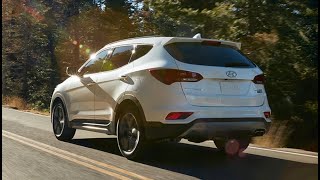
- Hyundai Santa Fe (2011-2018) — Extremely common for this code. The sensor is integrated with the rear wheel bearing/hub assembly, requiring replacement of the entire unit.
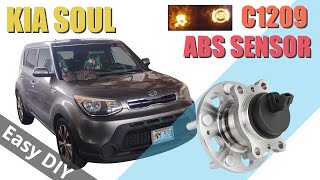
- Kia Soul (2014-2019) — Known for rear ABS sensor failures. The sensor is often part of the hub assembly, making the repair more involved than a simple bolt-on sensor.
- Hyundai Elantra (2008-2013) — Frequently sees C1209 for a rear-right wheel speed sensor open/short circuit. Models from 2006-2011 are particularly susceptible to internal sensor failures.
- Kia Sorento (2011-2015) — Presents C1209 due to a failing wheel bearing causing an erratic signal, or from water intrusion into the sensor housing on 2WD models in coastal areas (per TSB SC148).
- Kia Carnival / Sedona (2015-2021) — This code points to a failed rear wheel speed sensor integrated into the hub assembly. An aftermarket hub assembly part costs between $180-$240.
- Ford F-150 / Explorer (2009-2014) — On these models, C1209 means 'ABS Inlet Valve Coil Rear Circuit Short To Ground'. Diagnosis must focus on the ABS Hydraulic Control Unit, not wheel speed sensors.
- Chevrolet Silverado (2019-2021) — C1209 is linked to broken wiring or faulty connectors in the harness above the rear axle. GM also uses this code for unrelated powertrain issues.
- Nissan Qashqai / Rogue Sport (2014-2017) — Typically points to a fault in the ABS system, most often a defective rear wheel speed sensor or its associated wiring.
Manufacturer-Specific Notes

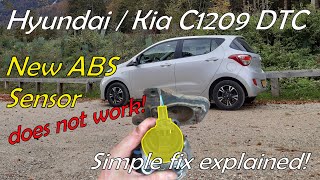
- Hyundai / Kia: A well-documented issue exists where aftermarket replacement sensors have reversed polarity in their connectors. If a new sensor doesn't fix the code, carefully swap the two wires in the connector pigtail as a test before further diagnosis.
- Hyundai / Kia: MAJOR RECALLS: Over 6 million vehicles (2010-2021) were recalled due to a fire risk from the ABS/HECU module short-circuiting internally. While not always triggering a C1209, a faulty HECU is a possible cause and a major safety concern.
- Ford / Lincoln / Mercury: The definition is almost always 'ABS Inlet Valve Coil Rear Circuit Short To Ground'. Diagnosis must focus on testing the ABS hydraulic control unit (HCU) and its wiring harness for shorts, not the wheel speed sensors.
- Chevrolet / GMC: The definition is highly inconsistent. It relates to the wheel speed sensor circuit on some trucks, but points to unrelated systems like the 'Turbocharger Wastegate Actuator' or 'Barometric Pressure Circuit' on others.
- Kia: Technical Service Bulletin (TSB) SC148 for 2011-2015 Sorento (2WD) vehicles notes that seawater enters the rear wheel speed sensor housing cover in coastal states, causing corrosion and setting code C1209.
Real Owner Stories
2014 Hyundai Santa Fe Sport with C1209
ABS and traction control lights came on. Owner scanned the code and found C1209, pointing to the rear right wheel speed sensor.
Outcome: The owner suspected the entire wheel hub assembly (which includes the sensor and tone ring) was faulty. The final resolution was replacing the entire hub assembly.
Lesson: On many modern Hyundai/Kia vehicles, the sensor is integrated with the hub. Simply replacing the sensor does not work; the entire hub assembly must be replaced.
2018 Hyundai Elantra GT with persistent C1209
A non-Hyundai dealership was trying to fix a C1209 code on an Elantra GT. The lights would not clear.
Outcome: After extensive testing, they found a 'short to power' condition reading 30 MΩ on the harness connector at the ABS pump, indicating a complex wiring fault.
Lesson: Do not assume the most common fix is the right one. Thoroughly test the wiring for continuity, shorts to ground, and shorts to power before replacing expensive parts.
2011-2015 Kia Sorento (2WD) in a coastal state
Owner experienced ABS/ESC warning lights triggering C1209. This issue was particularly noted in vehicles registered in coastal states like Florida and Texas.
Outcome: Kia determined seawater enters the sensor housing, interrupting the signal. The official fix is to inspect, clean, and apply silicone sealant to the housing covers, or replace them if DTCs are active.
Lesson: Environmental factors are a direct cause of failure. If you live in a coastal or 'salt belt' region, check for manufacturer TSBs related to your specific vehicle and code for low-cost fixes.
How to Prevent This Code From Triggering
- Periodically clean wheel speed sensors and tone rings (During every brake service or tire rotation) — Brake dust and metallic debris accumulate on the magnetic sensor or tone ring, disrupting the signal. Cleaning with brake cleaner restores a clear signal path.
- Apply dielectric grease to sensor connectors (Anytime a sensor connector is disconnected for service) — Dielectric grease seals the electrical connector pins from moisture, road salt, and oxygen, preventing the corrosion that leads to open or short circuits.
- Flush brake fluid per manufacturer's schedule (Every 2-3 years) — Brake fluid absorbs moisture, causing internal corrosion of the ABS hydraulic control unit's delicate valves. This prevents the Ford-specific version of C1209 and other expensive module failures.
- Secure and inspect sensor wiring harnesses (During under-vehicle service) — Ensures the wiring harness is properly clipped away from moving suspension parts and tires. Chafing and physical damage are common failure points for exposed wiring.
Frequently Asked Questions
Can I drive my car with code C1209?
Yes, but your ABS and traction/stability control are disabled. Your regular brakes function, but you must allow for significantly longer stopping distances. You will not be able to steer during a panic stop on a slippery surface.
I replaced the wheel speed sensor, but the C1209 code is still there. What now?
If you used an aftermarket sensor on a Hyundai/Kia, swap the two pins in the connector to correct potential reversed polarity. If that fails, test the wiring harness for continuity and inspect the tone ring for damage. The fault is likely a wiring short, a bad wheel bearing, or rarely, the ABS module itself.
My ABS lights came on right after a wheel bearing replacement. Is it related?
Almost certainly. The mechanic likely damaged the wheel speed sensor or its wiring during the repair. Another common mistake is installing the new wheel bearing backward, facing the magnetic encoder away from the sensor.
Will code C1209 clear itself?
The warning light turns off if the fault is intermittent, but the code remains stored in the ABS module's memory. The module re-checks the sensor on each ignition cycle, but the underlying issue must be repaired to permanently resolve the code.
How much does it cost to fix code C1209?
A DIY wheel speed sensor replacement costs under $50, while a professional repair runs $150-$350. Replacing an integrated wheel hub assembly costs $300-$650, and wiring repairs average $150-$400. The most expensive fix is replacing the ABS module, which easily exceeds $1,500.
Is the wheel speed sensor part of the wheel bearing?
On many modern vehicles, especially Hyundai and Kia, yes. The sensor and the magnetic tone ring it reads are integrated into the wheel bearing/hub assembly. The entire hub must be replaced to fix the sensor fault.
Can a bad alignment cause a C1209 code?
Not directly. A bad alignment itself does not set an ABS code. However, the impact that caused the bad alignment—such as hitting a curb—likely damaged the nearby ABS sensor or its wiring harness.
Key Takeaways
- C1209 is not a universal code; verify your manufacturer's specific definition before replacing parts, as it means 'Rear Right Wheel Speed Sensor' on a Hyundai but 'ABS Inlet Valve Coil' on a Ford.
- For Hyundai and Kia vehicles, replacing the rear right wheel speed sensor (a $20-$150 part) or the integrated wheel hub assembly fixes this code 80% of the time.
- Do not install aftermarket Hyundai/Kia sensors without testing polarity; reversed pins in cheap replacement parts cause the C1209 code to return immediately.
- Driving with C1209 disables your ABS and Electronic Stability Control, increasing stopping distances on loose surfaces by over 20% and risking a loss of steering during panic stops.
- Diagnose the wiring harness for continuity and shorts (aiming for less than 1 ohm) before condemning a $1,500+ ABS control module.
Helpful Videos

The information in this article is provided for general reference and educational purposes only. Vehicle specifications, procedures, and part compatibility can vary by production date, trim level, and region. Always consult your vehicle's factory service manual and verify part numbers before purchasing or performing repairs. Safety-critical components such as airbags, seat belts, and braking systems should be installed by a qualified professional.
- 🎬 Helpful Videos
- What Does C1209 Mean?
- Can I Drive With C1209?
- Common Causes
- Symptoms
- Diagnostic Flowchart
- Common Fixes & Costs
- DIY vs Professional
- Used vs. New Parts: Buying Guide
- What Happens If You Wait — Timeline
- Cost of Not Fixing It
- Diagnosis Steps
- When This Code Triggers (Freeze-Frame Conditions)
- Related Codes
- Climate & Environmental Factors
- How to Talk to a Mechanic About This Code
- Where to Take It: Dealer vs Independent vs Chain
- When to Walk Away From the Repair
- What Scan Tool You Need for This Code
- How to Clear the Code After You Fix It
- Will This Fail Emissions / State Inspection?
- Most Commonly Affected Vehicles
- Manufacturer-Specific Notes
- Real Owner Stories
- 2014 Hyundai Santa Fe Sport with C1209
- 2018 Hyundai Elantra GT with persistent C1209
- 2011-2015 Kia Sorento (2WD) in a coastal state
- How to Prevent This Code From Triggering
- Frequently Asked Questions
- Can I drive my car with code C1209?
- I replaced the wheel speed sensor, but the C1209 code is still there. What now?
- My ABS lights came on right after a wheel bearing replacement. Is it related?
- Will code C1209 clear itself?
- How much does it cost to fix code C1209?
- Is the wheel speed sensor part of the wheel bearing?
- Can a bad alignment cause a C1209 code?
- Key Takeaways
- 🎟️ Get 5% Off