

OBD-II Code C1203: Vehicle Communication Fault
What C1203 means, why it triggers, and how to fix it
- Code C1203 disables your ABS and stability control systems, increasing your risk of a fatal single-vehicle crash by up to 60%.
- Test your 12V battery and charging system first, as voltage drops below 9.5V are the most frequent cause of this communication failure.
- Verify the exact code definition for your vehicle make, because C1203 means a lost calibration on a Toyota but a failed right-front wheel speed sensor on a Hyundai.
- Expect to pay a shop $100 to $250 for a 'Zero Point Calibration' if this code appeared immediately after replacing your car battery.
What Does C1203 Mean?

Code C1203 signifies the Anti-lock Brake System (ABS) control module lost communication with the Engine Control Module (ECM). These computers constantly exchange data for safety systems to function. When this link breaks, the ABS and traction/stability control systems deactivate as a failsafe. On some vehicles, this code means the ABS module detected the ECM or another control unit is an incorrect part number or lacks configuration for that specific vehicle.
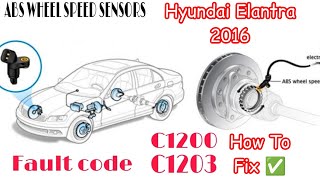
Technical definition: The official SAE/ISO definition for C1203 is 'ECM Communication Circuit Malfunction'. However, the meaning varies significantly by manufacturer. On Chrysler, Dodge, and Jeep vehicles, it means 'ABS Outlet Valve Coil Rear Circuit Open'. On Hyundai and Kia models, it indicates 'Front Right Wheel Speed Sensor - Open or Short 🎬 Watch: How to fix wheel speed sensor codes on Hyundai models'. For Toyota and Lexus, it triggers when vehicle information received from the ECM does not match what the ABS module expects, or when a required calibration is lost.
Can I Drive With C1203?

Yes, But With Caution. Yes, but with extreme caution. Your Anti-lock Braking System (ABS) and Electronic Stability Control (ESC/VSC) are disabled. This significantly increases the risk of losing control during emergency braking or on slippery surfaces like rain, snow, or gravel. Studies show ESC reduces the risk of fatal single-vehicle crashes by over 60% for SUVs and nearly 50% for cars. Driving without these systems removes a critical safety net. Your base hydraulic brakes still function, but stopping distances increase, and you have no anti-skid or steering assistance during a panic stop. Get the vehicle diagnosed immediately.
Common Causes

- Low Battery Voltage or Charging System Fault (Very Common) — A weak battery or failing alternator causes temporary voltage drops below the 9.5V to 17.0V operating range for the ECU, interrupting communication between modules and triggering the code. This is the simplest and most frequent cause.
- Incorrect Module Calibration (Common) — After replacing a component like an ABS actuator, battery, or yaw rate sensor, the system requires a 'Zero Point Calibration' 🎬 See how to perform a Zero Point and Linear Valve calibration. If this procedure is skipped or fails, the C1203 code sets because the modules are not synchronized.
- Damaged Wiring, Connectors, or Grounds (Common) — The wires and connectors linking the ABS module and the ECM become frayed, corroded, or disconnected due to engine heat, vibration, or moisture. Additionally, a loose or rusty ground strap creates electrical noise and communication failures.
- Failed ABS/Skid Control Module (Less Common) — The ABS module (Skid Control ECU) fails internally. This is an expensive failure resulting from electronic component breakdown or internal solder joint failure.
- Mismatched or Incorrectly Installed Modules (Less Common) — If the ABS module, ECM, or another related ECU is replaced with a used part from a different vehicle, the modules fail to communicate because their stored configuration data does not match. This also happens if the incorrect part number is used.
- Low Brake Fluid Level (Uncommon) — On specific vehicle designs, a critically low brake fluid level in the master cylinder reservoir triggers an ABS system fault, manifesting as a C1203 communication code.
- Electrical Noise Interference (Uncommon) — In specific cases, like the 2003 Toyota Sequoia, electrical noise from components like the ignition coil interferes with communication between the ECM and the ABS/VSC computers, falsely triggering a C1203 code.
Symptoms

- ABS, Traction Control, and Brake Warning Lights Illuminated — This is the most common symptom. The ABS, Traction Control (TCS/TRAC), Stability Control (VSC/ESC), and sometimes the general Brake warning lights illuminate on your dashboard, indicating these systems are disabled.
- Hard, Spongy, or Unresponsive Brake Pedal — While your standard hydraulic brakes still work, the pedal feels different. If the ABS actuator fails, the pedal becomes unresponsive or goes to the floor.
- Erratic Speedometer or Shifting Issues — On models where the C1203 code links to a wheel speed sensor (like Hyundai/Kia/Chevy), you experience an inaccurate speedometer or harsh transmission shifting because the vehicle speed data is compromised.
Diagnostic Flowchart
Tap your situation to follow the diagnostic path that matches what you're seeing on this code.
Common Fixes & Costs
- Replacing the Battery — Parts: $150-$300, Labor: $50-$100, ~0.5 hr book time (DIY)
- Performing Zero Point Calibration — Parts: $0, Labor: $100-$250, ~1.0 hr book time (Professional)
- Repairing Damaged Wiring or Grounds — Parts: $5-$50, Labor: $150-$400, ~1.5 hr book time (Intermediate)
- Replacing a Faulty Wheel Speed Sensor
— Parts: $50-$150, Labor: $100-$200, ~1.0 hr book time
(DIY)
2015 Kia Optima (Front Right): OEM 59830-4C000 (Alt: {"brand": "Standard Ignition", "part_number": "ALS2351"}, {"brand": "Carquest Premium", "part_number": "ARC1772"}) - Replacing the ABS Control Module/Actuator
— Parts: $800-$2500 (New), $200-$600 (Used/Remanufactured), Labor: $250-$500, ~2.5 hr book time
(Professional)
2010-2015 Toyota Prius: OEM 47070-47060, 47070-47050 (Alt: {"brand": "Dorman (Remanufactured)", "part_number": "599-943"}, {"brand": "Cardone (Remanufactured)", "part_number": "12-2708"})
2007-2009 Lexus RX350 (AWD): OEM 44540-48250, 44050-48320
2003 Toyota Sequoia ('Translate Computer'): OEM 89630-0C011
Used vs. New Parts: Buying Guide
When a used part is worth it: For an expensive ABS module/actuator on an older vehicle (over 8 years or 100k miles), a used part from a reputable supplier saves 50-80% compared to a new OEM part.
Donor-vehicle mileage cap: roughly under 100000 miles for the part to have meaningful remaining life.
Donor quality checklist:
- Purchase from a supplier that tests parts on the original vehicle before removal and offers a warranty.
- Match the part number exactly. Do not rely on year/make/model alone.
- Avoid parts from flood-damaged or heavy-corrosion vehicles.
Decision logic:
- If The vehicle is newer and under warranty or the part is relatively inexpensive new → buy new for maximum reliability and warranty coverage.
- If The vehicle is older, the budget is tight, and the new part costs over $1000 → a tested, warrantied used part is a reasonable choice.
- If The original module can be repaired or remanufactured by a reputable service → consider this option, as it avoids the need for VIN programming.
Warranty tradeoff: Used parts typically come with a 30-day to 1-year warranty. New aftermarket parts often have a 1-year to limited lifetime warranty. New OEM parts carry a 1-year/12,000-mile warranty.
Worst-case if a used part fails: $350-700. If a used module is dead on arrival, you pay for diagnostic and installation labor again, plus another part. Most used ABS modules require professional VIN programming, adding cost and complexity.
What Happens If You Wait — Timeline
- Immediate: ABS, Traction Control, and Stability Control warning lights illuminate. These safety systems are completely disabled. The vehicle's base hydraulic brakes remain functional. (MPG impact: 0%% · Added cost: $0. The immediate cost is a drastic reduction in vehicle safety and an increased risk of losing control in a panic stop.)
- 0-3 months (if WSS-related): If the C1203 code is for a wheel speed sensor, continued driving leads to erratic automatic transmission shifting and incorrect speedometer readings, causing unnecessary wear on the transmission clutches. (MPG impact: 3-10%% · Added cost: $0-$100 in wasted fuel due to inefficient shifting.)
- 3-12 months: The driver becomes accustomed to the warning lights. The underlying electrical issue worsens and potentially affects other nearby circuits. A failing ABS module develops further internal shorts. (MPG impact: 0-10% (depending on cause)% · Added cost: $0. The primary cost remains the sustained and increasing risk of a high-cost accident.)
- 12+ months: Long-term driving without ABS leads to uneven tire wear due to wheel lockup during hard braking. If the root cause is a failing control module, it fails completely, potentially causing a no-start condition. (MPG impact: 0-10%% · Added cost: $200-$500 in premature tire wear.)
Cost of Not Fixing It
- Immediate: ABS, Traction Control, and Vehicle Stability Control are disabled. The risk of skidding, hydroplaning, or losing control in a panic stop or on slippery surfaces significantly increases. Studies show ABS reduces fatal accidents by up to 35%. (Added cost: Potential for catastrophic accident costs.)
- 0-6 Months: Continued driving without safety aids increases cumulative accident risk. On models where C1203 ties to a wheel speed sensor, it causes erratic shifting, leading to premature transmission wear. (Added cost: $0 (if no accident occurs), potential for future transmission repair costs ($1500+).)
- 6+ Months: Ignoring the warning light leads to 'normalization of deviance,' where the driver becomes accustomed to disabled safety features, causing overconfidence. No significant additional mechanical damage is expected unless the root cause is a failing module creating other electrical issues. (Added cost: Negligible direct costs, but the primary risk of a serious accident remains and grows with time.)
Diagnosis Steps

- Scan for Other Codes
Use an advanced OBD-II scanner that reads Chassis (C) and Network (U) codes. C1203 often appears with other codes. U-codes (like U0100) point directly to a communication failure, while other C-codes (like C1345 or C1210) indicate a calibration issue.
Tools: Advanced OBD-II Scanner (Intermediate) - Check Battery and Charging System
Use a multimeter to check the battery voltage with the engine off (minimum 12.4V) and with the engine running (13.5V-14.5V). A weak battery or failing alternator is a very common cause. Clean any corrosion from the battery terminals.
Tools: Multimeter, Battery Terminal Brush (Beginner) - Check for Manufacturer-Specific TSBs
Research Technical Service Bulletins (TSBs) for your specific vehicle. For example, TSB BR002-03 for the 2003 Toyota Sequoia addresses a logic issue, and TSB TT066 for the 2015 Kia Optima points to a harness rubbing issue for a C1203 code related to a wheel speed sensor.
Tools: Online Repair Manual Access, NHTSA Website (Intermediate) - Inspect Fuses and Relays
Check all fuses related to the ABS, VSC, and ECU systems in both the interior and under-hood fuse boxes. A blown fuse cuts power and communication. Swap the ABS relay with an identical one from a non-critical system (like the horn) to see if the problem resolves.
Tools: Owner's Manual, Fuse Puller (Beginner) - Visually Inspect Wiring and Grounds
Look for obvious damage to the wiring harness between the Engine Control Module (ECM) and the ABS module. Check connectors for corrosion or moisture. Trace and inspect the main ground straps from the battery to the chassis and engine block, ensuring they are clean and tight.
Tools: Flashlight (Intermediate) - Verify Module Power and Grounds
Using a wiring diagram, identify the power and ground pins on the ABS module connector. With the key on, use a multimeter to confirm the module receives full battery voltage (12.4V+) on all power pins and has a solid ground connection (less than 100mV between the ground pin and chassis ground). Loss of either causes a communication fault.
Tools: Multimeter, Vehicle-Specific Wiring Diagram (Advanced) - Test CAN Bus Network Resistance
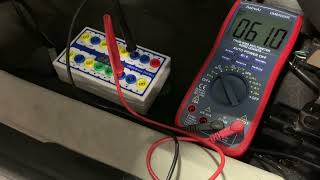
Disconnect the battery. At the OBD-II port, use a multimeter to measure the resistance between Pin 6 (CAN High) and Pin 14 (CAN Low). A healthy CAN bus network reads approximately 60 ohms. A reading of 120 ohms indicates a missing terminating resistor or a broken wire. A reading near 0 ohms indicates a short between the CAN wires.
Tools: Multimeter, Vehicle-Specific Wiring Diagram (Advanced) - Scope the CAN Bus Signal
Using an oscilloscope, connect to Pin 6 (CAN High) and Pin 14 (CAN Low) of the OBD-II port. With the ignition on, you should see a square wave pattern. CAN High toggles between 2.5V and 3.5V. CAN Low mirrors it, toggling between 2.5V and 1.5V. A flat line, excessive noise, or incorrect voltage levels point to a wiring short, open, or a faulty module corrupting the network.
Tools: Oscilloscope, Vehicle-Specific Wiring Diagram (Advanced) - Test Wheel Speed Sensor (for Hyundai/Kia/Chevy)
If the C1203 code points to a wheel speed sensor, disconnect the sensor and measure resistance with a multimeter (typically 800-1,700 ohms for passive sensors). Set the multimeter to AC voltage; spinning the wheel generates over 100mV. For active sensors, use a 'flying lead' to test the sensor while powered, looking for a current switch from ~0.7mA to ~1.4mA as the wheel turns.
Tools: Multimeter, Service Manual, Flying Lead Connector (for active sensors) (Advanced)
When This Code Triggers (Freeze-Frame Conditions)
- Vehicle Speed: 0-5 mph (The code sets shortly after startup, sometimes before the vehicle moves.)
- Engine RPM: 700-1200 RPM (Occurs at idle or just off-idle as the modules perform their initial communication handshake.)
- Battery Voltage: 11.5V - 14.5V (While low voltage is a cause, the code triggers within the normal operating voltage range once communication fails.)
- Time After Ignition On: 3-15 seconds (The fault is detected during the system's self-check immediately following ignition-on.)
Related Codes
- U0100 — 'Lost Communication With ECM/PCM'. If C1203 appears with U0100 and other U-codes, it suggests a widespread CAN bus failure or a faulty ECM. If only C1203 is present, the fault is isolated to the ABS system.
- C1345 — 'Linear Solenoid Valve Offset Learning Undone'. C1203 is the general communication fault that happens because the calibration is lost. C1345 points to the root cause: missing brake actuator calibration data.
- C1210 / C1336 — 'Zero Point Calibration of Yaw Rate Sensor Undone'. These codes pinpoint a missing calibration for the VSC sensors. C1203 is a secondary code appearing because the uncalibrated sensor prevents synchronization with the ECM.
- C1241 — 'Low or High Power Supply Voltage'. If you see C1241 alongside C1203, it strongly suggests the root cause of the communication failure is an electrical problem, such as a failing battery or poor ground connection.
Climate & Environmental Factors
- High Humidity / Salt: Areas with high humidity or heavy road salt use accelerate corrosion. This degrades wiring connections, ground points, and the internal components of the ABS module, leading to communication failures.
- Cold Weather: Low temperatures cause marginal batteries to fail, leading to voltage drops that trigger C1203. TSB BR002-03 for the 2003 Toyota Sequoia notes the electrical noise issue causing C1203 predominantly occurs in cold weather.
How to Talk to a Mechanic About This Code
Say this: "I have a C1203 code with the ABS and VSC lights on. I'd like to schedule a diagnostic. Before assuming it's an expensive module, please start by checking the battery, charging system, and all related ground connections. Also, please verify if it's a communication error, a calibration issue, or a wheel speed sensor fault for my specific vehicle."
This signals you've done your research and guides the mechanic to check the simplest, most common causes first, preventing a rush to diagnose an expensive module failure.
Avoid saying:
- 'My ABS light is on, can you fix it?'
- 'Just do whatever it takes to get the lights off.'
- 'A guy on the internet said it's the ABS module.'
Questions to ask before authorizing the repair:
- If you're recommending an ABS module: Did you confirm it has good power and ground, and that the CAN bus wiring is intact?
- If you're recommending a wiring repair: Can you show me the location of the damage or corrosion?
- If you're recommending a calibration: Is this because a battery was recently replaced or a component was changed?
- Does your quote for replacing the module include the cost of programming and calibration?
Where to Take It: Dealer vs Independent vs Chain
- Dealer:
Recommended for calibration-specific issues or if an independent shop is not equipped for advanced diagnostics.
Best for: Vehicles under warranty., Complex calibration issues, especially on Toyota/Lexus after a battery change., Diagnosing suspected module failures where manufacturer-specific tools are required.
Downsides: Highest labor rates., May default to module replacement instead of in-depth wiring diagnostics. (Typical cost: +50% vs. baseline) - Independent Shop:
Best overall fit, provided you vet the shop's diagnostic capabilities. Ask if they can perform ABS calibrations before you commit.
Best for: Out-of-warranty vehicles., Diagnosing common electrical faults like bad grounds or wiring., Replacing wheel-speed sensors on makes like Hyundai/Kia.
Downsides: Quality and equipment vary greatly. Ensure the shop has a professional bidirectional scanner and experience with ABS/VSC systems. (Typical cost: +0% vs. baseline) - Chain Shop:
AVOID for initial diagnosis. Their free code scan may not read 'C' codes and they are ill-equipped for the likely repair paths.
Best for: Battery testing and replacement., Simple wheel speed sensor replacement if the diagnosis is already certain.
Downsides: Technicians are unlikely to have the advanced scan tools or training for CAN bus diagnostics or sensor calibration., High risk of misdiagnosis, leading to unnecessary and expensive part replacements. (Typical cost: -10% vs. baseline)
When to Walk Away From the Repair
If the estimated repair cost exceeds 50% of the car's private-party value, it's often time to consider selling or trading it in.
- Car worth $3500, fix is $2800: Walk away. A nearly $3,000 repair for a failed ABS actuator on a car worth only $3,500 is not a sound investment.
- Car worth $15000, fix is $400: Fix it. A $400 wiring or sensor repair is well below the threshold and restores critical safety features.
- Car worth $8000, fix is $1200: Borderline. If the repair is for a remanufactured ABS module and the rest of the car is in good shape, it's likely worth fixing. Get a second opinion before proceeding.
What Scan Tool You Need for This Code
Minimum: An OBD-II scanner that reads and clears Anti-lock Brake System (ABS) codes. A basic engine-only code reader will not see 'C' (Chassis) codes like C1203.
Diagnosis requires viewing live data from sensors, and the most common fixes on many cars require a 'Zero Point Calibration,' which is a bidirectional command. A basic reader cannot perform this function.
Budget: Autel AutoLink AL629 / Foxwell NT301 (~$80) — Reads and clears codes from the ABS module, allowing you to confirm C1203. It displays live data, which helps for diagnosing a faulty wheel speed sensor. It CANNOT perform calibrations.
Mid-range: Innova 5610 / Foxwell NT510 Elite (~$250) — Offers bidirectional control. This is the minimum level required for a DIYer to perform the critical 'Zero Point Calibration' or 'Reset Memory' functions needed to fix this code after a battery replacement.
Professional: Autel MaxiCOM MK808 / Launch X431 series (~$500-900) — Provides full, dealer-level diagnostics. Performs all necessary calibrations, programming for new modules, and advanced functions like activating the ABS pump for brake bleeding.
Rent vs buy: Rent a scanner from an auto parts store to get the initial code for free, but their rental tools are typically basic readers. For C1203, if the cause is a calibration issue, you must buy a bidirectional tool or go to a shop.
How to Clear the Code After You Fix It
- Reconnect battery if disconnected for repair.
- Use an advanced OBD-II scan tool capable of accessing the ABS module to clear the C1203 code.
- If the code relates to calibration (common on Toyota/Lexus), perform the 'Zero Point Calibration' or 'Reset Memory' function with the scan tool.
- Perform a drive cycle to confirm the fix and allow related systems to run their self-checks.
Drive cycle (~20 minutes): After clearing the code, start the engine and idle for 2-3 minutes. Drive the vehicle, making several turns, and reach a speed of at least 28 mph to allow the VSC/ABS systems to verify sensor inputs. A 15-20 minute trip with mixed driving is sufficient.
Readiness monitors affected: This is a chassis code (C-code) and does not directly affect emissions readiness monitors like the Catalyst or O2 sensor monitors., If the root cause is a major electrical issue or ECM problem, it prevents emissions monitors from running.
Before emissions retest: drive at least 50 miles to fully set monitors.
Watch out for:
- Disconnecting the battery does not clear a C1203 code on most vehicles, especially if it relates to a calibration issue.
- A basic code reader that only accesses powertrain (P-codes) cannot see or clear chassis (C-codes).
- If the code immediately returns, the underlying electrical fault, module mismatch, or calibration need remains unresolved.
Will This Fail Emissions / State Inspection?
No — by itself this code doesn't fail OBD inspection (but it can keep readiness monitors from setting, which causes a separate fail).
- California: An illuminated ABS light is not an automatic failure for the smog check itself. However, the vehicle fails a brake and lamp inspection.
- New York: The NYS safety inspection requires all dashboard warning lights, including the ABS light, to function correctly and not be illuminated. An active C1203 code is an automatic failure.
- Texas: An illuminated ABS warning light is NOT a cause for rejection during the annual safety inspection. However, an illuminated primary 'Brake' warning light is a failure.
Most Commonly Affected Vehicles
- Toyota Prius (2004-2015) — Appears after a 12V battery replacement or if the brake actuator assembly fails. Frequently accompanied by codes C1345 and C1241, requiring calibration.
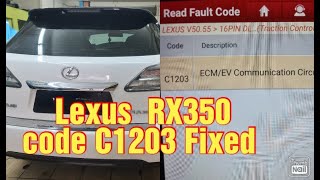
- Lexus RX Series (RX300, RX350, RX400h) (2001-2012) — Triggered by a failing battery or ABS module. Requires a 'reset memory' and calibration procedure with a professional scan tool after repairs.
- Toyota Sequoia (2003) — TSB BR002-03 addresses this model year. The VSC light illuminates with code C1203 due to electrical noise from the ignition coil in cold weather. Fix involves replacing the 'Translate Computer'.
- Toyota Highlander (2015-2018) — C1203 appears alongside C1433, pointing towards a problem with the steering angle sensor or its calibration.
- Chevrolet Aveo (2008-2011) — C1203 is defined as 'Right Front Wheel Speed Sensor Circuit Open or Shorted', pointing to a specific sensor or wiring fault rather than a general communication error.
- Kia Optima (2015) — TSB TT066 addresses code C1203 (RH Front Wheel Speed Sensor Open/Short). The cause is the main ESC wiring harness rubbing against a bracket near the radiator.
- Nissan Rogue (2014-2020) — C1203 indicates a communication failure between the ECM and the ABS control unit, traced back to faulty wiring or connectors.
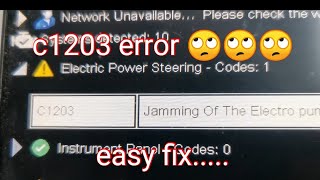
- Peugeot/Citroen Expert/Dispatch (2007-2016) — C1203 indicates a fault with the electro-pump for the power steering. A power wire chafing on a power steering pipe causes a voltage drop, disrupting communication with the ABS module.
Manufacturer-Specific Notes
- Toyota/Lexus: This code frequently appears after a 12V battery is replaced or disconnected. It indicates the system's memory and calibrations are lost and must be re-learned with a diagnostic tool. On some models, it means 'Vehicle Information Mismatch' when a used electronic module is installed.
- Chrysler/Dodge/Jeep: C1203 is defined as 'ABS Outlet Valve Coil Rear Circuit Open'. This points to a specific electrical fault in the ABS hydraulic unit's rear valve circuit, not a general communication error.
- Hyundai/Kia: On models like the Santa Fe, Accent, and Optima, C1203 is defined as 'Front Right Wheel Speed Sensor - Open or Short'. This points directly to a bad sensor or its wiring. For the 2015 Kia Optima, TSB TT066 notes this is caused by a wiring harness rubbing near the radiator.
- Chevrolet: On models like the Aveo, C1203 specifically means 'Right Front Wheel Speed Sensor Circuit Open or Shorted', directing diagnosis towards the sensor and its dedicated wiring harness.
- Peugeot/Citroen: In commercial vans, C1203 relates to a power steering malfunction. A chafed power wire to the electric power steering pump causes a voltage drop that disrupts communication with the ABS module.
Real Owner Stories
2007 Toyota Prius at 138K miles
ABS and brake warning lights appeared after a mechanic replaced the 12V auxiliary battery to fix a C1241 (low voltage) code. Brakes felt strange and grabbed unexpectedly.
What they tried:
- Mechanic attempted to perform the linear solenoid valve calibration multiple times, but codes C1203 and C1345 returned immediately.
- Took the car to a Toyota dealer, who failed to calibrate the system and diagnosed a failed ABS actuator assembly.
Outcome: The dealer quoted $3,000 to replace the ABS actuator assembly. The owner looked for a used part to reduce the cost.
Lesson: On a Toyota/Lexus, if C1203 and C1345 appear after a battery replacement, it is a calibration issue. If calibration repeatedly fails with a professional tool, it indicates a pre-existing or new failure of the ABS actuator.
2011 Hyundai Tucson
ABS, EBD, and ESP warning lights came on. A scan revealed code C1203, meaning 'Wheel Speed Sensor Front-RH Open/Short'.
What they tried:
- The diagnostic procedure specifies checking the sensor signal current. It should be between ~4mA and ~22mA.
Outcome: The fix is to test and replace the front right wheel speed sensor or repair its wiring. Once replaced, the code clears and stays off after driving over 10 km/h.
Lesson: Don't assume C1203 is a complex communication failure. On Hyundai, Kia, and Chevy models, it points to a specific wheel speed sensor. Always verify the code's definition for your exact make and model.
2012 Toyota Prius V
After replacing the ABS modulator with a new OEM part, the car would not start and codes C1203, C1336, and C1345 were present. The calibration procedure failed.
What they tried:
- Owner checked part numbers of all ECUs, suspecting a mismatch.
- While inspecting the fuse box, a damaged wire to the parking brake switch was discovered, caused by a poorly installed aftermarket alarm clip.
Outcome: After repairing the damaged parking brake switch wire, the system allowed the linear offset calibration to complete successfully. All codes cleared, and the car started normally.
Lesson: An obscure, seemingly unrelated circuit prevents critical system calibrations. The ABS system requires a valid signal from components like the parking brake switch to enter a learning mode.
Peugeot Expert / Citroen Dispatch Van
Power steering became very heavy, and a 'Stop, power steering malfunction' message appeared, along with code C1203.
What they tried:
- A new power steering electro-pump was installed, but the fault remained.
- Voltage checks at the pump connector showed only 1.4V with the pump plugged in.
Outcome: The technician traced the main power wire for the steering pump and found it chafed through its insulation, rubbing against a high-pressure power steering pipe. Repairing the wire restored full voltage, fixing the power steering and clearing the C1203 code.
Lesson: C1203 is triggered by a fault in a completely different system (like power steering) that shares a communication network or power source. A massive voltage drop in one component disrupts the entire CAN bus.
How to Prevent This Code From Triggering
- Periodically Test and Maintain the 12V Battery (Every 6 months) — Low voltage is a primary cause of module communication errors. Regularly testing the battery's health and cleaning corrosion prevents the voltage drops that trigger C1203.
- Change Brake Fluid per Manufacturer's Schedule (Every 2-3 years) — Brake fluid absorbs moisture over time. This moisture corrodes the sensitive internal components of the ABS module and hydraulic pump from the inside out, leading to failure.
- Apply Dielectric Grease to Key Electrical Connectors (When servicing nearby components) — Applying dielectric grease to the seals of connectors for the ABS module, wheel speed sensors, and ECM blocks moisture and prevents corrosion, a common cause of open or shorted circuits.
- Keep Under-hood and Under-vehicle Drains Clear (Annually, especially in leafy areas) — Clogged plenum or sunroof drains cause water to overflow into the cabin or engine bay, directly exposing sensitive control modules and wiring harnesses to moisture.
- Use Weatherproof Splices for any Wiring Repairs (During any electrical repair) — Using adhesive-lined heat shrink tubing or weatherproof butt connectors creates a sealed barrier against moisture. An improper splice corrodes quickly, causing the fault to return.
Frequently Asked Questions
Can I just clear the C1203 code?
You can try, but if the underlying issue isn't fixed, the code returns immediately. For calibration-related issues on brands like Toyota, the code cannot be cleared until the calibration is successfully completed.
My C1203 code appeared right after I changed my car battery. What happened?
Disconnecting the power erased the calibration memory for the steering, yaw rate, and brake sensors. The system now sees a communication mismatch. It needs recalibration using a bidirectional scan tool to clear the light.
Is it safe to drive with the C1203 code?
It is not recommended. Your regular brakes work, but your ABS, traction control, and stability control do not. This means your wheels lock up during a panic stop, significantly increasing accident risk.
I replaced the ABS module but the C1203 code came back. What now?
First, ensure the replacement module was programmed to your specific VIN. Second, re-investigate simpler causes like a corroded ground wire or a CAN bus wiring fault. A faulty replacement module is also possible.
What is 'Zero Point Calibration' and can I do it myself?
It resets the 'zero' position for sensors like steering angle and yaw rate so safety modules synchronize. Most modern cars require a professional-grade bidirectional scan tool to perform this calibration correctly. Do not attempt this without the proper equipment.
How can I avoid the high cost of replacing an ABS module?
Confirm the module is actually the problem through proper diagnosis, ruling out wiring or bad grounds first. If faulty, buy a remanufactured or used part to save 50-80% over dealer prices. Remember that used modules require professional VIN programming.
What does it mean if the brake pedal feels different with a C1203 code?
A change in brake pedal feel indicates the hydraulic portion of the ABS system is affected. A spongy or unresponsive pedal means the ABS actuator has an internal failure. Have the vehicle towed and inspected immediately.
My mechanic says the code is C1203 but it's a wheel speed sensor. Is that right?
Yes, for manufacturers like Hyundai, Kia, and Chevrolet, C1203 specifically means a fault with the right front wheel speed sensor circuit. This highlights why manufacturer-specific definitions are critical for accurate diagnosis.
Key Takeaways
- Code C1203 disables your ABS and stability control systems, increasing your risk of a fatal single-vehicle crash by up to 60%.
- Test your 12V battery and charging system first, as voltage drops below 9.5V are the most frequent cause of this communication failure.
- Verify the exact code definition for your vehicle make, because C1203 means a lost calibration on a Toyota but a failed right-front wheel speed sensor on a Hyundai.
- Expect to pay a shop $100 to $250 for a 'Zero Point Calibration' if this code appeared immediately after replacing your car battery.
Helpful Videos

The information in this article is provided for general reference and educational purposes only. Vehicle specifications, procedures, and part compatibility can vary by production date, trim level, and region. Always consult your vehicle's factory service manual and verify part numbers before purchasing or performing repairs. Safety-critical components such as airbags, seat belts, and braking systems should be installed by a qualified professional.
- 🎬 Helpful Videos
- What Does C1203 Mean?
- Can I Drive With C1203?
- Common Causes
- Symptoms
- Diagnostic Flowchart
- Common Fixes & Costs
- Used vs. New Parts: Buying Guide
- What Happens If You Wait — Timeline
- Cost of Not Fixing It
- Diagnosis Steps
- When This Code Triggers (Freeze-Frame Conditions)
- Related Codes
- Climate & Environmental Factors
- How to Talk to a Mechanic About This Code
- Where to Take It: Dealer vs Independent vs Chain
- When to Walk Away From the Repair
- What Scan Tool You Need for This Code
- How to Clear the Code After You Fix It
- Will This Fail Emissions / State Inspection?
- Most Commonly Affected Vehicles
- Manufacturer-Specific Notes
- Real Owner Stories
- 2007 Toyota Prius at 138K miles
- 2011 Hyundai Tucson
- 2012 Toyota Prius V
- Peugeot Expert / Citroen Dispatch Van
- How to Prevent This Code From Triggering
- Frequently Asked Questions
- Can I just clear the C1203 code?
- My C1203 code appeared right after I changed my car battery. What happened?
- Is it safe to drive with the C1203 code?
- I replaced the ABS module but the C1203 code came back. What now?
- What is 'Zero Point Calibration' and can I do it myself?
- How can I avoid the high cost of replacing an ABS module?
- What does it mean if the brake pedal feels different with a C1203 code?
- My mechanic says the code is C1203 but it's a wheel speed sensor. Is that right?
- Key Takeaways
- 🎟️ Get 5% Off