

OBD-II Code C1198: ABS Left Front Inlet Valve Circuit Failure
The Ultimate Guide to Diagnosing and Fixing C1198
- Code C1198 indicates an electrical fault in the front left wheel's ABS inlet valve circuit, completely disabling your anti-lock brakes.
- On 1997-2007 Ford trucks and SUVs, this code is almost always caused by cracked solder joints inside the ABS control module.
- If C1198 appears alongside code C1185 (Power Relay Failure), stop testing wiring—your ABS module has failed internally.
- Save $500 to $1,000 by removing your original ABS module and sending it to a specialized repair service instead of buying a new dealer replacement.
What Does C1198 Mean?

Code C1198 signifies the vehicle's Anti-lock Brake System (ABS) control module detected an electrical fault in the circuit for the left front wheel's inlet valve. This solenoid valve is a critical component the ABS module pulses rapidly to control brake fluid pressure to that specific wheel, preventing lockup during heavy braking.
Technical definition: The official SAE/OBD-II definition is "ABS Inlet Valve Coil LF Circuit Failure." This indicates the ABS control module detected an abnormal voltage or resistance (an open, short to ground, or short to power) in the electrical circuit operating the electromagnetic coil for the left front (LF) ABS inlet valve.
Can I Drive With C1198?
Yes, But With Caution. Yes, but your Anti-lock Braking System (ABS) and traction control are disabled. Your regular hydraulic brakes still function, but the wheels lock up during a hard stop, increasing stopping distances and skidding risks on wet or gravel surfaces. Have the vehicle inspected immediately to restore this critical safety feature.
Common Causes

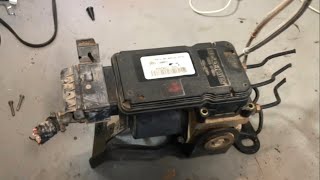
- Faulty ABS Control Module (Very Common) — This is the most frequent cause, especially in 1997-2007 Ford vehicles. 🎬 Watch: How to replace the ABS module on Ford trucks. Internal components of the ABS module, such as solder joints on the circuit board or electronic drivers, crack and fail from heat and vibration over time. If C1198 appears with C1185 (ABS Power Relay Output Circuit Failure), it guarantees an internal module failure.
- Corroded or Loose Electrical Connector (Common) — The main electrical connector at the ABS module loosens or develops green/white corrosion from water intrusion. This destroys the electrical connection, triggering the circuit failure code.
- Damaged Wiring Harness (Common) — The wiring harness leading to the ABS module is exposed to the elements. Road debris, engine heat, or chafing against the frame damages wires and interrupts the electrical signal to the left front inlet valve coil.
- Blown Fuse or Faulty Relay (Less Common) — High-amperage fuses and relays in the under-hood fuse box protect the ABS system. A blown fuse or a malfunctioning relay providing power to the valve circuit sets this code.
- Low Battery Voltage (Less Common) — The ABS module requires a stable voltage above 10.5 volts. A weak battery or a faulty alternator drops voltage during engine cranking, triggering intermittent circuit codes like C1198.
- Failed Inlet Valve Coil (Rare) — The electromagnetic coil inside the ABS hydraulic unit (modulator) that operates the valve burns out or develops an internal short. This requires replacing the hydraulic unit.
Symptoms

- ABS Warning Light is On — The ABS light on your dashboard illuminates and stays on constantly.
- Traction Control / Stability Control Light is On — Because traction and stability control systems use ABS components, their warning lights ('TCS', 'ESC', or a car with squiggly lines) also illuminate.
- Brakes Lock Up During Hard Braking — Without ABS, the left front wheel locks up and skids during an emergency stop, causing a loss of steering control.
- Spongy or Unresponsive Brake Pedal — A fault within the ABS hydraulic unit sometimes causes the brake pedal to feel softer or less responsive than usual. 🎬 See how to fix a spongy pedal by replacing the module.
Diagnostic Flowchart
Tap your situation to follow the diagnostic path that matches what you're seeing on this code.
Common Fixes & Costs
- Repair ABS Control Module (Send-Out Service) — Parts: $150-$300 (repair service fee), Labor: $150-$300 (removal and reinstallation), ~1.5 hr book time (Intermediate)
- Replace ABS Control Module/Assembly
— Parts: $650-$1,200 (new OEM), Labor: $250-$450, ~2.5 hr book time
(Professional)
Ford F-150 (1999-2004): OEM YL3Z2C219BA (Alt: Dorman 599-714)
Ford Super Duty F-250/F-350 (2002-2004): OEM 5C7Z2C219A (Alt: Dorman 599-771) - Repair Damaged Wiring or Connector — Parts: $20-$80 (pigtail/terminals), Labor: $100-$300, ~2.0 hr book time (Intermediate)
- Replace Blown Fuse or Relay — Parts: $5-$30, Labor: $0-$50, ~0.2 hr book time (DIY)
DIY vs Professional
- Replace Blown Fuse or Relay — Beginner:
Tools: ["Owner's Manual", 'Fuse Puller'] - Repair ABS Control Module (Remove and Send-Out) — Beginner:
Tools: ['Socket/Wrench Set', 'Torx Bits'] - Repair Damaged Wiring or Connector — Beginner:
Tools: ['Multimeter', 'Wire Strippers/Crimpers', 'Heat Shrink Tubing', 'Soldering Iron'] - Replace ABS Control Module/Assembly — Beginner:
Tools: ['Flare Nut Wrenches', 'Bi-directional Scan Tool', 'Pressure Brake Bleeder']
Used vs. New Parts: Buying Guide
When a used part is worth it: A used ABS control module is a budget-friendly option for an older vehicle, but carries high risk. It only makes sense if purchased from a reputable seller offering a warranty and exact part number matching.
Donor-vehicle mileage cap: roughly under 100000 miles for the part to have meaningful remaining life.
Donor quality checklist:
- Verify the part number on the module is an exact match.
- Ensure the donor vehicle was scrapped for accident damage, not electrical failure.
- Inspect the connector pins for any signs of green corrosion.
Decision logic:
- If The most common fix is a module repair service → Choose a repair service for your original module. It is cheaper than new, avoids programming issues, and is more reliable than a used part.
- If Vehicle is newer or has low mileage → Favor a new OEM part or a professional repair of your original module for maximum reliability.
- If Budget is the primary concern and the vehicle is old → A used module is an option, but it may have the same inherent flaws and require costly dealership programming.
Warranty tradeoff: Junkyard parts offer 30-90 day warranties. Remanufactured/repaired modules offer one-year or lifetime warranties. New OEM parts carry a one-year manufacturer's warranty.
Worst-case if a used part fails: $200-$500 if a used part fails after installation, covering repeat labor costs and the price of another part.
What Happens If You Wait — Timeline
- Immediate: The ABS and Traction/Stability Control warning lights illuminate. The ABS system is disabled. Conventional brakes still function. (MPG impact: 0%% · Added cost: $0)
- 0-6 months: The primary consequence is an ongoing safety risk. The vehicle fails mandatory safety inspections in certain states. (MPG impact: 0%% · Added cost: $50-$150 in potential inspection failure fees.)
- 6+ months: The system remains disabled. In very rare cases, an internal short within the faulty ABS module creates a parasitic battery drain. (MPG impact: 0%% · Added cost: $150-$300 for a new battery if a parasitic drain develops.)
- Variable: The lack of ABS contributes to an accident. The inability to steer during an emergency stop causes a collision. (MPG impact: 0%% · Added cost: $500+ in insurance deductibles or collision repair costs.)
Cost of Not Fixing It
- Immediate: Loss of anti-lock braking and traction/stability control. Increased risk of skidding and loss of control during emergency braking. (Added cost: Potential for vehicle collision and associated insurance deductibles.)
- 0-6 months: The vehicle fails state safety inspections in jurisdictions that check for illuminated ABS warning lights. (Added cost: Cost of a failed inspection ticket and re-inspection fees ($50-$150).)
- 6+ months: Continued driving does not cause cascading component damage. In rare cases, an internal module short creates a parasitic battery drain. (Added cost: $150-$300 for a new battery if a parasitic drain develops.)
Diagnosis Steps

- Read All ABS Codes
Use an ABS-capable OBD-II scanner to confirm C1198. Note any other codes. Multiple valve circuit codes (C1198, C1214) or power relay codes (C1185) guarantee a faulty ABS module is the root cause, not a wiring issue.
Tools: ABS-capable OBD-II Scanner (Beginner) - Check ABS Fuses and Relays
Locate the ABS fuses and relays in the under-hood fuse box. Visually inspect fuses and test or swap the main ABS power relay with a known good one.
Tools: Owner's Manual, Fuse Puller, Multimeter (Beginner) - PRO TIP: Perform a 'Tap Test' on the ABS Module
With the ignition on, have an assistant monitor the ABS light or live data on a scan tool. Firmly tap on the ABS control module with the handle of a screwdriver. If the light flickers or the code status changes, it confirms a cracked internal solder joint.
Tools: Screwdriver or Rubber Mallet (Intermediate) - Inspect the ABS Module Connector and Harness
Disconnect the main electrical connector on the ABS module. Look for green/white corrosion, moisture, or backed-out pins. Follow the wiring harness along the frame, looking for chafing or melting.
Tools: Flashlight, Inspection Mirror (Intermediate) - Test Power and Ground at the ABS Module Connector
Using a multimeter and wiring diagram, check for constant battery voltage and ignition-on voltage at the harness connector. Readings below 10.5V indicate a power supply issue. Check for a solid ground (less than 5.0 ohms resistance to the chassis).
Tools: Multimeter, Vehicle Wiring Diagram (Advanced) - PRO TIP: Test the Inlet Valve Coil Resistance
Measure the resistance of the left front inlet valve coil circuit by probing the correct two pins on the module itself. For many Ford Kelsey-Hayes units, this is 4-8 ohms. Infinite resistance (OL) indicates an open circuit; near zero indicates a short.
Tools: Multimeter, Vehicle Wiring Diagram/Pinout Chart (Advanced) - Perform an ABS Module Actuator Test
Use a bi-directional scan tool to command the ABS module to perform an actuator test. A failure to command the left front inlet valve, while other valves respond, isolates the fault to that circuit inside the module.
Tools: Advanced Bi-directional Scan Tool (Advanced) - PRO TIP: Scope Test the Valve Circuit
Backprobe the command wire for the LF inlet valve at the ABS module connector with an oscilloscope. When activated by a scan tool, you must see a square wave pattern. A flat line confirms a failure in the module's driver circuit.
Tools: Automotive Oscilloscope, Scan Tool, Wiring Diagram (Professional)
When This Code Triggers (Freeze-Frame Conditions)
- System Voltage: 10.5-16V (The fault is detected during the initial key-on self-test or if voltage drops during operation.)
- Vehicle Speed: >12 mph (20 km/h) (The ABS module performs a dynamic self-test once the vehicle exceeds 12 mph, triggering the code.)
- ABS Status: Inactive (The electrical circuit fault is detected when the system is not actively engaged in an ABS event.)
- Time Since Key-On: 1-10 seconds (The code sets immediately upon startup when the ABS module runs its initial power-on self-test.)
Related Codes
- C1185 — ABS Power Relay Output Circuit Failure. When C1185 appears with C1198, it guarantees a faulty ABS control module. The internal power relay fails, causing the valve circuit codes to set.
- C1194 — ABS Outlet Valve Coil LF Circuit Failure. Seeing inlet (C1198) and outlet (C1194) codes for the same wheel points to a problem with the ABS module or its main power/ground connection.
- C1214 — ABS Inlet Valve Coil RF Circuit Failure. Valve circuit codes for both front wheels (C1198 and C1214) dramatically increase the probability of a failed ABS module.
- U1900 / U2023 — CAN Bus communication failure codes. These appear with C1198 if the ABS module fails internally and disrupts communication on the vehicle's network.
Climate & Environmental Factors
- Road Salt and High Humidity: Winter road salt and moisture penetrate electrical connectors and module seals, causing corrosion on connector pins and internal circuit boards. This creates high resistance or short circuits.
- Extreme Temperature Cycles: Repeated expansion and contraction from engine heat puts mechanical stress on the ABS module's internal circuit board. Over thousands of cycles, this causes microscopic cracks in the solder joints, leading to an open circuit.
Where to Take It: Dealer vs Independent vs Chain
- Dealer:
Use for warranty work. For out-of-warranty vehicles, expect a massive quote for a full assembly replacement.
Best for: Vehicles under warranty, Complex repairs requiring manufacturer-specific software, Owners who prefer OEM parts
Downsides: Highest labor rates and part costs., Will recommend a $1,500+ assembly replacement rather than a module-only repair. (Typical cost: +50% vs. baseline) - Independent Shop:
Best fit. A good independent shop is familiar with this common failure and will offer the cost-effective module repair service.
Best for: Out-of-warranty vehicles where cost is a factor., Common failures like the C1198 module issue on Fords., Shops with ASE-certified technicians.
Downsides: Quality and expertise vary., May lack specialized tools for very new models. (Typical cost: +0% vs. baseline) - Chain Shop:
Avoid for this code. Diagnosis requires electrical testing and knowledge of common module failures beyond the scope of a chain shop.
Best for: Simple, routine maintenance like oil changes.
Downsides: Technician skill for complex diagnostics is highly variable., Lacks diagnostic equipment for ABS module faults, leading to misdiagnosis. (Typical cost: -10% vs. baseline)
When to Walk Away From the Repair
If the estimated repair cost exceeds 50% of the car's private-party value, seriously consider selling or trading it in.
- Car worth $3500, fix is $1800: Walk away. The repair cost is over 50% of the vehicle's value. This is a classic 'money pit' scenario.
- Car worth $8000, fix is $600: Fix it. The repair cost is well below the threshold and restores a critical safety feature.
- Car worth $4000, fix is $450: Fix it. This represents a cost-effective module repair that is a small fraction of the car's value.
What Scan Tool You Need for This Code

Minimum: An OBD-II scanner that reads and clears Anti-lock Brake System (ABS) codes. A basic engine-only code reader will not work.
A standard $20 OBD-II scanner only reads 'P' (Powertrain) codes. You need a scanner specifically advertised with ABS capabilities to see the C1198 code.
Budget: BlueDriver Pro or Foxwell NT604 Elite (~$100) — Reads and clears ABS codes like C1198. Displays live data from ABS sensors to rule out wheel speed sensor issues.
Mid-range: Foxwell NT630 Plus or XTOOL D7 (~$150) — Includes bi-directional control. Allows you to command the ABS module to perform an actuator test, attempting to cycle the specific left-front inlet valve.
Professional: Autel MaxiCOM MK808 or Innova 5610 (~$450-800) — Offers full bi-directional control and includes the ABS bleed function, necessary after replacing the hydraulic portion of the ABS unit.
Rent vs buy: Auto parts stores do NOT rent out scanners with ABS capabilities. Buying a mid-range bi-directional scanner is a valuable investment for DIYers.
How to Clear the Code After You Fix It
- Reconnect the ABS module and battery.
- Use an ABS-capable OBD-II scan tool to erase the trouble codes.
- Perform the specified drive cycle to allow the system to self-test.
Drive cycle (~10 minutes): Start the vehicle and drive it above 15 mph (25 km/h) for a few minutes. This allows the ABS module to complete its initialization and self-test routine. If the repair was successful, the ABS light remains off.
Readiness monitors affected: Not applicable. C-codes do not affect emissions readiness monitors.
Watch out for:
- Disconnecting the battery will not clear a C-code from the ABS module's memory.
- A basic $20 OBD-II scanner cannot communicate with or clear codes from the ABS module.
- The code returns immediately upon startup if the underlying electrical fault is not fixed.
Will This Fail Emissions / State Inspection?
No — by itself this code doesn't fail OBD inspection (but it can keep readiness monitors from setting, which causes a separate fail).
- California: An illuminated ABS light does not cause a failure of the Smog Check, which focuses strictly on emissions.
- New York: An illuminated ABS warning light is NOT a cause for rejection during the annual safety inspection, though proposed legislation seeks to change this.
- Texas: An illuminated ABS light is NOT a cause for failure. The inspection checks service brake performance, not ABS function.
- Colorado: A vehicle with an illuminated ABS warning light is considered hazardous and FAILS a safety inspection.
Most Commonly Affected Vehicles
- Ford F-150 (1997-2004) — Extremely common for the Kelsey-Hayes ABS control module to fail, presenting C1198 alongside C1185 and C1214.
- Ford Explorer (1997-2003) — Shares the F-150's ABS system and is highly prone to internal module failure causing a cluster of valve circuit codes.
- Ford Super Duty (F-250, F-350) (2002-2004) — Notorious for ABS module failures triggering a long list of codes including C1198, C1185, C1096, and C1214.
- Ford Excursion (2002-2005) — Utilizes the same problematic ABS control module as the Super Duty trucks, making it highly susceptible to internal failures.
- Ford Windstar (1999-2003) — Owners frequently report a cascade of ABS codes appearing at once, a classic sign of comprehensive ABS control module failure.
- Ford E-Series (E-150, E-250, E-350) (1999-2007) — A flurry of ABS codes including C1198 and C1095 indicates a failed ABS control module. Accessing the frame-mounted module is challenging.
- Chevrolet / GMC Silverado / Sierra (1999-2006) — The equivalent code is often related to a faulty Electronic Brake Control Module (EBCM) or a corroded ground connection on the frame below the driver's door.
- Lincoln Navigator (1998-2002) — Built on the T1 platform, this model experiences the same high rate of ABS module failures as the F-150.
Manufacturer-Specific Notes
- Ford: On 1997-2007 trucks and SUVs, C1198 is almost always caused by failed solder joints on the internal circuit board of the Kelsey-Hayes ABS module. Repair services that re-solder these connections are the standard fix.
- Ford: Despite widespread failure of these ABS modules, Ford never issued a safety recall for this specific electronic failure. Owners are responsible for repair costs.
- Ford: On 2020-2022 Explorer models, 'C1198' is not a trouble code but the name of a specific 14-pin electrical connector on the frame rail known for causing EVAP codes. It is unrelated to the ABS system.
- Chevrolet / GMC: On 1999-2006 trucks, a common cause for ABS codes is a poor ground connection. The main EBCM ground is located on the outside of the driver-side frame rail and rusts heavily.
Real Owner Stories
2002 Ford F-150 with intermittent ABS light
The ABS light came on intermittently while driving, eventually staying on permanently.
What they tried:
- Cleaned metal shavings from front wheel speed sensors.
- Replaced the rear differential speed sensor for $25, which did not fix the problem.
Outcome: A scan revealed C1198, C1214, and C1185. This combination pointed to a classic ABS control module failure. The owner performed a DIY solder repair on the module's circuit board and successfully fixed it.
Lesson: Don't replace sensors blindly. An intermittent light with multiple valve codes and a power relay code is a textbook symptom of a failed ABS control module.
2005 Ford Explorer with multiple ABS codes after part replacement
The ABS light and a blinking 4x4 light were on. The owner replaced the front right hub assembly and ABS sensor wire.
What they tried:
- Installed the new hub and sensor, but the code remained.
- Reinstalled the original ABS sensor wire, but the code still did not clear.
Outcome: The issue was not the wheel speed sensor or its wiring. The next logical step is investigating the ABS module itself.
Lesson: Replacing a wheel speed sensor will not fix a C1198 valve circuit code. Always diagnose based on the specific code pulled.
2002 Ford F-250 Super Duty with a cascade of ABS codes
The ABS light was on, and a scan revealed C1185, C1096, C1198, and C1214. Brake lights sometimes stayed on after turning the truck off.
What they tried:
- Cleaned rusted metal shavings off the front sensors.
- Cleaned the rear axle sensor.
Outcome: The combination of power relay, pump motor, and multiple valve codes strongly indicates a comprehensive internal failure of the ABS control module.
Lesson: A flood of simultaneous ABS codes is almost never a wiring or sensor problem. Suspect the ABS module immediately.
How to Prevent This Code From Triggering
- Apply Dielectric Grease to Connectors (During any brake or electrical work) — Applying dielectric grease to the ABS module connector's weather seal prevents moisture and road salt from causing pin corrosion.
- Maintain Battery and Charging System Health (Annually) — The ABS module is sensitive to low voltage. A weak battery causes voltage drops that trigger random circuit codes.
- Inspect and Secure Wiring Harnesses (During oil changes) — Checking that the ABS wiring harness is secure prevents chafing damage that causes shorts or open circuits.
- Fabricate a Heat Shield (Once (for specific models)) — If the ABS module is located directly above the exhaust manifold, fabricating an aluminum heat shield deflects heat and prolongs the module's life.
Frequently Asked Questions
Is it safe to drive with code C1198?
You can drive, but do so with increased caution. Your anti-lock brakes will not function, meaning wheels can lock up and cause a skid during an emergency stop. Repair it immediately if driving in wet or icy conditions.
Will C1198 make my regular brakes fail?
No, this code only affects the anti-lock function. Your standard hydraulic brakes still work to stop the car. The only exception is a rare simultaneous internal hydraulic failure.
Can a bad wheel speed sensor cause code C1198?
No. A bad wheel speed sensor triggers its own specific trouble codes (like C1145 or C1233). Code C1198 specifically points to an electrical circuit problem with the ABS inlet valve, not the speed sensor.
How much does it cost to fix code C1198?
A DIY fuse replacement costs under $20, while a module repair service runs $300 to $600 including labor. A full replacement of the ABS module assembly at a shop is the most expensive option, ranging from $900 to over $1,600. Always diagnose before replacing parts.
Can I fix code C1198 myself?
A DIYer can easily check fuses, inspect wiring, and remove the ABS module to send out for repair. However, replacing the entire ABS hydraulic unit requires special tools to bleed the brakes and program the new module. Leave full assembly replacements to a professional.
What are the most common misdiagnosis mistakes for C1198?
The biggest mistake is replacing the entire ABS hydraulic unit without confirming the fault, or replacing wheel speed sensors. Always test the module's power and ground circuits first, as a corroded wire mimics module failure. If the module is bad, repair it rather than replacing the whole assembly.
Why do I have so many ABS codes at once, like C1185, C1198, and C1214?
Seeing a cascade of ABS codes simultaneously is a classic symptom of a failed ABS control module. The internal failure disrupts power distribution for multiple circuits at once, logging a fault for each. It is extremely unlikely that all these separate external circuits failed at the exact same time.
What is an ABS module repair service?
You or your mechanic remove the electronic control module and mail it to a specialized company. They open the unit, repair known failure points like bad solder joints, and return it. This saves hundreds of dollars over buying a new module and requires no reprogramming.
Key Takeaways
- Code C1198 indicates an electrical fault in the front left wheel's ABS inlet valve circuit, completely disabling your anti-lock brakes.
- On 1997-2007 Ford trucks and SUVs, this code is almost always caused by cracked solder joints inside the ABS control module.
- If C1198 appears alongside code C1185 (Power Relay Failure), stop testing wiring—your ABS module has failed internally.
- Save $500 to $1,000 by removing your original ABS module and sending it to a specialized repair service instead of buying a new dealer replacement.
Helpful Videos

The information in this article is provided for general reference and educational purposes only. Vehicle specifications, procedures, and part compatibility can vary by production date, trim level, and region. Always consult your vehicle's factory service manual and verify part numbers before purchasing or performing repairs. Safety-critical components such as airbags, seat belts, and braking systems should be installed by a qualified professional.
- 🎬 Helpful Videos
- What Does C1198 Mean?
- Can I Drive With C1198?
- Common Causes
- Symptoms
- Diagnostic Flowchart
- Common Fixes & Costs
- DIY vs Professional
- Used vs. New Parts: Buying Guide
- What Happens If You Wait — Timeline
- Cost of Not Fixing It
- Diagnosis Steps
- When This Code Triggers (Freeze-Frame Conditions)
- Related Codes
- Climate & Environmental Factors
- Where to Take It: Dealer vs Independent vs Chain
- When to Walk Away From the Repair
- What Scan Tool You Need for This Code
- How to Clear the Code After You Fix It
- Will This Fail Emissions / State Inspection?
- Most Commonly Affected Vehicles
- Manufacturer-Specific Notes
- Real Owner Stories
- 2002 Ford F-150 with intermittent ABS light
- 2005 Ford Explorer with multiple ABS codes after part replacement
- 2002 Ford F-250 Super Duty with a cascade of ABS codes
- How to Prevent This Code From Triggering
- Frequently Asked Questions
- Is it safe to drive with code C1198?
- Will C1198 make my regular brakes fail?
- Can a bad wheel speed sensor cause code C1198?
- How much does it cost to fix code C1198?
- Can I fix code C1198 myself?
- What are the most common misdiagnosis mistakes for C1198?
- Why do I have so many ABS codes at once, like C1185, C1198, and C1214?
- What is an ABS module repair service?
- Key Takeaways
- 🎟️ Get 5% Off