

Ultimate Guide to OBD-II Code C1176: Left Rear Wheel Speed Sensor Circuit Failure
The Most Comprehensive C1176 Resource: What It Means, Why It Triggers, and Exactly How to Fix It
- Damaged wiring or a corroded connector causes over 50% of C1176 codes, making visual inspection more critical than immediate sensor replacement.
- Driving with a C1176 code disables your ABS and Traction Control, increasing emergency stopping distances by up to 50% on wet surfaces.
- Diagnosing this fault requires an ABS-capable scanner (starting around $60) to view live wheel speed data and confirm the exact failure point.
- Verify the code definition for your specific make; on Nissan vehicles, C1176 indicates a communication or brake switch failure, not a wheel speed sensor.
What Does C1176 Mean?

Code C1176 indicates the Anti-lock Brake System (ABS) module detects a fault in the left rear wheel speed sensor's electrical circuit. This sensor reports the left rear wheel's rotational speed to the main computer. When this signal is lost or erratic, the ABS and Traction Control Systems (TCS) shut down as a safety precaution, illuminating dashboard warning lights.
Technical definition: The SAE J2012 definition is 'Left Rear Wheel Speed Sensor Input Circuit Failure'. This signifies the ABS module registers an open circuit, short to ground, short to power, or an invalid signal from the left rear sensor. Note: For manufacturers like Nissan, this code signifies a completely different communication or brake switch issue.
Can I Drive With C1176?
Yes, But With Caution. Yes, but with significantly reduced safety. Standard hydraulic brakes function normally, but the Anti-lock Braking System (ABS) and Traction/Stability Control are disabled. This increases stopping distance on wet surfaces by up to 50% and eliminates skid prevention during emergency maneuvers. Repair this immediately.
Common Causes

- Damaged or Corroded Wiring/Connector (Very Common) — The wiring harness to the rear sensor is exposed to harsh conditions. Road debris, moisture, salt, and suspension movement cause wires to break, chafe, or corrode inside the connector, interrupting the signal.
- Failed Left Rear Wheel Speed Sensor (Common) — The sensor is a common wear item. Internal electronic components fail due to age, vibration, and heat cycles from the nearby braking system.
- Poor Chassis Ground Connection (Common) — The wheel speed sensor circuit relies on a clean ground connection to the vehicle's frame. On many vehicles (particularly GM trucks), this ground point corrodes, creating an open circuit and triggering a C1176 code even if the sensor and wiring are perfect.
- Failed Wheel Bearing / Hub Assembly (Common) — Modern vehicles integrate the ABS tone ring into the wheel bearing assembly. A worn wheel bearing develops excessive play, damaging the tone ring or increasing the air gap between the ring and sensor, causing signal loss.
- Damaged or Contaminated ABS Tone Ring (Less Common) — The sensor reads a toothed 'reluctor' or 'tone' ring to measure wheel speed. If this ring cracks, loses a tooth, or becomes coated in thick rust and metallic debris, the sensor cannot generate a clean signal.
- Incorrect Sensor Installation or Air Gap (Less Common) — If the sensor is not fully seated during a repair, or a required shim is missing, the air gap between the sensor and tone ring becomes too large. A typical required air gap ranges from 0.016 to 0.050 inches (0.4 to 1.3 mm).
- Failed ABS Control Module (Rare) — An internal fault in the ABS control module's driver circuit for the left rear sensor mimics the symptoms of a bad sensor or wire. This requires professional diagnosis to confirm.
Symptoms

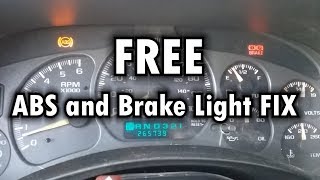
- ABS Warning Light On — The primary and most certain symptom. The amber ABS light on your instrument cluster illuminates immediately.
- Traction/Stability Control Light On — These systems rely on wheel speed data, so their warning lights (often a car with squiggly lines) activate alongside the ABS light.
- ABS and Traction Control Inoperative — During a hard stop, the wheels lock and skid without brake pedal pulsation. When accelerating on a slippery surface, the wheels spin excessively.
- Cruise Control Disabled — Most vehicles disable the cruise control system when an ABS fault is present because vehicle speed cannot be reliably verified.
- Erratic Speedometer Behavior (Rare) — On vehicles using a rear wheel speed sensor as the primary input for the vehicle speed gauge, the speedometer jumps erratically or drops to zero.
Diagnostic Flowchart
Tap your situation to follow the diagnostic path that matches what you're seeing on this code.
Common Fixes & Costs
- Repairing Damaged Wiring or Connector — Parts: $10-$50, Labor: $150-$350, ~1.5 hr book time (Intermediate)
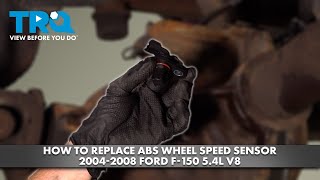
- Replacing the Left Rear Wheel Speed Sensor
— Parts: $40-$200, Labor: $100-$150, ~1 hr book time
(DIY)
Ford F-150 (2004-2014, rear diff sensor): OEM Motorcraft DY1073 (Alt: Dorman 970-021, Standard Motor Products ALS1971, NTK AB1990)
Ford Explorer (2011-2019): OEM AE9Z-2C190-B (Alt: Bosch 0265009516, Duralast SU14399, Holstein 2ABS2686)
Jeep Grand Cherokee (2011-2018): OEM 68291949AC (Alt: Dorman 970-054, Standard Motor Products ALS2552, Autopart Premium APABS2076) - Cleaning or Repairing Chassis Ground Point — Parts: $5, Labor: $75-$150, ~0.8 hr book time (DIY)
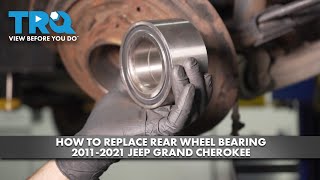
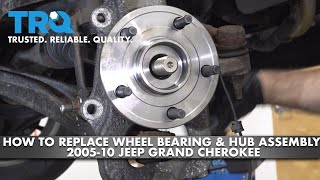
- Replacing the Wheel Hub/Bearing Assembly
— Parts: $150-$450, Labor: $200-$400, ~2.5 hr book time
(Intermediate)
Ford F-150 (2011-2014, 4WD): OEM CL3Z-1104-L (Alt: MOOG 515166, Timken HA590444, Driveworks S-515166)
Ford Explorer (2011-2019): OEM HB5Z-1104-C (Alt: MOOG 512460, Timken HA590412, National 512460)
Jeep Grand Cherokee (2011-2015, non-SRT): OEM 52124768AB (Alt: MOOG 512479, Timken HA590419, Driveworks S-510116) - Replacing the ABS Control Module — Parts: $600-$1800, Labor: $150-$300, ~1.5 hr book time (Professional)
Used vs. New Parts: Buying Guide
When a used part is worth it: Buying used sensors or hub assemblies is not recommended. These are wear-and-tear parts where labor costs outweigh part savings. A used part only makes sense for high-cost components like the ABS Control Module, purchased from a reputable seller with a warranty.
Donor-vehicle mileage cap: roughly under 50000 miles for the part to have meaningful remaining life.
Donor quality checklist:
- For sensors/hubs: Avoid used parts entirely.
- For ABS Modules: Match the part number exactly.
- Purchase from a specialized recycler offering at least a 90-day warranty.
- Be aware that a used ABS module requires reprogramming to your vehicle's VIN.
Decision logic:
- If The failed part is the wheel speed sensor or wheel hub assembly. → Always buy new. Part cost is low compared to labor, and new parts include warranties.
- If The failed part is the ABS Control Module and a new one costs over $1000. → A tested, warrantied used module from a low-mileage vehicle is a reasonable alternative.
- If The vehicle is over 15 years old and you are performing the labor yourself. → A used sensor from a pick-and-pull yard is a budget choice, but accept the risk of premature failure.
Warranty tradeoff: Used parts typically have a 30-90 day warranty covering only the part. New aftermarket parts carry 1-year to lifetime warranties. New OEM parts offer 1-2 year warranties.
Worst-case if a used part fails: $300-$600 if a used sensor or hub fails after installation, requiring a second round of labor.
What Happens If You Wait — Timeline
- 0-1 week: Code C1176 is stored and ABS/Traction Control warning lights illuminate. Systems are immediately disabled. Standard hydraulic brakes function normally. (MPG impact: 0%% · Added cost: $0. The primary cost is the immediate loss of safety features.)
- 1 week - 3 months: The vehicle operates with no ABS or ESC functionality. Accident risk during emergency braking is significantly higher. Cruise control remains disabled. (MPG impact: 0%% · Added cost: $0 in direct mechanical costs, but the vehicle automatically fails state safety inspections, leading to potential fines.)
- 3-12 months: If the root cause is a bad wheel bearing, continued driving causes the bearing to degrade further, leading to grinding noises and excessive heat. (MPG impact: 0-2%% · Added cost: $250-$600. A simple sensor issue escalates to requiring a full wheel hub/bearing assembly replacement due to consequential damage.)
- 12+ months: A severely failed wheel bearing seizes or collapses, causing a loss of control or wheel detachment in a worst-case scenario. (MPG impact: 0-5%% · Added cost: $1500+. Catastrophic bearing failure damages the axle spindle and brake components, leading to extensive repairs.)
Cost of Not Fixing It
- Immediate: Loss of Anti-lock Brakes (ABS) and Traction/Stability Control (TCS/ESC). Significantly increases the risk of wheel lock-up and skidding during emergency braking. (Added cost: Potential cost of an accident, ranging from hundreds to tens of thousands of dollars.)
- Short-Term (Weeks to Months): Failure of state safety inspection. An illuminated ABS light is an automatic failure in most jurisdictions, preventing legal vehicle registration. (Added cost: $50-$200 in re-inspection fees and fines for expired registration.)
- Long-Term (6+ Months): No significant consequential mechanical damage is expected unless the root cause is a failing wheel bearing. The primary cost remains the elevated safety risk. (Added cost: Negligible direct costs, but cumulative accident risk remains high.)
Diagnosis Steps

- Confirm Fault Code with ABS-Capable Scanner
Use an OBD-II scanner capable of accessing the ABS module to confirm C1176 is active. Document any other codes, as they provide critical diagnostic clues.
Tools: ABS-capable OBD-II Scanner (Beginner) - Analyze Live Wheel Speed Data
Access the live data stream for all four wheel speed sensors. Safely drive under 10 mph or raise the vehicle and spin the left rear wheel by hand. If the Left Rear (LR) sensor reads 0 while others register speed, the fault is confirmed in the LR circuit.
Tools: Advanced OBD-II Scanner with Live Data (Beginner) - Perform Detailed Visual Inspection
Safely raise and support the vehicle. Trace the left rear wheel speed sensor wire from the hub into the vehicle body. Look for cuts, chafing, or stretched wires. Unplug the connector and inspect for green/white corrosion, bent pins, or moisture.
Tools: Jack, Jack Stands, Flashlight (Intermediate) - [Pro Tip] Swap Sensors Side-to-Side
If the left and right rear sensors are identical and accessible, swap them. Clear the codes and drive. If the code changes to C1166 (Right Rear Sensor), the sensor is faulty. If the code remains C1176, the sensor is good; the problem is the wiring or hub.
Tools: Basic Hand Tools, ABS Scanner (Intermediate) - Inspect Wheel Bearing and Tone Ring
Grasp the raised wheel at 12 and 6 o'clock and attempt to rock it. Play or grinding noises indicate a bad wheel bearing, a likely root cause. Visually inspect the tone ring for cracks, missing teeth, or heavy rust.
Tools: Basic Hand Tools (Intermediate) - Test the Circuit with a Multimeter
Disconnect the sensor and the ABS module connector. Set a multimeter to Ohms. Check for continuity on both wires from the module to the sensor connector (should be < 1 Ohm). Check each wire for a short to ground (should be OL/infinite).
Tools: Multimeter, Vehicle Wiring Diagram (Advanced) - Check for Power and Ground at the Sensor
For active (3-wire) sensors: key on, sensor unplugged. One pin should have 12V, one ground (<0.1V), and one signal. For 2-wire active sensors: one pin has reference voltage (5V/12V), the other is signal return. Missing voltage indicates a wiring or module issue.
Tools: Multimeter, Vehicle Wiring Diagram (Advanced) - Test Passive Sensor Resistance
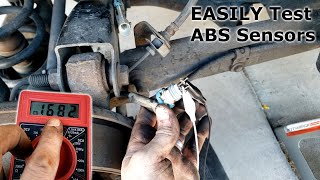
For passive (2-wire) sensors, disconnect the sensor and measure resistance between the two pins. A healthy sensor reads between 800 and 2,500 Ohms. A reading of 'OL' or near 0 Ohms indicates internal failure.
Tools: Multimeter (Advanced) - Test Passive Sensor AC Voltage Output
Reconnect the sensor, set the multimeter to AC Volts (mV), and back-probe the wires. Spin the wheel by hand at one revolution per second. A good sensor generates >100mV AC. No voltage indicates a dead sensor or excessive air gap.
Tools: Multimeter with AC Volts, Back-probe Pins (Advanced) - Analyze the Signal with an Oscilloscope
Back-probe the sensor's signal wire. Spinning the wheel should produce a clean square wave (active sensors) or sine wave (passive sensors). A malformed waveform indicates a bad sensor, damaged tone ring, or excessive bearing play.
Tools: Oscilloscope, Back-probe Pins (Professional)
When This Code Triggers (Freeze-Frame Conditions)
- Vehicle Speed: 10-70 mph (Triggers at any speed above the ABS self-test threshold (typically ~5-10 mph) when the sensor signal is lost or irrational.)
- System Voltage: 12.5-14.5V (Normal operating voltage. Low voltage triggers other ABS codes, but rarely C1176 directly.)
- ABS/TCS/ESC Status: Inactive/Fault (The ABS module disables anti-lock, traction, and stability control systems immediately upon setting the code.)
- Brake Pedal Status: Off/On (The fault is detected regardless of brake application due to continuous circuit monitoring.)
Related Codes
- C1166 — The identical fault for the 'Right Rear Wheel Speed Sensor'. If both appear together, focus on shared wiring or a common power/ground circuit.
- C0037 — The generic SAE equivalent code for 'Left Rear Wheel Speed Sensor Circuit'. Scanners may display this instead of the manufacturer-specific C1176.
- C1155 / C1145 — Codes for the front wheel speed sensors. Multiple speed sensor codes simultaneously suggest a systemic problem like a failing ABS module or bad ground.
- U0415 — 'Invalid Data Received From ABS Control Module'. A secondary code set by other modules relying on wheel speed data. Fix C1176 first, and U0415 resolves itself.
Climate & Environmental Factors
- Road Salt / De-icing Agents: The most significant environmental factor. Salt and moisture accelerate corrosion of wiring harnesses, connectors, and chassis ground points, directly triggering code C1176 in 'rust belt' regions.
- Snow and Ice Buildup: Packed snow and ice in the wheel well physically damages the sensor or wiring. It also temporarily blocks the signal between the sensor and tone ring, causing intermittent faults.
- Extreme Cold: Cold temperatures make wire insulation brittle and susceptible to cracking from suspension movement. Frozen moisture inside a connector breaks fragile electrical connections.
- High Humidity: Moisture penetrates non-sealed connectors or compromised wiring insulation, leading to slow corrosion and signal degradation over time.
How to Talk to a Mechanic About This Code
Say this: "I have a C1176 code for the left rear wheel speed sensor circuit and my ABS light is on. I'd like to book a diagnostic appointment. Please start by checking live data from all four wheel speed sensors and performing a visual inspection of the wiring harness before recommending part replacements."
This signals you know common failures are wiring issues, not just the sensor. It directs the technician to perform logical, low-cost diagnostic steps first, preventing unnecessary part replacements.
Avoid saying:
- 'My ABS light is on, can you fix it?'
- 'Just do whatever it takes to turn the light off.'
- 'I think I need a new wheel speed sensor.' (Don't diagnose for them)
Questions to ask before authorizing the repair:
- What did the live data show for the left rear sensor while the wheel was spinning? Was it zero, or erratic?
- Can you show me the physical damage to the wiring or the corrosion in the connector?
- If recommending a sensor replacement, how did you confirm the wiring is good?
- If recommending a wheel hub assembly, what was the measurement for play in the bearing?
- Can you provide me with the old parts that are replaced?
Where to Take It: Dealer vs Independent vs Chain
- Dealer:
Recommended for in-warranty work or if a specific Technical Service Bulletin (TSB) or module programming is required.
Best for: Vehicles still under warranty, Known manufacturer-specific issues (e.g., GM ground faults, Nissan code definitions), Repairs requiring ABS module replacement and programming
Downsides: Significantly higher labor rates and part costs., May default to replacing a full assembly (e.g., hub with sensor) when only a smaller component failed. (Typical cost: +50% vs. baseline) - Independent Shop:
Best fit for most out-of-warranty C1176 repairs. Provides the best balance of expertise and value.
Best for: Out-of-warranty vehicles where cost is a factor., Diagnosing common failure patterns like wiring damage or sensor failure., Building a long-term relationship with a trusted mechanic.
Downsides: Shop quality and diagnostic equipment vary greatly; look for ASE certification., May lack access to the latest manufacturer software updates. (Typical cost: +0% vs. baseline) - Chain Shop:
Use with caution. Acceptable if you are certain only a sensor needs replacing, but AVOID for initial diagnosis.
Best for: Simple, clear-cut part replacements if the diagnosis is already confirmed.
Downsides: Technician skill varies widely; often lacks advanced electrical diagnostic experience., High pressure to upsell services and parts., Less likely to perform detailed wiring repairs; prefers replacing parts. (Typical cost: -10% vs. baseline)
When to Walk Away From the Repair
If the total estimated repair cost exceeds 40-50% of your car's current private-party value, seriously consider not fixing it.
- Car worth $8000, fix is $350: Fix it. This is a minor repair cost relative to the vehicle's value.
- Car worth $4000, fix is $750: Borderline, but likely worth fixing. Get a second opinion to confirm the diagnosis.
- Car worth $3000, fix is $2100: Walk away. The repair cost is 70% of the car's value. It is not economically sensible to proceed.
What Scan Tool You Need for This Code

Minimum: A scanner that reads and clears diagnostic trouble codes (DTCs) from the Anti-lock Braking System (ABS) module and displays a live data stream of all four wheel speed sensors.
A standard sub-$50 OBD-II code reader only communicates with the engine control unit. It cannot see ABS faults and shows 'No Codes Found' even when your ABS light is on.
Budget: Autel AP200 or BlueDriver Pro (~$60-120) — Bluetooth dongles connecting to a smartphone app. They read/clear ABS codes and display live wheel speed data, essential for diagnosing sensor function.
Mid-range: Foxwell NT630 Plus or Innova 5610 (~$150-350) — Powerful handheld units providing robust ABS/SRS diagnostics, live data graphing, and bidirectional tests like activating the ABS pump.
Professional: Autel MaxiCOM MK808 series (~$450-600) — Tablet-based professional scan tools offering full-system diagnostics, extensive live data, and bidirectional controls for nearly all makes.
Rent vs buy: Auto parts store 'loan-a-tool' programs offer basic readers that CANNOT read ABS codes. Renting is not viable. Buying a budget ABS-capable scanner for ~$60-$100 is cheaper than a shop's diagnostic fee.
How to Clear the Code After You Fix It
- Perform the physical repair (e.g., replace sensor, fix wiring).
- Use an ABS-capable OBD-II scan tool to erase the C1176 fault code from the ABS module.
- Turn the ignition off, wait 10 seconds, then start the engine and drive above 10 mph to allow the ABS module to self-test.
Drive cycle (~10 minutes): Drive the vehicle for 5-10 minutes, including turns and reaching at least 20 mph. The ABS light remains off if the repair was successful. There is no complex emissions-style drive cycle for the ABS system.
Readiness monitors affected: This code does not directly affect emissions readiness monitors.
Watch out for:
- Using a basic OBD-II scanner that cannot access or clear ABS module codes.
- Forgetting to clear the code after repair; the light stays on even if the fault is fixed.
- The code returning immediately, indicating the root cause was not correctly identified.
Will This Fail Emissions / State Inspection?
Yes — this code typically fails an OBD-II emissions inspection.
- California: An illuminated ABS light is a safety system failure and causes the vehicle to fail the overall safety inspection, a prerequisite for the Smog Check in some cases.
- New York: New York state law explicitly includes Anti-lock Brake System warning lights in the safety inspection. An illuminated ABS light is grounds for failure.
- Texas: An illuminated ABS light causes a failure of the Texas state safety inspection. Official guidelines list brake system warning lamps as a mandatory inspection item.
Most Commonly Affected Vehicles
- Ford F-150 / F-250 (2004-2014) — Extremely common. The single sensor sits on top of the rear differential housing, making its wiring highly vulnerable to damage. Disables cruise control.
- Ford Explorer (2011-2019) — Known for frequent failures of the rear wheel speed sensors and chafing issues with the wiring harness along the rear suspension.
- Jeep Grand Cherokee (2005-2018) — A frequent cause for ABS/TCS lights. Both internal sensor failure and external wiring damage are common.
- Dodge / Ram Ram 1500 / 2500, Challenger (2006-2018) — The wiring path over the rear axle is a primary failure point. On the Challenger, this fault immediately disables cruise control.
- Chevrolet / GMC Silverado / Sierra (2007-2018) — Corrosion at the main EBCM ground point on the frame rail under the driver's door is a well-documented issue. Cleaning this ground is often the fix.
- Hyundai / Kia Santa Fe, Sorento, Tucson (2010-2020) — Experiences internal sensor failures and corrosion of the integrated tone ring in the rear wheel bearing.
- BMW 3-Series (E90) / X3 (F25) (2006-2017) — Presents as a 'trifecta' of DSC, ABS, and Brake lights. The reluctor ring on the rear driveshaft corrodes, swells, and contacts the sensor.
- Mazda 3 / 6 (2008-2013) — Suffers from intermittent C1176 codes caused by internal breaks in the sensor wiring harness that are not visually apparent.
Manufacturer-Specific Notes
- Nissan: On many Nissan vehicles (Rogue, Juke, Murano), C1176 indicates a 'Stop Lamp Switch Circuit' failure or an 'ECU HS Bus Off' communication error, not a wheel speed sensor.
- Ford: On models like the Explorer, a complete open circuit on a wheel speed sensor causes scan tool live data to display an impossibly high speed (e.g., 158 mph) instead of 0 mph.
- Audi / Volkswagen: Do not confuse C1176 with P1176 (O2 Sensor Correction) or 01176 (Key Signal too Low). Use a scanner that correctly interprets Chassis ('C') codes.
- Honda: Honda uses B1176 for a 'Fuel Level Sensor Circuit' issue and P1176 for an O2 sensor fault. Always verify the code's first letter.
- General Motors: TSB 04-05-25-004A addresses corrosion at the EBCM ground (G103/G104) on the frame rail below the driver's door, causing numerous ABS codes. Clean the ground point before replacing sensors.
Real Owner Stories
2008 Ford F-150 at 115K miles
ABS and Brake light came on intermittently, then stayed on. Cruise control stopped working.
What they tried:
- Ignored the light, but failed state inspection.
- Used a basic scanner, which showed no codes.
- Took to a shop, which used an ABS-capable scanner to pull C1176.
- Replaced the rear differential speed sensor.
Outcome: Replacing the sensor on top of the rear differential cleared the code and restored ABS and cruise control. The old sensor's wiring was visibly frayed near the connector.
Lesson: On many Ford trucks, a single sensor on the differential serves both rear wheels. Its exposed location makes wiring damage the most likely cause. Basic scanners cannot read ABS codes.
2011 Chevy Silverado at 140K miles
ABS and Stabilitrak lights appeared in wet weather. Code C1176 was present alongside other wheel sensor codes.
What they tried:
- Replaced the left rear wheel speed sensor; codes returned immediately.
- Inspected the wiring harness and found no visible damage.
- Searched forums for Silverado-specific ABS issues.
Outcome: Found GM TSB 04-05-25-004A regarding a corroded EBCM ground point. Cleaned the ground on the frame rail under the driver's door to bare metal. All ABS codes cleared permanently.
Lesson: On GM trucks, multiple simultaneous ABS codes point to a single bad ground, not multiple failed sensors. Always check for model-specific TSBs before replacing parts.
2012 Jeep Grand Cherokee at 85K miles
ABS and Traction Control lights came on after hitting a large pothole.
What they tried:
- Swapped the left and right rear wheel speed sensors. The code stayed C1176.
- Visually inspected the wiring and found a small break in the insulation 6 inches from the connector.
- Performed a temporary repair by twisting the wires together.
Outcome: Permanently repaired the broken wire using a weatherproof butt connector and heat shrink tubing. The fault was an open circuit from the pothole impact snapping the wire.
Lesson: A sharp impact easily breaks an old, brittle wire. The sensor-swap test is a highly effective, no-cost diagnostic step to isolate a wiring problem from a sensor problem.
How to Prevent This Code From Triggering
- Apply Dielectric Grease to Connectors (Any time a sensor is replaced or disconnected) — Fills air gaps in the connector, sealing out moisture and oxygen. This prevents terminal pin corrosion, a primary cause of high resistance and signal loss.
- Inspect and Secure Wiring Harnesses (During every tire rotation or brake service) — Identifies wiring rubbing against suspension components. Using zip ties to secure the harness away from moving parts prevents chafing and wire breaks.
- Clean Chassis Ground Points (Once every 5 years, or if you live in a rust-belt state) — Key ground points on truck frames corrode over time. Cleaning contact surfaces to bare metal ensures the ABS circuit maintains a solid ground path.
- Thoroughly Wash Wheel Wells (Regularly, especially after winter) — Washing away road salt and mud prevents corrosive agents from degrading the sensor, connector, and wiring.
Frequently Asked Questions
Can I fix a C1176 code myself?
Yes, replacing a wheel speed sensor is a DIY-friendly repair involving a single bolt. However, proper diagnosis is crucial to ensure you aren't replacing a good sensor when the real problem is wiring or a bad wheel bearing.
Will a C1176 code fail a safety inspection?
Yes. In virtually all regions with vehicle safety inspections, an illuminated ABS warning light is an automatic failure.
Why did my cruise control stop working with the ABS light?
Cruise control relies on accurate data from wheel speed sensors. If the ABS module reports a C1176 fault, it disables cruise control as a safety precaution.
What is the most common misdiagnosis for C1176?
The most common mistake is replacing the wheel speed sensor without testing the circuit. The true cause is often a broken wire near the connector, a corroded chassis ground, or a failing wheel bearing.
Can I test a sensor by swapping it with the one on the other side?
Yes, swapping identical left and right rear sensors is an excellent diagnostic technique. If the fault code changes to the other side (e.g., C1166), the sensor is bad. If the code stays C1176, the problem is in the left-side wiring or hub.
Why did the ABS light appear after hitting a pothole?
A sharp impact snaps old, brittle wires or dislodges connectors. It can also physically damage the sensor or the tone ring on the hub.
Can I just clear the code and see if it comes back?
You can, but for a hard fault like a broken wire, the code returns instantly or within the first few feet of driving during the ABS self-test.
Key Takeaways
- Damaged wiring or a corroded connector causes over 50% of C1176 codes, making visual inspection more critical than immediate sensor replacement.
- Driving with a C1176 code disables your ABS and Traction Control, increasing emergency stopping distances by up to 50% on wet surfaces.
- Diagnosing this fault requires an ABS-capable scanner (starting around $60) to view live wheel speed data and confirm the exact failure point.
- Verify the code definition for your specific make; on Nissan vehicles, C1176 indicates a communication or brake switch failure, not a wheel speed sensor.
Helpful Videos

The information in this article is provided for general reference and educational purposes only. Vehicle specifications, procedures, and part compatibility can vary by production date, trim level, and region. Always consult your vehicle's factory service manual and verify part numbers before purchasing or performing repairs. Safety-critical components such as airbags, seat belts, and braking systems should be installed by a qualified professional.
- 🎬 Helpful Videos
- What Does C1176 Mean?
- Can I Drive With C1176?
- Common Causes
- Symptoms
- Diagnostic Flowchart
- Common Fixes & Costs
- Used vs. New Parts: Buying Guide
- What Happens If You Wait — Timeline
- Cost of Not Fixing It
- Diagnosis Steps
- When This Code Triggers (Freeze-Frame Conditions)
- Related Codes
- Climate & Environmental Factors
- How to Talk to a Mechanic About This Code
- Where to Take It: Dealer vs Independent vs Chain
- When to Walk Away From the Repair
- What Scan Tool You Need for This Code
- How to Clear the Code After You Fix It
- Will This Fail Emissions / State Inspection?
- Most Commonly Affected Vehicles
- Manufacturer-Specific Notes
- Real Owner Stories
- 2008 Ford F-150 at 115K miles
- 2011 Chevy Silverado at 140K miles
- 2012 Jeep Grand Cherokee at 85K miles
- How to Prevent This Code From Triggering
- Frequently Asked Questions
- Can I fix a C1176 code myself?
- Will a C1176 code fail a safety inspection?
- Why did my cruise control stop working with the ABS light?
- What is the most common misdiagnosis for C1176?
- Can I test a sensor by swapping it with the one on the other side?
- Why did the ABS light appear after hitting a pothole?
- Can I just clear the code and see if it comes back?
- Key Takeaways
- 🎟️ Get 5% Off