

OBD-II Code C1134: Stability/Brake System Sensor Circuit Failure
What C1134 means, why it triggers, and how to fix it
- Code C1134 disables your anti-lock braking (ABS) and electronic stability control (ESC) systems, increasing your risk of skidding.
- Because C1134 definitions vary by manufacturer, you must use an OBD-II scanner with ABS capabilities to pinpoint the exact failing sensor.
- Over 80% of C1134 codes stem from a failed wheel speed sensor, corroded wiring harness, or a cracked ABS tone ring.
- You can drive with a C1134 code, but your wheels will lock up during emergency braking, requiring double the normal stopping distance on wet roads.
What Does C1134 Mean?

Code C1134 means your car's main computer detects a problem with a sensor in the Anti-lock Braking System (ABS) or Electronic Stability Control (ESC) system. These systems help you maintain control in slippery conditions or during emergency maneuvers. Because the definition varies by brand, it points to a faulty wheel speed sensor, brake pressure sensor, steering angle sensor, or lateral acceleration sensor.
Technical definition: There is no single, universal SAE/ISO definition for code C1134; its meaning is highly dependent on the vehicle manufacturer. Common manufacturer-specific definitions include: * **Ford:** "Right Front Brake Pressure Sensor - Signal Plausibility Failure" or "Gear Shift Position Sensor Circuit: Internal Electronic Failure". * **Nissan:** "Vehicle Speed Sensor No Signal". * **Dodge/Chrysler:** "Gear Shift Position Short to Ground". * **Mercedes-Benz:** "Rear Right Wheel Speed Sensor; Implausible". * **General Motors:** Often relates to a "Lateral Accelerometer Circuit Malfunction". * **Subaru:** Relates to a "Steering Angle Sensor" malfunction.
Can I Drive With C1134?
Yes, But With Caution. You can drive, but with extreme caution. Your Anti-lock Braking (ABS) and Electronic Stability Control (ESC) systems are disabled. This increases stopping distances on slippery surfaces and removes the system's ability to prevent wheel lock-up and skidding in an emergency stop. On some vehicles, the loss of a wheel speed signal causes erratic transmission shifting or speedometer failure, leading to further component damage if ignored.
Common Causes

- Failed ABS/ESC Sensor (Very Common) — The sensor itself (whether for wheel speed, brake pressure, or lateral acceleration) is the most frequent point of failure. These sensors fail internally from age, heat, and vibration, with failure rates increasing significantly after 80,000-100,000 miles.
- Wiring or Connector Issue (Very Common) — The wiring harness or electrical connectors going to the sensor become corroded, frayed, or damaged. This is especially common for wheel speed sensors exposed to the elements and constant flexing. Road salt 🎬 Watch: How to replace a damaged ABS sensor wire harness. significantly accelerates this corrosion.
- Damaged or Rusted ABS Tone Ring (Common) — The tone ring (or reluctor ring), which the wheel speed sensor reads, becomes cracked, rusted, or clogged with debris, leading to an implausible or erratic signal. In regions with heavy road salt use, rust builds up under the ring, causing it to split.
- Failed ABS Control Module (Common) — The ABS module is the 'brain' of the system. Internal electronic failure, often from bad solder joints, moisture ingress, or corrosion, causes it to send false codes or lose communication with a sensor.
- Rust Buildup Under Sensor (Less Common) — On some vehicles, particularly Hondas, rust builds up on the hub underneath the wheel speed sensor's mounting point. This increases the air gap between the sensor and the tone ring, leading to a weak or lost signal.
- Incorrect Installation or Damage During Repair (Less Common) — If the ABS light appears after a wheel bearing replacement, the bearing was likely installed backward. The magnetic encoder ring must face the sensor. The sensor or its wiring is also easily damaged during brake or suspension work.
- Poor Wheel Alignment / Uncalibrated Steering Angle Sensor (Less Common) — If the steering angle sensor is not calibrated correctly after a wheel alignment, it sends implausible data to the stability control system, triggering a fault. A calculated angle more than 15 degrees from center while driving straight flags an error.
- Low or Contaminated Brake Fluid (Rare) — Very low or old, contaminated brake fluid affects hydraulic pressure and triggers pressure sensor-related faults in sensitive systems.
- Weak Vehicle Battery or Charging System Issue (Rare) — The ABS module is sensitive to voltage. A weak or failing battery causes communication errors and triggers various electronic faults, including C1134.
Symptoms
- ABS and Traction/Stability Control Lights On — The dashboard lights for the ABS, traction control (TCS), and electronic stability control (ESC/VSC) illuminate simultaneously, as these systems rely on the same sensors.
- Wheels Lock Up Under Hard Braking — Without ABS, your wheels lock up and skid during a hard stop, increasing stopping distances and causing a loss of steering control.
- Brake Pedal Feels Different or Hard to Press — The brake pedal feels harder to press, spongy, or the ABS activates at the wrong times, like on dry pavement at low speeds.
- Inaccurate or Dead Speedometer — In many modern cars, the speedometer gets its reading from the wheel speed sensors, so a fault causes the speedometer to stop working or show the wrong speed.
- ABS Pump Runs Constantly — A faulty ABS module causes the ABS pump to run continuously, even when the vehicle is parked and turned off.
Diagnostic Flowchart
Tap your situation to follow the diagnostic path that matches what you're seeing on this code.
Common Fixes & Costs
- Replace a Wheel Speed Sensor
— Parts: $30-$150, Labor: $100-$200, ~1 hr book time
(DIY)
Ford Fusion (2013-2018): OEM JG9Z2C204A (Front Right) (Alt: Duralast SU1283, Carquest ARA1612, Bosch WS826)
Hyundai/Kia (Various): OEM Varies by model (e.g., 95681-D3100 for Tucson) (Alt: Standard Motor Products ALS2588, Denso 5S13321) - Repair Damaged Wiring or Connector — Parts: $10-$50, Labor: $125-$300, ~1.5 hr book time (Intermediate)
- Replace a Wheel Hub Assembly (with integrated sensor/tone ring) — Parts: $100-$400, Labor: $150-$300, ~1.5 hr book time (Intermediate)
- Replace or Rebuild the ABS Control Module
— Parts: $250-$1000, Labor: $150-$300, ~2 hr book time
(Professional)
Ford Fusion (2013-2014): OEM DG9Z-2C405-A (Varies) (Alt: N/A (Rebuild services like UpFix or My Auto Solutions are common)) - Replace a Lateral Acceleration / Yaw Rate Sensor — Parts: $75-$700, Labor: $125-$180, ~1.2 hr book time (Intermediate)
DIY vs Professional
- Replace a Wheel Speed Sensor — Beginner:
Tools: Jack and jack stands, socket set, torque wrench, wire brush. - Replace a Wheel Hub Assembly — Beginner:
Tools: Jack and jack stands, large breaker bar, torque wrench, socket set, possibly a slide hammer or hub puller. - Repair Damaged Wiring — Beginner:
Tools: Soldering iron or quality crimp connectors, heat shrink tubing, wire strippers, multimeter. - Replace ABS Module (Electronics Only) — Beginner:
Tools: Socket set (often Torx bits), trim removal tools. - Replace ABS Module (Full Assembly) — Beginner:
Tools: Line wrenches, socket set, torque wrench, professional scan tool with ABS bleed function, pressure bleeder.
Used vs. New Parts: Buying Guide
When a used part is worth it: For expensive components like an ABS control module, a used or rebuilt unit offers significant savings. A used module from a reputable recycler that has been tested is a viable option, especially for older vehicles where new parts are discontinued or prohibitively expensive. Rebuilding your original module is often the best choice as it avoids the need for VIN programming.
Donor-vehicle mileage cap: roughly under 100000 miles for the part to have meaningful remaining life.
Donor quality checklist:
- Match the part number exactly. Even from the same model year, there are multiple incompatible versions.
- Purchase from a seller that offers a warranty and has good reviews.
- For used ABS modules, verify if the donor vehicle was involved in a front-end collision, which damages the unit.
- Avoid parts from regions with heavy road salt use due to the high risk of corrosion.
Decision logic:
- If The part is a simple wheel speed sensor → Buy new. The cost savings for a used sensor are minimal and not worth the risk of premature failure.
- If The part is an ABS Control Module and the vehicle is over 10 years old → A rebuilt original module or a warrantied used module is a cost-effective choice. A new OEM module is often too expensive to justify the repair.
- If The ABS module requires VIN programming → Favor rebuilding your original module. This completely avoids the cost and complexity of programming a new or used unit.
Warranty tradeoff: Used parts typically come with a 30-90 day warranty. Rebuilt modules often have a 1-year to lifetime warranty. New aftermarket parts usually offer a 1-3 year warranty, while new OEM parts carry a 1-year warranty.
Worst-case if a used part fails: $300-$600. If a used or improperly rebuilt ABS module fails, the cost includes repeat labor for removal/installation and potential programming fees, in addition to the cost of another replacement part.
What Happens If You Wait — Timeline
- Immediate: ABS and Stability Control warning lights illuminate. The ABS, traction control, and stability control systems are disabled. The vehicle's base hydraulic brakes remain functional. (MPG impact: 0%% · Added cost: $0)
- 1 week - 3 months: If the fault is from a wheel speed sensor, vehicles that use this data for transmission logic begin to exhibit harsh or erratic shifting. The speedometer becomes inaccurate or fails completely. (MPG impact: 0-5%% · Added cost: $0-$200 in wasted fuel and potential for other system confusion.)
- 3-12 months: Continued harsh shifting causes premature wear on internal transmission components like clutch packs and solenoids. The risk of an accident due to lack of ABS/ESC in an emergency situation remains high. (MPG impact: 5-10%% · Added cost: $1500-$4000 (potential for significant transmission repair).)
- 12+ months: In rare cases, a fault within the ABS module itself (like the one in GM recall 22V709000) causes a short circuit, creating a fire risk even when the vehicle is parked. The likelihood of cascading electronic or mechanical failures increases. (MPG impact: 5-10%% · Added cost: $2000-$5000+ (risk of total vehicle loss or major component failure).)
Cost of Not Fixing It
- Immediate: Loss of ABS and Electronic Stability Control (ESC). This significantly increases the risk of wheel lock-up and skidding in an emergency stop or on slippery surfaces. (Added cost: 0)
- 1-6 months: On vehicles where the transmission control module uses wheel speed sensor data for shift logic, continued driving causes harsh shifting, premature wear on transmission clutches, and leads to internal transmission damage. (Added cost: $1500-$4000)
- 6+ months: Uneven and accelerated tire wear occurs if the fault causes unintended brake application or if wheels lock up during braking. In rare cases, a short-circuiting ABS module or sensor is a fire risk, even when parked. (Added cost: $300-$1000+)
Diagnosis Steps

- Scan for All Codes
Use an OBD-II scanner that reads manufacturer-specific 'C' (Chassis) codes from the ABS module. C1134 is often accompanied by other, more specific codes that pinpoint the exact sensor or circuit at fault.
Tools: OBD-II Scanner (with ABS/Chassis capability) (Beginner) - Check Live Data
Use an advanced scanner to view live data from the sensors. For a wheel speed sensor fault, watch the speed readings from all four wheels while driving slowly. A sensor that reads 0, an erratic speed, or a speed that differs significantly from the others is the fault location. For a pressure sensor, observe the pressure reading in Bar or PSI as the brake pedal is applied and released.
Tools: Advanced Scan Tool with Live Data (Advanced) - Visually Inspect Wiring and Connectors
Based on the specific code from your scanner, locate the corresponding sensor (e.g., at the wheel hub for a wheel speed sensor). Look for obvious signs of damage, corrosion, or loose connections in the wiring and connectors. Pay close attention to the wiring within 6 inches of the connector, as this is a common failure point.
Tools: Flashlight, Jack and Jack Stands (Intermediate) - Inspect the ABS Tone Ring and Sensor Mounting
If the code points to a wheel speed sensor, inspect the tone ring on the axle or wheel hub. Look for rust buildup, missing teeth, or cracks that disrupt the sensor's reading. Clean the sensor's mounting surface with a wire brush to ensure a proper air gap.
Tools: Flashlight, Brake Cleaner, Wire Brush (Intermediate) - Test Passive Wheel Speed Sensor (2-wire)
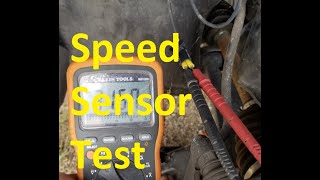
Disconnect the sensor and test its internal resistance with a multimeter. A typical passive sensor reads between 800 and 2,500 ohms. An infinite (OL) reading indicates an open circuit, while 0 ohms indicates a short. Next, set the multimeter to AC Volts. While spinning the wheel by hand (about one revolution per second), you must see a generated voltage of at least 100mV (0.1V) AC. No voltage indicates a failed sensor or a problem with the tone ring.
Tools: Multimeter, Vehicle-Specific Repair Manual, Jack and Jack Stands (Advanced) - Test Active Wheel Speed Sensor (2 or 3-wire)
Active (Hall-effect) sensors require power to operate. With the sensor connected and the ignition on, back-probe the connector. You must find a reference voltage (typically 5V or 12V) on one wire and a good ground (near 0V) on another. The third wire is the signal. This signal is a DC square wave that changes frequency with wheel speed and is best viewed with an oscilloscope.
Tools: Multimeter, Oscilloscope, Back-Probes, Repair Manual with Wiring Diagram (Advanced) - Test Brake Pressure Sensor Circuit
These are typically 3-wire sensors. With the key on, back-probe the connector to verify a 5V reference voltage and a good ground. The signal wire outputs a voltage proportional to hydraulic pressure, typically around 0.5V with no pressure applied, rising toward 4.5V under full pressure. A fault sets if the signal is below a minimum threshold (e.g., 0.3V) or above a maximum (e.g., 4.85V) for more than a few seconds.
Tools: Multimeter, Back-Probes, Repair Manual with Wiring Diagram (Advanced) - Perform a Circuit Integrity Test
If the sensor tests good, the fault is in the wiring. Check for continuity between the sensor connector and the ABS module connector. Set your multimeter to Ohms and check each wire; a good wire reads less than 1 ohm. A reading above 5 ohms is problematic. Check for a short to ground by testing for continuity between each wire and a known good chassis ground; the reading must be infinite (OL).
Tools: Multimeter, Vehicle-Specific Repair Manual with Wiring Diagrams (Advanced) - Check Brake Fluid
Ensure the brake fluid level is between the 'MIN' and 'MAX' lines in the reservoir. Low fluid triggers system warnings and indicates a potential leak that needs immediate attention.
Tools: None (Beginner) - Analyze Waveform with an Oscilloscope (Pro-Tip)
For intermittent issues, an oscilloscope is the definitive tool. Back-probe the sensor's signal wire at the ABS module. A good active (Hall-effect) sensor produces a clean square wave that increases in frequency with wheel speed. A good passive (inductive) sensor produces a sine wave. Look for signal dropouts, noise, or a malformed pattern, which indicates a failing sensor or a damaged tooth on the tone ring that a multimeter test misses.
Tools: Automotive Oscilloscope, Back-Probes (Professional)
When This Code Triggers (Freeze-Frame Conditions)
- Vehicle Speed: 15-50 mph (Steady driving. The fault logs when the ABS module compares the signals from all four wheel speed sensors and finds one that is erratic, missing, or doesn't match the others.)
- Brake Pedal Status: Off (During cruise. A wheel speed sensor signal that drops out during steady driving triggers the code.)
- RPM: 1200-2500 (Light to moderate engine load, not during heavy acceleration or deceleration.)
- System Voltage: 12.5-14.5V (Normal operating voltage. The code sets when the electrical system is stable, ruling out low voltage as the cause.)
Related Codes
- C1130 — On Nissan vehicles, this code for 'Engine Signal 1' frequently appears with C1134. To differentiate, always scan the Engine Control Module (ECM) first. If any engine-related codes are present, they are the root cause; fixing them clears both C1130 and C1134.
- C1288 — This is a specific code for a 'Brake Pressure Sensor Circuit Failure'. If you see this alongside C1134 (common on Ford/BMW), the problem is almost certainly the pressure sensor inside the ABS module. C1134 is the general alert, while C1288 confirms the specific component.
- U0121 — This code means 'Lost Communication With ABS Control Module'. C1134 indicates a sensor *reporting* a fault *to* the module. U0121 means the module itself is offline. If you see U0121, the problem is not a sensor but the module's power, ground, or an internal module failure. This is common on Honda models with a failed ABS modulator.
- C0035 to C0050 — These are generic codes for wheel speed sensor circuits (e.g., C0035 for Left Front, C0040 for Right Front). C1134 is a manufacturer-specific code for the same issue. If you see both, the C00XX code confirms the location. Use your scanner's live data to watch the wheel speeds to verify.
Climate & Environmental Factors
- Road Salt / Saline Environments: This is a primary accelerator of failures. Saltwater is highly corrosive to copper wiring, electrical connector pins, and steel ABS tone rings. It causes wiring to become brittle and break, and causes tone rings to rust, expand, and crack, leading to a lost signal.
- High Humidity / Water Exposure: Moisture ingress is a leading cause of failure for both the external sensors/connectors and the main ABS control module itself. Water shorts internal circuits and causes corrosion on the circuit board.
- Extreme Cold: In very cold temperatures, sensors temporarily provide inaccurate readings, triggering a fault light that disappears once the vehicle warms up. Wires and plastic connectors also become brittle and more susceptible to damage.
- Vibration and Heat: Constant vibration from road surfaces and heat from the engine and brakes contribute to the breakdown of internal sensor components and solder joints on the ABS module over the vehicle's lifetime.
How to Talk to a Mechanic About This Code
Say this: "I have an ABS and traction control light on, and my scanner shows code C1134. I'd like to book a diagnostic appointment. Can you please check the live data from all wheel speed sensors and inspect the related wiring and tone ring before recommending a part replacement?"
This signals to the shop that you've done your research and are requesting a specific diagnostic process, not just a blind part replacement. It focuses their attention on the most likely causes (sensor, wiring, tone ring) and prevents them from immediately upselling an expensive ABS module.
Avoid saying:
- 'My ABS light is on, can you fix it?' (This is too vague and invites a costly, broad diagnosis).
- 'Just replace the sensor the code points to.' (The sensor itself may not be the root cause).
- 'I have a C1134, just fix whatever is wrong.'
Questions to ask before authorizing the repair:
- What was the specific failure you found? Was it the sensor, the wiring, or the tone ring?
- Can you show me the live data from the faulty sensor compared to a good one?
- If the ABS module needs to be replaced, is rebuilding my original module an option to avoid programming costs?
- What is the warranty on the parts and labor for this repair?
Where to Take It: Dealer vs Independent vs Chain
- Dealer:
Recommended if a new ABS module requires programming or if the fault is a known, complex manufacturer-specific issue. Otherwise, a more expensive option.
Best for: Vehicles under warranty., Complex manufacturer-specific electrical issues., Repairs requiring module programming that independent shops cannot perform.
Downsides: Significantly higher labor rates and part costs., Defaults to expensive module replacement instead of repair or rebuild options. (Typical cost: +50% vs. baseline) - Independent Shop:
Best fit for most C1134 scenarios. A good independent shop easily handles sensor, wiring, and tone ring issues, which are the most common causes. They are also more likely to work with you on cost-saving measures like using a rebuilt ABS module.
Best for: Out-of-warranty vehicles where cost is a factor., Diagnosing common failures like wheel speed sensors, wiring, and tone rings., Shops with ASE-certified technicians and good reviews.
Downsides: Shop quality and diagnostic equipment vary greatly., Often lacks the expensive tools to program a new ABS module, sometimes requiring a second trip to the dealer. (Typical cost: +0% vs. baseline) - Chain Shop:
Acceptable for a straightforward wheel speed sensor replacement if the diagnosis is already certain. AVOID for initial diagnosis of the C1134 code, as they misdiagnose complex wiring or module issues.
Best for: Simple, clear-cut wheel speed sensor replacements.
Downsides: Technician skill varies dramatically; lacks the advanced diagnostic experience for intermittent or complex electrical faults., Quick to replace parts without a thorough diagnosis, leading to repeat repairs. (Typical cost: -10% vs. baseline)
When to Walk Away From the Repair
If the estimated repair cost exceeds 50% of your car's private-party value (using a source like Kelley Blue Book), sell or trade in the vehicle instead of repairing it.
- Car worth $4000, fix is $350: Fix it. A simple wheel speed sensor replacement is a minor cost relative to the car's value.
- Car worth $5000, fix is $2200: Borderline. This repair (e.g., a new ABS module) is nearly 50% of the car's value. Get a second opinion and explore using a rebuilt module before proceeding.
- Car worth $3000, fix is $2500: Walk away. The repair cost is not a sound investment. The money is better put toward a replacement vehicle.
What Scan Tool You Need for This Code

Minimum: A scanner that reads and clears 'C' (Chassis/ABS) codes and displays live data from the ABS module.
A basic $20 engine code reader cannot access the ABS module. It will not see the C1134 code or any related chassis codes, making it useless for this diagnosis. You need a tool that specifically queries the ABS system to see which sensor is faulting and watch its live data stream.
Budget: BlueDriver Pro (~$100) — Pairs with your smartphone and reads/clears ABS codes, views freeze-frame data, and graphs live data from all four wheel speed sensors to identify the faulty one.
Mid-range: Foxwell NT630 Plus / Innova 5610 (~$150-250) — These handheld units offer full ABS/SRS diagnostics, live data graphing, and crucial bi-directional controls. This allows you to perform an 'automated bleed' or 'ABS bleed' after replacing a module or hydraulic components, a function a basic scanner cannot do.
Professional: Autel MaxiCOM MK808Z / Launch CRP919E (~$450-700) — Provides full, professional-level diagnostics for all vehicle systems. Offers advanced bi-directional controls, component testing, and potential for module programming functions, which are essential for replacing and configuring a new ABS module.
Rent vs buy: Many auto parts stores (like AutoZone) scan your ABS codes for free. This is a great first step to get the code. However, to perform the repair yourself and clear the code afterward, you need to own a capable scanner. If you only plan one repair, a budget pick is sufficient. If you do regular maintenance, a mid-range tool is a great investment.
How to Clear the Code After You Fix It
- Use an OBD-II scan tool with ABS capabilities to clear the fault codes from the ABS module.
- Perform the specific drive cycle recommended by the manufacturer to allow the ABS module to self-test.
- If a new ABS module or steering angle sensor was installed, perform a calibration or programming procedure with a specialized scan tool.
Drive cycle (~15 minutes): After clearing the code, start the vehicle and drive it above 15-20 mph for several minutes. The ABS light turns off after its initial self-test if the repair was successful. The cycle involves straight-line driving and a few turns to allow the sensors to report plausible data.
Readiness monitors affected: This is a 'C' (Chassis) code and does not directly affect emissions-related readiness monitors like the Catalyst or O2 sensor monitors.
Watch out for:
- Using a basic code reader that cannot access or clear codes from the ABS module.
- The code returns immediately if the underlying mechanical or electrical fault is not properly fixed.
- Forgetting to perform a required steering angle sensor calibration after an alignment or sensor replacement, causing the light to stay on.
Will This Fail Emissions / State Inspection?
No — by itself this code doesn't fail OBD inspection (but it can keep readiness monitors from setting, which causes a separate fail).
- California: An illuminated ABS light will NOT cause a failure of the emissions-only Smog Check. However, it fails a separate, more comprehensive 'Brake and Lamp' or 'Vehicle Safety Systems' inspection required for salvage vehicles.
- New York: An illuminated ABS warning light IS grounds for failure of the annual safety inspection.
- Texas: An illuminated ABS warning light will NOT cause a failure of the annual safety inspection. The inspector checks the base brake system, but the ABS light itself is not a rejection criterion.
Most Commonly Affected Vehicles
- Ford Fusion, MKZ, C-Max (2013-2018) — Commonly points to brake pressure sensor or ABS module failure. TSB SSM 44504 notes that on 2013-14 Fusion/MKZ, wheel speed sensor codes are caused by corroded wires within 6 inches of the harness connector. A new module from a dealer costs over $1,000, while rebuild services are available for around $400.
- Chevrolet Silverado 4500HD, 5500HD, 6500HD (2019-2024) — Subject to a major safety recall (NHTSA ID: 22V709000, GM No: N222375270) for a defective brake pressure sensor assembly that leaks brake fluid into the switch's electrical components. This causes a short circuit and a fire hazard, even when the vehicle is parked and off. A separate 2020 recall (N202305070) addressed a software issue where the ABS light would not illuminate during a fault.
- Hyundai / Kia Sorento, Santa Fe, Sportage, Tucson, Veloster (2011-2021) — Commonly affected by failed wheel speed sensors or damaged sensor wiring. A replacement sensor with labor typically costs between $250 and $450. Cracked ABS tone rings are also observed, causing erratic ABS activation.
- Honda Civic, Accord, Pilot, CR-V (2008-2017) — Issues often stem from internal failure of the ABS/VSA modulator, frequently logging a 'Lost Communication with ABS' code (U0121) along with sensor faults. Rust buildup under a wheel speed sensor, altering the air gap, is also a known problem.
- Subaru Outback, Forester, Crosstrek (2014-2019) — Triggered by a steering angle sensor fault. It is critical to check wheel alignment and perform a steering angle sensor recalibration before replacing the sensor itself. A loose connector on the electronic parking brake module also causes general brake system warnings.
- Volkswagen Golf, Jetta (MK5/MK6), Passat (2006-2014) — Prone to faults from rusted and burst ABS tone rings on the rear wheel bearings, leading to 'implausible signal' codes. The ring is often part of the wheel bearing assembly.
- Nissan Qashqai, Murano, Rogue (2006-2015) — On these models, C1134 often appears with C1130 ('Engine Signal 1'). Always scan the engine computer first; an unrelated engine code (e.g., camshaft sensor) is often the root cause.
- Mercedes-Benz ML-Class (W163), C-Class (W203) (1999-2007) — Prone to faults with the lateral acceleration sensor or yaw rate sensor, which triggers this code family and causes random ESP/BAS activation, especially during turns. The sensor reads approximately 2.5V when stationary on level ground.
- BMW 3 Series (E46), X3 (E83) (2002-2008) — These vehicles often use the ATE MK60 ABS unit, which is known for internal brake pressure sensor failures, requiring the module to be rebuilt or replaced.
Manufacturer-Specific Notes

- Nissan: The C1134 code is often a secondary fault. The true cause is frequently another engine code (like a camshaft sensor fault) that stops the engine computer from sending required data to the ABS module.
- Ford: On hybrid models like the C-Max and Fusion, this code indicates a failure of the ABS module itself or the integrated brake pressure sensor. Per TSB SSM 44504, on Fusion/MKZ models, look for corroded wheel speed sensor wires in the harness about 1-3 inches from the connector.
- Dodge/Chrysler: For these brands, C1134 has a completely different meaning: 'Gear Shift Position Short to Ground'. This relates to the transmission shifter assembly, not the brake system.
- Toyota: On many hybrid models (Camry, Highlander, Prius), a 'Braking Power Low' warning is common and is caused by a failing brake booster or the ABS actuator/module assembly, which is an expensive, integrated unit.
- Honda: A faulty ABS/VSA modulator is a very common failure on 2008-2017 models. It typically sets a U0121 'Lost Communication' code and triggers various wheel speed sensor codes simultaneously.
Real Owner Stories
2014 Ford Fusion at 110K miles - ABS Module Failure
ABS, traction control, and hill start assist warning lights came on intermittently, especially after sharp turns. No other noticeable driving issues initially.
What they tried:
- Initially suspected a wheel speed sensor based on online forums.
- A mechanic scanned the car and found code C1288 for brake pressure sensor failure along with C1134.
- The pressure sensor is internal to the ABS module on this model.
Outcome: Owner opted to have the original ABS module removed and sent to a rebuild service for approximately $400. After re-installation, the codes were cleared and did not return. This avoided the ~$1,000+ cost of a new dealer-supplied module and programming.
Lesson: On many Fords, C1134 paired with C1288 points directly to an internal ABS module fault. Rebuilding the original module is often the most cost-effective solution and avoids expensive VIN programming.
2012 Nissan Qashqai at 85K miles - Secondary Fault Code
ABS and traction control lights were on. Scan tool showed C1134 (Vehicle Speed Sensor) and C1130 (Engine Signal 1).
What they tried:
- Mechanic initially focused on the ABS system, inspecting wheel speed sensors.
- A more experienced technician scanned the Engine Control Module (ECM) and found a separate code for a faulty camshaft position sensor.
- Replaced the camshaft position sensor and cleared all codes.
Outcome: Replacing the engine's camshaft sensor resolved the engine code, which in turn cleared the C1130 and C1134 codes in the ABS module. The ABS system was never faulty.
Lesson: On Nissans, C1134 is often a 'ghost' code caused by a problem in the engine management system. Always scan the ECM for 'P' codes first before attempting any ABS repairs.
2009 Chevy Silverado at 150K miles - Wiring Harness Damage
ABS light came on. A scan revealed a code for the right front wheel speed sensor circuit.
What they tried:
- The owner first replaced the right front wheel speed sensor, but the code returned immediately.
- Next, they replaced the entire wheel hub assembly (which included a new sensor and tone ring), but the light stayed on.
- Finally, they carefully inspected the wiring harness leading from the sensor up into the engine bay.
Outcome: The owner discovered a break in the wire about a foot away from the connector, where it had been rubbing against a suspension component. They repaired the broken wire using a weatherproof butt connector and heat shrink tubing. This fixed the problem permanently.
Lesson: Don't assume the sensor is bad just because the code points to it. Always perform a circuit integrity test by inspecting the wiring harness for damage, especially if replacing the sensor doesn't solve the issue.
How to Prevent This Code From Triggering
- Perform a brake fluid flush every 2-3 years or 30,000 miles. (Every 2-3 years) — Brake fluid is hygroscopic, meaning it absorbs moisture over time. This moisture corrodes the sensitive internal valves and electronic components of the ABS control module from the inside out, leading to expensive failure.
- Apply dielectric grease to sensor connectors. (During any brake or wheel service) — In salt-belt regions, applying a non-conductive dielectric grease to the pins of wheel speed sensor connectors helps seal out moisture and salt, preventing the corrosion that causes most circuit-related failures.
- Regularly wash the vehicle's undercarriage. (Monthly, especially in winter) — Washing away road salt, dirt, and debris prevents corrosive buildup on exposed ABS sensors, tone rings, and wiring harnesses, extending their service life.
- Inspect wiring harnesses during tire rotations. (Every 5,000-7,500 miles) — A quick visual inspection of the wheel speed sensor wires for rubbing, stretching, or damage catches potential issues before a wire breaks and triggers a fault. Ensure the wiring is secured in its factory clips.
Frequently Asked Questions
Why does C1134 have so many different meanings?
While 'P' (Powertrain) codes are standardized, 'C' (Chassis) codes are not strictly defined by SAE/ISO standards. Manufacturers use them for their specific systems, leading to different definitions for the same code number.
What are common misdiagnosis mistakes with C1134?
A frequent mistake is replacing parts without a full diagnosis, like swapping a wheel speed sensor when the real issue is rust buildup under the mount. On Nissans, mechanics often try to fix the ABS system when the root cause is an unrelated engine fault. Always verify the specific sensor using live data before replacing parts.
Is it safe to drive with the ABS and Traction Control lights on?
Your normal hydraulic brakes still work, but you lack anti-lock braking or stability control assistance. You must drive carefully, leave extra following distance, and avoid hard braking. Your wheels will lock up and skid during an emergency stop.
What happens if I keep driving with a bad ABS module?
Continuing to drive with a bad ABS module is risky. Aside from lacking safety features, the loss of wheel speed data causes harsh shifting on some vehicles. This damages the transmission over time.
Can a bad wheel alignment cause the ABS light to come on?
Yes. Severe misalignment causes the steering angle sensor to report data conflicting with the wheel speed sensors, making the system think the car is skidding. This triggers the ABS and traction control lights, requiring a sensor recalibration after the alignment.
Can I pass a state inspection with the ABS light on?
This depends on your local regulations. In states like New York, an illuminated ABS warning light is an automatic failure for a safety inspection. In others like Texas, it passes.
My ABS light came on right after a brake job or hitting a pothole. What happened?
The wheel speed sensor or its wiring was likely damaged, disconnected, or stressed during the repair. Hitting a severe pothole damages the fragile sensor, severs wiring, or cracks the ABS tone ring.
Could a weak car battery cause this code?
Yes. The ABS module and its sensors are highly sensitive to voltage drops. A weak battery causes communication errors between modules, triggering random electronic faults like C1134.
Can I just clear the code to turn the light off?
You can clear the code with a scanner, but it returns immediately when the control module runs its self-test and detects the hard fault. Clearing the code does not fix the underlying problem.
Do I need a special mechanic to fix a C1134 code?
Diagnosing this code requires a scan tool that reads ABS-specific live data. While replacing a wheel speed sensor is DIY-friendly, replacing an ABS module requires special brake bleeding and system programming. Stop DIYing and visit a shop if the repair requires opening hydraulic brake lines or module programming.
Key Takeaways
- Code C1134 disables your anti-lock braking (ABS) and electronic stability control (ESC) systems, increasing your risk of skidding.
- Because C1134 definitions vary by manufacturer, you must use an OBD-II scanner with ABS capabilities to pinpoint the exact failing sensor.
- Over 80% of C1134 codes stem from a failed wheel speed sensor, corroded wiring harness, or a cracked ABS tone ring.
- You can drive with a C1134 code, but your wheels will lock up during emergency braking, requiring double the normal stopping distance on wet roads.
Helpful Videos

The information in this article is provided for general reference and educational purposes only. Vehicle specifications, procedures, and part compatibility can vary by production date, trim level, and region. Always consult your vehicle's factory service manual and verify part numbers before purchasing or performing repairs. Safety-critical components such as airbags, seat belts, and braking systems should be installed by a qualified professional.
- 🎬 Helpful Videos
- What Does C1134 Mean?
- Can I Drive With C1134?
- Common Causes
- Symptoms
- Diagnostic Flowchart
- Common Fixes & Costs
- DIY vs Professional
- Used vs. New Parts: Buying Guide
- What Happens If You Wait — Timeline
- Cost of Not Fixing It
- Diagnosis Steps
- When This Code Triggers (Freeze-Frame Conditions)
- Related Codes
- Climate & Environmental Factors
- How to Talk to a Mechanic About This Code
- Where to Take It: Dealer vs Independent vs Chain
- When to Walk Away From the Repair
- What Scan Tool You Need for This Code
- How to Clear the Code After You Fix It
- Will This Fail Emissions / State Inspection?
- Most Commonly Affected Vehicles
- Manufacturer-Specific Notes
- Real Owner Stories
- 2014 Ford Fusion at 110K miles - ABS Module Failure
- 2012 Nissan Qashqai at 85K miles - Secondary Fault Code
- 2009 Chevy Silverado at 150K miles - Wiring Harness Damage
- How to Prevent This Code From Triggering
- Frequently Asked Questions
- Why does C1134 have so many different meanings?
- What are common misdiagnosis mistakes with C1134?
- Is it safe to drive with the ABS and Traction Control lights on?
- What happens if I keep driving with a bad ABS module?
- Can a bad wheel alignment cause the ABS light to come on?
- Can I pass a state inspection with the ABS light on?
- My ABS light came on right after a brake job or hitting a pothole. What happened?
- Could a weak car battery cause this code?
- Can I just clear the code to turn the light off?
- Do I need a special mechanic to fix a C1134 code?
- Key Takeaways
- 🎟️ Get 5% Off