

OBD-II Code C1130: Engine Signal Fault
The Ultimate 2026 Guide to What C1130 Means, Why It Triggers, and How to Fix It for Good
- Treat C1130 as a symptom code; in 90% of cases, the root cause is a primary engine fault like a failing camshaft sensor.
- Perform a full-system OBD-II scan immediately to locate the hidden 'P' (Powertrain) code triggering the ABS module's C1130 error.
- Resolve any accompanying engine codes (like P0340 or P0335) first, which automatically clears the C1130 code upon a system reset.
- Never replace the $1,000+ ABS module unless you own a 2008-2016 VW/Audi with a solo '01130' code, which indicates a known internal ATE Mk60 pump failure.
- Limit driving to under 10 miles to reach a repair shop, as your vehicle's ABS and traction control systems are completely disabled.
What Does C1130 Mean?

Code C1130 indicates the Anti-lock Brake System (ABS) module lost communication or received invalid data from the Engine Control Module (ECM). The ABS module requires critical engine data—such as RPM, throttle position, and torque—to operate safety systems correctly. When this data is missing or corrupted, the ABS module logs C1130 and disables traction control, stability control, and automatic emergency braking.
Technical definition: SAE/ISO defines C1130 as 'Engine Signal 1' or 'Engine Signal Missing'. It is a Chassis ('C') code stored in the ABS control unit, indicating an expected data signal from the ECM over the Controller Area Network (CAN) bus is missing or implausible. It signifies a communication breakdown or data integrity issue, not necessarily a hardware fault within the ABS itself.
Can I Drive With C1130?
Yes, But With Caution. You can drive short distances to a repair shop, but exercise extreme caution. Disabled Anti-lock Braking (ABS) and Traction Control (TCS/ESC) increase the risk of wheel lock-up and skidding during hard braking, significantly extending stopping distances in wet or icy conditions. Driving with this code will not cause immediate mechanical damage, but the compromised safety systems dramatically increase accident risk and guarantee a failed safety inspection.
Common Causes

- A Separate Engine-Related Fault Code is Present (Very Common) — C1130 is almost always a 'companion code'. The true fault is an engine issue reported by a 'P' code. Problems with sensors prevent the ECM from sending valid data to the ABS module. Manufacturer Technical Service Bulletins (TSBs) mandate fixing any 'P' codes first, which automatically resolves the C1130 code.
- Faulty Crankshaft or Camshaft Position Sensor (Common) — These sensors provide essential engine speed (RPM) and position data. If one fails, the ECM cannot generate the signal the ABS module needs. This is the most frequent underlying cause on Nissan and Infiniti vehicles, often accompanied by codes P0335 or P0340. 🎬 Watch: A quick guide to fixing C1130 on Nissan vehicles.
- Blocked or Faulty DPF Pressure Pipe (Diesel Models) (Common) — On specific diesel vehicles, notably the Nissan Qashqai 1.5dCi, a carbon-clogged metal pipe for the Diesel Particulate Filter (DPF) pressure sensor prevents the ECM from sending correct engine load signals, triggering C1130 and C1132 simultaneously. 🎬 See how to clear a blocked DPF pipe on diesel models.
- Wiring or Connector Issues in the CAN Bus (Common) — Damaged, corroded, or loose wires between the ECM and ABS module interrupt the signal. Poor ground connections for the engine or transmission create electrical noise and intermittent communication glitches.
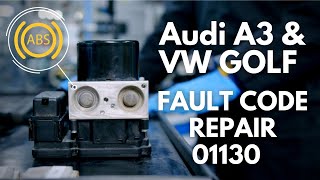
- Failing ABS Control Module (Less Common) — The ABS module fails internally, making it unable to process incoming ECM signals. This is a notoriously common failure on 2008-2016 Volkswagen and Audi models (presenting as VAG code 01130) involving the ATE Mk60/Mk61 module. 🎬 Watch: Diagnosing the 01130 code on Audi and VW models.
- Faulty Mass Airflow (MAF) Sensor (Uncommon) — A failing MAF sensor provides incorrect airflow data to the ECM, triggering a P0101 code. This invalid data corrupts the engine load signals sent to the ABS module, causing a secondary C1130 fault.
- Low Battery Voltage or Charging System Fault (Uncommon) — A weak battery or failing alternator causes unstable voltage across the vehicle, leading to random communication glitches between modules on the CAN network.
- Faulty Powertrain Control Module (ECM) (Rare) — The main engine computer fails and no longer sends necessary signals to other modules. This is accompanied by multiple communication codes ('U' codes) and severe engine performance problems.
Symptoms

- ABS Warning Light On — The primary symptom indicating a fault detected within the anti-lock braking system.
- Traction Control/Stability Control Light On — Often labeled 'TCS', 'VDC', 'ESP', or a sliding car icon. The system disables itself as a safety precaution due to missing engine data.
- Check Engine Light On — Illuminates simultaneously, providing a strong clue that the C1130 code is a symptom of an underlying engine problem ('P' code).
- Engine Performance Issues — Depending on the root cause (e.g., a bad cam sensor), you experience stalling, rough idling, hesitation, loss of power, or 'limp mode'.
- Erratic Shifting or Stalling When Put In Gear — Particularly on Infiniti models, the vehicle stalls or exhibits erratic RPM behavior when shifted into Drive or Reverse because the engine sensor fault confuses the Transmission Control Module (TCM).
Diagnostic Flowchart
Tap your situation to follow the diagnostic path that matches what you're seeing on this code.
Common Fixes & Costs
- Replace Crankshaft or Camshaft Position Sensor
— Parts: $50-$150, Labor: $100-$200, ~1.0 hr book time
(DIY)
Nissan Altima (2013-2018, 3.5L VQ35DE): OEM 23731-JA10C (Alt: {'Duralast': 'SU12940', 'Hitachi': 'CPS0006'})
Infiniti G37 (2008-2013, VQ37VHR): OEM 23731-EY00B (Alt: {'Denso': '196-4008', 'Hitachi': 'CPS0202'}) - Clean or Replace DPF Pressure Sensor Pipe — Parts: $35-$50, Labor: $120-$200, ~1.5 hr book time (Intermediate)
- Repair or Replace Damaged Wiring/Ground Strap — Parts: $10-$50, Labor: $150-$400, ~2.0 hr book time (Intermediate)
- Repair ABS Control Module (e.g., VW/Audi)
— Parts: $150-$350, Labor: $150-$300, ~2.5 hr book time
(Professional)
Volkswagen Jetta/Golf, Audi A3 (ATE Mk60/Mk61): OEM N/A (Repair Service) - Replace ABS Control Module
— Parts: $800-$2,500, Labor: $200-$500, ~3.0 hr book time
(Professional)
Volkswagen Jetta (2011-2014): OEM 1K0-907-379-BE
DIY vs Professional
- Replace Crankshaft or Camshaft Position Sensor — Beginner: Yes, on many vehicles.
Tools: Basic socket set, ratchet, flashlight. Possibly a long extension or swivel socket. - Repair or Replace Damaged Wiring/Ground Strap — Beginner: Maybe. Repairing a visible, accessible wire is possible with a good kit.
Tools: Multimeter, wire cutters/strippers, soldering iron or quality crimp connectors, heat shrink tubing. - Clean or Replace DPF Pressure Sensor Pipe — Beginner: Yes, if the pipe is reasonably accessible.
Tools: Socket set, wrenches, brake cleaner, a long flexible wire. - Repair or Replace ABS Control Module — Beginner: No.
Tools: Professional scan tool for coding/bleeding, socket set, flare nut wrenches, brake fluid.
Used vs. New Parts: Buying Guide
When a used part is worth it: Buy a new OEM or premium aftermarket sensor. Given the low cost ($50-$150) and critical function of camshaft/crankshaft sensors, installing a used part risks immediate repeat failure.
Donor-vehicle mileage cap: roughly under 60000 miles for the part to have meaningful remaining life.
Donor quality checklist:
- Verify the donor vehicle's mileage and reason for being salvaged.
- Avoid parts from vehicles with fire or flood damage.
- Match the part number exactly; visual similarities do not guarantee compatibility.
Decision logic:
- If The part is difficult to access (high labor cost for replacement) → Buy a new OEM or top-tier OE aftermarket part to minimize the risk of repeat failure.
- If The vehicle is old and budget is the primary concern → A used OEM sensor is preferable to a new, unbranded, low-quality aftermarket sensor.
- If The price difference between a new reputable aftermarket and a used part is less than $50 → Buy new for the warranty and peace of mind.
Warranty tradeoff: Used parts typically offer a 30-90 day warranty for the part only. New aftermarket parts range from 1-year to limited lifetime warranties. New OEM parts usually carry a 12-month/12,000-mile warranty.
Worst-case if a used part fails: $200-$400 if a used or cheap aftermarket sensor fails shortly after installation, requiring repeat labor costs.
What Happens If You Wait — Timeline
- 0-2 weeks: ABS/TCS lights come on. C1130 is logged alongside a P-code. Engine has a slightly rough idle. Safety systems are disabled. (MPG impact: 0-5%% · Added cost: $0)
- 2 weeks - 3 months: Engine symptoms worsen. Noticeable drop in fuel economy, stalling when coming to a stop, and hard starting become frequent as the root-cause sensor degrades. (MPG impact: 5-15%% · Added cost: $50-$150 in wasted fuel.)
- 3-6 months: Persistent misfires dump unburnt fuel into the exhaust. The catalytic converter overheats, leading to internal substrate damage. (MPG impact: 15-25%% · Added cost: $1,200-$2,500 (cost to replace a damaged catalytic converter).)
- 6+ months: Catastrophic failure. The catalytic converter melts internally, causing severe exhaust backpressure that prevents the engine from starting. The vehicle is undrivable. (MPG impact: 25%+% · Added cost: $2,000-$4,000+ (catalytic converter, O2 sensors, and potential exhaust manifold damage).)
Cost of Not Fixing It
- 0-1 month: Inefficient engine operation from a failing sensor causes a 5-15% drop in fuel economy. Disabled ABS/TCS drastically increases accident risk. (Added cost: $20-$60 per month in extra fuel costs.)
- 1-6 months: Persistent misfires dump unburnt fuel into the exhaust, overheating and destroying the catalytic converter. Unexpected stalling creates a severe safety hazard. (Added cost: $1200-$3500 to replace a damaged catalytic converter.)
- 6+ months: The catalytic converter melts internally, causing severe exhaust backpressure that prevents the engine from starting. The vehicle fails all state inspections and requires thousands in repairs. (Added cost: Up to $4000+, including potential damage to oxygen sensors and exhaust manifolds.)
Diagnosis Steps

- Perform a Full System Diagnostic Scan
Use an advanced OBD-II scanner capable of reading codes from ALL vehicle modules. Do not just check for engine codes. The C1130 is in the ABS module, but the cause is likely a 'P' code (e.g., P0335, P0340, P0101) in the engine module. Always diagnose and fix any 'P' codes first.
Tools: Advanced OBD-II Scanner (Beginner) - Diagnose the Primary Engine Code
If other codes were found in Step 1, follow the specific diagnostic procedure for that code. For example, if you have a P0340 (Camshaft Sensor Fault), test the sensor's voltage and signal circuit. Fixing this root cause automatically resolves the C1130 code.
Tools: Multimeter, Vehicle-Specific Repair Manual (Intermediate) - Check Battery Health and Fuses
Ensure the battery is fully charged (12.4V+ with engine off) and the alternator is charging correctly (13.7V-14.7V with engine on). Low voltage causes widespread communication errors. Visually inspect and test all fuses related to the ABS and ECM systems.
Tools: Multimeter, Socket Set/Wrench (Beginner) - Inspect Wiring, Connectors, and Grounds
Visually inspect the wiring harnesses for the ECM and ABS module. Look for chafed, burnt, or corroded wires. Unplug the connectors and check for corrosion or bent pins. Locate and inspect the main engine-to-chassis and transmission-to-chassis ground straps for tightness and corrosion.
Tools: Flashlight, Inspection Mirror (Intermediate) - Pro Tip: Clean the DPF Pressure Pipe (Diesel Only)
For Nissan 1.5dCi engines showing C1130/C1132, the primary suspect is the metal pipe leading to the DPF pressure sensor. Remove the pipe and thoroughly clean the carbon buildup from inside using a piece of wire and brake cleaner until air passes through freely.
Tools: Socket Set, Wire, Brake Cleaner (Intermediate) - Advanced: Test Sensor Voltage and Power
For a suspected bad crankshaft/camshaft sensor, test the sensor connector with the key on. One pin requires battery voltage, another requires a 5V reference from the ECM, and the third requires a solid ground. Missing voltage points to a wiring or ECM issue, not the sensor.
Tools: Multimeter, Vehicle Wiring Diagram (Advanced) - Advanced: Test CAN Bus with a Multimeter
If no other codes are present, test the CAN network directly. With the battery disconnected, check for resistance between the CAN-High and CAN-Low pins (pins 6 and 14 at the OBD-II port); it reads ~60 ohms on a healthy network. With the key on, measure approximately 2.5-3.0V on CAN-High and 2.0-2.5V on CAN-Low relative to ground.
Tools: Multimeter, Wiring Diagram (Advanced) - Advanced: Analyze CAN Bus with an Oscilloscope
Connect to the CAN High and Low lines. A healthy signal shows a clean, mirrored square wave pattern. Distorted or noisy waveforms indicate a physical layer problem like a failing module creating interference or compromised wiring. Unplug modules one by one to identify which component corrupts the signal.
Tools: Oscilloscope, Wiring Diagram (Advanced) - Test Control Modules
If all wiring, grounds, and sensors check out, suspect a faulty control module (ABS or ECM). On VW/Audi vehicles with code 01130, this step becomes the highest priority due to the known ATE Mk60 ABS module failure rate.
Tools: Advanced Scan Tool, Vehicle-Specific Repair Manual (Professional)
When This Code Triggers (Freeze-Frame Conditions)
- Engine Coolant Temp: 175-205°F (80-96°C) (The fault is typically logged when the engine is fully warmed up and operating in closed-loop mode.)
- Engine RPM: 750-3000 RPM (The code sets during idle or steady driving as the ABS module continuously monitors for a valid engine signal.)
- Vehicle Speed: 15-65 mph (25-105 kph) (Triggered during normal city or highway driving when the underlying engine sensor provides erratic data.)
- Battery Voltage: 12.5-14.8V (Requires the ignition in the 'RUN' position with normal system voltage; low voltage triggers separate 'U' network codes.)
Related Codes
- P0335 / P0340 — The most common cause-and-effect pair. P0335 (Crankshaft Sensor) and P0340 (Camshaft Sensor) are the CAUSE. C1130 is the EFFECT, stored because the ABS module cannot get RPM data from the faulty sensor. Fix the 'P' code first.
- U1000 / U0100 — C1130 indicates a specific missing ECM signal. U1000 or U0100 indicates a broader network failure. If both are present, suspect a systemic issue like a bad ground or a failed module dragging the network down.
- C1132 — Often appears with C1130 on Nissan diesel models. This pair points strongly toward a fault in the DPF pressure monitoring system, such as a blocked pipe.
- P0101 — A faulty Mass Airflow (MAF) sensor sends bad data to the ECM. The ECM then fails to provide a valid engine load signal to the ABS module, resulting in a secondary C1130 code.
Climate & Environmental Factors
- High Humidity and Salty Air (Coastal/Winter Climates): Accelerates corrosion on wiring connectors, ground points, and the ABS module. Saltwater penetrates seals and degrades copper wires, causing complete communication loss.
- Extreme Cold / Freeze-Thaw Cycles: Moisture seeps into connectors or cracked wire insulation and freezes, breaking the electrical connection. This causes temporary ABS faults on cold starts that disappear as the engine bay warms up.
- Snow and Ice Buildup: Packed snow and ice obstruct wheel speed sensors and pack moisture into wiring harnesses, accelerating the corrosion that triggers CAN bus communication errors.
How to Talk to a Mechanic About This Code
Say this: "My ABS and traction control lights are on, and I pulled a C1130 code. Please perform a full-system scan to check for underlying engine 'P' codes, as C1130 is usually a secondary communication fault."
This signals you've done your research and directs the technician to the correct first step, preventing them from immediately and incorrectly focusing on the expensive ABS module.
Avoid saying:
- 'My ABS light is on, I think I need a new ABS module.'
- 'Just fix whatever's wrong with the brakes.'
- 'My traction control isn't working.'
Questions to ask before authorizing the repair:
- What other fault codes did you find in the engine computer (ECM) or other modules?
- If you found a 'P' code, are you confident that fixing it will resolve the C1130 code?
- If C1130 was the only code, what were the results of the CAN bus network health check?
- For a VW/Audi with code 01130, have you ruled out the common ABS module failure?
- Can you provide a printout or photo of the codes you found across all modules?
Where to Take It: Dealer vs Independent vs Chain
- Dealer:
A safe but expensive choice. Recommended for VW/Audi with a solo 01130 code or for any vehicle still under warranty.
Best for: Vehicles still under warranty., Complex, manufacturer-specific issues like the VW/Audi 01130 ABS module failure., When a previous shop has failed to diagnose the problem.
Downsides: Highest labor rates, typically 1.5-2x more than an independent shop., May recommend expensive module replacement when a repair or cleaning would suffice. (Typical cost: +50% vs. baseline) - Independent Shop:
Best fit for most C1130 scenarios, especially on Nissan/Infiniti. A qualified independent shop easily traces the fault to the engine sensor or wiring, saving you 30-50% compared to the dealer.
Best for: Out-of-warranty vehicles where the cause is likely a standard engine sensor., Diagnosing the root cause 'P' code and performing the associated repair., Customers who are cost-sensitive but want quality diagnostics.
Downsides: Shop quality and diagnostic tool capabilities vary widely. Vet the shop by checking for ASE certifications. (Typical cost: +0% vs. baseline) - Chain Shop:
AVOID for C1130 diagnosis. This code requires comprehensive diagnostic skill, not just simple code reading.
Best for: Simple, unrelated maintenance like oil changes or tire rotations.
Downsides: Technicians using basic scanners will misdiagnose the issue and push an unnecessary $1,500+ ABS module replacement., High pressure to upsell parts and services. (Typical cost: -10% vs. baseline)
When to Walk Away From the Repair
Sell or trade the vehicle if the estimated repair cost exceeds 50% of its private-party value.
- Car worth $3000, fix is $2200: Walk away. The repair cost is over 70% of the car's value. Sell as a 'mechanic special' or scrap it.
- Car worth $15000, fix is $350: Fix it. A common camshaft sensor replacement is a minor cost relative to the car's value.
- Car worth $5000, fix is $2500: Borderline. This is exactly at the 50% threshold. Get a second opinion before authorizing. If the rest of the car is in excellent condition, it might be worth it.
What Scan Tool You Need for This Code
Minimum: Requires a scanner capable of reading codes from ALL vehicle systems (Engine, ABS, SRS). A basic $20 engine-only reader misses the C1130 code entirely.
A cheap reader only checks the engine and misses the C1130 code in the ABS module. Conversely, a simple ABS reader sees the C1130 but misses the root-cause 'P' code in the engine module. You need to see the whole picture.
Budget: Autel AP200 (~$65) — A Bluetooth dongle that pairs with your smartphone. It provides a full system scan for one vehicle make for free, allowing you to see codes in both the ABS and Engine modules simultaneously.
Mid-range: Foxwell NT510 Elite (~$180) — A handheld scanner offering all-system diagnostics plus manufacturer-specific functions. It shows live data from engine sensors, crucial for confirming if a sensor is failing.
Professional: Autel MaxiCOM MK808S (~$450) — A professional-level tablet scanner providing full system diagnostics, extensive live data graphing, and bidirectional controls to test components directly.
Rent vs buy: AutoZone's Loan-A-Tool program often includes scanners capable of reading both engine and ABS codes. For a one-time fix, this is the most cost-effective option.
How to Clear the Code After You Fix It
- Fix the primary engine ('P') code or communication fault first.
- Use a compatible OBD-II scan tool to clear codes from ALL modules (ABS, ECM).
- Perform a complete drive cycle to allow readiness monitors to run.
Drive cycle (~20 minutes): A generic drive cycle includes: 1) A cold start (engine off overnight). 2) Idle for 2-3 minutes. 3) 10 minutes of mixed city driving (stops, starts, varied speeds). 4) 5-10 minutes of steady highway speed driving (55-65 mph). 5) Allow the vehicle to cool down. Check monitor status with a scan tool.
Readiness monitors affected: Catalyst (CAT), Evaporative System (EVAP), Oxygen (O2) Sensor, O2 Sensor Heater
Before emissions retest: drive at least 50 miles to fully set monitors.
Watch out for:
- Clearing only the C1130 code without fixing the underlying engine fault causes the code to return immediately.
- Disconnecting the battery clears the code but resets all readiness monitors, requiring a full drive cycle before an emissions test.
- Driving only on the highway fails to set the EVAP monitor, which requires specific stop-and-go criteria.
Will This Fail Emissions / State Inspection?
Yes — this code typically fails an OBD-II emissions inspection.
- California: An illuminated Check Engine Light is an automatic smog check failure. All required readiness monitors must be set to 'Ready' to pass.
- New York: An illuminated Check Engine Light causes the vehicle to fail the emissions portion of the inspection. Recent legislation also makes an illuminated ABS light a cause for safety inspection failure.
- Texas: In the 17 counties requiring emissions testing, an illuminated Check Engine Light or 'Not Ready' monitors result in an automatic failure.
Most Commonly Affected Vehicles
- Nissan Altima (2012-2017) — Specifically listed in Nissan TSB NTB16-116. The bulletin stresses diagnosing engine 'P' codes before addressing C1130.
- Nissan Rogue (2012-2017) — Included in TSB NTB16-116. Often related to underlying camshaft or crankshaft sensor faults.
- Nissan Qashqai (2010-2016) — Very common issue. On 1.5L diesel (dCi) models, it is frequently caused by a blocked DPF pressure sensor pipe, which also triggers code C1132.
- Infiniti G37 / Q40 / Q60 (2008-2015) — Frequently triggered by failing camshaft position sensors (P0340/P0345). Covered under Infiniti TSB ITB16-047, which advises fixing engine codes first.
- Nissan Maxima (2012-2017) — Listed in Nissan's TSB NTB16-116. The diagnostic priority is always to resolve any stored engine fault codes first.
- Volkswagen Jetta, Golf, GTI (2008-2016) — Displays as VAG code '01130 - ABS Operation Implausible Signal'. This is a hallmark symptom of an internal failure of the ATE Mk60/Mk61 ABS pump and module. Repair services are highly recommended over replacement.
- Audi A3 (2006-2013) — Shares the same '01130' fault code and common ATE Mk60/Mk61 ABS module failure as its Volkswagen counterparts.
Manufacturer-Specific Notes
- Nissan/Infiniti: Nissan TSB NTB16-116 and Infiniti ITB16-047 explicitly state technicians MUST diagnose and repair any engine-related 'P' codes before performing any diagnosis on the C1130 code itself.
- Volkswagen/Audi: The code appears as '01130' and is defined as 'ABS Operation Implausible Signal'. When it appears alone, it is almost always caused by an internal failure of the ATE Mk60 or Mk61 ABS pump/module assembly. Repairing the module is the standard fix.
- Nissan (Diesel): For 1.5dCi diesel engines, the combination of C1130 and C1132 almost always points to a carbon-clogged DPF pressure sensor pipe. The fix is cleaning the pipe, not replacing the sensor.
- General: Inexperienced technicians using basic scanners that only read the ABS module mistakenly replace the expensive ABS unit. The professional approach requires a full system scan to find the root cause in the engine controller.
Real Owner Stories
2013 Infiniti G37 at 114K miles
The engine went into limp mode (won't rev above 3500 RPMs) and shifted hard. ABS, Slip, and Check Engine lights were on, with codes C1130, P0340, and P0603.
What they tried:
- Cleaned MAF sensors and throttle bodies.
- Performed throttle relearn procedure and reset ECU.
- Charged the battery.
Outcome: The primary cause was identified as the Camshaft Position Sensor (Bank 1) indicated by code P0340. Replacing the faulty camshaft sensor resolved the P0340 code, which in turn cleared the C1130 code after a reset.
Lesson: On Nissan/Infiniti vehicles, C1130 is almost always a secondary code caused by a primary engine sensor fault like P0340. Always diagnose the 'P' code first to avoid unnecessary ABS system diagnosis.
2011 Nissan Qashqai 1.5dCi
ESP/Traction Control and ESP OFF warning lights appeared on the dashboard. No noticeable driving symptoms initially.
What they tried:
- A diagnostic scan revealed codes C1130 (Engine Signal 1) and C1132 (Engine Signal 2).
Outcome: The issue was traced to a blocked metal pipe for the Diesel Particulate Filter (DPF) pressure sensor. Cleaning the carbon-clogged pipe thoroughly and clearing the codes resolved both C1130 and C1132. The repair cost was approximately £120 at a shop.
Lesson: On Nissan 1.5dCi diesel engines, the combination of C1130 and C1132 is a very strong indicator of a blocked DPF pressure sensor pipe. This inexpensive fix should be the first suspect.
2010 Volkswagen Golf with 85K miles
The ABS and ESP/Traction Control warning lights stayed on. A diagnostic scan showed a single fault code: 01130 - ABS Operation Implausible Signal.
What they tried:
- Checked all related fuses near the battery.
- Inspected wiring to the ABS module, finding no visible damage.
Outcome: The 01130 code on VW/Audi vehicles is a classic sign of internal ABS control module failure. Instead of a $2,000+ dealer replacement, the owner sent the module to a specialist repair service for $250. After reinstallation, the code cleared permanently.
Lesson: If you have a VW or Audi with only the 01130 code, the ABS module itself is the most likely culprit. A mail-in repair service is a highly cost-effective and reliable solution.
2014 Nissan 370Z with stalling issues
While braking to a stop, the engine almost stalled. A scan revealed only code C1130. The owner suspected a crankshaft sensor issue but had already replaced the camshaft sensors.
What they tried:
- Replaced both camshaft position sensors with OEM parts, but the C1130 code returned.
- Considered replacing the crankshaft position sensor next.
Outcome: A faulty Mass Airflow (MAF) sensor (throwing a P0101 code) was the true cause. The bad MAF data corrupted the engine signal sent to the ABS module, triggering C1130.
Lesson: Even if symptoms scream 'crank sensor,' always perform a full system scan. A seemingly unrelated code like P0101 (MAF Sensor) can be the root cause, as the ABS module relies on accurate engine load data.
How to Prevent This Code From Triggering
- Perform regular engine sensor cleaning (Every 30,000 miles) — Magnetic sensors accumulate metallic debris and oil grime, weakening their signal. Cleaning with electrical contact cleaner maintains signal integrity.
- Protect and inspect wiring harnesses (During every oil change) — The CAN bus communication is vulnerable to wiring damage. Visually inspect harnesses for chafing, proximity to hot exhaust, or rodent damage. Ensure ground straps are tight.
- Maintain a healthy battery and charging system (Test annually) — Low or fluctuating system voltage disrupts the sensitive CAN network, causing modules to lose communication and trigger 'U' and 'C' codes.
- Address engine oil leaks promptly (As needed) — Oil leaking from valve covers saturates sensor connectors, degrading insulation and causing short circuits. This is a common cause of premature camshaft sensor failure.
- Consider proactive sensor replacement at high mileage (Once per 100,000-150,000 miles) — Crankshaft and camshaft sensors have an average lifespan of 100-150k miles. Replacing them proactively prevents sudden no-start situations and cascading codes like C1130.
Frequently Asked Questions
Can I just clear the C1130 code?
You can clear it, but it returns instantly if the underlying problem isn't fixed. C1130 is a symptom; you must fix the root cause, which is usually an engine-related 'P' code.
Why is my ABS light on if the problem is with the engine?
Your ABS and traction control systems need engine speed and load data to prevent wheel spin. If a bad engine sensor stops providing that data, the ABS module disables itself as a safety measure and turns on the warning light.
Is it expensive to fix code C1130?
The cost depends entirely on the root cause. A bad camshaft sensor costs $150-$350 to replace, while a blocked DPF pipe on a diesel costs $120-$200 to clean. If the ABS module itself has failed on a VW, repair services cost $300-$600, while a dealer replacement exceeds $2,000.
My only code is C1130. What should I do?
First, re-verify with a high-quality scanner that reads all modules to ensure no 'P' codes are hidden. If C1130 is truly alone, inspect the wiring between the ECM and ABS module. On a VW or Audi, a solo '01130' code points strongly to an internal ABS module failure.
Can a bad MAF sensor cause a C1130 code?
Yes, indirectly. A faulty Mass Airflow (MAF) sensor sets a P0101 code in the engine computer. Because the ECM has unreliable airflow data, it cannot send a valid engine load signal to the ABS module, triggering C1130.
What's the difference between a 'P', 'C', and 'U' code in this context?
'P' codes (Powertrain) relate to the engine. 'C' codes (Chassis) relate to systems like ABS. 'U' codes (Network) indicate communication problems between computers. For C1130, a 'P' code is the cause, the 'C' code is the symptom, and a 'U' code suggests a wider wiring problem.
Can a bad battery cause a C1130 code?
Yes. A weak battery provides unstable voltage, causing communication glitches between computer modules. This randomly triggers various communication fault codes, including C1130.
Key Takeaways
- Treat C1130 as a symptom code; in 90% of cases, the root cause is a primary engine fault like a failing camshaft sensor.
- Perform a full-system OBD-II scan immediately to locate the hidden 'P' (Powertrain) code triggering the ABS module's C1130 error.
- Resolve any accompanying engine codes (like P0340 or P0335) first, which automatically clears the C1130 code upon a system reset.
- Never replace the $1,000+ ABS module unless you own a 2008-2016 VW/Audi with a solo '01130' code, which indicates a known internal ATE Mk60 pump failure.
- Limit driving to under 10 miles to reach a repair shop, as your vehicle's ABS and traction control systems are completely disabled.
Helpful Videos



The information in this article is provided for general reference and educational purposes only. Vehicle specifications, procedures, and part compatibility can vary by production date, trim level, and region. Always consult your vehicle's factory service manual and verify part numbers before purchasing or performing repairs. Safety-critical components such as airbags, seat belts, and braking systems should be installed by a qualified professional.
- 🎬 Helpful Videos
- What Does C1130 Mean?
- Can I Drive With C1130?
- Common Causes
- Symptoms
- Diagnostic Flowchart
- Common Fixes & Costs
- DIY vs Professional
- Used vs. New Parts: Buying Guide
- What Happens If You Wait — Timeline
- Cost of Not Fixing It
- Diagnosis Steps
- When This Code Triggers (Freeze-Frame Conditions)
- Related Codes
- Climate & Environmental Factors
- How to Talk to a Mechanic About This Code
- Where to Take It: Dealer vs Independent vs Chain
- When to Walk Away From the Repair
- What Scan Tool You Need for This Code
- How to Clear the Code After You Fix It
- Will This Fail Emissions / State Inspection?
- Most Commonly Affected Vehicles
- Manufacturer-Specific Notes
- Real Owner Stories
- 2013 Infiniti G37 at 114K miles
- 2011 Nissan Qashqai 1.5dCi
- 2010 Volkswagen Golf with 85K miles
- 2014 Nissan 370Z with stalling issues
- How to Prevent This Code From Triggering
- Frequently Asked Questions
- Can I just clear the C1130 code?
- Why is my ABS light on if the problem is with the engine?
- Is it expensive to fix code C1130?
- My only code is C1130. What should I do?
- Can a bad MAF sensor cause a C1130 code?
- What's the difference between a 'P', 'C', and 'U' code in this context?
- Can a bad battery cause a C1130 code?
- Key Takeaways
- 🎟️ Get 5% Off