

OBD-II Code C1122: Engine Speed Signal Malfunction
What C1122 means, why it triggers, and how to fix it
- Code C1122 instantly disables power steering and ABS when the control module loses the engine RPM signal, increasing steering effort by up to 50%.
- Verify your specific manufacturer definition before buying parts, as C1122 means a power steering fault on Suzukis but points to a $1,000+ ABS module failure on Nissans.
- Clean the magnetic tips of all 4 wheel speed sensors before buying parts, as metallic brake dust buildup causes over 40% of these signal errors.
- Test your battery and alternator output, because system voltage dropping below 8.0V or spiking above 18.0V triggers this exact code on many vehicles.
What Does C1122 Mean?

Code C1122 means a critical control module—typically Power Steering (PSCM) or Anti-lock Brakes (ABS)—is not receiving a valid engine speed (RPM) signal. Your car uses this data to adjust power steering effort for different speeds and to enable ABS. When the signal drops, these systems shut down as a safety precaution, triggering warning lights and heavy steering.
Technical definition: The SAE/OBD-II definition for C1122 is "Engine Speed Signal Malfunction." This indicates the Power Steering Control Module (PSCM) or related module lost the RPM signal from the Engine Control Module (ECM) or crankshaft sensor. However, definitions vary dramatically: Nissan defines it as an ABS solenoid or voltage issue, Hyundai points to a TPMS sensor battery, and Kia indicates a coolant pump fault.
Can I Drive With C1122?
Yes, But With Caution. You can drive, but proceed with extreme caution. The primary risks are a sudden loss of power steering assist, making the wheel very difficult to turn, and the deactivation of the Anti-lock Braking System (ABS) and traction/stability control. Drive directly to a repair shop, especially in bad weather.
Common Causes

- Damaged, Corroded, or Loose Wiring/Connectors (Very Common) — The wiring harness carrying the engine speed signal to the power steering or ABS module frequently suffers damage from heat, vibration, or corrosion. This is the most frequent cause and requires immediate visual inspection.
- Dirty or Faulty Wheel Speed Sensor (ABS Sensor) (Common) — An accumulation of metallic debris and brake dust on a wheel speed sensor's magnetic tip disrupts its reading. The control module misinterprets this conflicting data as an engine speed signal error, triggering C1122.
- Faulty Vehicle Speed Sensor (VSS) (Common) — Distinct from wheel speed sensors, the VSS on the transmission provides overall vehicle speed data. A failure here causes the PSCM to log C1122 because it receives conflicting information between engine RPM and vehicle speed.
- Faulty Crankshaft Position Sensor (CKP) (Common) — The CKP sensor is the primary source for engine RPM data. If it fails, it sends an erratic or nonexistent signal to the ECM, which then fails to relay it to other modules. This is usually accompanied by a P0335 code.
- Low System Voltage (Uncommon) — A weak battery, failing alternator, or poor grounding causes unpredictable communication errors between modules. On Nissan models, C1122 specifically sets if voltage drops below 8.0V or exceeds 18.0V.
- Faulty Power Steering Control Module (PSCM) (Less Common) — The PSCM itself fails internally. It becomes incapable of processing a perfectly valid engine speed signal, erroneously reporting a fault and triggering C1122. This is a known issue on Suzuki Swift, Wagon R, and SX4 models.
- Faulty ABS Control Module/Actuator (Less Common) — On Nissan and Infiniti vehicles, C1122 points directly to a failure within the ABS module itself, its internal solenoids, or the pump motor. The repair requires replacing the entire ABS actuator assembly.
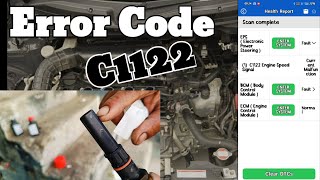
- Leaking Fluid Causing BCM/Fuse Box Corrosion (Uncommon) — On specific Maruti Suzuki models, a leaking rear washer fluid line drips onto the Body Control Module (BCM) or main fuse box in the driver's footwell. This causes 🎬 Watch: How to fix C1122 on a Suzuki Swift or Dzire extensive corrosion on connectors, leading to C1122.
- Faulty Engine Control Module (ECM/ECU) (Rare) — The main ECM receives correct signals from all sensors but fails to transmit the necessary engine speed data to the PSCM or ABS modules, causing them to log a fault.
Symptoms

- Power Steering (EPS/PS) Warning Light On — A light showing a steering wheel icon with an exclamation mark illuminates on your dashboard. This is the most common indicator.
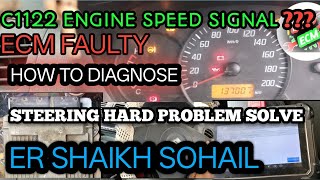
- Steering is Hard to Turn — Without a valid speed signal, the electric power steering system reverts to a fail-safe mode with no assistance. This makes the steering feel extremely heavy 🎬 Watch: Troubleshooting a hard steering problem and faulty ECM at parking-lot speeds.
- ABS and/or Traction Control (VDC, SLIP, ESP) Lights On — Because ABS and stability control systems rely on the same speed signals, their warning lights illuminate alongside the power steering light. This is the primary symptom on Nissan and Infiniti vehicles.
- Speedometer Not Working — If the Vehicle Speed Sensor (VSS) is the source of the fault, your speedometer stops working or behaves erratically. This directly leads to the C1122 code.
- Engine Stalling, Rough Idle, or No-Start — If the root cause is a failing crankshaft position sensor (CKP), you experience significant engine performance problems. The C1122 code is a secondary symptom in this scenario.
Diagnostic Flowchart
Tap your situation to follow the diagnostic path that matches what you're seeing on this code.
Common Fixes & Costs
- Cleaning or Replacing a Wheel Speed Sensor — Parts: $50-$150, Labor: $100-$200, ~1.2 hr book time (DIY)
- Repairing Damaged Wiring or Connectors — Parts: $10-$50, Labor: $150-$400, ~2 hr book time (Intermediate)
- Replacing the Crankshaft Position Sensor (CKP) — Parts: $50-$175, Labor: $100-$250, ~1.5 hr book time (Intermediate)
- Replacing the Power Steering Control Module (PSCM) — Parts: $400-$1000, Labor: $150-$250, ~1.8 hr book time (Professional)
- Replacing the ABS Control Module/Actuator — Parts: $800-$2000, Labor: $150-$300, ~2.5 hr book time (Professional)
DIY vs Professional
- Cleaning or Replacing a Wheel Speed Sensor — Beginner: No, this is best for an intermediate DIYer.
Tools: Jack and jack stands, socket set, wrenches, torque wrench, brake cleaner, rag. - Repairing Damaged Wiring or Connectors — Beginner: No, requires intermediate electrical skills.
Tools: Multimeter, wire strippers, soldering iron or crimp tool, heat shrink tubing, wiring diagrams. - Replacing the Crankshaft Position Sensor (CKP) — Beginner: Yes, a patient beginner can often do this.
Tools: Socket set, flashlight. - Replacing the Power Steering Control Module (PSCM) — Beginner: No, professional installation is required.
Tools: Professional diagnostic scan tool for programming, socket set, trim removal tools. - Replacing the ABS Control Module/Actuator — Beginner: No, professional installation is required.
Tools: Professional diagnostic scan tool, flare nut wrenches, torque wrench, pressure bleeder.
Used vs. New Parts: Buying Guide
When a used part is worth it: For expensive electronic modules like an ABS actuator or Power Steering Control Module (PSCM) on an older vehicle, a used part from a reputable salvage yard is a cost-effective option. It is impractical for inexpensive wear items like wheel speed sensors.
Donor-vehicle mileage cap: roughly under 100000 miles for the part to have meaningful remaining life.
Donor quality checklist:
- Verify the part number matches exactly.
- Source from a vehicle with similar or lower mileage.
- Inquire about the donor vehicle's reason for being salvaged (accident damage is better than electrical or flood damage).
- Ask about the seller's warranty and return policy.
Decision logic:
- If The part is a simple sensor (wheel speed, crankshaft) and under $150 → Buy new from an OEM or reputable aftermarket brand for reliability.
- If The part is a control module (ABS, PSCM) and the vehicle is over 10 years old → A used or professionally rebuilt module is a reasonable choice to save significant cost.
- If The part requires programming to the vehicle's VIN (most modern modules) → Factor in the cost of dealership or specialist programming ($150-$300) for a used part. A rebuilt original module often avoids this cost.
Warranty tradeoff: Used parts typically offer a 30-90 day warranty. Remanufactured modules come with a 1-year or lifetime warranty. New OEM parts carry the manufacturer's 1-year warranty.
Worst-case if a used part fails: $300-$600 if a used module fails after installation, requiring a second labor charge and replacement part.
What Happens If You Wait — Timeline
- Immediate: A warning light (EPS or ABS) illuminates. The corresponding system is disabled as a fail-safe. Steering becomes very heavy, or ABS function is lost. (Added cost: $0)
- 1 week - 2 months: If the fault is intermittent, the system switches on and off unpredictably, causing sudden changes in steering effort or braking behavior. Continued driving with heavy steering causes minor premature wear on steering column components. (Added cost: $0 - $150 in peripheral wear.)
- 2-6 months: If the root cause is an underlying electrical issue like a fluid leak or corrosion, the problem worsens. A slow leak of washer fluid onto a BCM/fuse box causes irreversible corrosion, destroying the module. A failing crankshaft sensor causes engine stalling. (Added cost: $500 - $1500 (for a new BCM or fuse box).)
- 6+ months: Catastrophic failure of the affected control module (PSCM or ABS). An ABS module that has suffered prolonged water damage fails internally. A vehicle with a completely failed CKP sensor will not start at all. (Added cost: $1500 - $3000+)
Cost of Not Fixing It
- Immediate: Loss of power steering assist and/or ABS and traction control. This creates a significant safety hazard, increasing the risk of an accident in emergency maneuvers or on slippery surfaces. (Added cost: Potential for accident-related costs.)
- 0-3 months: Continued driving without power steering causes premature wear on steering components due to increased manual effort. If the fault is intermittent, sudden changes in steering effort are dangerous. (Added cost: $0 - $200 in peripheral wear.)
- 3+ months: If the root cause is a failing crankshaft sensor, continued operation leads to engine stalling, no-start conditions, and catalytic converter damage. If caused by leaking fluid, irreversible corrosion destroys the module. (Added cost: $500 - $2500+ for a new control module or catalytic converter.)
Diagnosis Steps

- Read All Codes from All Modules
Use a professional-grade OBD-II scanner to access all modules (Engine, ABS, Power Steering, Body). Note all codes. A 'P' code (like P0335) points to the engine, while a 'U' code (like U0121) indicates a network failure. C1122 is often a secondary code.
Tools: Professional OBD-II Scanner (Beginner) - Check for Manufacturer-Specific Definitions
Verify the C1122 definition for your specific vehicle. On a Suzuki it is engine speed, but on a Hyundai i20 it is 'Front Right Sensor Battery Voltage Low' (TPMS), requiring a completely different diagnostic path.
Tools: OBD-II Scanner with Manufacturer-Specific Data (Beginner) - Test Battery and Charging System
Use a multimeter to verify system voltage. The battery must be ~12.6V with the engine off and ~13.7-14.7V while running. On Nissan models, C1122 specifically triggers if system voltage drops below 8.0V or exceeds 18.0V.
Tools: Multimeter (Beginner) - Inspect Wiring and Connectors
Visually inspect the wiring harnesses going to the PSCM, ABS module, ECM, and all wheel speed sensors. Look for chafing, melting, corrosion, or rodent damage. A loose or corroded pin at the module connector is a very common culprit.
Tools: Flashlight, Mirror, Gloves (Beginner) - Clean and Inspect Wheel Speed Sensors
Remove each wheel speed sensor. Clean the magnetic tip thoroughly with brake cleaner and a rag to remove brake dust and metallic debris. A simple cleaning often restores the signal and fixes the code.
Tools: Socket Set, Brake Cleaner, Rag (Intermediate) - Analyze Live Data from Sensors
Using your scanner's live data function, monitor Engine RPM and all four Wheel Speed Sensors simultaneously while driving. The RPM must be smooth, and all wheel speeds must read identically when driving straight. An erratic or zero reading pinpoints the problem circuit.
Tools: OBD-II Scanner with Live Data (Intermediate) - [PRO TIP] Verify Signal Passthrough with Live Data
View live data in the Engine Control Module (ECM) and confirm it reads Engine RPM correctly. Next, switch to the Power Steering (PSCM) or ABS module's live data. If it shows 0 RPM while the ECM shows correct readings, the ECM is faulty and failing to transmit the data.
Tools: Professional OBD-II Scanner (Advanced) - [PRO TIP] Test Crankshaft Position Sensor (CKP) Resistance
If P0335 is present, disconnect the CKP sensor and set a multimeter to Ohms (Ω). For a two-pin inductive sensor, resistance between pins must be 200-1,000 Ohms. 0 Ohms indicates a short; an infinite reading (OL) indicates an open circuit.
Tools: Multimeter, Vehicle-specific repair manual (Advanced) - [PRO TIP] Test Wheel Speed Sensor Signal
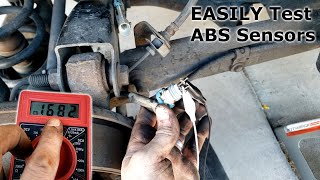
Set your multimeter to AC Volts (V~). Safely raise the vehicle, connect the probes to the sensor's two pins, and spin the wheel by hand. You must see a small AC voltage that increases with wheel speed. No voltage indicates a dead sensor or wiring problem.
Tools: Multimeter, Jack and Jack Stands (Advanced) - [PRO TIP] Scope the Signal at the Control Module
Using an oscilloscope, back-probe the engine speed signal input pin at the PSCM or ABS module connector. Start the engine. You must see a clean square wave signal that increases in frequency with RPM. A flat line indicates a wiring break; a clean signal points to an internal module failure.
Tools: Oscilloscope, Vehicle-specific wiring diagram (Advanced)
When This Code Triggers (Freeze-Frame Conditions)
- Engine RPM: < 220 RPM (During engine running. On many Suzukis, the code sets if the engine speed signal is less than 220 RPM while other conditions suggest it should be running.)
- Vehicle Speed: Any (The fault occurs at any speed, from stationary to highway speeds, manifesting as a sudden loss of power steering.)
- System Voltage: < 8.0V or > 18.0V (On Nissan models, the C1122 code triggers when system voltage goes outside the acceptable 8.0V to 18.0V range.)
- Ignition Status: Ignition ON, Engine OFF (For Suzuki vehicles, C1122 appears in a scan when the engine is not running, as the PSCM expects an RPM signal that isn't present. This is normal and clears upon starting the engine.)
Related Codes
- P0335 — This code for 'Crankshaft Position Sensor 'A' Circuit Malfunction' is a primary fault. If you see P0335 with C1122, the C1122 is simply a symptom. The power steering/ABS module is reporting a lost signal because the main engine RPM sensor failed. Fix P0335 first.
- P0500 — This code means 'Vehicle Speed Sensor (VSS) Malfunction'. If seen with C1122, it strongly suggests the VSS or its circuit is the root cause. The power steering module flags C1122 because it is not getting a plausible vehicle speed reading.
- U0121 — 'Lost Communication With ABS Control Module.' If this U-code appears with C1122, the problem is almost certainly the ABS module itself or the CAN bus wiring to it. The U-code indicates a total communication failure, which is a more severe fault than the C1122 signal error.
- C1111 — This code indicates an 'ABS Actuator / Pump Motor Fault.' On a Nissan or Infiniti, seeing this with C1122 strongly confirms the entire ABS pump and module assembly is faulty. The repair is typically to replace the whole assembly.
Climate & Environmental Factors
- Humidity and Moisture: High humidity or direct water ingress provides an electrolyte that promotes corrosion on connector pins and circuit boards within modules, causing signal degradation.
- Road Salt (Winter Climates): Salt spray from de-iced roads is extremely corrosive to wiring, connectors, and module casings. Chloride ions dramatically accelerate metal degradation, leading to high resistance or open circuits.
- Vibration and Thermal Cycling: Constant vibration causes micro-movements (fretting) between electrical contacts, wearing away protective plating. This exposes the base metal, which oxidizes and causes intermittent signal loss.
How to Talk to a Mechanic About This Code
Say this: "I have a C1122 code on my [Make, Model] and the [Power Steering/ABS] light is on. I'd like to schedule a diagnostic. Please start by checking the basics like sensor signals, wiring, and system voltage before assuming it's an expensive control module."
This signals that you are an informed customer. It directs the technician to follow a logical diagnostic path, starting with the most common and least expensive failures, rather than jumping to a costly module replacement.
Avoid saying:
- 'My steering feels heavy, can you fix it?'
- 'My ABS light is on, just replace whatever is broken.'
- 'I have a C1122 code, just put in a new power steering computer.'
Questions to ask before authorizing the repair:
- What were the results of the sensor and wiring tests? Did you see a good signal at the module?
- If you are recommending a module replacement, have you ruled out all other possibilities?
- Does the replacement module require programming, and is that cost included in your quote?
- What is the warranty on both the parts and the labor for this repair?
Where to Take It: Dealer vs Independent vs Chain
- Dealer:
A good choice if the fix requires programming a new ABS or PSCM module, but likely the most expensive option.
Best for: Vehicles under warranty, Complex repairs requiring module programming, Manufacturer-specific quirks (like the Maruti washer fluid leak)
Downsides: Highest labor rates, Prefers to replace an entire assembly rather than repair a smaller component (Typical cost: +50% vs. baseline) - Independent Shop:
Best fit. An experienced independent mechanic effectively diagnoses and repairs the most common causes of C1122 (sensors, wiring) and sources used or rebuilt modules to save money.
Best for: Out-of-warranty vehicles, Diagnosing and repairing common issues like faulty sensors or wiring, Cost-effective solutions, such as using remanufactured modules
Downsides: Quality and diagnostic capabilities vary widely; check reviews and certifications (e.g., ASE), Lacks the expensive, dealer-level tools for programming newer modules (Typical cost: +0% vs. baseline) - Chain Shop:
Risky. Best avoided for initial diagnosis of C1122 due to its complexity and manufacturer-specific nature. Only use if you have already diagnosed a simple, specific part failure.
Best for: Simple, confirmed repairs like replacing an accessible wheel speed sensor
Downsides: Technician skill varies greatly, Lacks the advanced diagnostic tools and experience for complex electrical problems, leading to misdiagnosis or a 'parts cannon' approach. (Typical cost: -10% vs. baseline)
When to Walk Away From the Repair
If the estimated repair cost exceeds 40-50% of the car's private-party value, it is time to seriously consider selling or trading it in.
- Car worth $3500, fix is $1800: Walk away. The repair cost is over 50% of the car's value. It is not a sound investment.
- Car worth $10000, fix is $1800: Fix it. The repair cost is less than 20% of the vehicle's value and restores critical safety systems.
- Car worth $4000, fix is $350: Fix it. A low-cost repair for a sensor or wiring is well worth it to keep the car safe and functional.
What Scan Tool You Need for This Code

Minimum: A scanner that reads manufacturer-specific 'C' (Chassis) codes from the ABS and Power Steering modules, and displays live sensor data.
A cheap, basic code reader only checks for 'P' (Powertrain) codes from the engine computer. It will not see the C1122 code stored in the ABS or steering modules, making it useless for this diagnosis. You need to see live data from wheel speed sensors to find the fault.
Budget: BlueDriver Pro Scan Tool (~$100) — Connects to your phone via Bluetooth and reads/clears enhanced codes from systems like ABS and power steering for many makes. It displays live data from wheel speed sensors, which is crucial for diagnosing C1122.
Mid-range: Foxwell NT630 Plus (~$150) — A dedicated handheld scanner that specializes in ABS and SRS (Airbag) systems. It reads/clears codes, views live sensor data, and performs active tests like ABS automated bleeding, which is necessary if you replace an ABS module.
Professional: Autel MaxiCOM MK808S/MK808Z (~$500) — A professional-level tablet scanner that provides full system diagnostics, live data graphing, and bidirectional control to test components directly. It offers deep diagnostic capabilities to differentiate between a bad sensor, faulty wiring, or a failed control module.
Rent vs buy: Many auto parts stores offer a free loaner tool program. Check if their scanners read ABS/Chassis codes. If so, this is a great no-cost option for a one-time diagnosis. Buy a scanner only if you plan to do your own repairs regularly.
How to Clear the Code After You Fix It
- Fix the underlying mechanical or electrical fault.
- Use a compatible OBD-II scan tool to erase the code from the specific module (ABS or PSCM) where it is stored.
- Perform a complete drive cycle to allow the vehicle's readiness monitors to reset.
Drive cycle (~20 minutes): A general drive cycle involves a cold start (after sitting for 8+ hours), a few minutes of idling, followed by mixed city and highway driving. Steady-state cruising between 55-60 mph for at least 5-10 minutes is crucial. Allow the vehicle to cool completely afterward.
Readiness monitors affected: This is a 'C' (Chassis) code and does not directly affect emissions readiness monitors like the Catalyst or O2 sensor monitors., If the root cause is an engine issue (like a bad CKP sensor setting a 'P' code), emissions monitors will be affected.
Before emissions retest: drive at least 50 miles to fully set monitors.
Watch out for:
- Disconnecting the battery does not reliably clear this code from the ABS or PSCM module memory.
- The code returns immediately if the root cause (e.g., bad wiring, faulty sensor) is not properly repaired.
- Failing to perform a full drive cycle results in failing a state emissions test, as readiness monitors remain unset.
Will This Fail Emissions / State Inspection?
No — by itself this code doesn't fail OBD inspection (but it can keep readiness monitors from setting, which causes a separate fail).
- California: An illuminated ABS or Power Steering warning light is grounds for a safety inspection failure. While not an emissions failure itself, a lit dashboard warning lamp prevents the vehicle from passing the overall inspection.
- New York: The NYS inspection includes checking for the proper function of safety systems. An illuminated ABS warning light causes the vehicle to fail the safety portion of the inspection.
- Texas: According to the Texas Department of Public Safety, an illuminated ABS warning light is NOT a cause for rejection during the safety inspection. However, if the main red 'BRAKE' warning light is also on, it fails.
Manufacturer-Specific Notes
- Suzuki: It is normal for C1122 to be stored in the PSCM when the ignition is on but the engine is not running. The module is looking for an RPM signal that doesn't exist yet. The code clears itself once the engine starts.
- Nissan / Infiniti: For these brands, C1122 is an ABS code, not a power steering code. It often means 'Front Right Inlet ABS Solenoid' or a general 'System Voltage' problem. The diagnostic focus must be entirely on the ABS system and the vehicle's charging system.
- Maruti Suzuki: A leaking rear window washer fluid line is a known cause for this code. The fluid hose runs through the cabin and leaks inside the driver's A-pillar or footwell, dripping directly onto the Body Control Module (BCM) or fuse box, causing corrosion.
- Hyundai / Kia: The C1122 code on many Hyundai and Kia models is completely unrelated to engine speed. For Hyundai, it means 'Front Right Sensor Battery Voltage Low' for the TPMS system. For Kia, it means 'Coolant Pump Control Circuit High'.
- Suzuki (Recalls): Suzuki issued a recall (REC-006262) for 2022-2023 Swift and Ignis models for a steering shaft nut that is not tightened to specification, which causes the steering wheel to become loose. While not directly C1122, it affects the steering system.
Real Owner Stories
2010 Maruti Suzuki Dzire with intermittent hard steering
Owner performed a routine OBD-II scan with no check engine light on and found a C1122 code stored in the Electronic Power Steering (EPS) module. The steering occasionally felt hard.
What they tried:
- Visually inspected the wiring to the vehicle speed sensor and found no breaks.
- Removed the vehicle speed sensor and found it heavily covered in dust and grime.
- Cleaned the sensor thoroughly with throttle body cleaner and a cloth, then reinstalled it.
Outcome: After cleaning the sensor and clearing the code, the C1122 did not return. The power steering felt noticeably smoother, requiring no new parts.
Lesson: For Suzuki models, the simplest and most common fix for C1122 is cleaning accumulated metallic dust off the relevant speed sensor. Always try this before replacing parts.
2011 Mazda 3 with spongy brakes and ABS light after hitting a pothole
While braking, the owner hit a pothole, resulting in a spongy brake pedal and multiple warning lights. A shop diagnosed a catastrophic ABS module failure.
What they tried:
- The shop quoted $1400 for a full ABS module replacement and brake flush.
Outcome: The owner sought advice online, confirming that ABS module replacement is an expensive repair, with parts alone often costing $800+ and requiring programming. The price was in the expected range.
Lesson: A sudden, severe impact causes internal failure of sensitive electronics like an ABS module. Be prepared for a bill over $1000 for module replacement.
Old Suzuki Swift with persistent C1122 and hard steering despite part swaps
The vehicle had a C1122 code that would not clear, and the steering was hard. The owner had already tried swapping the power steering module from a known-good car.
What they tried:
- Replaced the Power Steering Control Module (PSCM) with a working unit, but the problem remained.
- Checked all related wiring and found no issues.
- Used a scanner to view live data and discovered the PSCM received a vehicle speed signal but showed 0 for engine RPM, even though the engine was running.
Outcome: The technician concluded the Engine Control Module (ECM) was faulty. It correctly received the RPM signal from the crankshaft sensor but failed to transmit it to the PSCM. Replacing the ECM resolved the code.
Lesson: If replacing a sensor or module doesn't fix the issue, use a scanner's live data to trace the signal. If the ECM shows a correct reading but the target module doesn't, the ECM itself is the culprit.
2014 Suzuki Kizashi with C1122 and occasional engine stalling
The owner experienced the engine stalling twice and a scan revealed code C1122. The code appeared with the engine off, but could be cleared.
What they tried:
- The owner posted on a forum seeking advice.
- Another user advised that C1122 appearing with the engine off is normal for Suzukis and should be ignored if it clears upon starting.
- The owner left the car parked for a week without performing repairs.
Outcome: The problem resolved itself without intervention, suggesting an intermittent fault caused by a temporary condition like moisture that dried out.
Lesson: Confirm the exact conditions under which the code sets. For Suzuki, C1122 with the engine off is normal. If the issue is intermittent, check simple things like battery connections and moisture intrusion first.
How to Prevent This Code From Triggering
- Clean Wheel Speed Sensors Periodically (Every 30,000 miles or during every brake job) — The magnetic tip of the sensor attracts metallic brake dust and road grime. This buildup weakens the signal, leading to a C1122 fault. Regular cleaning prevents this common failure.
- Apply Dielectric Grease to Connectors (Whenever a relevant connector is disconnected) — Applying a thin layer of non-conductive dielectric grease to the connector's seal and pins blocks moisture and oxygen, preventing the corrosion that causes high resistance and signal loss.
- Maintain Battery Health and Connections (Every 6 months) — Low voltage from a weak battery causes unpredictable communication errors between modules. Regularly clean terminals of corrosion and ensure the battery is securely fastened.
- Inspect and Secure Wiring Harnesses (During oil changes or other maintenance) — Visually check for wiring harnesses that are rubbing against engine components or show signs of heat damage. Securing them with zip ties prevents chafing that eventually leads to a broken wire.
- Address Fluid Leaks Immediately (As soon as they are noticed) — Engine oil, coolant, or washer fluid leaking onto electrical modules degrades the plastic and seals, leading to moisture intrusion and catastrophic corrosion.
Frequently Asked Questions
Can I just clear the C1122 code and keep driving?
You can clear it, but it returns almost immediately if the fault is persistent. Ignoring the code means driving without power steering assist, ABS, and stability control, which is a significant safety risk.
Why is my steering so heavy with the C1122 code?
Electric power steering uses the engine speed signal to calculate how much assistance to provide. When it loses that signal, it enters a fail-safe mode, disabling the assist motor. This makes the steering feel exceptionally heavy, as you are now turning the wheels manually.
My scanner says C1122 is an ABS code, but you say it's for power steering. Which is it?
It depends entirely on your car's manufacturer. On a Suzuki, it is a power steering code, while on a Nissan, it is an ABS code. Let your vehicle's specific symptoms (heavy steering vs. ABS light) guide your diagnosis.
I replaced the speed sensor but the code came back. What did I miss?
If a new sensor doesn't fix it, the fault lies elsewhere. Meticulously inspect the wiring for breaks, check for corrosion in the module connector, or investigate possibilities like a washer fluid leak onto the BCM.
My C1122 symptoms disappeared on their own. Am I in the clear?
Not likely. This indicates an intermittent fault, such as a loose connection making intermittent contact, a frayed wire, or moisture that temporarily dried out. The problem will almost certainly return.
Is it expensive to fix code C1122?
The cost varies wildly. Cleaning a sensor is virtually free, and a new speed sensor costs $150-$350 installed. However, if a control module is the cause, a Suzuki PSCM costs $500-$700, while a Nissan ABS module exceeds $1500.
The code C1122 only appears when I scan with the engine off. Is that a problem?
On many Suzuki vehicles, this is normal and should be ignored. The power steering module logs the code because it is not receiving an RPM signal when the engine isn't running. If the code vanishes the moment the engine starts, you do not have a problem.
What is the difference between a wheel speed sensor and a vehicle speed sensor?
A wheel speed sensor is located at each wheel hub and reports that individual wheel's speed to the ABS module. A vehicle speed sensor (VSS) is typically located on the transmission and reports the overall speed of the vehicle to the ECM and instrument cluster.
Key Takeaways
- Code C1122 instantly disables power steering and ABS when the control module loses the engine RPM signal, increasing steering effort by up to 50%.
- Verify your specific manufacturer definition before buying parts, as C1122 means a power steering fault on Suzukis but points to a $1,000+ ABS module failure on Nissans.
- Clean the magnetic tips of all 4 wheel speed sensors before buying parts, as metallic brake dust buildup causes over 40% of these signal errors.
- Test your battery and alternator output, because system voltage dropping below 8.0V or spiking above 18.0V triggers this exact code on many vehicles.
Helpful Videos

The information in this article is provided for general reference and educational purposes only. Vehicle specifications, procedures, and part compatibility can vary by production date, trim level, and region. Always consult your vehicle's factory service manual and verify part numbers before purchasing or performing repairs. Safety-critical components such as airbags, seat belts, and braking systems should be installed by a qualified professional.
- 🎬 Helpful Videos
- What Does C1122 Mean?
- Can I Drive With C1122?
- Common Causes
- Symptoms
- Diagnostic Flowchart
- Common Fixes & Costs
- DIY vs Professional
- Used vs. New Parts: Buying Guide
- What Happens If You Wait — Timeline
- Cost of Not Fixing It
- Diagnosis Steps
- When This Code Triggers (Freeze-Frame Conditions)
- Related Codes
- Climate & Environmental Factors
- How to Talk to a Mechanic About This Code
- Where to Take It: Dealer vs Independent vs Chain
- When to Walk Away From the Repair
- What Scan Tool You Need for This Code
- How to Clear the Code After You Fix It
- Will This Fail Emissions / State Inspection?
- Manufacturer-Specific Notes
- Real Owner Stories
- 2010 Maruti Suzuki Dzire with intermittent hard steering
- 2011 Mazda 3 with spongy brakes and ABS light after hitting a pothole
- Old Suzuki Swift with persistent C1122 and hard steering despite part swaps
- 2014 Suzuki Kizashi with C1122 and occasional engine stalling
- How to Prevent This Code From Triggering
- Frequently Asked Questions
- Can I just clear the C1122 code and keep driving?
- Why is my steering so heavy with the C1122 code?
- My scanner says C1122 is an ABS code, but you say it's for power steering. Which is it?
- I replaced the speed sensor but the code came back. What did I miss?
- My C1122 symptoms disappeared on their own. Am I in the clear?
- Is it expensive to fix code C1122?
- The code C1122 only appears when I scan with the engine off. Is that a problem?
- What is the difference between a wheel speed sensor and a vehicle speed sensor?
- Key Takeaways
- 🎟️ Get 5% Off