

C1110 on 2005-2014 Volkswagen Passat: ABS Controller Failure Causes and Fixes
On a 2005-2014 Passat, C1110 means the ABS module has failed or isn't getting power. Before replacing the expensive module, inspect the engine bay fuse box for melting, a common issue on B6 models (2005-2010) that mimics module failure. A fuse box repair can cost $100-$400, while a rebuilt ABS module is closer to $500-$900.
- Code C1110 on a 2005-2014 Passat means ABS Controller Failure.
- BEFORE you replace the ABS module, you MUST inspect the engine bay fuse box for melting, especially on 2005-2010 models. This is the most common cause.
- Driving is possible, but unsafe, as you will not have Anti-lock Brakes or Stability Control.
- Repairing the fuse box is a much cheaper fix than replacing the ABS module.
- If the module must be replaced, having your original unit rebuilt is often cheaper and avoids the need for dealer programming.
What's Unique About the 2005-2014 Volkswagen Passat

For this generation of Passat, especially the B6 (2005-2010), the C1110 code is frequently a symptom of another problem: a melting engine bay fuse box (E-box). The main power terminal for the ABS module can develop high resistance, generating enough heat to melt the fuse box housing and cut power. This starves the ABS module of power, making it appear as if the module itself has failed. A thorough inspection of this fuse box is mandatory before condemning the expensive ABS module, which itself is also a common failure point due to internal pressure sensor issues.
Generation note: This range covers the B6 (2005-2010) and B7/NMS (2011-2014) Passat generations. The issue of the engine bay fuse box melting and causing a C1110 code is far more prevalent in the B6 generation. While the B7 can still suffer from ABS module failure, the fuse box is a less common point of failure for this specific issue. The B6 is also more prone to general electronic issues.
Symptoms You May Notice
- ABS warning light is on
- ESC (Electronic Stability Control) or Traction Control light is on
- Brake warning light may be illuminated (often flashing)
- In some cases, the electronic parking brake (EPB) light may be on with related faults
- Loss of communication with the ABS module when using a scan tool
- Wheels may lock up and skid during hard braking
- Replacing the ABS module without first inspecting the engine bay fuse box. Many owners have spent over $1000 on a new module and programming only to find the root cause was a $150 fuse box that was failing to supply power.
Most Likely Causes

- Melting or Corrosion in Engine Bay Fuse Box (E-Box) 🔴 High Probability A well-documented design flaw on the B6 Passat, where the main power stud for the ABS module overheats due to a poor crimp or loose connection, melting the fuse box housing and causing an open circuit.
How to confirm: Visually inspect the large-gauge wire connections on the engine bay fuse box (located near the battery). Look for melted black plastic, discoloration, scorch marks, or a loose connection nut on the main power feeds. A voltage drop test at the ABS module power supply wire will confirm a power delivery issue.
Typical fix: Replace the engine bay fuse box and repair or replace the damaged wire terminal. The fuse box itself is often part number 3C0937125A.
Est. part cost: $50-$250 - Internal Failure of the ABS Control Module 🔴 High Probability The ATE Teves Mk60/Mk60E ABS module used in these cars is known for internal failures. The most common is a failure of the integrated brake pressure sensor (G201), which triggers fault 01435. Other failures include broken internal micro-wires or general electronic failure causing communication loss.
How to confirm: If the fuse box and all power/ground wires to the ABS module are confirmed to be good, and the module still won't communicate or clears the code only for it to return immediately, the module itself has likely failed internally. Specific codes like 01435 or 01276 point directly to an internal module fault.
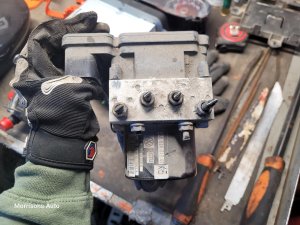
Typical fix: Remove the original module and send it to a specialist for rebuilding, or replace it with a new/remanufactured unit. Rebuilding is often preferred as it avoids the need for costly dealer programming.
Est. part cost: $150-$600 (rebuild service), $800-$1500 (new) - Blown Fuse for ABS System ⚪ Low Probability While less common than the fuse box melting, a simple blown fuse can cut power. Fuses can blow due to age or a short circuit.
How to confirm: Check the fuses related to the ABS system in both the engine bay and interior fuse panels (left side of dash). 🎬 Watch: Locate all fuse boxes and relay panels on your Passat. Consult a fuse diagram for your specific year, as there are multiple fuses for the pump and controller.
Typical fix: Replace the blown fuse. If it blows again immediately, it indicates a short circuit that needs to be traced.
Est. part cost: $1-$5
Rare But Worth Checking
- Damaged Wiring or Ground Connection: The wiring harness leading to the ABS module can become damaged from road debris or improper repairs. The main ground point for the module can also corrode, causing intermittent issues. This is worth checking if both the fuse box and module seem okay.
Diagnosis Steps
- Scan for all fault codes in all modules using a VW-compatible scanner like VCDS. Note any communication errors or specific codes like 01130, 01435, or 01044.
- CRITICAL STEP (B6 Models): Thoroughly inspect the engine bay fuse box (E-box) next to the battery. Unbolt and lift the main power wires. Check the plastic underneath the terminals for any signs of melting, burning, or charring. Check that the nuts are tight.
- If the fuse box is damaged, this is your most likely problem. Replace the fuse box (e.g., VW P/N 3C0937125A) and repair the wire end before proceeding.
- If the fuse box looks perfect, check all fuses related to the ABS/ESC system. There are large fuses in the engine bay box and smaller ones in the panel on the driver's side of the dashboard.
- If fuses are good, access the ABS module connector. Using a multimeter and a wiring diagram, verify that the module is receiving full battery voltage on its main power pins and has a solid connection to ground on its ground pins. A load test using a test light is crucial; a multimeter may show voltage, but a high-resistance connection will fail under load.
- If power and ground are good, and codes like C1110/01130 or 01435 are present, this confirms an internal failure of the ABS module.
- The most common repair is to remove the electronic portion of the ABS unit and send it to a specialized rebuilding service. This is typically more cost-effective and avoids programming issues.
- If replacing the module with a new or used unit, it will require coding with a compatible diagnostic tool (like VCDS by Ross-Tech) to match the vehicle's configuration. You may also need to perform a Basic Setting for the Steering Angle Sensor (G85) and Brake Pressure Sensor (G201).
Parts You'll Likely Need

- Engine Bay Fuse Box (E-Box)
(OEM #3C0937125A)— This is the most common point of failure on B6 Passats that leads to a C1110 code by mimicking an ABS module failure.
Trusted brands: Genuine VW
OEM price range: $150-$250
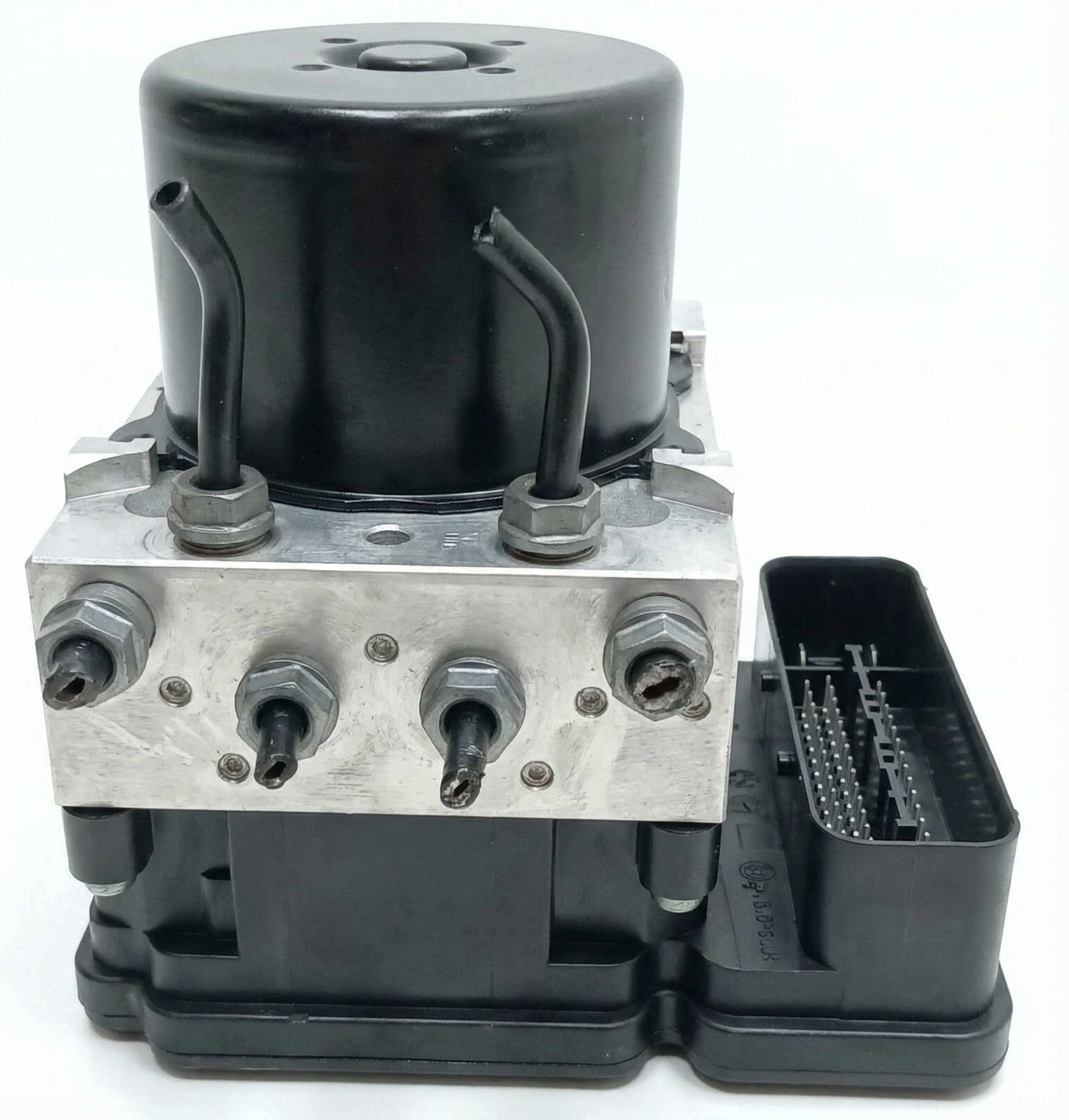
Aftermarket price range: $50-$120 (Used) - ABS Control Module (Rebuild Service) — If the fuse box and wiring are good, the ATE Mk60 module itself has likely failed internally. Rebuilding is the most common and cost-effective solution.
Trusted brands: ATE (Original), Bosch (Some applications)
OEM price range: $1200-$2000 (New Module)
Aftermarket price range: $150-$600 (Rebuild Service)
Related Codes That Often Appear With This One
- 01130 — This VW-specific code for 'ABS Operation - Implausible Signal' is almost always present alongside C1110 and points to a general, non-specific failure in the ABS system, often the module itself.
- 01044 — This VW-specific code means 'Control Module Incorrectly Coded'. It will appear if a new or used ABS module is installed without being properly programmed to the vehicle's specific features (engine, transmission, etc.) using a tool like VCDS.
- 01435 — This code for 'Brake Pressure Sensor 1 (G201)' indicates a specific, and very common, internal failure 🎬 Watch: Step-by-step guide to replacing the ABS pump and sensor. of the ATE Mk60 ABS module. It confirms the module needs to be rebuilt or replaced.
- 01276 — This code for 'ABS Hydraulic Pump (V64)' suggests a fault with the pump motor portion of the ABS unit, which can also be an internal failure of the module assembly.
Platform-Specific Known Issues
- The 2005-2010 (B6) Passat is widely known for the engine bay fuse box melting at the main power stud, causing a loss of power to various components, most notably the ABS module. This single issue is the most common misdiagnosis for code C1110 on this platform.
Mechanic-Grade Diagnostic Values
- ABS Module Power Supply Pins (Large Gauge Wires) — expected: Full battery voltage (approx. 12.6V KOEO, 13.5V+ engine running) that remains stable under load.. Failure: Using a multimeter may show correct voltage, but applying a load with a test light causes the voltage to drop significantly or disappear, indicating high resistance in the circuit (often from the melting fuse box).
- ABS Module Ground Pins (Brown Wires) — expected: Less than 0.1 Ohms resistance to a known good chassis ground. A test light connected to battery positive should light brightly when touching the ground pin.. Failure: High resistance or an open circuit. The test light will be dim or will not light at all.
- Steering Angle Sensor (G85) Value via VCDS — expected: Between -1.5 and +1.5 ° when the steering wheel is perfectly straight.. Failure: A value outside this range after module replacement indicates the basic setting has not been performed or was unsuccessful.
Scan Tool Commands That Help

- VCDS (Ross-Tech): 03-ABS Brakes -> Basic Settings - 04 -> Group 001 or Group 002 — To cycle the ABS hydraulic pump for bleeding air out of the module after replacement or if air has entered the system. The exact group may vary by module, but this function is essential for a firm brake pedal.
- VCDS (Ross-Tech): 03-ABS Brakes -> Security Access - 16 -> Enter Code 40168 — This security access code is required to enable basic settings on the ABS module, such as calibrating the Steering Angle Sensor (G85), Lateral Acceleration Sensor (G200), and Brake Pressure Sensor (G201) after module replacement.
- VCDS (Ross-Tech): 03-ABS Brakes -> Coding - 07 — Used to program a new or used ABS module to the car's specific equipment (e.g., engine, transmission, AWD). An incorrect or missing coding will set fault 01044 and keep the ABS/ESC lights on.
- VCDS (Ross-Tech): 03-ABS Brakes -> Measuring Blocks - 08 — To view live data from ABS sensors. Group 001 typically shows the four wheel speeds, which is useful for diagnosing a faulty wheel speed sensor. Other groups show data from the steering angle and pressure sensors.
Wiring & Ground Locations
- ABS Module Main Ground — The main ground wires for the ABS module are typically brown and terminate at a chassis ground point in the engine compartment, often on the left-side longitudinal member or near the battery tray.. A corroded or loose ground connection can cause a loss of communication or intermittent power to the ABS module, mimicking an internal module failure. It's a critical check before replacing the unit.
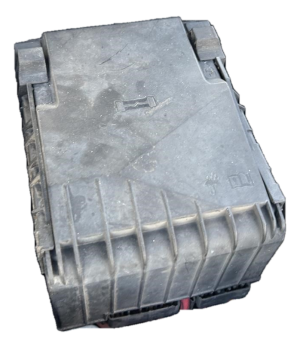
- Engine Bay Fuse Box (E-Box) — Located in the engine compartment, next to the battery, under a black plastic cover.. This is the source of the main power feeds for the ABS module. On B6 models, the terminals inside are prone to melting, which cuts power to the ABS module and directly causes the C1110 fault.
- Ground Point 1 on Bulkhead — Designated as ground point 645, located on the firewall (bulkhead) in the engine compartment.. This is a major grounding location for various engine bay components. While not the primary ABS ground, poor contact here can introduce electrical noise and intermittent issues across multiple systems.
Documented NHTSA Reports
While C1110 is a common Volkswagen fault, it is also documented by other manufacturers as a significant failure point. For instance, NHTSA ODI #11488151 describes a situation where a technician detected code C1110-04 and recommended replacing the ABS controller and actuator. Similarly, NHTSA ODI #10315935 notes that a dealer identified C1110 as a "controller failure" in a case where the ABS warning lamp was on and the system activated during normal braking. In some instances, this fault can lead to severe electrical symptoms; NHTSA ODI #10639052 reports that the ABS actuator continued to run even when the car was shut off, eventually draining the battery. Another report, NHTSA ODI #10560718, highlights that the code appeared during braking even when road conditions were dry and speeds were low.
Real Owner Repair Stories
- Ross-Tech Forum user 'SnellSebbe' (2006 VW Passat B6 (3C)) — Multiple warning lights (ABS, EPC, EPB, ESP) and lost ABS module coding after a shop replaced the Electronic Parking Brake (EPB) module.
❌ Tried (didn't work) A repair shop replaced the EPB module but was unable to resolve the resulting ABS fault codes, likely because they did not save and restore the original ABS coding.
✅ What actually fixed it Using VCDS, the owner received help on the forum to find the correct 'long coding' value for the ABS module based on the vehicle's equipment. Once the correct code (0013722) was entered, the faults could be cleared and basic settings performed. - YouTube video by 'Fixing it cheap!' (VW Passat B6) — ABS and ESP lights on, multiple fault codes including 01130 (ABS Operation Implausible Signal).
❌ Tried (didn't work) Initial diagnosis pointed towards a faulty ABS module.
✅ What actually fixed it The actual cause was a melted engine bay fuse box. The power cable terminal for the ABS module had overheated and melted the plastic housing, creating a poor connection. Replacing the fuse box and cleaning the cable terminal resolved all the faults without needing to replace the ABS module.
OEM Part Supersession History
3C0937125→3C0937125A— The original fuse box design was prone to overheating and melting at the high-amperage terminals. The 'A' revision is an updated part intended to address this weakness.
Heads up: While the 'A' version is a direct replacement for the older part, some aftermarket versions may have lower quality construction and can fail similarly. It is crucial to ensure the main power cable terminals are cleaned and torqued correctly during installation to prevent a repeat failure.
Model Year Variations Within This Range
- 2005-2010 (B6 Generation): These models are highly susceptible to the engine bay fuse box (E-Box) melting, which is the primary cause to investigate for a C1110 code before suspecting the ABS module.
- 2011-2014 (B7/NMS Generation): While these models can still experience ABS module failure, the redesigned engine bay fuse box is significantly less likely to be the cause of the C1110 code compared to the B6 generation. Diagnosis for a B7 is more likely to lead directly to a faulty ABS module or wiring issue.
Diagnostic Flowchart
Other Known Issues on This Vehicle
Issues unrelated to this code that are worth knowing about as an owner of this generation:
- 2.0T FSI (BPY) Cam Follower Wear 🔴 High — Extremely common on 2006-2008.5 models. Failure can occur as early as 20,000-30,000 miles if not monitored. Leads to HPFP and camshaft destruction. (Ref: VW issued an extended warranty and TSB 2015153 for this issue.)
- DSG Mechatronic Unit Failure 🔴 High — Common across all years with the DSG transmission, particularly the DQ200 7-speed dry clutch version. Symptoms include harsh shifting, loss of gears, and a flashing PRNDS indicator.
- Electronic Parking Brake (EPB) Failure 🟠 Medium — Widespread on the B6 generation (2005-2010). Can be caused by a faulty switch in the dash, wiring corrosion, or failed caliper motors.
- Steering Column Lock Module Failure 🔴 High — A known issue on B6 models where the module fails, preventing the car from starting and unlocking the steering wheel. (Ref: An extended warranty was offered for this component.)
- Excessive Oil Consumption (2.0T TSI Engine) 🟠 Medium — More prevalent in later B7 models with the EA888 Gen2 engine. Often caused by piston ring design issues. (Ref: Class-action lawsuits were filed regarding this issue.)
Used vs. New Parts: Buying Guide for This Vehicle
When a used part is the smart pick: A used Engine Bay Fuse Box (E-Box) from a junkyard is a very sensible and cost-effective repair, especially if it's the updated '3C0937125A' part number. A used ABS module can also be an option, but it is critical that it has the exact same part number as the original and you have access to VCDS to perform the necessary coding.
Donor-vehicle mileage cap: roughly under 150000 miles for the part to have meaningful remaining life.
What to inspect on the donor part:
- For a Fuse Box: Inspect the large terminal studs for any signs of discoloration, melting plastic around the base, or charring. Ensure the plastic is not brittle or cracked.
- For an ABS Module: Check that the electrical connector pins are clean, straight, and free of corrosion. Ensure the aluminum hydraulic block has no cracks or signs of leaking brake fluid.
Aftermarket brands forum-validated for this vehicle:
- For ABS Module Repair: Sending the original module to a dedicated electronics rebuilder (many available online) is often the most reliable and cost-effective option, as it requires no reprogramming.
Brands owners have reported issues with on this vehicle:
- Cheap, unbranded engine bay fuse boxes from online marketplaces may use inferior materials that can lead to a repeat of the melting issue.
Real Owner Stories
Aggregated from forums and TSBs cited above. Mileages and costs reflect what owners reported in those sources.
2007 Volkswagen Passat B6
Symptoms: Multiple electrical failures occurred, including persistent ABS and ESC fault lights on the dashboard.
What fixed it: The melted engine bay fuse box was replaced and the damaged main power wire terminal was repaired, restoring power to the ABS module.
Source hint: UKPassats Forum: Passat B6 - Common Faults Support Thread
2009 Volkswagen Passat B6
Symptoms: The ABS and traction control warning lights were illuminated, and a scan tool could not establish communication with the ABS control module.
What fixed it: After confirming power and ground to the module were good, the ABS module was determined to have failed internally and was sent to a specialist for rebuilding.
Source hint: VW Vortex Forum: Official B6 Passat Problems and Complaints Thread
2008 Volkswagen Passat
Symptoms: ABS and ESC lights were on, with diagnostic codes 01130 and 01276 stored, pointing to an internal ABS module failure related to the pressure sensor (G201).
What fixed it: The ATE Mk60e ABS module was removed and sent to a rebuilding service to correct the internal electronic failure.
Source hint: GOLFMKV.com: Mk60e ABS module failure - DIY and/or cheap repair options?
2006 Volkswagen Passat B6
Symptoms: After installing a used replacement ABS module to fix the initial problem, the ABS and ESC fault lights remained on the dashboard.
What fixed it: The replacement module had to be correctly coded to the car's configuration using a diagnostic tool like VCDS, and a calibration was performed to finally clear the fault lights.
Source hint: Ross-Tech Forums: Passat B6 ABS Module Change
Related OBD-II Codes
Frequently Asked Questions
I have a 2007 Passat with the ABS and ESC lights on. My mechanic wants to replace the ABS module immediately. Is this the right first step?
What is the part number for the engine bay fuse box that is known to melt on the VW Passat?
My scan tool can't communicate with the ABS module. Does this confirm the module is dead?
If my fuse box is fine and the ABS module is confirmed to be faulty, is rebuilding it a good option?
I'm getting fault code 01435 along with C1110 on my Passat. What does that point to?
If I install a used ABS module in my 2011 Passat, will it work right away?
Besides the fuse box and the module itself, could my ABS light be caused by something simple like a fuse?
Helpful Videos
We Have This Part in Stock




The information in this article is provided for general reference and educational purposes only. Vehicle specifications, procedures, and part compatibility can vary by production date, trim level, and region. Always consult your vehicle's factory service manual and verify part numbers before purchasing or performing repairs. Safety-critical components such as airbags, seat belts, and braking systems should be installed by a qualified professional.
- Volkswagen Passat:
- 🎬 Helpful Videos
- 🛍️ Shop This Part
- What's Unique About the 2005-2014 Volkswagen Passat
- Symptoms You May Notice
- Most Likely Causes
- Rare But Worth Checking
- Diagnosis Steps
- Parts You'll Likely Need
- Related Codes That Often Appear With This One
- Platform-Specific Known Issues
- Mechanic-Grade Diagnostic Values
- Scan Tool Commands That Help
- Wiring & Ground Locations
- Documented NHTSA Reports
- Real Owner Repair Stories
- OEM Part Supersession History
- Model Year Variations Within This Range
- Diagnostic Flowchart
- Other Known Issues on This Vehicle
- Used vs. New Parts: Buying Guide for This Vehicle
- Real Owner Stories
- 2007 Volkswagen Passat B6
- 2009 Volkswagen Passat B6
- 2008 Volkswagen Passat
- 2006 Volkswagen Passat B6
- Related OBD-II Codes
- Frequently Asked Questions
- 🎟️ Get 5% Off