

C1110 on 2005-2014 Volkswagen Golf: ABS Controller Failure Causes and Fixes
On a 2005-2014 VW Golf, code C1110 typically means an ABS module failure or a power supply issue. Before replacing the expensive module, check the engine bay fuse box for a melted power connection, a common issue on this platform. A module rebuild costs around $150-$600, while a new one can exceed $1200.
- Code C1110 on a 2005-2014 Golf means a serious ABS system fault.
- **ALWAYS** inspect the engine bay fuse box for a melted power connection before you consider replacing the ABS module. This is a very common failure point for this specific vehicle range.
- Driving is possible but unsafe; your anti-lock brakes will not function in an emergency.
- If the ABS module is faulty, having it rebuilt is often much cheaper than buying a new one from the dealer.
- This is not a beginner-friendly DIY repair due to the safety-critical nature of the brake system and the potential need for electronic programming.
What's Unique About the 2005-2014 Volkswagen Golf
For the Mk5 and Mk6 Golf (2005-2014), a primary suspect for C1110 is not always the ABS module itself, but the engine bay fuse box (often called the E-box or Power Distribution Module) located on top of the battery. The main power stud that supplies voltage to the ABS module is a known weak point that can overheat, corrode, and melt the surrounding plastic. This creates a high-resistance connection, starving the module of sufficient electrical current and tricking the system into reporting a module failure. Always inspecting this fuse box before condemning the ABS module is critical for an accurate diagnosis on these specific vehicles.
Generation note: This guide covers the Volkswagen Golf Mk5 (approx. 2005-2009) and Mk6 (approx. 2010-2014), which are both built on the PQ35 platform. The common causes, particularly the potential for a melted engine bay fuse box and failure of the ATE Mk60 ABS module, are relevant to both generations within this year range.
Symptoms You May Notice
- ABS warning light is illuminated on the dashboard.
- Electronic Stability Control (ESC/ESP) warning light is on.
- Traction Control (TCS/ASR) warning light may be on.
- Red 'BRAKE' warning light may be illuminated or flashing.
- Wheels may lock up during hard braking.
- Brake pedal feels spongy or unresponsive.
- Buzzing or grinding noise from the ABS module area in the engine bay.
- Replacing the ABS module without first checking the engine bay fuse box for melting. The power supply issue is a well-documented cause that can mimic a module failure.
- Replacing a wheel speed sensor for a specific wheel fault without checking the sensor's reluctor ring (ABS ring) for damage or corrosion, which can also cause incorrect readings.
Most Likely Causes
- Melted Engine Bay Fuse Box (E-Box) Connection 🔴 High Probability The high-current connection for the ABS module power supply on the fuse box is a known design flaw that can overheat, develop high resistance, and fail over time, melting the plastic housing.
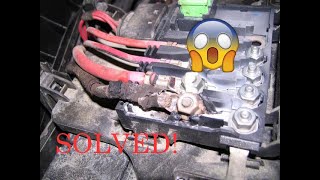
How to confirm: Visually inspect the main power feeds on the engine bay fuse box, which sits on top of the battery. Look for signs of melted plastic, discoloration, charring, or corrosion around the large-gauge wire connections and fusible links. The wire may be hot to the touch after driving.
Typical fix: Replace the entire fuse box 🎬 Watch: How to identify and fix a melting fuse box and the alternator-to-fuse-box wiring harness. Simply replacing the box without replacing the compromised wire often leads to a repeat failure.
Est. part cost: $75-$300 - Internal ABS Control Module Failure 🔴 High Probability The ATE Mk60 and Mk60EC1 ABS modules used in this era are known to fail electronically across many brands. Common internal failures include broken micro-wires on the brake pressure sensor (G201) or a complete loss of communication with the module's ECU.
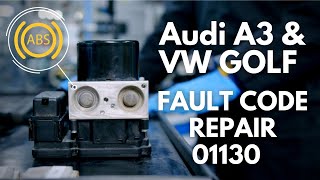
How to confirm: After confirming the fuse box and wiring are intact and have proper voltage/ground, the diagnosis points to the module. A professional scan tool (like VCDS) will show codes like 01130, 16352, or 01276 🎬 See how to diagnose ABS light and fault code 01130, and may be unable to communicate with the ABS controller at all.
Typical fix: Remove the ABS module and send it to a specialist for rebuilding, or replace it with a new or pre-coded used unit. A new or uncoded used unit requires programming (coding) to the vehicle's VIN and specific options.
Est. part cost: $150-$600 for a rebuild service, $1200-$2500 for a new OEM module. - Damaged Wiring or Corroded Connectors 🟡 Medium Probability Wiring to the ABS module or wheel speed sensors can become damaged from road debris, and connectors can suffer from water intrusion and corrosion. The main 47-pin connector at the ABS module is a key inspection point.
How to confirm: Perform a visual inspection of the wiring harness leading to the ABS module and each wheel speed sensor. Check for continuity and voltage drops on the power and ground wires at the ABS module connector using a multimeter.
Typical fix: Repair the broken wire or clean/replace the corroded connector. The 47-pin connector housing is available as a separate part (e.g., OEM P/N 7L0973047).
Est. part cost: $10-$80
Rare But Worth Checking
- Faulty Wheel Speed Sensor: While a faulty wheel speed sensor usually sets its own specific code (e.g., for 'Left Rear Wheel Speed Sensor Circuit'), it can sometimes cause communication errors that may be misinterpreted or lead to a cascade of warning lights. It's a much cheaper part to check before suspecting the module.
- Low Battery Voltage: ABS and other control modules are sensitive to system voltage. A weak or dying battery, or a failing alternator, can cause communication errors and trigger various codes, including C1110. If multiple unrelated modules show faults, check the battery and charging system first.
Diagnosis Steps
- Read the fault codes from the '03 - ABS Brakes' module using a VW-compatible scan tool like VCDS. Note all codes present.
- CRITICAL STEP for VW: Open the hood and remove the cover from the fuse box located on top of the battery. Carefully inspect the main power wire connection (a thick red or black cable) for any signs of melting, charring, discoloration, or corrosion.
- If the fuse box looks good, test the power and ground circuits at the 47-pin ABS module connector with a multimeter. Ensure the module is receiving correct battery voltage and has a solid ground connection. Refer to a wiring diagram for correct pin locations.
- Inspect the wiring harness to the ABS module for any visible damage, chafing, or corrosion.
- Check for any other related codes, such as those for wheel speed sensors. If a wheel speed sensor fault is present, diagnose that issue first by checking the sensor, its wiring, and the reluctor ring on the wheel hub.
- If all wiring, power, and grounds are confirmed to be good, and codes like 01130, 16352, or 01435 are present, the fault is highly likely to be internal to the ABS control module itself.
- At this point, the module can be removed for replacement or rebuilding. Note that this requires opening the hydraulic brake lines and the system will need to be bled afterward. The replacement module will also require electronic coding.
Parts You'll Likely Need
- ABS Control Module Rebuild Service — This is the most common and cost-effective fix for an internal module failure, as it corrects the electronic fault without requiring expensive dealer programming.
Trusted brands: ModuleMaster, BBA Reman, ECU Testing, ACtronics
Aftermarket price range: $150-$600 - ABS Control Module
(OEM #1K0907379AE, 1K0907379AD, 1K0907379BL, 1K0907375BA (Varies by year/options, must match original))— If the module is not rebuildable or a quick replacement is needed, a new or used module is the fix. New or used units require coding with a tool like VCDS.
Trusted brands: ATE (OEM), Bosch (OEM)
OEM price range: $1200-$2500
Aftermarket price range: $150-$500 (Used) - Engine Bay Fuse Box / Power Distribution Box
(OEM #1K0937125A (Example, varies by model))— Required if the power stud for the ABS circuit has melted, which is a known issue on this platform causing a C1110 code.
Trusted brands: Volkswagen Genuine
OEM price range: $150-$300
Aftermarket price range: $75-$150 - Alternator to Fuse Box Cable — Often damaged by heat when the fuse box melts. It is critical to replace this harness along with the fuse box to prevent a repeat failure.
Trusted brands: Volkswagen Genuine
Related Codes That Often Appear With This One
- 01130 — This is a common VAG-specific fault code for 'ABS Operation - Implausible Signal', which frequently accompanies internal module faults or power supply issues.
- 01435 — This code points to a fault with the Brake Pressure Sensor (G201), which is often integrated into the ATE Mk60 ABS hydraulic unit. A failure here is a very common cause of module failure.
- 16352 — This code explicitly means 'Control Module - Faulty' and is a strong indicator that the ABS module itself has failed internally and needs to be rebuilt or replaced.
- 01276 — This code indicates a fault with the 'ABS Hydraulic Pump (V64)'. It can mean the pump motor has failed or, more commonly, the control module that operates it has an internal fault.
Technical Service Bulletins (TSBs) & Recalls
- While no specific TSB for C1110 was found, VW has issued recalls and service campaigns for related ABS module issues on other models. It is always recommended to check with a VW dealer for any open recalls or campaigns for your specific VIN.
Platform-Specific Known Issues
- Owner Experience: Melted Fuse Box Mimicking ABS Failure: A user on a VW forum described having the ABS, ESP, and Brake lights on. The initial diagnosis pointed to a failed ABS module. However, upon closer inspection, they discovered the main power terminal on the fuse box atop the battery was severely melted. Replacing the fuse box and the attached power cable resolved all the warning lights and the C1110 code without needing to touch the expensive ABS module.
- Repair Story: ABS Module Rebuild for 01435 Code: A 2009 GTI owner on GOLFMKV.com reported multiple ABS-related codes, including 01130 and 01276, after the ABS/ESC lights came on during a snowstorm. Research indicated the internal brake pressure sensor (G201) in the ATE Mk60e module was a common failure point. Instead of paying over $3000 at the dealer, the owner explored options for sending the module to a US-based repair service for a rebuild, which is a common and successful repair path for this specific failure.
Mechanic-Grade Diagnostic Values
- ABS Module Power and Ground at T47c Connector — expected: Pins T47c/1 and T47c/32 should have constant battery voltage (Terminal 30). Pin T47c/8 should have battery voltage with ignition on (Terminal 15). Pin T47c/47 should have continuity to ground (Terminal 31).. Failure: No voltage at power pins, or high resistance on the ground pin. A load test (e.g., with a headlamp bulb) is recommended to ensure the circuit can carry current, not just show surface voltage.
- CAN Bus Voltage at T47c Connector — expected: With ignition on, the voltage of CAN-High (T47c/12) and CAN-Low (T47c/13) when measured to ground should add up to approximately 5V.. Failure: Voltages that do not sum to ~5V, or one line being stuck at 0V or battery voltage, indicates a CAN bus communication problem.
- VCDS - Brake Pressure Sensor (G201) Basic Setting — expected: In ABS Module -> Basic Settings -> Group 066, the value in field 1 should be between -8.0 and +8.0 bar with the pedal not pressed. After a successful calibration, field 2 should display 'OK'.. Failure: A value outside the specified range or the inability to complete the basic setting points to a faulty G201 sensor, which is internal to the ABS module.
- VCDS - Steering Angle Sensor (G85) Basic Setting — expected: In ABS Module -> Basic Settings -> Group 060, the value in field 1 must be between -1.5 and +1.5 ° with the wheels straight. After a successful calibration, field 2 should say 'OK'.. Failure: Inability to calibrate the G85 sensor can prevent the ESP system from working correctly and may be required after ABS module coding.
Scan Tool Commands That Help
- VCDS (VAG-COM): 03-ABS Brakes -> Coding - 07 — This is used to program a new or used ABS module to the car. The long coding contains information about the vehicle's VIN, engine, transmission, and installed features (like XDS, Brake Assist). Incorrect coding will result in a persistent fault.
- VCDS (VAG-COM): 03-ABS Brakes -> Basic Settings - 04 — After coding a new module, several sensors must be calibrated. This includes the Steering Angle Sensor (G85) in Group 060, the Lateral Acceleration Sensor (G200) in Group 063, and the Brake Pressure Sensor (G201) in Group 066. These must be performed in a specific sequence for the ESP light to turn off.
- VCDS (VAG-COM): 03-ABS Brakes -> Output Tests - 03 — This allows the technician to sequentially activate each ABS solenoid and the hydraulic pump motor. This can help confirm if the pump motor (V64) is functional and if the valves are responding, which is useful for diagnosing codes like 01276.
Wiring & Ground Locations
- T47c — The main 47-pin electrical connector on the ABS control module itself, located in the engine bay.. This is the central point for all power, ground, and communication signals to the module. Testing for voltage and ground at pins 1, 32, 8, and 47 is a primary diagnostic step.
- Ground Point 12 — In the engine compartment, on the left side, below the battery tray.. This is a primary chassis ground point for multiple systems in the engine bay, including the headlight harness and potentially impacting the ABS module's ground path integrity. A loose or corroded connection here can cause intermittent electronic faults.
- Ground Point 652 — Main ground connection for the engine and gearbox.. While not a direct ground for the ABS module, a poor engine/gearbox ground can introduce electrical noise and voltage fluctuations across the entire vehicle, potentially causing sensitive modules like the ABS controller to log faults.
- Fuse Panel on Battery (E-Box) — Black plastic box sitting directly on top of the vehicle's battery.. This box contains the main high-amperage fuses (fusible links) that provide power to the ABS module. The threaded connections in this box are a known failure point for melting and causing power loss that mimics a module failure.
Real Owner Repair Stories
- Ross-Tech Forums user (2009 VW Golf Mk5 GTD) — ABS, ESP, and brake lights illuminated on the dash. Fault code 01130 (Implausible Signal) would appear after driving above 15mph.
❌ Tried (didn't work) Replacing the right rear wheel bearing (based on a previous intermittent wheel speed sensor code)., Replacing the right rear wheel speed sensor.
✅ What actually fixed it The user sent the original ABS control module (Part No. 1K0 907 379 AD) to a specialist (ECU Testing) for a rebuild. After reinstalling the rebuilt module, the fault was resolved. This confirmed the issue was an internal electronic failure of the module, a common fate for the ATE Mk60EC1 unit.
OEM Part Supersession History
1K0907379AD (ATE Mk60EC1)→1K0907379CD (and others like AE, BL, etc.)— Revisions to address hardware and software issues. Different part numbers often correspond to different vehicle options (e.g., with/without certain ESP features) or model years.
Heads up: Using a module with a different suffix (e.g., replacing an 'AD' with a 'BL') can be problematic. While sometimes possible, it often fails because the replacement module's firmware is not compatible with the car's other systems or the original coding is rejected. It is critical to match the part number exactly or use a confirmed supersession from a VW parts catalog.
Model Year Variations Within This Range
- 2005-2009 (approx. Mk5) vs 2010-2014 (approx. Mk6): While both use ATE modules, later models are more likely to have the MK60EC1 version, which integrates more ESP sensor logic directly into the module. Swapping between a base MK60 and an MK60EC1 is a complex retrofit requiring wiring changes (front brake line connectors change from M10 to M12 and vice-versa), a different mounting bracket, and complex coding, as the VIN is embedded in the EC1's long code.
Diagnostic Flowchart
Other Known Issues on This Vehicle
Issues unrelated to this code that are worth knowing about as an owner of this generation:
- Timing Chain Tensioner Failure (2.0T TSI) 🔴 High — Common on 2008-2013 models with the TSI engine. An early tensioner design is prone to failure, which can occur at mileage as low as 30k, leading to catastrophic engine damage. (Ref: A class-action lawsuit was settled regarding this issue, but preventative replacement with the updated part is highly recommended.)
- DSG Mechatronic Unit Failure 🔴 High — Common across models with the DSG automatic transmission. Symptoms include harsh shifting, flashing 'PRNDS' light, hesitation, or complete loss of drive.
- Intake Manifold Runner Flap Failure (TSI/FSI) 🟠 Medium — The plastic intake manifold's runner flaps or their position sensor can fail, causing a check engine light, rough idle, and loss of power.
- Carbon Buildup on Intake Valves (Direct Injection Engines) 🟠 Medium — A systemic issue for all direct-injection engines (TSI/FSI). Over time, carbon deposits build up on the intake valves, leading to misfires, hesitation, and reduced performance. Typically requires cleaning every 60k-80k miles.
- Water Pump Failure 🟠 Medium — The water pumps, often with plastic housings, are a known failure point, leading to coolant leaks and potential overheating. It is a higher-than-average failure rate item.
- PCV Valve Failure 🟡 Low — The diaphragm in the Positive Crankcase Ventilation (PCV) valve can tear, causing a high-pitched squealing noise, oil leaks (especially from the rear main seal), and lean fault codes.
Used vs. New Parts: Buying Guide for This Vehicle
When a used part is the smart pick: A used ABS module can be a cost-effective option if the part number EXACTLY matches the original failed unit. Given the high failure rate of these modules, a used part is a gamble, but can work as a temporary or budget fix. It is less risky than buying a non-matching part number.
Donor-vehicle mileage cap: roughly under 80000 miles for the part to have meaningful remaining life.
What to inspect on the donor part:
- Verify the part number suffix (e.g., 'AD', 'BL') matches your original module perfectly.
- Obtain the VIN of the donor car if possible. This can help a specialist determine if the coding is likely to be similar.
- Inspect the connector pins for any corrosion or damage.
- Ask the seller if the part was tested or if it comes from a vehicle that was running without ABS faults prior to being dismantled.
OEM-only on this vehicle (don't cheap out):
- ABS Control Module: While rebuild services are the top recommendation, if buying a replacement part, a new OEM unit is the only way to guarantee it hasn't suffered the same internal wear and will accept coding. Used units are a significant risk.
Aftermarket brands forum-validated for this vehicle:
- ATE (OEM supplier for new parts)
- Bosch (OEM supplier for new parts)
Brands owners have reported issues with on this vehicle:
- Unbranded, no-name modules from online marketplaces. These often have incorrect software, cannot be coded, and fail quickly.
Real Owner Stories
Aggregated from forums and TSBs cited above. Mileages and costs reflect what owners reported in those sources.
2009 Volkswagen GTI
Symptoms: Multiple ABS-related codes appeared and the ABS/ESC lights came on during a snowstorm.
What fixed it: The owner researched sending the ATE Mk60e module to a US-based repair service for a rebuild to fix the common internal brake pressure sensor (G201) failure, avoiding a dealer replacement cost of over $3000.
Source hint: Repair Story: ABS Module Rebuild for 01435 Code from GOLFMKV.com
Symptoms: The ABS, ESP, and Brake warning lights were all illuminated.
What fixed it: The initial diagnosis pointed to the ABS module, but the actual cause was a severely melted main power terminal on the fuse box located on top of the battery. Replacing the fuse box and the attached power cable resolved all warning lights and the C1110 code.
Source hint: Owner Experience: Melted Fuse Box Mimicking ABS Failure
Documented NHTSA Reports
While the following records involve different manufacturers, they provide critical cross-manufacturer context for how the C1110 code is interpreted by technicians and the NHTSA. In many cases, C1110 is explicitly defined as an internal controller failure. For instance, NHTSA ODI #10315935 notes that a dealer identified C1110 as a "controller failure" requiring an actuator change. Similarly, NHTSA ODI #11488151 describes a technician recommending the replacement of the ABS controller and actuator after detecting code C1110-04. Another report, NHTSA ODI #10560718, mentions the code appearing every time the driver was braking. In some severe instances, such as described in NHTSA ODI #10639052, the ABS actuator continued to run even when the car was shut off, leading to a drained battery alongside codes C1110, C1105, and C1106.
Related OBD-II Codes
Frequently Asked Questions
My 2010 Golf has the ABS, ESP, and BRAKE lights on. Should I assume the expensive ABS module has failed?
What is the very first thing I should check myself for code C1110 on my Volkswagen Golf?
My mechanic confirmed the ABS module is bad. Is there a cheaper alternative to the $2000+ dealer replacement?
If I buy a used ABS module for my Golf, can I just plug it in?
I found the fuse box on my battery is melted. Is it enough to just replace the box itself?
Does this C1110 ABS issue affect other VW models besides the Golf?
Helpful Videos
Used OEM Parts in Stock


New Aftermarket Parts Available



The information in this article is provided for general reference and educational purposes only. Vehicle specifications, procedures, and part compatibility can vary by production date, trim level, and region. Always consult your vehicle's factory service manual and verify part numbers before purchasing or performing repairs. Safety-critical components such as airbags, seat belts, and braking systems should be installed by a qualified professional.
- Volkswagen Golf:
- 🎬 Helpful Videos
- 🛍️ Shop This Part
- What's Unique About the 2005-2014 Volkswagen Golf
- Symptoms You May Notice
- Most Likely Causes
- Rare But Worth Checking
- Diagnosis Steps
- Parts You'll Likely Need
- Related Codes That Often Appear With This One
- Technical Service Bulletins (TSBs) & Recalls
- Platform-Specific Known Issues
- Mechanic-Grade Diagnostic Values
- Scan Tool Commands That Help
- Wiring & Ground Locations
- Real Owner Repair Stories
- OEM Part Supersession History
- Model Year Variations Within This Range
- Diagnostic Flowchart
- Other Known Issues on This Vehicle
- Used vs. New Parts: Buying Guide for This Vehicle
- Real Owner Stories
- 2009 Volkswagen GTI
- Documented NHTSA Reports
- Related OBD-II Codes
- Frequently Asked Questions
- 🎟️ Get 5% Off