

Ultimate Guide to OBD-II Code C1104: ABS/Traction Control & ADAS Fault
The most comprehensive guide to what C1104 means, why it happens, and exactly how to fix it.
- C1104 indicates a front left wheel speed sensor circuit fault on Nissan/Infiniti, but means a $1,200+ front ADAS camera malfunction on VW/Audi vehicles.
- Never replace a wheel speed sensor without checking live scanner data; a reading of 0 MPH confirms a hard fault in the sensor, wiring, or tone ring.
- Rust buildup under the sensor mounting point ('rust jacking') increases the air gap and triggers C1104; cleaning this surface to bare metal fixes the code for under $10.
- Driving with C1104 disables your ABS and Traction Control, increasing emergency stopping distances and skidding risk on wet roads.
What Does C1104 Mean?

OBD-II code C1104 is a chassis fault with manufacturer-specific definitions. On Nissan and Infiniti, it specifies a front left wheel speed sensor circuit failure. On Volkswagen and Audi, it means 'Camera Malfunction' in the front-facing ADAS camera. For others, it indicates a Traction Control Active Lamp circuit short.
Technical definition: SAE/ISO defines C1104 as 'Traction Control Active Lamp - Circuit Short to Battery.' Nissan and Infiniti implement it as 'Front Left Wheel Speed Sensor Circuit Fault.' VW and Audi define it as 'Camera Malfunction' in the A5 Driver Assistance module.
Can I Drive With C1104?
Yes, But With Caution. Yes, but your Anti-lock Braking System (ABS), Traction Control (TCS), and AWD systems are disabled. Your wheels will lock up during a panic stop, increasing stopping distances and skidding risk on wet roads. Drive cautiously to a repair shop; ignoring this risks an avoidable accident.
Common Causes

- Damaged ABS Wheel Speed Sensor Wiring (Very Common) — The wiring harness is exposed to harsh elements, flexing, and road debris. Wires break, chafe, or connectors corrode, leading to an open or short circuit.
- Faulty ABS Wheel Speed Sensor (Very Common) — The sensor fails internally from age, heat, or contamination. Low-quality aftermarket sensors are a frequent source of repeat failures.
- Excessive Rust Buildup ('Rust Jacking') (Common) — Rust builds up on the steering knuckle underneath the sensor. This pushes the sensor away from the tone ring, increasing the air gap and causing a weak signal.
- Contaminated or Damaged ABS Tone Ring (Common) — The toothed tone ring or magnetic encoder gets covered in rust, grease, or metal debris. Physical damage like cracked or missing teeth prevents a clean sensor reading.
- Faulty ADAS Front Camera (VW/Audi) (Common) — On VW and Audi models, C1104 points to an internal failure of the windshield-mounted front camera, disabling Lane Assist and Pre-Sense.
- Damage During Prior Repairs (Common) — ABS sensors are fragile and often seize in the knuckle. They are easily broken during wheel bearing or axle replacements if not removed carefully.
- Failed Wheel Bearing (Less Common) — A failing wheel bearing introduces excessive hub wobble. This movement varies the distance between the sensor and tone ring, creating an erratic signal.
- Faulty ABS Control Module (Less Common) — The ABS control module itself fails, causing communication errors or misinterpreting sensor data. Suspect this only after ruling out sensor and wiring issues.
Symptoms

- ABS and Traction Control Lights Illuminated — The primary symptom. The ABS, Traction Control (TCS), and Stability Control (ESC) systems disable simultaneously, illuminating their dashboard warning lights.
- 4WD/AWD System Disabled — On many vehicles (especially Nissan and BMW), a wheel speed sensor fault disables the 4WD/AWD system as a safety measure, triggering a warning light.
- ADAS Feature Warnings (VW/Audi) — If the code indicates a camera malfunction, messages like 'Lane Assist Unavailable' or 'Front Assist not available' appear on the instrument cluster.
- Inaccurate Speedometer — Vehicle speed is calculated using wheel speed sensor data. A fault causes the speedometer to read incorrectly or drop to zero.
- Rough Transmission Shifting — The transmission control module uses wheel speed data for shift points. A bad signal leads to harsh or unpredictable gear changes.
Diagnostic Flowchart

Tap your situation to follow the diagnostic path that matches what you're seeing on this code.
Common Fixes & Costs
- Replace ABS Wheel Speed Sensor — Parts: $50-$150, Labor: $100-$200, ~1.2 hr book time (DIY)
- Repair ABS Wiring Harness Pigtail — Parts: $20-$50, Labor: $150-$300, ~1.5 hr book time (Intermediate)
- Clean Sensor Mounting Surface and Tone Ring — Parts: $10, Labor: $100-$150, ~0.8 hr book time (DIY)
- Replace Wheel Hub/Bearing Assembly — Parts: $150-$350, Labor: $200-$400, ~2.5 hr book time (Professional)
- Replace ADAS Front Camera and Calibrate (VW/Audi) — Parts: $500-$1200, Labor: $400-$800, ~3.5 hr book time (Professional)
- Replace ABS Control Module — Parts: $600-$1500, Labor: $200-$400, ~2.0 hr book time (Professional)
Used vs. New Parts: Buying Guide
When a used part is worth it: Never buy a used ABS wheel speed sensor. For the expensive VW/Audi ADAS camera, a used part from a low-mileage donor is viable if you have guaranteed access to calibration services.
Donor-vehicle mileage cap: roughly under 50000 miles for the part to have meaningful remaining life.
Donor quality checklist:
- Verify donor VIN for exact part number compatibility.
- Avoid ADAS cameras from vehicles with front-end collision damage.
- Avoid sensors or wiring from the 'Rust Belt'.
Decision logic:
- If The part is an ABS wheel speed sensor or wiring pigtail → Buy new OEM. Cost savings are negligible compared to the risk of repeat labor.
- If The part is an expensive ADAS Camera → Consider a used part with a warranty if the new price exceeds $1,000.
Warranty tradeoff: Used parts offer 30-90 day warranties. New OEM parts offer 1-2 year warranties.
Worst-case if a used part fails: $200-$500 for a failed used ABS sensor. $1000+ for a failed used ADAS camera requiring recalibration.
What Happens If You Wait — Timeline
- 0-1 month: ABS, Traction Control, and AWD warning lights remain on. Safety systems are disabled, increasing skidding risk. Base braking functions normally. (MPG impact: 0%% · Added cost: $0)
- 1-6 months: Vehicle fails state safety inspections. Erratic speed signals cause harsh automatic transmission shifting and disable cruise control. (MPG impact: 0-5%% · Added cost: $50-$200 (failed inspection fees))
- 6-12 months: Continued erratic shifting contributes to premature wear on transmission clutches. The primary risk remains an avoidable collision. (MPG impact: 0-5%% · Added cost: $250-$1000 (transmission wear))
- 12+ months: For VW/Audi, ignoring camera faults leads to software conflicts with other ADAS modules. The cost of an accident far exceeds the repair cost. (MPG impact: 0-5%% · Added cost: $1500-$5000+ (preventable accident))
Cost of Not Fixing It
- Immediate: Loss of ABS, Traction Control, and Stability Control. Increases stopping distances and skidding risk in emergencies. (Added cost: N/A)
- 1-6 months: Erratic signals cause abnormal transmission shifting and guarantee a failed state safety inspection. (Added cost: $0 - $500)
- 6+ months: Normalizes risky driving behavior. A minor incident that ABS could have prevented becomes a major accident. (Added cost: $500 - $5000+)
Diagnosis Steps
- Read Codes from ALL System Modules
Use an advanced OBD-II scanner to access the ABS, Transmission, and ADAS modules. Confirm C1104 and note its specific definition. Diagnose any U-codes (communication errors) first.
Tools: Advanced ABS/ADAS-capable OBD-II Scanner (Beginner) - Analyze Live Wheel Speed Data
Access the ABS live data stream and view all four wheel speeds while driving slowly. The faulty sensor will read 0 mph or show erratic jumps compared to the others.
Tools: ABS-capable OBD-II Scanner (Beginner) - Visual Inspection of Sensor and Wiring
Raise the vehicle. Inspect the identified wheel speed sensor, wiring harness, and tone ring for broken wires, corroded connectors, debris, or cracked teeth.
Tools: Jack, Jack Stands, Flashlight (Intermediate) - Check Sensor Mounting and Air Gap
Remove the sensor. Clean the mounting surface on the steering knuckle to bare metal with a wire brush. Rust buildup increases the air gap and weakens the signal.
Tools: Socket Set, Wire Brush, Brake Cleaner (Intermediate) - Test Harness for Power and Ground (Active Sensors)
Disconnect the sensor and turn the ignition ON. Use a multimeter to test the harness connector for power (5V-12V) and ground (<0.1V). Lack of power points to a wiring or module issue.
Tools: Multimeter, Vehicle Service Manual (Advanced) - Test Sensor Resistance and AC Voltage (Passive Sensors)
For 2-wire passive sensors, measure internal resistance (typically 800-1,700 ohms). Then, set the multimeter to AC Volts, spin the wheel, and look for >100mV output. Do not perform this on active sensors.
Tools: Multimeter (Advanced) - Test Sensor Signal with Oscilloscope
Back-probe the sensor's signal wire with the ignition on. Spin the wheel. A good passive sensor produces a clean AC sine wave; an active sensor produces a DC square wave. Erratic signals indicate bad sensors or tone rings.
Tools: Oscilloscope, Back-probe Kit (Professional) - Check Wiring Continuity to ABS Module
Disconnect the harness from the sensor and the ABS module. Use a multimeter to check continuity on each wire. An 'OL' reading confirms a broken wire requiring repair.
Tools: Multimeter, Vehicle Service Manual (Professional)
When This Code Triggers (Freeze-Frame Conditions)
- Vehicle Speed: 10-20 MPH (The ABS module performs a self-test upon initial movement, setting the code at low speeds.)
- System Voltage: 11.5-14.5V (Code sets under normal operating voltage. Low voltage triggers unrelated communication codes.)
- Time Since Key-On: < 1 minute (Hard circuit faults (open/short) store the code immediately after the ignition turns on.)
Related Codes
- C1101, C1102, C1103 — Identical circuit fault codes for the Front Right, Rear Right, and Rear Left wheel speed sensors.
- C1105, C1106, C1107, C1108 — Indicate irrational or inconsistent signals from the wheel speed sensors, rather than the complete circuit failure of C1104.
- U1000 / U0121 — CAN communication error codes. If present with C1104, diagnose the communication fault first.
- B200000 (VW/Audi) — Indicates 'Control unit defective' and often accompanies C110400, confirming a failed A5 Driver Assistance camera module.
Climate & Environmental Factors
- High Humidity & Road Salt: Vehicles in the 'Rust Belt' experience significantly higher C1104 failure rates. Salt accelerates corrosion inside wiring harness connectors and destroys the sensor body.
- Rust Buildup ('Rust Jacking'): Corrosive environments cause rust to form on the steering knuckle directly under the sensor mount. This physically pushes the sensor away from the tone ring, weakening the signal.
How to Talk to a Mechanic About This Code
Say this: "I have an ABS light on and a C1104 code. For my vehicle, I believe this points to a [front left wheel speed sensor circuit fault OR a front ADAS camera fault]. I'd like to book a diagnostic. Can you start by checking the live wheel speed data for all four wheels [For Nissan] OR scanning the A5 Driver Assistance module [For VW/Audi]?"
Signals you have done your research and directs the technician to the most likely cause, saving diagnostic time and preventing a 'parts cannon' approach.
Avoid saying:
- 'My ABS light is on, can you fix it?'
- 'Just replace the C1104 sensor.'
- 'Do whatever you think is best.'
Questions to ask before authorizing the repair:
- Did you confirm the diagnosis with live data or an oscilloscope?
- Can you show me the damaged part or the corrosion on the wiring?
- Is the proposed fix a new sensor, a wiring repair, or something else?
- Does this written estimate include all parts, labor, and taxes?
- [For VW/Audi] Is camera calibration included in this quote, and do you perform it in-house?
Where to Take It: Dealer vs Independent vs Chain
- Dealer:
Required for the VW/Audi ADAS camera version of C1104. Safe but expensive for standard sensor faults.
Best for: VW/Audi vehicles requiring ADAS camera calibration., Vehicles under warranty., Complex electrical issues requiring manufacturer-specific tools.
Downsides: Highest labor rates., Defaults to expensive module replacement over wiring repairs. (Typical cost: +50% vs. baseline) - Independent Shop:
Best fit for the common wheel speed sensor fault. Avoid for VW/Audi ADAS issues unless they are a confirmed specialist.
Best for: Nissan, Infiniti, and makes where C1104 is a wheel speed sensor issue., Out-of-warranty vehicles.
Downsides: May lack specialized equipment for ADAS calibration on VW/Audi models. (Typical cost: +0% vs. baseline) - Chain Shop:
High risk. Not recommended for diagnosing wiring or module issues.
Best for: Simple part replacements like batteries.
Downsides: Incentivized to upsell., Lacks advanced diagnostic tools for complex electrical issues. (Typical cost: -10% vs. baseline)
When to Walk Away From the Repair
If the estimated repair cost exceeds 40-50% of the car's current private-party value, seriously consider selling or trading in the vehicle.
- Car worth $5000, fix is $350: Fix it. The repair cost is well below the threshold and restores a critical safety feature.
- Car worth $8000, fix is $1800: Borderline (VW/Audi ADAS Camera). Get a second opinion from a specialist shop before authorizing.
- Car worth $3000, fix is $2200: Walk away. The repair cost is over 70% of the car's value.
What Scan Tool You Need for This Code

Minimum: A scanner that reads/clears ABS codes and displays live sensor data. Basic engine-only readers are insufficient.
Basic $20 scanners only talk to the engine control unit (ECU). You must access the ABS module to view live wheel speed data and identify the failing sensor.
Budget: BlueDriver Pro or Innova 3040RS (~$70-100) — Connects to a smartphone to read ABS codes and display live data for all four wheel speed sensors.
Mid-range: Foxwell NT604 Elite / Autel AutoLink AL619 (~$120-200) — Dedicated handheld units providing robust ABS code reading and live data graphing.
Professional: Autel MaxiCOM MK808 / Launch X431 Series (~$450-1200) — Provides bi-directional control to command the ABS module. Essential for advanced diagnostics and VW/Audi ADAS camera calibration.
How to Clear the Code After You Fix It
- Use an ABS-capable OBD-II scanner to clear the code from the ABS module.
- Test drive the vehicle above 15 mph to allow the ABS module to run its self-test.
- Re-scan the ABS module to confirm the code remains clear.
Drive cycle (~10 minutes): Drive for 10 minutes, ensuring speeds exceed 15 mph. Chassis codes do not require complex drive cycles; the system simply verifies the repaired component during its self-test.
Readiness monitors affected: Not Applicable
Watch out for:
- Using a basic engine-only code reader that cannot access the ABS module.
- Disconnecting the battery, which fails to clear codes from the ABS module's non-volatile memory.
- Clearing the code without fixing the physical fault, causing immediate return.
Will This Fail Emissions / State Inspection?
No — by itself this code doesn't fail OBD inspection (but it can keep readiness monitors from setting, which causes a separate fail).
- California: An ABS light will NOT cause a Smog Check failure, though some shops refuse inspection on policy.
- New York: An illuminated ABS light is a direct failure of the mandatory safety inspection portion.
- Texas: The annual inspection checks all warning lamps. An illuminated ABS light results in failure.
- General Note: States with comprehensive annual safety inspections fail vehicles with active ABS warning lights.
Manufacturer-Specific Notes
- Nissan: C1104 is laser-focused on the front left wheel speed sensor circuit. TSB NTB10-102a warns against replacing the sensor without confirming the fault via live data.
- Volkswagen / Audi: C1104 means 'Camera Malfunction' and is unrelated to braking. Replacement requires mandatory dynamic calibration using specialized dealer equipment.
- BMW: ABS, DSC, and 4x4 lights trigger together. The cause is often a corroded magnetic reluctor ring integrated into the wheel bearing, requiring full bearing replacement.
- Honda / Acura: False wheel speed sensor codes are primarily caused by 'rust jacking' under the sensor mount. Always clean the knuckle to bare metal.
Real Owner Stories
2009 Nissan Frontier with C1104
ABS, 4WD, and SLIP lights illuminated simultaneously with no drivability symptoms.
What they tried:
- Used an ABS scanner to read C1104, specifying the front left sensor.
- Viewed live data confirming the front left sensor read 0 MPH while driving.
- Tested sensor resistance and found an open circuit.
Outcome: Replaced the front left ABS sensor. Cleared the code, and all warning lights permanently extinguished.
Lesson: Live data is the fastest way to confirm a dead sensor. A simple multimeter resistance test prevents wasting money on unnecessary parts.
2014 Nissan Juke with intermittent C1104
Installed a cheap aftermarket ABS sensor after breaking the original during a wheel bearing replacement. Code C1104 returned intermittently.
What they tried:
- Replaced the wheel bearing a second time, suspecting a bad magnetic encoder.
- Purchased an OEM Nissan sensor and installed it.
Outcome: Installing the OEM sensor permanently fixed the intermittent code.
Lesson: Aftermarket ABS sensors suffer from poor quality control. Always use OEM or high-quality OEM-supplier parts to avoid repeat repairs.
2015 Nissan Frontier with multiple warning lights
ABS, Brake, and Traction Control lights illuminated, and the speedometer dropped to zero.
What they tried:
- Suspected a wheel speed sensor but checked forums first.
- Located the ABS module wiring harness grounds behind the air intake.
- Cleaned the three corroded ground points to bare metal.
Outcome: Cleaning the grounds immediately restored the speedometer and cleared all codes.
Lesson: Corroded grounds mimic sensor failures. Always check main ground connections before replacing expensive modules or multiple sensors.
How to Prevent This Code From Triggering
- Apply Dielectric Grease to Connectors (Whenever a sensor is replaced or disconnected) — Seals out moisture and oxygen, preventing terminal pin corrosion that causes intermittent signals.
- Clean Sensor Mounting Surfaces (During brake jobs or tire rotations) — Removing rust prevents 'rust jacking,' which increases the air gap and weakens the signal. Anti-seize prevents future seizing.
- Clean ABS Tone Rings (Every 1-2 years in corrosive environments) — Magnetic tone rings attract metallic brake dust. Cleaning with brake cleaner restores signal clarity.
Frequently Asked Questions
I replaced the ABS sensor but the C1104 code came back. What's next?
Inspect the wiring harness for breaks, especially near suspension flex points. Remove the sensor and wire-brush the mounting hub to bare metal to fix air-gap issues. If the tone ring is clean and intact, the ABS control module requires testing.
Can a bad wheel bearing cause a C1104 code?
Yes. A worn bearing creates hub wobble that disrupts the sensor's signal. Additionally, many modern bearings integrate the magnetic encoder ring; if this ring fails, it triggers the code.
My ABS, VDC/Slip, and 4WD lights are all on. Is this one problem or many?
This is a single problem. Traction control and AWD systems require data from all four wheel speed sensors to function. When one sensor fails, the vehicle disables these dependent systems and illuminates all related warning lights.
What is the difference between a passive and active ABS sensor?
A passive sensor is a 2-wire magnetic pickup that generates its own AC voltage as a toothed wheel spins past it. An active sensor is a powered 2- or 3-wire Hall-effect sensor that produces a digital DC square-wave signal. You must identify your sensor type before testing with a multimeter.
How much does it cost to fix a C1104 code?
A DIY sensor replacement costs $50-$150 for parts, while a shop charges $250-$350 total. Wheel bearing replacements run $350-$750. VW/Audi ADAS camera replacements are the most expensive, exceeding $1,200 due to mandatory dealer calibration.
Why do I need a special scanner for ABS codes?
Standard $20 OBD-II readers only communicate with the Engine Control Unit (ECU) and cannot see chassis codes. You need an advanced scanner to access the separate ABS control module. This allows you to read C1104 and view live wheel speed data.
Can I just clear the code?
You can clear the code with an ABS-capable scanner, but it will return immediately. The ABS module runs a self-test the next time you drive over 15 mph. If the physical fault remains, the code resets and the warning lights return.
Key Takeaways
- C1104 indicates a front left wheel speed sensor circuit fault on Nissan/Infiniti, but means a $1,200+ front ADAS camera malfunction on VW/Audi vehicles.
- Never replace a wheel speed sensor without checking live scanner data; a reading of 0 MPH confirms a hard fault in the sensor, wiring, or tone ring.
- Rust buildup under the sensor mounting point ('rust jacking') increases the air gap and triggers C1104; cleaning this surface to bare metal fixes the code for under $10.
- Driving with C1104 disables your ABS and Traction Control, increasing emergency stopping distances and skidding risk on wet roads.
Helpful Videos
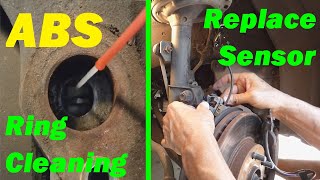

The information in this article is provided for general reference and educational purposes only. Vehicle specifications, procedures, and part compatibility can vary by production date, trim level, and region. Always consult your vehicle's factory service manual and verify part numbers before purchasing or performing repairs. Safety-critical components such as airbags, seat belts, and braking systems should be installed by a qualified professional.
- 🎬 Helpful Videos
- What Does C1104 Mean?
- Can I Drive With C1104?
- Common Causes
- Symptoms
- Diagnostic Flowchart
- Common Fixes & Costs
- Used vs. New Parts: Buying Guide
- What Happens If You Wait — Timeline
- Cost of Not Fixing It
- Diagnosis Steps
- When This Code Triggers (Freeze-Frame Conditions)
- Related Codes
- Climate & Environmental Factors
- How to Talk to a Mechanic About This Code
- Where to Take It: Dealer vs Independent vs Chain
- When to Walk Away From the Repair
- What Scan Tool You Need for This Code
- How to Clear the Code After You Fix It
- Will This Fail Emissions / State Inspection?
- Manufacturer-Specific Notes
- Real Owner Stories
- 2009 Nissan Frontier with C1104
- 2014 Nissan Juke with intermittent C1104
- 2015 Nissan Frontier with multiple warning lights
- How to Prevent This Code From Triggering
- Frequently Asked Questions
- I replaced the ABS sensor but the C1104 code came back. What's next?
- Can a bad wheel bearing cause a C1104 code?
- My ABS, VDC/Slip, and 4WD lights are all on. Is this one problem or many?
- What is the difference between a passive and active ABS sensor?
- How much does it cost to fix a C1104 code?
- Why do I need a special scanner for ABS codes?
- Can I just clear the code?
- Key Takeaways
- 🎟️ Get 5% Off