

Ultimate Guide to OBD-II Code C1043: Left Rear Wheel Speed Signal Performance
The Most Comprehensive Guide to Diagnosing and Fixing C1043 for DIYers and Professionals
- Code C1043 disables your ABS and Traction Control because the module detects an erratic speed signal from the left rear wheel.
- Do not blindly replace the $50 wheel speed sensor; the root cause is usually a cracked tone ring or a failing wheel bearing.
- Graph live wheel speed data using an OBD-II scanner above 25 mph to instantly confirm if the left rear signal is dropping out.
- Always jack up the left rear wheel and check for play at the 12 and 6 o'clock positions to rule out a $300-$800 wheel bearing failure.
- On BMW E9x models, inspect the driveshaft reluctor ring for rust swelling, which physically scrapes and destroys the sensor.
What Does C1043 Mean?

Code C1043 means the Anti-Lock Brake System (ABS) module detects a performance problem with the left rear wheel speed sensor signal. Unlike a circuit code pointing to an electrical failure, C1043 indicates the signal is erratic, dropping out periodically, or implausible compared to other wheels while the vehicle is in motion. The ABS module disables safety systems as a precaution because it cannot rely on this corrupted data to prevent wheel lock-up.
Technical definition: The official SAE/ISO definition for C1043 translates to "Left Rear Tone Wheel Performance" or "Abnormality in Periodical Signal for Left Rear Wheel Speed Sensor." The ABS module sets this fault when it sees intermittent or illogical signal drops from the left rear sensor while the vehicle moves above 25 mph (40 km/h).
Can I Drive With C1043?
Yes, But With Caution. Yes, but drive with extreme caution. Your Anti-lock Braking System (ABS) and Traction/Stability Control systems are disabled. This means the wheels lock during hard braking, increasing stopping distances by 15-25% on wet or slippery surfaces and causing a loss of steering control in a panic stop. Your standard hydraulic brakes function, but the enhanced safety features do not. Ignoring the underlying cause, such as a bad wheel bearing, leads to severe mechanical failure.
Common Causes

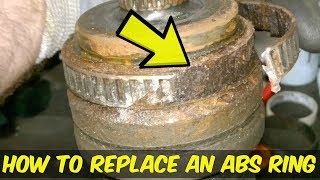
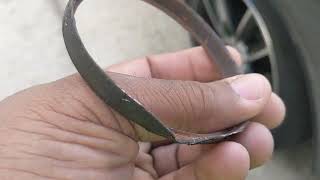
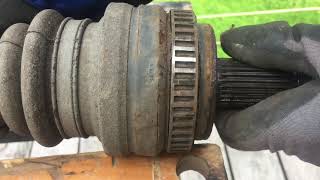
- Damaged, Corroded, or Contaminated ABS Tone Ring (Very Common) — The tone ring (or reluctor ring) is the most frequent culprit. It cracks, loses teeth, or gets covered in rust. On many BMW, Dodge, and Chrysler vehicles, rust builds up underneath the ring, causing it to swell, distort, and physically destroy the sensor.
- Failing or Loose Wheel Bearing (Common) — A worn wheel bearing allows excessive movement in the hub. This constantly changes the critical air gap between the sensor and tone ring, leading to an erratic or lost signal.
- Faulty Left Rear Wheel Speed Sensor (Common) — The sensor fails internally due to age or heat cycles. It also becomes contaminated with metallic grime, obscuring its reading, or gets seized in the hub from corrosion.
- Wiring and Connector Issues (Less Common) — The wiring harness is exposed to the elements. Wires fray or break from road debris, and connector pins corrode in rust-prone areas, leading to intermittent connections.
- Loose Axle Fastener (Less Common) — A loose axle nut causes lateral 'in-out' play in the axle shaft, disrupting the signal between the tone ring and sensor even if the wheel bearing feels tight vertically.
- Incorrectly Installed or Incompatible Parts (Less Common) — A new wheel speed sensor that isn't fully seated, a new wheel bearing with a damaged magnetic encoder, or a tone ring damaged during installation triggers this code immediately after a repair.
Symptoms

- ABS and Traction Control Lights On — The primary symptom. The ABS, Traction Control (TCS), and Electronic Stability Control (ESC) lights illuminate on the dashboard because the systems are disabled.
- Brake Pedal Pulsation or Grinding Noise — A grinding noise or pulsation that changes with wheel speed indicates a bad wheel bearing or a swollen tone ring making physical contact with the sensor.
- Erratic ABS Activation at Low Speeds — The brake pedal pulsates or the ABS pump activates at low speeds (e.g., pulling into a parking spot) because the system incorrectly thinks a wheel is locking up due to the faulty signal.
- Cruise Control Inoperative — Most vehicles disable the cruise control system when an ABS fault is present as a safety measure.
- Juddering or Power Loss on Turns — On rear-wheel-drive vehicles (especially BMWs), a faulty wheel speed sensor causes the traction control to activate inappropriately during turns, resulting in juddering or cutting engine power.
Diagnostic Flowchart
Tap your situation to follow the diagnostic path that matches what you're seeing on this code.
Common Fixes & Costs
- Replace the Left Rear Wheel Bearing/Hub Assembly — Parts: $100-$300, Labor: $200-$500, ~2 hr book time (Professional)
- Replace the ABS Tone Ring Only — Parts: $25-$75, Labor: $200-$400, ~3 hr book time (Intermediate)
- Replace the Left Rear Wheel Speed Sensor — Parts: $40-$150, Labor: $100-$300, ~1 hr book time (DIY)
- Repair Damaged Wiring or Connector — Parts: $5-$50, Labor: $100-$250, ~1.5 hr book time (DIY)
- Clean the Tone Ring and Sensor — Parts: $0-$15, Labor: $50-$100, ~0.5 hr book time (DIY)
DIY vs Professional
- Replace the Left Rear Wheel Bearing/Hub Assembly — Beginner: No
Tools: Breaker bar, large axle nut socket, torque wrench, 12-point sockets, slide hammer. - Replace the ABS Tone Ring Only — Beginner: No
Tools: Hub replacement tools, shop press or bearing puller, chisel, ring installation tool. - Replace the Left Rear Wheel Speed Sensor — Beginner: Yes
Tools: Basic hand tools, jack, jack stands, penetrating oil. - Repair Damaged Wiring or Connector — Beginner: No
Tools: Digital multimeter, wiring diagrams, wire strippers, soldering iron, heat shrink tubing. - Clean the Tone Ring and Sensor — Beginner: Yes
Tools: Basic hand tools, jack, jack stands, brake cleaner, wire brush.
Used vs. New Parts: Buying Guide
When a used part is worth it: Buying a used wheel bearing or hub assembly is never recommended. These are critical wear-and-tear components with unknown lifespans. The high labor cost for installation makes the risk of premature failure unacceptable. Used electronic modules (like the ABS controller) are acceptable if sourced from a reputable recycler.
Donor-vehicle mileage cap: roughly under 20000 miles for the part to have meaningful remaining life.
Donor quality checklist:
- Verify the donor vehicle had very low mileage and was scrapped for reasons unrelated to the suspension or drivetrain.
- Avoid parts from rust-belt regions, as corrosion is the primary cause of failure.
- Match the part number exactly.
Decision logic:
- If The part is a wheel bearing or hub assembly. → Buy a new, quality aftermarket (e.g., Timken, SKF, MOOG) or OEM part. The repeat-labor cost of a used part failing is too high.
- If Budget is the primary concern. → A new, value-priced aftermarket hub assembly is safer and more reliable than a used OEM part.
- If The part is an electronic module like the ABS controller. → A used part from a reputable recycler with a warranty is a cost-effective option.
Warranty tradeoff: Used parts typically come with a 30-90 day part-only warranty, which does not cover the hundreds of dollars in labor to replace it if it fails. New aftermarket parts offer 1-year to lifetime warranties.
Worst-case if a used part fails: $400-$800. If a used wheel bearing fails after installation, you pay the full labor cost again plus the cost of another part.
What Happens If You Wait — Timeline
- 0-1 month: ABS and traction control lights illuminate. Code C1043 is stored. There are no audible or physical symptoms. Cruise control is disabled. (MPG impact: 0-1%% · Added cost: $0)
- 1-4 months: If caused by a failing bearing, a faint humming or droning noise begins above 40 mph. Transmission shifting becomes slightly harsher on some models. (MPG impact: 1-3%% · Added cost: $20-80 in wasted fuel and potential for minor tire wear.)
- 4-8 months: Bearing noise progresses to a distinct growling or grinding. Steering wheel vibration becomes noticeable. Excessive play causes uneven tire wear. (MPG impact: 3-5%% · Added cost: $300-$800. The repair now requires a new wheel bearing and possibly a new tire.)
- 8+ months: Catastrophic failure is imminent. The wheel feels loose or wobbles. The bearing seizes or separates from the axle, causing a total loss of control. (MPG impact: N/A% · Added cost: $2,000-$10,000+. Cost includes hub, axle, body, and suspension damage from wheel detachment.)
Cost of Not Fixing It
- 0-1 month: Immediate loss of ABS, traction control, and stability control, creating a significant safety risk in emergency maneuvers or slippery conditions. Incorrect transmission shifting occurs on some models. (Added cost: Negligible, unless an accident occurs due to disabled safety systems.)
- 1-6 months: If caused by a failing wheel bearing, continued driving leads to worsening noise, vibration, and excessive tire wear. The bearing failure damages the wheel hub and axle spindle. (Added cost: $200-$600. A repair requiring just a bearing assembly now requires a new hub or axle components damaged by the failure.)
- 6+ months: Catastrophic wheel bearing failure causes the wheel to seize completely or detach from the vehicle while driving, leading to a total loss of control. (Added cost: $2,000-$10,000+. The cost of repairing suspension, body, and axle damage after a wheel separation, plus the immense safety risk.)
Diagnosis Steps

- Read and Verify the Code
Use an OBD-II scanner capable of reading ABS codes to confirm C1043 is present. Note any related codes. Clear the codes and drive above 25 mph (40 km/h) to see if the code returns, confirming an active fault.
Tools: OBD-II Scanner with ABS capability (Beginner) - Graph Live Sensor Data
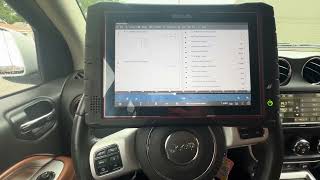
The most effective diagnostic step. Use an advanced scan tool to graph the output of all four wheel speed sensors while driving. The left rear graph will show sharp dropouts to zero or a noisy pattern compared to the smooth waves of the other sensors.
Tools: Advanced OBD-II Scanner with live data graphing (Advanced) - Inspect the Tone Ring and Sensor
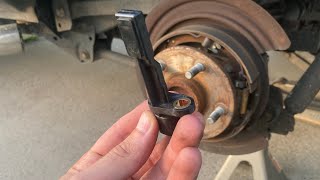
Safely raise the vehicle. Remove the left rear wheel speed sensor (typically one 8mm or 10mm bolt). Shine a light into the hole and slowly rotate the axle. Look for cracks, missing teeth, heavy rust, or a swollen ring surface. On BMWs, look for scrape marks on the sensor tip.
Tools: Jack, jack stands, flashlight, 8mm or 10mm socket, ratchet (Intermediate) - Check for Wheel Bearing and Axle Play
Grab the left rear wheel at 12 and 6 o'clock and rock it. Any significant movement or clunking indicates a bad wheel bearing. Push and pull the axle shaft in and out to check for lateral play caused by a loose axle nut.
Tools: Jack, jack stands (Intermediate) - Test Sensor and Wiring with a Multimeter
Disconnect the sensor harness. For a passive sensor, check resistance (typically 800-2,500 Ohms). For an active sensor, check for reference voltage (5V or 12V) at the harness connector with the key on. Test wiring for continuity and shorts to ground.
Tools: Digital Multimeter, vehicle-specific wiring diagram (Advanced) - Analyze the Signal with an Oscilloscope
Connect an oscilloscope to the sensor's signal and ground wires. Spin the wheel to view the waveform. A C1043 fault manifests as a messy waveform, missing sections, or uneven amplitude, proving the signal is corrupt.
Tools: Automotive Oscilloscope (Professional) - Check for Technical Service Bulletins (TSBs)
Check for TSBs related to code C1043 for your specific vehicle. Manufacturers occasionally release software updates or identify specific production issues that cause this code.
Tools: Online access to TSB databases (Intermediate) - [SUZUKI ONLY] Check Fuel Pressure
On certain Suzuki models, C1043 indicates 'Fuel Rail Pressure Too High'. Connect a high-pressure gauge to the fuel rail and observe pressure at idle to see if it exceeds the manufacturer threshold.
Tools: High-Pressure Fuel Gauge, Service Manual (Advanced)
When This Code Triggers (Freeze-Frame Conditions)
- Vehicle Speed: 25-60 mph (40-97 km/h) (Steady highway or city driving. The code triggers from an erratic signal over time, not during a single event like hard braking.)
- Engine RPM: 1500-2500 (Consistent with steady cruising speed.)
- Brake Pedal Status: Off (The fault logs during normal driving when the brakes are not applied.)
- System Voltage: 13.0-14.5V (Normal charging system operation. Low voltage is not a typical trigger for this specific performance code.)
Related Codes
- C1027 — A Chrysler-specific code for 'Left Rear Wheel Speed Sensor Signal Erratic Performance'. Seeing C1027 and C1043 together strongly suggests a mechanical failure (cracked ring, bearing play) rather than an electrical fault.
- U1417 — Means 'Implausible Left Wheel Speed Signal Received' on Chrysler/Jeep products. Seeing this with C1043 confirms the signal is so illogical the module rejects it entirely.
- C102A — A Chrysler/Jeep code for 'Left Rear Wheel Speed Sensor Circuit'. If present with C1043, it points to an internal sensor failure affecting the circuit and producing an erratic signal, or a wiring issue.
- C1020 — Indicates a 'Left Rear Wheel Speed Sensor Circuit Malfunction.' If present with C1043, it points toward a complex fault, possibly an internal sensor failure or wiring short.
Climate & Environmental Factors
- Road Salt / De-icing Agents: The single most significant factor. Salt accelerates corrosion, causing steel tone rings on Dodge/Chrysler vehicles to crack and BMW reluctor rings to swell and destroy the sensor.
- High Humidity / Coastal Climates: High ambient moisture promotes corrosion of the tone ring, sensor body, and electrical connector pins, leading to intermittent signals.
- Off-Roading / Mud & Debris: Exposure to mud and water accelerates wear on wheel bearing seals. Compromised seals allow contaminants to destroy the bearing and integrated magnetic encoder.
How to Talk to a Mechanic About This Code
Say this: "I have an ABS light on and my scanner shows code C1043, which is 'Left Rear Tone Wheel Performance'. I'd like to book a diagnostic appointment. Please instruct the technician to physically inspect the tone ring for cracks or rust, and check the wheel bearing for play before recommending a new sensor."
This signals you understand C1043 is a mechanical/performance issue, not just a bad sensor. It directs the mechanic to perform the correct diagnostic steps first, preventing them from simply replacing the cheapest part.
Avoid saying:
- 'My ABS light is on, can you fix it?'
- 'I think I need a new ABS sensor.'
- 'Just replace whatever is needed to turn the light off.'
Questions to ask before authorizing the repair:
- What was the condition of the tone ring upon inspection? Were there any visible cracks, rust swelling, or damage?
- Did you find any play in the wheel bearing when you checked it at the 12 and 6 o'clock positions?
- Were you able to graph the live data from the wheel speed sensors? Can you show me the printout of the faulty signal?
- What is the warranty on the recommended parts and the labor?
Where to Take It: Dealer vs Independent vs Chain
- Dealer:
Best for: Vehicles still under a bumper-to-bumper or extended warranty., Complex manufacturer-specific quirks (e.g., Suzuki or Nissan where C1043 has a different meaning)., If an independent shop has already failed to diagnose the issue correctly.
Downsides: Significantly higher labor rates and parts costs., Defaults to replacing a more expensive assembly (like a full axle shaft on a BMW) when a smaller component repair is possible. (Typical cost: +50% vs. baseline) - Independent Shop:
Best fit. C1043 is a very common code with straightforward mechanical causes. A reputable independent shop is the most cost-effective choice for a reliable repair.
Best for: Most out-of-warranty vehicles, especially common models like Jeeps, Dodges, and BMWs., Cost-conscious owners, as labor and parts are competitively priced.
Downsides: Shop quality and diagnostic skill vary greatly. Vet shops based on reviews and ASE certifications., May lack specialized tools for certain repairs (e.g., pressing on a new tone ring). (Typical cost: +0% vs. baseline) - Chain Shop:
Use with caution. Acceptable if you need a simple sensor replaced. AVOID for initial diagnosis, as they are likely to misdiagnose the root cause.
Best for: Simple, clear-cut part replacements if you have already diagnosed the problem yourself.
Downsides: Technician skill varies dramatically; they may lack the experience to diagnose beyond replacing the sensor., High pressure to upsell. May recommend replacing calipers, rotors, and pads when only the hub is needed. (Typical cost: -10% vs. baseline)
When to Walk Away From the Repair
If the estimated repair cost exceeds 40-50% of your car's private-party value, pause and consider your options.
- Car worth $5000, fix is $700: Fix it. This repair is well below the threshold and restores a critical safety system.
- Car worth $3000, fix is $1500: Walk away. The repair cost is 50% of the car's value. It's not financially prudent to invest this much into an older vehicle.
- Car worth $15000, fix is $1200: Fix it. The cost is a small fraction of the vehicle's value and is a necessary safety repair.
What Scan Tool You Need for This Code

Minimum: A scanner that can read and clear codes from the Anti-lock Braking System (ABS) module. A basic engine-only code reader will not work.
A $20 engine code reader cannot communicate with the ABS module. It will not see the C1043 code, cannot clear the ABS light, and cannot show you the live wheel speed data needed for an accurate diagnosis.
Budget: BlueDriver Pro Scan Tool (~$100) — Connects to your smartphone via Bluetooth. It reads and clears ABS codes and graphs live data from all four wheel speed sensors, allowing you to see the erratic signal from the faulty wheel.
Mid-range: Foxwell NT510 Elite (~$180) — A powerful handheld unit providing OE-level diagnostics for a specific car make. It excels at reading ABS codes and displaying live sensor data in a graph format to easily pinpoint the faulty wheel.
Professional: Autel MaxiCOM MK808BT (~$550) — A professional-grade wireless tablet scanner. It provides full system diagnostics, including advanced ABS functions and live data graphing.
Rent vs buy: Many auto parts stores read codes for free, but their store-use tools often cannot clear ABS codes or show live data. Buying a tool like the BlueDriver is a smart investment, allowing you to perform the critical live data diagnosis yourself.
How to Clear the Code After You Fix It
- Use an OBD-II scan tool with ABS capabilities to clear the fault code from the ABS module.
- Perform a short test drive reaching speeds above 25 mph (40 km/h) to allow the ABS module to verify the repair.
- Re-scan the ABS module to confirm the C1043 code has not returned.
Drive cycle (~10 minutes): After clearing the code, start the vehicle and drive for 5-10 minutes, ensuring you reach a steady speed above 25 mph (40 km/h). If the ABS light remains off, the repair is successful. The ABS system self-test is continuous and sets a fault quickly if the problem persists.
Readiness monitors affected: ABS and traction control systems do not use readiness monitors. A battery disconnect resets emissions monitors but does not reliably clear an ABS code.
Watch out for:
- Using a basic code reader that only accesses the engine control unit (ECU) cannot clear the code from the ABS module.
- The code returns immediately if the root mechanical cause (e.g., a cracked tone ring or bad wheel bearing) is not fixed, even if you replace the sensor.
- Disconnecting the battery is not a reliable method for clearing ABS fault codes.
Will This Fail Emissions / State Inspection?
No — by itself this code doesn't fail OBD inspection (but it can keep readiness monitors from setting, which causes a separate fail).
- California: An illuminated ABS light does NOT cause a failure of the standard biennial smog check. The test only concerns emissions and the Check Engine Light.
- New York: An illuminated ABS warning light WILL cause a failure of the annual safety inspection. The system must be functional.
- Texas: An illuminated ABS light does NOT cause a failure of the state safety inspection, provided the standard service brakes work correctly.
Most Commonly Affected Vehicles
- Jeep Wrangler (JK) (2007-2018) — Extremely common. Caused by a bad wheel bearing/hub assembly containing the magnetic encoder ring. Aftermarket oversized tires accelerate bearing wear.
- BMW 1-Series / 3-Series (E8x, E9x) (2004-2013) — Notorious for rear driveshaft reluctor rings corroding underneath, expanding, and physically destroying the ABS sensor. Requires replacing the ring or axle shaft.
- Dodge Charger / Magnum (2006-2010) — Frequently caused by the separate tone ring on the rear axle cracking or delaminating due to rust. Loose axle nuts also cause this.
- Chrysler 300 (2005-2010) — Shares the platform and axle design with the Dodge Charger, making it highly susceptible to tone ring failures from corrosion.
- Jeep Compass / Patriot (2007-2017) — Rust buildup between the CV axle and wheel bearing 'jacks' the components apart, damaging the magnetic encoder ring integrated into the bearing seal.
- Ford F-150 / Expedition (2004-2014) — Issues point to wiring harness damage near the sensor connector or problems with the integrated sensor in the sealed rear wheel bearing hub assembly.
- Hyundai Santa Fe / Sonata (2007-2012) — Failures relate to the sensor failing internally or corrosion building up within the electrical connector pins.
- Mitsubishi Outlander / Lancer (2007-2013) — Official service information emphasizes checking for a loose wheel bearing as the primary cause of an incorrect sensor-to-encoder air gap.
Manufacturer-Specific Notes
- Chrysler/Dodge/Jeep: Well-known for separate, press-on rear ABS tone rings that crack or delaminate from rust. Loose axle nuts also cause axle play and trigger this code.
- BMW: On E9x 3-Series, the separate reluctor ring on the driveshaft rusts underneath, swells, and physically scrapes against the ABS sensor, destroying the signal.
- Nissan: CRITICAL: On some Nissan models (Maxima, Note), code C1043 points to the Rear Right sensor rotor, not the left. Verify the code definition for the specific model.
- Suzuki: CRITICAL: On some Suzuki models (Swift), C1043 indicates a 'Master Cylinder Cut Solenoid Circuit Failure' or 'Fuel Rail Pressure Too High'. A model-specific scanner is essential.
- Mitsubishi: Diagnostic procedures emphasize checking for a loose wheel bearing as the primary cause of an incorrect sensor gap before suspecting other components.
Real Owner Stories
2010 Jeep Wrangler JK - The Classic Misdiagnosis
ABS/Traction Control/ESP BAS lights came on during a highway drive. Cruise control stopped working, but the vehicle drove normally otherwise.
What they tried:
- Read code C1043 - Left Rear Tone Wheel Performance.
- Replaced the left rear wheel speed sensor. The lights turned off, but came back on 10 seconds later.
Outcome: The actual problem was a bad wheel bearing. The temporary fix of replacing the sensor failed because the underlying mechanical issue (play in the bearing) was still present, corrupting the signal from the new sensor.
Lesson: Don't just replace the sensor for a 'Tone Wheel Performance' code. Always inspect the wheel bearing for play and the tone ring for damage before buying parts.
2006 Dodge Charger - Rusted and Cracked Tone Ring
ABS, BAS, and traction control lights were on. Scan showed codes C1043 and C1027. The owner also had a P0730 (Incorrect Gear Ratio) code and the transmission was going into limp mode.
What they tried:
- Owner suspected a bad tone ring due to living in a rust-prone area.
- Removed the wheel speed sensor and shined a light inside, confirming the tone ring had corroded and cracked.
Outcome: Replaced the separate, press-on tone ring on the rear axle shaft. This fixed all ABS codes and the transmission code, restoring normal shifting. Total part cost was $25.
Lesson: On Dodge/Chrysler vehicles, a bad wheel speed signal tricks the transmission module into setting false codes. Fix the ABS issue first. The tone ring is the most likely culprit in rust-belt states.
2014 Jeep Compass - Rust Jacking the Bearing
ABS and 4WD lights on with code C1043 and U1415. Vehicle had only 49,000 miles.
What they tried:
- A technician inspected the left rear wheel and found significant rust buildup between the CV axle and the wheel bearing.
- Graphing live data from the wheel speed sensor showed clear spikes and dropouts in the signal.
Outcome: Rust buildup physically pushed on and chewed up the magnetic encoder ring integrated into the wheel bearing's seal. The only fix was replacing the entire wheel bearing/hub assembly.
Lesson: On Jeep Compass/Patriot models, rust damages the magnetic encoder on the bearing itself. Even on lower mileage vehicles, environmental factors require a full hub replacement.
DIY Repair Gone Wrong - Damaged Tone Ring
Immediately after having the rear CV axle seals replaced by a mechanic, the ABS, ESP/BAS, and traction lights came on with code C1043.
What they tried:
- The owner confirmed with the mechanic that the tone ring was likely nicked during the axle seal replacement.
Outcome: Instead of replacing the entire CV axle, the owner purchased just the ABS tone ring online for $25 and pressed it onto the existing axle.
Lesson: If C1043 appears immediately after a repair involving the axle or hub, it is highly probable the tone ring was damaged during service.
How to Prevent This Code From Triggering
- Perform annual underbody rust proofing. (Once per year, especially before winter in rust-belt states.) — Applying a wax or oil-based undercoating creates a barrier against road salt and moisture, preventing the corrosion that causes tone rings to crack or swell.
- Regularly wash the vehicle's undercarriage. (Every 2-3 weeks during winter months.) — Washing removes the buildup of corrosive road salt and de-icing brines from the suspension, hub, and sensor components.
- Clean the ABS sensor and mounting area during brake jobs. (Every time brakes are replaced.) — Brake dust contains fine metallic particles that contaminate the magnetic tip of the sensor. Cleaning prevents this buildup and ensures a clean signal.
- Avoid driving through deep standing water or mud. (Daily habit.) — Submerging wheel hubs forces water and grit past the bearing seals, washing out grease and corroding internal parts.
- Inspect for wheel play and noise periodically. (Annually or during every tire rotation.) — Early detection of a failing wheel bearing allows for replacement before it fails catastrophically, preventing secondary damage to the hub or axle.
Frequently Asked Questions
What is the most common cause of code C1043?
The most common cause is a physically damaged tone ring—cracked, swollen with rust, or contaminated. A failing wheel bearing causing excessive play is the second most common cause. The sensor itself is a less frequent culprit for this specific performance code.
Why did the ABS light come back on after I replaced the sensor?
This almost always means the sensor was not the root cause. The problem is likely a cracked or swollen tone ring, a failing wheel bearing causing excessive play, or an intermittent break in the wiring harness. You must diagnose the entire system, not just replace the easiest part.
Can I just clean the ABS sensor to fix C1043?
You can try, and if the issue is merely a buildup of metallic debris, it might work. However, C1043 is a performance code usually caused by a physical deformity like a crack or rust swelling on the tone ring. Cleaning will not fix physical damage.
What is an ABS tone ring?
An ABS tone ring (or reluctor ring) is a notched or toothed ring that spins with the wheel. The ABS sensor reads these teeth to measure wheel speed. On newer cars, this is often a magnetic encoder ring integrated into the wheel bearing seal.
Is it safe to drive with the ABS light on?
Your normal brakes still work, but you lose the crucial safety net of ABS, traction control, and stability control. In a panic stop, your wheels can lock up, increasing stopping distance and causing a loss of steering control. Do not drive for an extended period in this condition.
How much does it cost to fix code C1043?
Costs vary widely based on the root cause. A sensor replacement runs $150-$450, while a tone ring replacement costs $250-$450 due to labor. The most common repair, a wheel bearing hub assembly, typically costs $300-$800 at an independent shop.
What is a common misdiagnosis for C1043?
The most common misdiagnosis is immediately replacing the wheel speed sensor without inspecting the tone ring or checking for wheel bearing play. A technician who fails to check for subtle cracks in the ring will likely have the car come back with the same problem. Always verify mechanical components first.
Will a bad wheel speed sensor affect my transmission?
Yes, on some vehicles it causes transmission issues. The transmission control module (TCM) uses wheel speed data to determine shift points. An incorrect signal from a rear wheel causes harsh shifting, incorrect gear selection, or forces the vehicle into limp mode.
Key Takeaways
- Code C1043 disables your ABS and Traction Control because the module detects an erratic speed signal from the left rear wheel.
- Do not blindly replace the $50 wheel speed sensor; the root cause is usually a cracked tone ring or a failing wheel bearing.
- Graph live wheel speed data using an OBD-II scanner above 25 mph to instantly confirm if the left rear signal is dropping out.
- Always jack up the left rear wheel and check for play at the 12 and 6 o'clock positions to rule out a $300-$800 wheel bearing failure.
- On BMW E9x models, inspect the driveshaft reluctor ring for rust swelling, which physically scrapes and destroys the sensor.
Helpful Videos

The information in this article is provided for general reference and educational purposes only. Vehicle specifications, procedures, and part compatibility can vary by production date, trim level, and region. Always consult your vehicle's factory service manual and verify part numbers before purchasing or performing repairs. Safety-critical components such as airbags, seat belts, and braking systems should be installed by a qualified professional.
- 🎬 Helpful Videos
- What Does C1043 Mean?
- Can I Drive With C1043?
- Common Causes
- Symptoms
- Diagnostic Flowchart
- Common Fixes & Costs
- DIY vs Professional
- Used vs. New Parts: Buying Guide
- What Happens If You Wait — Timeline
- Cost of Not Fixing It
- Diagnosis Steps
- When This Code Triggers (Freeze-Frame Conditions)
- Related Codes
- Climate & Environmental Factors
- How to Talk to a Mechanic About This Code
- Where to Take It: Dealer vs Independent vs Chain
- When to Walk Away From the Repair
- What Scan Tool You Need for This Code
- How to Clear the Code After You Fix It
- Will This Fail Emissions / State Inspection?
- Most Commonly Affected Vehicles
- Manufacturer-Specific Notes
- Real Owner Stories
- 2010 Jeep Wrangler JK - The Classic Misdiagnosis
- 2006 Dodge Charger - Rusted and Cracked Tone Ring
- 2014 Jeep Compass - Rust Jacking the Bearing
- DIY Repair Gone Wrong - Damaged Tone Ring
- How to Prevent This Code From Triggering
- Frequently Asked Questions
- What is the most common cause of code C1043?
- Why did the ABS light come back on after I replaced the sensor?
- Can I just clean the ABS sensor to fix C1043?
- What is an ABS tone ring?
- Is it safe to drive with the ABS light on?
- How much does it cost to fix code C1043?
- What is a common misdiagnosis for C1043?
- Will a bad wheel speed sensor affect my transmission?
- Key Takeaways
- 🎟️ Get 5% Off