

OBD-II Code C1034: Electronic Parking Brake or Wheel Speed Sensor Fault
What C1034 means, why it triggers, and how to fix it
- Code C1034 points to an Electronic Parking Brake (EPB) failure on most cars (especially Ford) and a rear wheel speed sensor fault on Harley-Davidson motorcycles.
- Inspect the rear wiring pigtail harness before replacing the $300+ EPB actuator, as corroded wires cause over 80% of C1034 codes on Ford vehicles.
- Driving with an active C1034 code disables your ABS and stability control, significantly increasing your accident risk on wet or slippery roads.
- Scan for companion codes like C2007 (right side) or C2008 (left side) to instantly pinpoint which rear wheel contains the electrical fault.
What Does C1034 Mean?

Code C1034 indicates your vehicle's Anti-lock Brake System (ABS) module detected a fault related to the right rear wheel. For most Ford, Lincoln, and GM vehicles, it signifies a problem with the Electronic Parking Brake (EPB) actuator, usually a stuck motor or an undetectable position. For Harley-Davidson motorcycles, it points to an open or shorted circuit for the rear wheel speed sensor.
Technical definition: The official definition for C1034 varies by manufacturer. For Ford models, it is defined as 'Parking Brake Actuator Stuck' or 'Right Rear Wheel Speed Sensor Coherency Fault'. For Harley-Davidson, it is 'Rear Wheel Speed Sensor Circuit Open or Shorted'. For Mazda, a C1034:48 indicates the control unit rejected an EPB control request for safety reasons.
Can I Drive With C1034?
Yes, But With Caution. You can drive, but do so with extreme caution. Critical safety systems including your Anti-lock Braking System (ABS), electronic stability control, and traction control are disabled, significantly increasing the risk of losing control on slippery surfaces. Furthermore, the electronic parking brake can fail to release, leaving you stranded, or fail to engage, allowing the vehicle to roll away when parked. Driving with a partially engaged brake causes extreme heat, destroying the brake pads, rotors, and caliper, adding hundreds of dollars to the final repair bill.
Common Causes

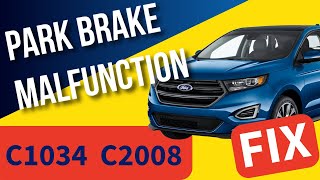
- Damaged or Corroded Wiring Harness and Connectors (Very Common) — The wiring pigtail and electrical connectors going to the electronic parking brake motor or wheel speed sensor are highly exposed to road salt and water. Wires corrode internally, showing green crust, or break from suspension movement, causing an open circuit. Moisture also penetrates weather seals, corroding connector pins. This is the number one cause on Ford vehicles. 🎬 Watch: How to fix C1034 and C2007 on a Ford Edge.
- Failed Electronic Parking Brake (EPB) Actuator (Common) — The electric motor (actuator) that engages and disengages the parking brake fails due to internal wear or an electrical short. This is a common failure point often misdiagnosed when the real problem is the wiring.
- Improper Rear Brake Service Procedure (Common) — If the EPB system is not put into 'Maintenance Mode' using a scan tool before a rear brake job, manually forcing the caliper piston back permanently damages the internal gearing of the EPB actuator, triggering this code immediately.
- Failed Rear Wheel Speed Sensor (Common) — On vehicles like Harley-Davidson motorcycles, a faulty rear wheel speed sensor is the primary trigger. The sensor itself fails, or the wiring leading to it becomes damaged.
- Low Vehicle Battery Voltage (Less Common) — The ABS and EPB control modules are highly sensitive to system voltage. A weak or failing battery provides insufficient voltage, causing modules to behave erratically and set false diagnostic trouble codes.
- Failure to Calibrate New Components (Less Common) — After replacing an EPB actuator or ABS module, a calibration procedure must be performed with a scan tool. Skipping this 'apply and release' routine causes the code to persist.
- Faulty ABS Control Module (Rare) — In rare instances, the fault lies within the ABS control module itself. This is a last resort after exhaustively testing all wiring, sensors, and actuators. This fault often sets secondary codes like U3000.
Symptoms

- Parking Brake is Stuck (On or Off) — You are unable to apply the electronic parking brake, or you are unable to release it once applied, potentially stranding the vehicle.
- Dashboard Warning Lights and Messages — A 'Parking Brake Malfunction Service Now' message appears on the dash. The red 'BRAKE' or yellow 'P' light stays illuminated or flashes continuously.
- ABS and Traction Control Warning Lights On — The amber ABS and traction control (ESC) lights illuminate, signaling these critical safety systems are disabled.
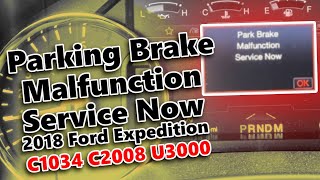
- Audible Dashboard Warning Chimes — The vehicle produces persistent beeping or chiming sounds 🎬 See a diagnostic walkthrough for C1034 and U3000 on an Expedition. to alert the driver to the active brake system fault.
- Shift System Fault Message — On modern vehicles like the Mustang Mach-E, a CAN bus network fault from the brake system causes related warnings, such as a 'Shift System Fault'.
Diagnostic Flowchart
Tap your situation to follow the diagnostic path that matches what you're seeing on this code.
Common Fixes & Costs
- Repairing or Replacing the Rear Wiring Harness Pigtail — Parts: $30-$60, Labor: $150-$250, ~1.5 hr book time (Intermediate)
- Replacing the Electronic Parking Brake Actuator/Motor — Parts: $100-$300, Labor: $100-$200, ~1.2 hr book time (Intermediate)
- Replacing the Rear Wheel Speed Sensor — Parts: $50-$150, Labor: $90-$150, ~1 hr book time (DIY)
- Replacing the In-Cabin Parking Brake Switch — Parts: $50-$150, Labor: $100-$150, ~1 hr book time (DIY)
- Replacing the ABS Control Module — Parts: $600-$1,500, Labor: $150-$300, ~2 hr book time (Professional)
Used vs. New Parts: Buying Guide
When a used part is worth it: Always buy a new wiring pigtail. Buying a used EPB actuator is risky but makes sense if the vehicle is old (>150k miles), the budget is tight, and the used part comes from a low-mileage donor with a warranty.
Donor-vehicle mileage cap: roughly under 60000 miles for the part to have meaningful remaining life.
Donor quality checklist:
- Verify the part number exactly to avoid older, failure-prone designs.
- Avoid parts from flood-damaged or rust-belt vehicles.
- Demand a functional warranty of at least 30-90 days.
Decision logic:
- If The part is a wiring pigtail → Always buy new; the cost is minimal.
- If The part is an EPB actuator and a new aftermarket version with a multi-year warranty is available for a similar price to a used OEM part → Buy the new aftermarket part for the longer warranty.
- If Vehicle is newer or has lower mileage (<100K miles) → Buy a new OEM or high-quality aftermarket actuator.
Warranty tradeoff: Used parts typically offer a 30-90 day warranty covering only the part. New aftermarket actuators come with a 1-year to lifetime warranty. New OEM parts carry a 1-2 year warranty.
Worst-case if a used part fails: $250-$400 if a used actuator fails after the warranty period, requiring repeat labor and a new part.
What Happens If You Wait — Timeline
- 0-2 weeks: Warning lights illuminate and a 'Parking Brake Malfunction' message appears. ABS and stability control are disabled, but the vehicle drives normally if the brake is not stuck. (MPG impact: 0%% · Added cost: $0)
- 2 weeks - 2 months: If the fault prevents the brake from fully disengaging, it begins to drag. You notice a slight burning smell after driving and a feeling of sluggishness. Fuel economy decreases. (MPG impact: 5-10%% · Added cost: $50-$150 in wasted fuel)
- 2-6 months: Constant drag generates extreme heat, rapidly wearing down the brake pad and scoring the brake rotor. The burning smell becomes prominent, and the rotor appears discolored. (MPG impact: 10-15%% · Added cost: $300-$500 (New brake pads and rotor for one wheel are required).)
- 6+ months: Extreme heat cooks the brake caliper, damaging its seals and boiling the brake fluid. The wheel bearing seal is damaged, leading to bearing failure. (MPG impact: 15-25%% · Added cost: $600-$1200 (New caliper, pads, rotor, and potentially a wheel bearing and hub assembly).)
Cost of Not Fixing It
- Immediate: Loss of ABS, traction control, and stability control. This significantly increases the risk of losing control and having an accident. (Added cost: N/A)
- 0-1 Month: If the parking brake is stuck partially engaged, it creates constant drag, causing a noticeable drop in fuel economy and a persistent burning smell. (Added cost: $50-$150 in wasted fuel)
- 1-3 Months: Driving with a partially engaged brake rapidly destroys the rear brake pads and rotors due to extreme overheating, and damages the brake caliper. (Added cost: $300-$800 to replace ruined pads, rotors, and calipers.)
Diagnosis Steps

- Read All Trouble Codes from All Modules
Use an OBD-II scanner capable of reading ABS codes. Note all codes present. C1034 is often accompanied by C2007 (right motor circuit) or C2008 (left motor circuit), which instantly confirm which side of the vehicle has the fault.
Tools: OBD-II Scanner with ABS/CAN capability (Beginner) - Check Battery Voltage
Electronic brake systems require stable voltage. Use a multimeter to confirm the battery has at least 12.4 volts with the engine off. A weak battery causes numerous false electronic codes.
Tools: Multimeter (Beginner) - Perform a Detailed Visual Inspection of Wiring and Connectors
Safely lift the vehicle and remove the rear wheel indicated by the codes. Meticulously inspect the wiring harness running to the EPB actuator or wheel speed sensor. Look for chafing, melting, or cuts. Unplug the connector and examine the pins for moisture, green corrosion, or bent pins. Clean any corrosion with contact cleaner.
Tools: Jack, Jack Stands, Lug Wrench, Flashlight, Electrical Contact Cleaner (Beginner) - Test Wiring Harness for Continuity, Resistance, and Shorts
Disconnect the harness from both the ABS module and the component. Use a multimeter set to Ohms (Ω). Check each wire for continuity (should read <5 ohms). A reading in the thousands of ohms indicates a corroded wire needing replacement. Next, check for a short by testing for continuity between the two wires (should read 'OL' or infinite).
Tools: Multimeter with long leads (Advanced) - Simulate Actuator Load with a Test Light
If the wiring tests good, connect a 12V test light or headlight bulb to the vehicle-side harness connector where the actuator plugs in. Have a helper operate the parking brake switch. The light must illuminate brightly for both apply and release commands. If it does, the ABS module is sending power correctly, and the actuator is faulty.
Tools: 12V Test Light or Headlight Bulb with wires (Advanced) - Test the Component (Actuator or Sensor)
For an EPB actuator, check the motor's internal resistance with a multimeter; it should be under 10 ohms. An 'OL' reading means the motor is open internally. For a wheel speed sensor, check its resistance against manufacturer specifications, or test for AC voltage output while spinning the wheel by hand.
Tools: Multimeter, Service Manual (Advanced) - Monitor Live Data with a Scan Tool
Using a capable scan tool, access the live data stream for the ABS module. Monitor wheel speed PIDs while driving slowly to identify a dead sensor. For EPB faults, monitor motor current and position status while operating the switch to verify the module is commanding the motor.
Tools: OBD-II Scanner with Live Data Function (Advanced)
When This Code Triggers (Freeze-Frame Conditions)
- System Voltage: 11.5-14.5V (Code sets at key-on during self-test or while driving. Low voltage (<12V) triggers false codes.)
- Vehicle Speed: 0 MPH or >5 MPH (Fault is detected at 0 MPH during EPB actuation, or while driving if a wheel speed sensor signal is lost.)
- EPB Switch Status: Applied or Released (The code sets at the moment the driver operates the EPB switch and the module detects an open circuit or stuck actuator.)
- Ignition Status: ON (The ABS/EPB module performs a self-test upon ignition-on. A pre-existing open circuit is flagged immediately.)
Related Codes
- C2007 — Points to a fault in the right-side parking brake motor circuit. If you have C1034 and C2007, the problem is on the right rear wheel. C2007 identifies the specific electrical cause, while C1034 reports the resulting stuck actuator.
- C2008 — Points to a fault in the left-side parking brake motor circuit. If you have C1034 and C2008, the fault is on the left rear wheel.
- U3000 — An internal failure code for a control module. It often appears with C1034 as a secondary 'ghost' code because the ABS module receives invalid data from the primary fault. Fix the C-codes first; the U3000 typically clears automatically.
- C003A — This code is for the Right Rear Wheel Speed Sensor circuit. On a Ford, seeing C1034 and C003A together strongly suggests a wiring harness issue, as the EPB and wheel speed sensor wires route together in the same vulnerable harness.
Climate & Environmental Factors
- Road Salt / De-icing Agents: This is the primary environmental cause. Salt spray and moisture penetrate the wiring harness and electrical connectors near the rear wheels, causing severe corrosion that leads to high resistance or open circuits.
- High Humidity / Heavy Rain: Constant exposure to moisture defeats connector seals over time, allowing water to penetrate and corrode the electrical pins, leading to intermittent faults.
- Extreme Cold: In very cold temperatures, plastic wire insulation becomes brittle. The normal movement and vibration of the suspension causes these brittle wires to crack and break, resulting in an open circuit.
How to Talk to a Mechanic About This Code
Say this: "I have a C1034 code, and I'd like to schedule a diagnostic. Based on my research, this is often a wiring issue at the rear wheel, not a failed actuator. Can you please confirm you will perform a continuity and resistance test on the harness from the ABS module to the EPB motor before recommending an actuator replacement?"
This signals you are an informed customer and directs the technician to perform the correct diagnostic steps first. It prevents them from jumping to the most expensive conclusion when the most common fault is a cheaper wiring pigtail.
Avoid saying:
- 'My parking brake light is on, can you fix it?'
- 'Just replace the parking brake motor.'
- 'I have a C1034, do whatever you think is best.'
Questions to ask before authorizing the repair:
- Did you test the wiring harness for continuity, high resistance, and shorts to ground and power? What were the multimeter readings?
- Can you show me the damaged wiring or the failed part?
- If the actuator needs replacement, does the estimate include the mandatory post-repair calibration procedure?
- What is the warranty on the parts and labor for this specific repair?
Where to Take It: Dealer vs Independent vs Chain
- Dealer:
Recommended only if the vehicle is under warranty or if an independent shop has exhausted its diagnostic capabilities. For Ford Mach-E owners, starting at the dealer is wise due to specific service bulletins.
Best for: Vehicles under warranty (especially Ford Mach-E, which has extended coverage for this issue)., Complex cases where the ABS module is suspected after all other diagnostics have failed.
Downsides: Highest labor rates., Quick to replace an entire caliper/actuator assembly instead of a cheaper wiring repair. (Typical cost: +50% vs. baseline) - Independent Shop:
Best fit for most situations. A good independent mechanic effectively diagnoses the common wiring failure, saving you money over a dealer. Ask if they are equipped to service electronic parking brakes specifically.
Best for: Out-of-warranty vehicles where cost is a concern., Diagnosing and repairing the most common causes (wiring harness, actuator motor).
Downsides: Quality varies; ensure the shop has strong electrical diagnostic skills and a scan tool with EPB functions. (Typical cost: +0% vs. baseline) - Chain Shop:
AVOID for C1034 diagnosis. These shops are generally not equipped for the specific wiring tests or bidirectional scan tool functions required for an accurate and cost-effective repair.
Best for: Simple, unrelated services like oil changes or tires.
Downsides: Technicians lack the advanced electrical diagnostic training needed for this code., High likelihood of misdiagnosis and unnecessary replacement of expensive parts. (Typical cost: -10% vs. baseline)
When to Walk Away From the Repair
If the estimated repair cost exceeds 40-50% of the car's private-party value, consider selling or trading it in. For older, high-mileage vehicles (>150,000 miles), this threshold drops to 30-40%.
- Car worth $5000, fix is $2500: Walk away. The repair cost is 50% of the car's value, and on an older vehicle, other expensive repairs are likely looming.
- Car worth $15000, fix is $1200: Fix it. The repair is well below the threshold and restores critical safety features.
- Car worth $3000, fix is $1300: Borderline. This is a tough call. If the rest of the car is in excellent condition, it might be worth it, but get a second opinion first.
What Scan Tool You Need for This Code
Minimum: A scanner that reads and clears ABS/Chassis codes and performs EPB (Electronic Parking Brake) service functions.
A basic $20 engine code reader cannot see 'C' codes like C1034. It lacks the bidirectional control needed to put the EPB system into 'Maintenance Mode' for service and to run the calibration routine after a repair. Attempting the repair without this function damages new parts.
Budget: Kingbolen Ediag Elite / XTOOL A30M (~$75-120) — These Bluetooth dongle-based scanners work with a smartphone app and offer full system diagnostics (including ABS) and basic bidirectional controls, which include the EPB service function for many popular models.
Mid-range: Autel MaxiCOM MK808S / Foxwell NT809 / XTOOL D7 (~$300-450) — These tablet-style scanners provide robust bidirectional control, dedicated EPB service and calibration functions, and live data streaming to monitor actuator commands and wheel speed sensors. They are the sweet spot for serious DIYers.
Professional: Autel MaxiCheck Pro / Launch X431 Series (~$450-1200) — Offers comprehensive, dealer-level diagnostics. Provides EPB service, calibration, module coding, and guided diagnostics that make pinpointing the exact failure faster and more certain.
How to Clear the Code After You Fix It
- Use an OBD-II scan tool with ABS functions to clear the trouble codes.
- With the scan tool, perform the 'EPB Calibration' or 'Apply and Release' function.
- Cycle the ignition off, wait 10 seconds, then turn it back on.
- Manually operate the electronic parking brake button several times to confirm normal operation.
Drive cycle (~20 minutes): Drive the vehicle for 15-20 minutes, including stop-and-go city driving and steady driving above 40 MPH. This allows the ABS module to verify wheel speed sensor signals and confirms EPB fixes under normal operating temperatures.
Readiness monitors affected: This is a 'C' (Chassis) code and does not directly affect emissions readiness monitors.
Watch out for:
- Clearing the code without fixing the root cause results in the code returning immediately.
- Forgetting to run the EPB calibration routine after replacing an actuator causes the code to persist.
- Disconnecting the battery to clear the code also clears emissions readiness monitors, requiring a longer drive cycle before a smog test.
Will This Fail Emissions / State Inspection?
No — by itself this code doesn't fail OBD inspection (but it can keep readiness monitors from setting, which causes a separate fail).
- California: Will NOT fail. California's smog inspection only fails for an illuminated 'Check Engine' light. ABS and brake warning lights do not affect the test outcome.
- New York: Will NOT fail for the ABS light alone. However, the parking brake's functionality is tested during the safety inspection, so a stuck or inoperative brake leads to failure.
- Texas: Will FAIL. The Texas safety inspection fails a vehicle if the main red 'Brake' warning lamp is on or if the parking brake is non-functional.
Most Commonly Affected Vehicles
- Ford Edge (2015-2018) — Extremely prone to wiring harness damage near the rear calipers and EPB actuator failure.
- Ford Mustang Mach-E (2021-2023) — Subject to TSB 22-2143 and Customer Satisfaction Program 22P31 for models built before mid-March 2022. The EPB connector fails from corrosion.
- Ford Expedition (2018-2021) — Often shows C1034 due to wiring harness corrosion where the harness flexes near the rear lower control arm.
- Ford F-150 (2015-2020) — Electronic parking brake system faults are a common source of this code, often due to wiring issues misdiagnosed as a failed actuator.
- Ford Bronco (2021-2024) — Owners report EPB malfunctions triggering C1034 along with C2007 or C2008, pointing to either wiring or motor circuit failures.
- Ford Escape (2017-2019) — TSB 17-0005 addresses 2017 models with 17-inch wheels built before Oct 10, 2016, for this code being caused by a damaged EPB wiring harness.
- Harley-Davidson Touring Models (2014-2020) — C1034 specifically indicates a fault with the rear wheel speed sensor circuit, often from a chafed wire near the rear wheel or electrical interference from aftermarket LED lighting.
- Jaguar XF, XJ (2009-2015) — These models are known for similar EPB faults, often related to the actuator motor or the central EPB module located in the trunk.
- Nissan Rogue (2014-2023) — Frequently displays a 'When Parked, Apply Parking Brake' message. The most common cause is a faulty parking brake switch near the gear shifter, followed by low battery voltage.
Manufacturer-Specific Notes
- Ford: C1034 almost always relates to the Electronic Parking Brake (EPB) system. For the 2021-2022 Mustang Mach-E, Ford issued TSB 22-2143 and Customer Satisfaction Program 22P31, extending the warranty for the faulty rear EPB wiring connector to 10 years or 150,000 miles.
- Harley-Davidson: C1034 exclusively means there is an open or shorted circuit for the rear wheel speed sensor. The cause is often a wire chafed by the rear tire or suspension, or electromagnetic interference from aftermarket LED lights.
- Mazda: C1034 may have a suffix like ':48', indicating the control module intentionally rejected a command from the parking brake switch for safety reasons, such as activating the switch while driving.
- Toyota/Lexus: Similar 'Parking Brake Malfunction' warnings are caused by software glitches or a failure to exit service mode properly after a brake job. Disconnecting the 12V battery for 5-10 minutes resets the Skid Control ECU.
Real Owner Stories
2021 Mustang Mach-E with 67K miles
Owner received a 'Parking Brake Fault Service Now' message and the brake was stuck on, requiring a tow.
Outcome: The actual problem was a corroded pigtail connector at the rear left caliper. The dealer replaced the pigtail harness for ~$500, covered by an extended warranty under Ford's TSB 22-2143.
Lesson: On a 2021-2022 Mach-E, this code is almost always the wiring connector. Check with your dealer about Customer Satisfaction Program 22P31 before paying for a repair.
2016 Ford F-150 after DIY rear brake job
Immediately after replacing rear pads and rotors, the owner got a 'Parking Brake Malfunction Service Now' message with codes C1034 and C2008.
Outcome: The issue was a calibration error. The owner performed a manual reset by swapping connectors between the left and right motors to trick the module into retracting and recalibrating both sides.
Lesson: Failing to use the EPB Maintenance Mode is a primary cause of this code after a brake job. Calibration errors highlight the complexity of modern brake systems.
2018 Ford Expedition with intermittent fault
A 'Parking Brake Malfunction' message appeared intermittently. The dealer cleared codes C1034 and U3000 and replaced an electronic brake module, but the fault returned.
Outcome: The root cause was broken wires inside the harness where it flexes near the rear suspension ball joint, confirmed by a high resistance reading (over 5,000 ohms) on a multimeter.
Lesson: Do not trust part replacement as a fix for intermittent electrical faults. The true cause is almost always a wiring issue found with a multimeter.
Harley-Davidson V-Rod after rear wheel service
After replacing a rear wheel bearing, the ABS light stayed on with code C1034 'rear wheel speed sensor circuit open or shorted'.
Outcome: The immediate code return pointed to a circuit fault. The sensor wire was damaged and its connector disturbed during the wheel service.
Lesson: On a Harley-Davidson, C1034 is always about the rear wheel speed sensor circuit. Inspect the wiring harness and connector for damage after any rear wheel work.
How to Prevent This Code From Triggering
- Apply Dielectric Grease to Connectors (During any brake service or tire rotation) — Unplug the EPB actuator and wheel speed sensor connectors, fill the female end with dielectric grease, and reconnect. This seals the connection, preventing moisture and road salt intrusion.
- Regular Undercarriage Washing (Monthly, especially in 'Salt Belt' regions) — Washing the undercarriage removes the buildup of corrosive road salt and de-icing agents that are the primary environmental cause of wiring harness failure.
- Inspect and Secure Wiring Harnesses (Annually or during tire rotation) — Visually inspect the wiring running to the rear wheels. Ensure it is properly secured in its clips and not rubbing against suspension components. Add a zip tie to prevent chafing.
- Periodic Battery Health Check (Annually, especially for batteries over 3 years old) — The EPB and ABS modules are sensitive to low voltage. A weak battery causes these systems to malfunction and set false codes.
- Always Use EPB Service Mode for Brake Work (Every time rear brakes are serviced) — Never manually force the rear caliper piston back on a vehicle with an EPB. Always use a scan tool to put the system into 'Maintenance Mode' to prevent permanent actuator damage.
Frequently Asked Questions
What is the most common fix for code C1034 on a Ford?
The most common and cost-effective fix is repairing or replacing the damaged wiring pigtail connecting to the electronic parking brake motor. This harness is notoriously prone to corrosion and breakage from road exposure.
My parking brake is stuck on with code C1034. How can I release it?
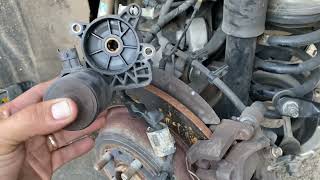
You can retract it manually for transport by removing the electric motor from the back of the brake caliper. Use a tool to turn the internal piston drive spline clockwise until the brake releases.
What are common misdiagnosis mistakes for C1034?
The most frequent mistake is replacing the expensive parking brake actuator without exhaustively testing the wiring harness. Technicians often replace the actuator only to find the code persists because the true fault was a broken wire.
Can low rear brake pads cause a C1034 code?
No, low brake pads do not directly cause code C1034. However, the code appears after a rear brake job if the EPB system was not put into service mode correctly, damaging the actuator.
Can I just clear the C1034 code and keep driving?
You can clear the code, but it returns immediately if the underlying physical or electrical fault is not repaired. Ignoring it leaves you without ABS and stability control, posing a major safety risk.
Can other electrical accessories cause a C1034 code?
Yes, particularly on Harley-Davidson motorcycles. Installing aftermarket LED lighting or unshielded electronics creates electromagnetic interference that disrupts the wheel speed sensor's signal, triggering the code.
Will a weak car battery cause a C1034 code?
Yes. Control modules for brakes require a stable voltage to operate correctly. A weak or dying battery causes them to malfunction and generate false trouble codes. Always ensure your battery is healthy before starting complex diagnostics.
Key Takeaways
- Code C1034 points to an Electronic Parking Brake (EPB) failure on most cars (especially Ford) and a rear wheel speed sensor fault on Harley-Davidson motorcycles.
- Inspect the rear wiring pigtail harness before replacing the $300+ EPB actuator, as corroded wires cause over 80% of C1034 codes on Ford vehicles.
- Driving with an active C1034 code disables your ABS and stability control, significantly increasing your accident risk on wet or slippery roads.
- Scan for companion codes like C2007 (right side) or C2008 (left side) to instantly pinpoint which rear wheel contains the electrical fault.
Helpful Videos

The information in this article is provided for general reference and educational purposes only. Vehicle specifications, procedures, and part compatibility can vary by production date, trim level, and region. Always consult your vehicle's factory service manual and verify part numbers before purchasing or performing repairs. Safety-critical components such as airbags, seat belts, and braking systems should be installed by a qualified professional.
- 🎬 Helpful Videos
- What Does C1034 Mean?
- Can I Drive With C1034?
- Common Causes
- Symptoms
- Diagnostic Flowchart
- Common Fixes & Costs
- Used vs. New Parts: Buying Guide
- What Happens If You Wait — Timeline
- Cost of Not Fixing It
- Diagnosis Steps
- When This Code Triggers (Freeze-Frame Conditions)
- Related Codes
- Climate & Environmental Factors
- How to Talk to a Mechanic About This Code
- Where to Take It: Dealer vs Independent vs Chain
- When to Walk Away From the Repair
- What Scan Tool You Need for This Code
- How to Clear the Code After You Fix It
- Will This Fail Emissions / State Inspection?
- Most Commonly Affected Vehicles
- Manufacturer-Specific Notes
- Real Owner Stories
- 2021 Mustang Mach-E with 67K miles
- 2016 Ford F-150 after DIY rear brake job
- 2018 Ford Expedition with intermittent fault
- Harley-Davidson V-Rod after rear wheel service
- How to Prevent This Code From Triggering
- Frequently Asked Questions
- What is the most common fix for code C1034 on a Ford?
- My parking brake is stuck on with code C1034. How can I release it?
- What are common misdiagnosis mistakes for C1034?
- Can low rear brake pads cause a C1034 code?
- Can I just clear the C1034 code and keep driving?
- Can other electrical accessories cause a C1034 code?
- Will a weak car battery cause a C1034 code?
- Key Takeaways
- 🎟️ Get 5% Off