

C1001 on 2016-2020 Mazda CX-9: Forward Camera Visibility Causes and Fixes
Code C1001 on a 2016-2020 Mazda CX-9 means the Forward Sensing Camera (FSC) has a poor field of view. Most often, this is a temporary issue caused by a dirty windshield, fog, or sun glare. Before seeking repairs, thoroughly clean the windshield area in front of the interior rearview mirror, as Mazda explicitly advises against immediate camera replacement.
- C1001 on your CX-9 almost always means the front camera's vision is blocked.
- Before anything else, thoroughly clean the inside and outside of your windshield where the camera is mounted (near the rearview mirror).
- The warning is expected in certain conditions like heavy fog, snow, or driving directly into the sun. It should clear when conditions improve.
- Do not replace the camera unless these simple, common causes have been ruled out.
- If the windshield is replaced, the camera MUST be recalibrated by a professional to ensure safety systems work correctly.
What's Unique About the 2016-2020 Mazda CX-9
For the second-generation Mazda CX-9, this code is very common and well-documented by Mazda itself through numerous service bulletins. The manufacturer explicitly states that C1001 often sets due to environmental conditions like sun glare, fog, or a dirty windshield, and advises against immediate replacement of the camera. This suggests the system is highly sensitive to visual obstructions, and owners should rule out these simple causes before assuming a more serious hardware fault. Some TSBs note that early control logic for the FSC was overly sensitive and has since been updated via software reprogramming to correct the issue.
Symptoms You May Notice
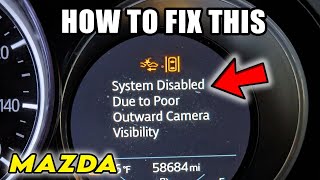
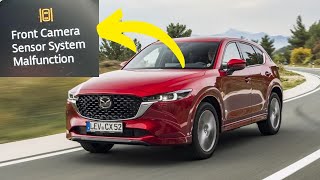
- "Front Camera Sensor System Malfunction" message on the multi-information display.
- "Safety and Driver Support Systems Temporarily Disabled" warning message.
- Lane Departure Warning System (LDWS) is inoperative.
- Automatic High Beam Control (HBC) does not function.
- Smart Brake Support (SBS) or Smart City Brake Support (SCBS) warning lights may illuminate.
- The Mazda Radar Cruise Control may be disabled or have limited functionality.
- Master Warning Light illuminated on the dashboard.
- Replacing the Forward Sensing Camera without first checking for simple obstructions. Mazda explicitly warns against this in service bulletins, as the cause is often temporary and environmental.
Most Likely Causes
- Dirty or Obstructed Windshield 🔴 High Probability The system is sensitive to any obstruction. Dirt, bugs, stickers, or even residue from cleaning can block the camera's view.
How to confirm: Visually inspect the area of the windshield directly in front of the Forward Sensing Camera, which is located near the rearview mirror.
Typical fix: Thoroughly clean the inside and outside of the windshield in the camera's line of sight.
Est. part cost: $0-$15 - Environmental Conditions 🔴 High Probability The camera's performance is inherently limited by visibility. Mazda TSBs specifically list these as common triggers.
How to confirm: Note if the warning appears during heavy rain, snow, dense fog, driving directly into bright sunlight (sunrise/sunset), or on roads with poor lane markings.
Typical fix: The condition is temporary and should resolve itself once visibility improves. No repair is needed. The system is operating as designed by disabling itself in conditions where it cannot be reliable.
Est. part cost: $0 - Windshield or Camera Lens Fogging 🟡 Medium Probability Temperature and humidity differences can cause condensation on the inside of the windshield or the camera lens itself. TSBs explicitly mention this as a cause.
How to confirm: Check for visible fogging on the windshield. The camera lens itself is harder to inspect directly.
Typical fix: Use the vehicle's defroster for 5-10 minutes to clear the condensation.
Est. part cost: $0 - Improper Windshield Replacement ⚪ Low Probability Using an aftermarket windshield that doesn't meet OEM optical clarity standards or failing to recalibrate the camera after replacement can cause this code.
How to confirm: Check service records or with the owner if the windshield has been replaced recently. The problem would appear immediately after the replacement.
Typical fix: The camera system must be recalibrated by a dealer or qualified shop with ADAS service equipment. In some cases, the aftermarket windshield may need to be replaced with an OEM-quality one.
Est. part cost: $250-$500 for calibration only
Rare But Worth Checking
- Failing Forward Sensing Camera (FSC) Module: While Mazda TSBs advise against replacing the FSC as a first step, the camera can genuinely fail. If all other causes are ruled out and the code persists or returns immediately in clear conditions, the camera module itself may be the culprit. One owner on Reddit confirmed a warranty replacement of the camera (part # GSH7-67-XCXV) fixed the issue after persistent warnings.
- Low Battery Voltage: Some owners report that a weak 12V battery can cause various electronic modules, including the ADAS, to malfunction during startup, triggering warning lights. This is less of a direct cause of C1001 but can create a cascade of electrical issues. A related code, U3003:16, specifically points to low voltage at the FSC module.
- Outdated FSC Control Logic: For earlier models within this generation, some TSBs indicate the original control logic for the FSC was too sensitive. A dealer may need to perform a software update to the Forward Sensing Camera (FSC) module to prevent the code from being triggered unnecessarily by minor environmental conditions.
Diagnosis Steps
- Read the code with an OBD-II scanner to confirm C1001:92 is present.
- Visually inspect the exterior of the windshield in front of the rearview mirror. Clean off any dirt, bugs, snow, or ice.
- Inspect the interior of the windshield for fogging, stickers, or other obstructions. Use the defroster to clear any condensation.
- Consider the current weather and lighting conditions. If it's foggy, raining heavily, or you're driving into direct sun, the code is likely temporary. Wait for conditions to improve.
- Clear the DTC using a scan tool. Drive the vehicle above 12 mph (20 km/h) for several minutes to see if the code returns under clear conditions.
- Check the 12V battery's health. A weak battery can cause various electronic issues at startup, and a specific DTC U3003:16 exists for low voltage to the FSC.
- If the windshield was recently replaced, the issue is likely related to incorrect glass or lack of calibration. The system will need to be recalibrated by a professional.
- If the code consistently returns in clear, dry conditions and the windshield is clean, the Forward Sensing Camera (FSC) module may be faulty and require professional diagnosis and likely replacement and calibration.
- Check with a Mazda dealer if any software updates are available for the FSC, as some TSBs address overly sensitive logic.
Parts You'll Likely Need
- Forward Sensing Camera
(OEM #GSH7-67-XCXV)— This is the part to replace only after all other environmental and obstruction-related causes have been completely ruled out and the code persists.
Trusted brands: Mazda (OEM)
OEM price range: $900-$1000
Aftermarket price range: Not generally available - OEM-spec Windshield
(OEM #TD11-63-900D)— Required if an improper aftermarket windshield was installed, preventing the camera from functioning correctly. The key is the optical quality and correct mounting brackets.
Trusted brands: Mazda (OEM)
OEM price range: $400-$700
Aftermarket price range: $250-$500
Related Codes That Often Appear With This One
- B14F0:92 — This is a similar code for 'General temporary failure in forward sensing camera (FSC)' often cited in the same TSBs as C1001:92, particularly for different vehicle generations or production dates. [SA-043-25, SA-066-22, SA-037-20]
- C1001:97 — This sub-code indicates 'Vision System Camera - Component or System Operation Obstructed or Blocked'. It is functionally very similar to C1001:92 and points to the same set of environmental and physical obstructions.
Technical Service Bulletins (TSBs) & Recalls
- SA-043-25: Notes C1001:92 relates to a poor field of view for the Forward Sensing Camera (FSC).
- SA-066-22: Also identifies C1001:92 as an FSC poor field of view issue, often accompanied by a dash notice.
- SA-037-20: States that C1001:92 can be stored in memory due to poor visibility and does not automatically mean the FSC is defective.
- 15-001/18: Addresses FSC concerns on various 2017 models, noting the cause can be overly sensitive control logic and that a software update is available to correct it.
Platform-Specific Known Issues
- Mazda has issued multiple Technical Service Bulletins (TSBs), such as SA-043-25, SA-066-22, and SA-037-20, acknowledging that code C1001:92 frequently occurs due to temporary poor visibility and does not necessarily indicate a faulty camera.
- Owners on forums like Mazdas247 and Reddit frequently report this warning appearing temporarily during sunrise/sunset due to sun glare or in high humidity, with the system resuming normal function on its own after conditions change.
Mechanic-Grade Diagnostic Values
- FSC Module Temperature for Reprogramming — expected: Below 140 °F (60 °C). Failure: If the module is hotter than 140°F, the reprogramming process with the Mazda IDS may fail. The vehicle should be parked in the shade to cool down before attempting.
- FSC Module Reprogramming Prerequisite (C_SCORE) — expected: 174 or higher. Failure: If the 'C_SCORE' value in the M-MDS data logger is below 174, the FSC cannot be reprogrammed.
- FSC Power Supply Voltage — expected: Normal battery voltage (B+). Failure: If voltage is 8.0V ± 0.8V or less for 5 seconds or more, DTC U3003:16 will set, indicating a power supply issue to the camera.
Hidden / Shadow Codes Worth Checking
- U3003:16: FSC Battery Voltage - Indicates the power supply circuit voltage to the Forward Sensing Camera is 8.0V or less for over 5 seconds. (see via A professional scan tool like the Mazda M-MDS is required. This code points towards a battery, charging system, or wiring harness issue rather than a camera fault.)
- B115E:54: Forward sensing camera (FSC) aiming not completed. (see via A professional scan tool like the Mazda M-MDS. This indicates a failed or incomplete calibration process after a replacement.)
Scan Tool Commands That Help
- Mazda IDS/M-MDS: Module Reprogramming > FSC — Used to update the FSC control logic to a newer calibration file, which can resolve issues of the system being too sensitive on earlier models. TSB 15-001/18 specifies this for DTC C1001:92.
- Mazda IDS/M-MDS, Autel MaxiSYS ADAS: FSC Aiming (Static or Dynamic) — Required after replacing the FSC or the windshield. Static aiming uses a target board, while dynamic aiming is done by driving the vehicle under specific conditions.
- FORScan: LIN Bus calibration — While more commonly discussed for Ford vehicles which share some architecture, a LIN Bus calibration can sometimes resolve communication issues between modules after a component replacement. This would be an advanced, non-standard procedure to try if other methods fail.
Wiring & Ground Locations
- FSC Power Supply Fuse — The C/U IG1 15A fuse in the main fuse block provides power to the FSC.. A blown or faulty fuse will cause a loss of power to the camera, triggering DTC U3003:16 and disabling all FSC functions.
- FSC Connector — Directly on the back of the Forward Sensing Camera module, behind the plastic housing near the rearview mirror.. Corrosion or a loose connection at this connector can cause intermittent power loss or communication faults, leading to various FSC-related codes.
Real Owner Repair Stories
- Mazdas247 Forums (2019 Mazda CX-5 (similar system)) — Rain sensor and auto headlights stopped working after windshield replacement by Safelite.
❌ Tried (didn't work) Safelite attempted to 'fix' the issue, resulting in a glue smell and no resolution.
✅ What actually fixed it A Mazda dealer diagnosed a cracked sensor and broken housing clips, likely damaged during the initial replacement. Safelite's manager agreed to replace the broken components and the windshield again. The dealer noted that calibration is often not needed unless there's a problem, but the physical damage was the root cause. - Reddit r/MazdaCX9 (2020 Mazda CX-9) — "Front Radar Sensor System Malfunction" warning light.
❌ Tried (didn't work) Initial diagnosis focused on the radar/camera system itself.
✅ What actually fixed it The user reported that adding brake fluid resolved the warning light. While seemingly unrelated, low brake fluid can trigger a general master warning light, which can sometimes be confused with or accompanied by other system warnings on the display.
OEM Part Supersession History
Unknown early PNs→B61L 67 XCXN— A TSB mentions that after a specific software update, the FSC module is considered equivalent to part number B61L 67 XCXN.
Heads up: This suggests that software and hardware are tightly linked. Installing a newer camera on an older, non-updated vehicle may not work correctly without the corresponding software flash.
Model Year Variations Within This Range
- 2016-2020: The camera hardware is largely the same, but the control logic was updated via software for earlier models (approx. 2016-2018) to be less sensitive. Owners of earlier models are more likely to resolve the issue with a dealer software update.
- 2021+: Starting with the 2021 model year, the CX-9 received a larger 10.25-inch infotainment screen with a new interface. While the FSC function is the same, the camera image quality (especially for the backup camera) was noted to be improved, suggesting potential hardware changes to the imaging sensors themselves, though the C1001 fault logic remains.
Diagnostic Flowchart
Other Known Issues on This Vehicle
Issues unrelated to this code that are worth knowing about as an owner of this generation:
- Cracked Cylinder Head Causing Coolant Leak 🔴 High — Affects 2016-2020 models with the 2.5T engine. While not affecting a majority of vehicles, it is a well-documented and potentially catastrophic failure. Leaks are typically external, near the exhaust manifold. (Ref: Mazda issued a Customer Satisfaction Program (CSP11) and TSBs (e.g., 01-013-21) extending the warranty for this specific issue to 10 years/120,000 miles in the US.)
- Excessive Oil Consumption (2021 models) 🟠 Medium — Primarily documented in early 2021 models due to faulty valve stem seals. (Ref: TSB 01-012/21 was issued to address this, and a class-action lawsuit resulted in a warranty extension for affected VINs in the US.)
- Infotainment Screen Delamination / 'Ghost Touch' 🟡 Low — Common across many Mazda models from this era, including the CX-9. The touchscreen's top layer can delaminate, causing phantom inputs or unresponsiveness. (Ref: A class-action lawsuit settlement provided extended warranty coverage for this issue on some models/years. Repair often involves replacing the digitizer layer.)
- Premature Water Pump Failure (First Gen V6) 🔴 High — This is a major issue for the first generation CX-9 (2007-2015) with the Ford-derived V6, not the 2.5T. The internally-mounted, timing-chain-driven water pump can fail, leaking coolant into the engine oil and causing catastrophic engine damage.
- Direct Injection Carbon Buildup 🟠 Medium — An inherent characteristic of all Skyactiv-G direct injection engines, including the 2.5T. Over time (typically 80k-120k miles), carbon deposits can build up on intake valves, leading to reduced performance and rough idling.
- Leaking Oil Control Valve (OCV) 🟡 Low — Some owners on forums report minor oil leaks from the Oil Control Valve, located at the top of the engine. This is generally a minor repair.
Used vs. New Parts: Buying Guide for This Vehicle
When a used part is the smart pick: A used Forward Sensing Camera (FSC) is a high-risk purchase and generally not recommended. The part is a sensitive electronic module that is critical to safety systems. Its history is unknown, and it may have been exposed to impact or moisture. Given the high cost of labor and mandatory calibration, the savings on a used part may be lost if it fails to calibrate or has a short lifespan.
Donor-vehicle mileage cap: roughly under 50000 miles for the part to have meaningful remaining life.
What to inspect on the donor part:
- Verify the part number EXACTLY matches your original part.
- Inspect the electrical connector pins for any signs of corrosion, bending, or water intrusion.
- Check the lens for any deep scratches or cloudiness.
- Source from a reputable salvage yard with a return policy, specifically asking if it can be returned if it fails to calibrate.
OEM-only on this vehicle (don't cheap out):
- Forward Sensing Camera (FSC)
- Windshield (OEM-spec glass is critical for optical clarity)
Aftermarket brands forum-validated for this vehicle:
- For this specific, safety-critical, and calibration-required part, no aftermarket brands are widely validated or recommended. Stick to OEM Mazda parts.
Brands owners have reported issues with on this vehicle:
- Any unbranded aftermarket cameras sold on marketplaces. They are unlikely to be compatible with the vehicle's ADAS software and will not calibrate.
Real Owner Stories
Aggregated from forums and TSBs cited above. Mileages and costs reflect what owners reported in those sources.
2016-2020 Mazda CX-9 2.5T
Symptoms: Persistent camera malfunction warnings on the dashboard.
What fixed it: Replacement of the Forward Sensing Camera (part # GSH7-67-XCXV).
Cost: $1200-$1200
Source hint: Reddit r/MazdaCX9
2016-2020 Mazda CX-9 2.5T
Symptoms: The 'Front Camera Sensor System Malfunction' warning appears temporarily during sunrise or sunset due to sun glare.
What fixed it: No repair needed; the system resumes normal function on its own after environmental conditions change.
Source hint: Mazdas247 Forums
Related OBD-II Codes
Frequently Asked Questions
My 2017 CX-9 is showing a 'Front Camera Sensor System Malfunction' during my morning commute. Does TSB 15-001/18 apply to me?
I see code C1001:92 on my Mazda CX-9. Does this mean I definitely need to replace the Forward Sensing Camera?
Can a weak 12V battery cause the C1001 code on my CX-9?
Will using the defroster help clear the C1001:92 code?
I just had my windshield replaced and now the safety systems are disabled. What is the fix?
Is the cracked cylinder head issue on the 2.5T engine covered by Mazda?
Helpful Videos
We Have This Part in Stock



The information in this article is provided for general reference and educational purposes only. Vehicle specifications, procedures, and part compatibility can vary by production date, trim level, and region. Always consult your vehicle's factory service manual and verify part numbers before purchasing or performing repairs. Safety-critical components such as airbags, seat belts, and braking systems should be installed by a qualified professional.
- Mazda CX-9:
- 🎬 Helpful Videos
- 🛍️ Shop This Part
- What's Unique About the 2016-2020 Mazda CX-9
- Symptoms You May Notice
- Most Likely Causes
- Rare But Worth Checking
- Diagnosis Steps
- Parts You'll Likely Need
- Related Codes That Often Appear With This One
- Technical Service Bulletins (TSBs) & Recalls
- Platform-Specific Known Issues
- Mechanic-Grade Diagnostic Values
- Hidden / Shadow Codes Worth Checking
- Scan Tool Commands That Help
- Wiring & Ground Locations
- Real Owner Repair Stories
- OEM Part Supersession History
- Model Year Variations Within This Range
- Diagnostic Flowchart
- Other Known Issues on This Vehicle
- Used vs. New Parts: Buying Guide for This Vehicle
- Real Owner Stories
- 2016-2020 Mazda CX-9 2.5T
- 2016-2020 Mazda CX-9 2.5T
- Related OBD-II Codes
- Frequently Asked Questions
- 🎟️ Get 5% Off