

C1001 on 2016-2021 Mazda CX-3: Forward Camera Fault Causes and Fixes
Code C1001 on a Mazda CX-3 means the Forward Sensing Camera (FSC) has a poor field of view. This is often temporary, caused by a dirty/foggy windshield, heavy rain, or sun glare. First, clean the windshield and camera area. If the code persists, the camera may need professional recalibration or replacement.
- C1001 on your CX-3 most likely means the front camera's view is temporarily blocked.
- Before seeking repairs, thoroughly clean your windshield, especially the area in front of the rearview mirror.
- The warning light will often turn off by itself once driving conditions (like heavy rain or sun glare) improve.
- If the warning persists in clear weather, the camera may be faulty or require calibration.
- Any replacement of the front camera or windshield requires a professional ADAS calibration, which is critical for safety system function.
What's Unique About the 2016-2021 Mazda CX-3
The first-generation Mazda CX-3, like many Mazdas from this era (Gen 6), is known for the sensitivity of its Forward Sensing Camera. Mazda has issued multiple Technical Service Bulletins (TSBs) acknowledging that the system can set a C1001 code under normal but challenging conditions like driving into direct sunlight, heavy rain, or on roads with faded lane markings. In many cases, the alert is temporary and resolves on its own, but Mazda also released updated camera parts and software to make the system less prone to these false alarms and more resilient to overheating.
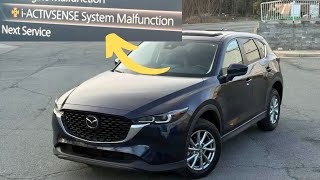
🎬 Watch: How to fix camera visibility and overheating alerts.Diagnostic Flowchart
Tap your situation to follow the diagnostic path that matches what you're seeing on this vehicle.
Symptoms You May Notice
- Warning message on the multi-information display (e.g., "Forward Sensing Camera Low Visibility", "Front Camera Sensor System Malfunction").
- Master warning light illuminated.
- i-ACTIVSENSE warning light on.
- Lane Departure Warning System (LDWS) warning light on.
- High Beam Control (HBC) or Adaptive LED Headlights (ALH) warning light on.
- Smart Brake Support/Smart City Brake Support (SBS/SCBS) indicator light on.
- Lane Keep Assist, automatic high beams, and adaptive cruise control become inoperative.
- Replacing the Forward Sensing Camera when the issue is only a temporary obstruction. Mazda service bulletins specifically warn technicians NOT to replace the FSC for a stored C1001:92 code without first investigating environmental causes.
Most Likely Causes
- Obstructed or Dirty Windshield 🔴 High Probability The FSC system is highly sensitive to any visual impairment, a fact repeatedly stated in Mazda TSBs.
How to confirm: Visually inspect the area of the windshield directly in front of the camera (near the rearview mirror) for dirt, bugs, stickers, ice, or debris. Check for fogging on the inside or outside of the glass.
Typical fix: Thoroughly clean the inside and outside of the windshield. Use the defroster to clear any fog.
Est. part cost: $0 - Adverse Environmental Conditions 🔴 High Probability Mazda TSBs explicitly state that the system may temporarily shut down and set this code in certain conditions, such as driving into low-angle sun glare, in heavy rain/fog, or on roads with no visible lane lines.
How to confirm: Note if the warning appeared while driving into direct sun glare, in heavy rain or fog, or on a road with no lane lines. The code often clears itself once conditions improve. Forum users frequently report this happening during sunrise/sunset drives.
Typical fix: No repair is needed; the system is operating as designed by temporarily disabling itself to prevent incorrect operation. Explaining this to the vehicle owner is the recommended action per Mazda service bulletins.
Est. part cost: $0 - Forward Sensing Camera (FSC) Malfunction or Outdated Software 🟡 Medium Probability Mazda has released updated FSC parts and software to reduce sensitivity and improve heat resistance. An older camera may be more prone to setting this code. Some cameras were also prone to overheating in hot weather, triggering DTC U3000:98 alongside C1001.
How to confirm: If the code persists after cleaning the windshield and ruling out environmental factors, a diagnostic scan with a Mazda-specific tool (M-MDS) is needed. If the code cannot be cleared or returns immediately in clear conditions, the camera is suspect.
Typical fix: Replace the Forward Sensing Camera with an updated part and perform a static or dynamic calibration. This requires specialized tools and targets.
Est. part cost: $400-$550 - Improper Windshield Replacement ⚪ Low Probability Using non-OEM glass or failing to properly mount and calibrate the camera after a windshield replacement can block or distort the camera's view. The camera's alignment is critical.
How to confirm: Check service records or ask the owner if the windshield was recently replaced. Forum discussions show owners often face this issue after using non-dealer glass installers who may not have the correct calibration equipment. A persistent C1001 immediately after a replacement is a strong indicator.
Typical fix: Ensure the correct OEM-spec windshield is installed and that the FSC is properly mounted. The camera must then be professionally calibrated ("FSC Aiming").
Est. part cost: $0 (if only calibration is needed)
Rare But Worth Checking
- Weak 12V Battery:
Diagnosis Steps
- Verify the customer's complaint and the conditions under which the warning light appears (e.g., time of day, weather).
- Visually inspect the windshield in front of the FSC for any dirt, debris, stickers, cracks, or fogging. Clean the glass thoroughly.
- Inspect the camera lens itself for any internal fogging. Use the defroster to clear it if present.
- Connect a Mazda-compatible scan tool (M-MDS) to read the full DTC, including the sub-code (e.g., :92).
- Check for related DTCs, especially U3000:98 (overheating) or U3000:04 (internal fault).
- Clear the DTCs.
- Test drive the vehicle above 12 mph (20 km/h) for several minutes to see if the code returns under normal, clear driving conditions.
- If the code returns immediately in clear conditions, the camera is likely faulty.
- If a new camera or windshield has been installed, perform the FSC aiming and calibration procedure using specialized ADAS equipment. This can be a 'static aiming' or 'dynamic aiming' procedure.
- If the code persists after all steps, replace the Forward Sensing Camera (FSC) with the latest revised part number and perform the calibration.
Parts You'll Likely Need
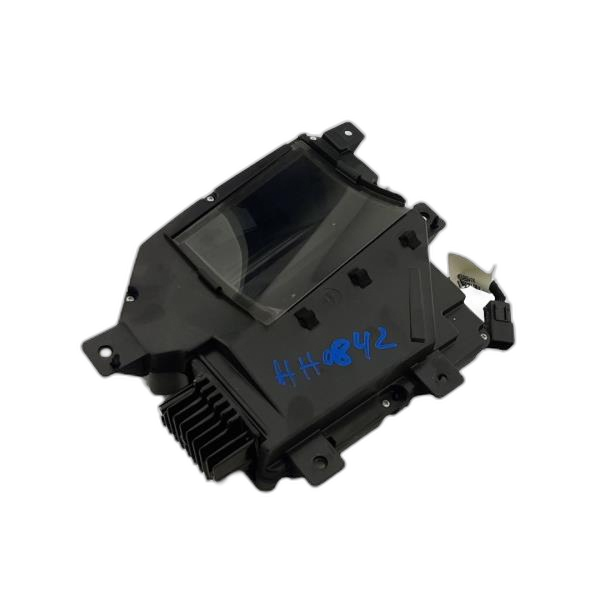
- Forward Sensing Camera (FSC)
(OEM #KDD1-67-XCXB)— This is the part that fails if the code is persistent and not caused by simple obstructions. An internal fault or overheating issue requires replacement. This part number supersedes many previous versions.
Trusted brands: Mazda (OEM)
OEM price range: $400-$570
Aftermarket price range: $100-$300 (Used OEM from sources like AH Dismantlers or eBay)
Related Codes That Often Appear With This One
- B14F0:92 — This is the equivalent code for the same 'General temporary failure in forward sensing camera' issue on later generation (Gen 7) Mazda vehicles and is often listed alongside C1001:92 in TSBs.
- U3000:98 — This code indicates 'Forward sensing camera (FSC) stops functioning due to temporary high temperature'. An older version of the FSC was known to overheat in hot climates, which would disable the system and could be accompanied by C1001. TSB 15-002/18 addresses this directly.
- U3000:04 — This code indicates an 'FSC internal malfunction'. On earlier production vehicles, a high-temperature event (U3000:98) could also trigger a persistent U3000:04 due to sensitive software logic, requiring an ignition cycle to clear even after the camera cooled down.
- B14F0:76 — This DTC indicates that FSC aiming has not been completed. It will appear after camera or windshield replacement and before calibration is successfully performed.
Technical Service Bulletins (TSBs) & Recalls
- SA-043-25 / SA-066-22 / SA-037-20 / SA-003-19: A series of similar bulletins stating C1001:92 is for poor field of view and often sets due to adverse conditions, not a defect. Instructs dealers NOT to replace the camera for this code alone.
- 15-002/18: Addresses camera overheating (DTC U3000:98) on 2017-2018 models in hot weather, requiring an updated camera with better thermal
- 15-004/17: Addresses C1001:92 on 2016 models where the FSC is too sensitive. The fix is to replace the camera with an updated part.
- SA-050/19: Explains that dynamic aiming may fail if road markings are not visible (e.g., due to snow) or if the road is too winding, and that static aiming should be performed instead in these cases.
Platform-Specific Known Issues
- Mazda has issued multiple TSBs (e.g., SA-043-25, SA-066-22, SA-003-19) for the C1001:92 code, noting it often indicates a temporary low visibility condition and does not mean the camera has failed.
- A specific TSB (15-002/18) addresses FSC overheating in hot weather on 2017-2018 models, which requires replacing the camera with an updated part that has better heat radiation, sometimes involving an added thermal pad.
- Another TSB (R046/17A, also referenced as 15-001/16) notes that overly sensitive software logic on early 2016 models could cause warnings and system deactivation in rain or at night, and an updated camera part or software was implemented to fix it.
Hidden / Shadow Codes Worth Checking
- C1001:92: Forward sensing camera (FSC) poor field of view. This is the most common sub-code and often indicates a temporary obstruction or adverse environmental condition rather than a hardware fault. (see via A Mazda-compatible scan tool like the M-MDS (Mazda Modular Diagnostic System) is required to read sub-codes.)
- B14F0:76: FSC aiming not complete. This code is stored after the FSC is replaced or the windshield is replaced, and will persist until a successful static or dynamic aiming procedure is performed. (see via A Mazda-compatible scan tool like the M-MDS is needed. This code will be present during the pre-scan before calibration.)
Scan Tool Commands That Help
- Mazda M-MDS (or equivalent): FSC Configuration (Using Read/Write Function) — Before removing the old FSC, this function reads and saves the vehicle's specific configuration data. After installing the new camera, this data is written to the new module. This is the preferred method to ensure all vehicle-specific features work correctly.
- Mazda M-MDS (or equivalent): FSC Configuration (Using As-Built Data) — If the original FSC is damaged and its configuration data cannot be read, this function is used to program a new FSC using the vehicle's original factory 'As-Built' data.
- Mazda M-MDS (or equivalent): Static Aiming for FSC — After replacing the FSC or windshield, this procedure is performed in a workshop using specific targets placed at precise distances and heights. It calibrates the camera's angle and position while the vehicle is stationary.
- Mazda M-MDS (or equivalent): Dynamic Aiming for FSC — This procedure calibrates the camera by driving the vehicle under specific conditions (e.g., straight roads with clear lane markings at speeds over 25 mph). It's often simpler than static aiming but can fail in poor weather or on unmarked roads.
Wiring & Ground Locations
- FSC Connector — Directly on the back of the Forward Sensing Camera, behind the plastic cover near the rearview mirror.. A loose or corroded connector at the camera itself can cause intermittent communication and trigger fault codes. The connector must be securely latched after camera replacement.
- Main Chassis Ground — A primary ground point is from the negative battery terminal to the chassis on the driver's side fender area.. A poor main ground connection can cause widespread, unpredictable electrical issues across multiple modules, including the FSC.
- Transmission/Engine Ground — A key ground strap connects the engine/transmission assembly to the chassis. On some models, a ground point is located on a bracket on top of the transmission.. The alternator is grounded through the engine block. A faulty engine ground strap can create unstable voltage and electrical noise, potentially disrupting sensitive modules like the FSC.
Real Owner Repair Stories
- Mazdas247 Forum (Unknown year Mazda CX-5 (shares FSC system with CX-3)) — ADAS warning lights appeared after a windshield replacement by Safelite.
❌ Tried (didn't work) Safelite attempted recalibration but the problem persisted.
✅ What actually fixed it The owner took the vehicle to a Mazda dealer. The dealer found that the camera sensor itself was cracked and the housing clips were broken, likely damaged during the windshield installation. Safelite's manager agreed to replace the broken camera components and the windshield again. After the new parts were properly installed, no further calibration was needed and the system worked correctly.
OEM Part Supersession History
DD2J-67-XCX (for early 2016 w/o MRCC)→DB2R-67-XCXB— Updated part to address overly sensitive logic that caused false warnings in rain or at night.KDD1-67-XCX, KDD1-67-XCXA→KDD1-67-XCXB— General part revision and consolidation.
Heads up: KDD1-67-XCXB is the current primary replacement part and supersedes a long list of previous numbers including many starting with B61L-67-XCX*.N243-67-XCXA→Updated part mentioned in TSB 15-004/17— Updated part to correct overly sensitive control logic.
Model Year Variations Within This Range
- 2016 (early production): Vehicles produced before December 21, 2015 (without MRCC) used an earlier version of the FSC that was overly sensitive. TSB 15-004/17 and a related bulletin advise replacing the camera with an updated part (DB2R-67-XCXB) to fix issues with frequent C1001:92 codes in non-ideal conditions.
- 2017-2018: A specific TSB (15-002/18) was issued for these model years to address camera overheating (DTC U3000:98) in hot climates, which could also trigger C1001. The fix involves an updated camera part with better heat dissipation.
Helpful Videos


We Have This Part in Stock



The information in this article is provided for general reference and educational purposes only. Vehicle specifications, procedures, and part compatibility can vary by production date, trim level, and region. Always consult your vehicle's factory service manual and verify part numbers before purchasing or performing repairs. Safety-critical components such as airbags, seat belts, and braking systems should be installed by a qualified professional.
- Mazda CX-3:
- 🎬 Helpful Videos
- 🛍️ Shop This Part
- What's Unique About the 2016-2021 Mazda CX-3
- Diagnostic Flowchart
- Symptoms You May Notice
- Most Likely Causes
- Rare But Worth Checking
- Diagnosis Steps
- Parts You'll Likely Need
- Related Codes That Often Appear With This One
- Technical Service Bulletins (TSBs) & Recalls
- Platform-Specific Known Issues
- Hidden / Shadow Codes Worth Checking
- Scan Tool Commands That Help
- Wiring & Ground Locations
- Real Owner Repair Stories
- OEM Part Supersession History
- Model Year Variations Within This Range
- 🎟️ Get 5% Off