

C1001 on 2019-2023 Ford Ranger: Front Camera Fault Causes and Fixes
Code C1001 on a 2019-2023 Ford Ranger indicates a fault with the front-facing camera system (IPMA). This usually triggers 'Front Camera Fault' or 'Pre-Collision Assist Not Available' warnings. The most common causes are a loose camera connection, a software glitch requiring an update, a failed camera module, or an issue that arose after a windshield replacement.
- C1001 on your Ranger means there's a problem with the front camera system used for safety features.
- Before buying parts, check for simple fixes: clean the windshield and check the camera's electrical connector behind the rearview mirror.
- A diagnostic scan to find the two-digit suffix code is crucial for an accurate diagnosis (e.g., :31 is electrical, :78 is alignment).
- Any repair involving replacing or adjusting the camera requires a professional ADAS recalibration to ensure safety systems work properly.
What's Unique About the 2019-2023 Ford Ranger
The 2019-2023 Ford Ranger (P703 generation) comes standard with Pre-Collision Assist with Automatic Emergency Braking, making the front camera (IPMA) a core safety component, not just an optional feature. Problems with this system are common across many modern Fords, with Technical Service Bulletins for similar models like the F-150 and Explorer frequently pointing to issues with software or the coaxial camera wiring. A Ranger-specific TSB (21-7001) also exists to help diagnose alignment and functionality concerns for the IPMA system.
Symptoms You May Notice
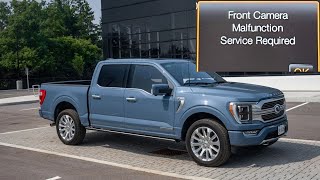
- "Front Camera Fault Service Required 🎬 Watch this video on diagnosing the front camera fault warning" message on the instrument cluster
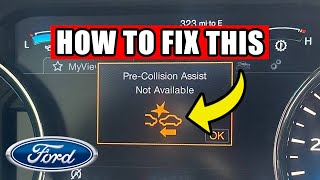
- "Pre-Collision Assist Not Available 🎬 Watch how to fix warning messages on 2019+ Ford Rangers" warning message
- Lane-Keeping System is inoperative or shows a fault
- Adaptive Cruise Control (if equipped) is disabled
- Auto High-Beams may not function correctly
- Warning message appears intermittently, sometimes triggered by direct sunlight on the windshield or after starting the vehicle.
- Replacing the radar sensor in the bumper. The radar is for Adaptive Cruise Control, but the Pre-Collision Assist and Lane-Keeping systems primarily rely on the IPMA camera. Cleaning the radar sensor will not fix a camera-specific fault.
Most Likely Causes
- Loose or Damaged Coaxial Cable Connection 🔴 High Probability Vibrations and thermal cycles can affect the small coaxial connectors at the IPMA module behind the rearview mirror. Ford has issued TSBs for other models like the F-150 (TSB 23-2146) for this exact issue, which involves a poor connection between the camera and the module. Condensation can also form in the module, corroding the connection and causing an intermittent signal loss.
How to confirm: With a diagnostic tool, check for C1001:31 (No Signal). Visually inspect and perform a 'wiggle test' on the connector at the back of the windshield camera assembly (connectors C900 and C9128). The fault may be intermittent at first.
Typical fix: Reseating the connector firmly. In some cases, the coaxial pigtail or the entire cable running to the A-pillar needs to be replaced as outlined in Ford TSB 23-2146 for the F-150. This involves carefully overlaying a new cable and is often a warranty repair.
Est. part cost: $0 - $120 - IPMA Software/Calibration Issue 🟡 Medium Probability Ford has released multiple software updates for IPMA modules across its vehicle lines to fix bugs that can cause false fault messages or calibration issues, particularly C1001:78 on uneven roads (per SSM 52246 on other Fords). Lifting or leveling the truck can also necessitate a recalibration.
How to confirm: Check for TSBs related to IPMA software for your vehicle's year. A Ford dealer or a shop with Ford's diagnostic software (FDRS) can check the current software level and see if an update is available. Codes like C1001:78 (Incorrect Alignment) or C1001:54 (Missing Calibration) often point to software or calibration needs.
Typical fix: Reprogramming the IPMA to the latest software version, followed by a camera alignment procedure. This can be done by the dealer or with tools like FORScan, which requires driving on a well-marked road at over 40 MPH to complete.
Est. part cost: $0 - Failed Image Processing Module A (IPMA) 🟡 Medium Probability
How to confirm: If the wiring is confirmed to be good and a software update does not resolve the issue, the module itself is the likely culprit. This is a process-of-elimination diagnosis. One owner on a Ranger forum confirmed a dealer diagnosed a faulty module and replaced it for just over $1,000.
Typical fix: Replace the IPMA (front camera assembly) and perform the mandatory ADAS calibration. When a new IPMA is installed, it will store a calibration DTC until the alignment is successfully completed.
Est. part cost: $350 - $600 - Obstructed or Dirty Windshield ⚪ Low Probability
How to confirm: Visually inspect the area of the windshield directly in front of the camera for dirt, debris, stickers, cracks, or chips. This can set a C1001:97 code. Also check for aftermarket tint or banners. A loose or jiggly rearview mirror can also affect the IPMA's stability and cause faults.
Typical fix: Clean the windshield thoroughly. A cracked or chipped windshield in the camera's line of sight will need to be replaced, followed by recalibration.
Est. part cost: $0 - $1000+
Rare But Worth Checking
- Recent Windshield Replacement: If the code appeared shortly after a new windshield was installed, it's highly likely the camera was not reinstalled correctly or, more commonly, the mandatory static and dynamic recalibration was not performed or failed. This will typically set a C1001:78 (Alignment) or C1001:54 (Missing Calibration) code. Using an aftermarket windshield without the proper 'Carlite' branding or with glass distortions can also prevent successful calibration.
- Rodent Damage: One Ranger owner reported finding that a rodent had chewed through the camera wiring harness located near the brake fluid reservoir under the hood, causing similar fault messages.
Diagnosis Steps
- Read the code with a Ford-capable scanner to get the specific suffix (e.g., :31, :78, :54). This is critical for diagnosis.
- Inspect the windshield area in front of the camera for any obstructions, dirt, damage, or aftermarket tinting. Clean if necessary.
- Carefully remove the plastic cover behind the rearview mirror to access the IPMA.
- Check the coaxial cable connection at the IPMA (C9128) and at the A-pillar (C900). Disconnect and reconnect it to ensure it is fully seated. Perform a 'wiggle test' while checking for active faults, as specified in TSB 23-2146.
- If the code is C1001:31 and reseating the connector doesn't help, the coaxial cable itself may be faulty and require replacement by overlaying a new one.
- If the code is C1001:78 or C1001:54, especially after a windshield replacement or ride height change, the system requires recalibration using FDRS or FORScan.
- Check for any available TSBs or software updates for the IPMA. TSB 21-7001 specifically addresses Ranger IPMA diagnostics. This may require a trip to the dealer.
- If all other steps fail and codes persist after attempting cable replacement and recalibration, the IPMA module itself has likely failed and requires replacement, followed by mandatory recalibration.
Parts You'll Likely Need
- Image Processing Module A (IPMA) / Front Camera
(OEM #JB3T-19H406-CC)— This module is the 'brain' and 'eye' of the ADAS system. It can fail internally or require replacement due to software corruption or physical damage. A replacement requires mandatory recalibration.
Trusted brands: Motorcraft
OEM price range: $350-$600
Aftermarket price range: $250-$450 - IPMA Coaxial Cable
(OEM #ML3Z-10E929-FAA)— Ford has identified this cable as a common point of failure for C1001:31 codes on similar trucks due to connection issues. TSB 23-2146 details the replacement procedure.
Trusted brands: Motorcraft
OEM price range: $50-$120
Related Codes That Often Appear With This One
- U3000:49 — This code for an internal electronic failure is often seen alongside C1001 codes in various Ford TSBs (like 23-2146 and 23-2155), pointing to either a software bug or a hardware problem within the IPMA, often related to the coaxial cable connection.
- U0401 — Indicates invalid data was received from the ECM/PCM. This can occur when the IPMA faults, as it can no longer send valid data to other modules it communicates with.
- U3000:89 — This DTC for 'No Signal' or 'Component Failure' is frequently cited along with C1001:31 in TSBs related to the IPMA coaxial cable connection issue.
Technical Service Bulletins (TSBs) & Recalls
- TSB 23-2146: Addresses C1001:31 on 2021-2023 F-150s, blaming a connection issue between the IPMA camera and module. Provides detailed diagnostic and repair steps.
- SSM 52246: Notes C1001:78 on other Ford models can be caused by software issues when driving on uneven roads.
- TSB 23-2155 / TSB 25-2156: Link C1001:31 with other codes like U3000:49 and U3000:89, often pointing to connection or internal module faults.
- TSB 23-2040: Details a required IPMA software update that may be necessary after a windshield replacement, even if the initial calibration appears successful, to make the dash lights clear.
Platform-Specific Known Issues
- While no TSBs are specific to the Ranger for C1001, numerous bulletins for the F-150, Explorer, and Mustang Mach-E with identical symptoms and codes (C1001:31, C1001:78) point to a pattern of issues with Ford's IPMA hardware, wiring, and software across this era of vehicles.
- A 2020 Ranger owner on FordRangerForum.com reported a dealer diagnosed and replaced a faulty IPMA module for just over $1,000 after the 3-year warranty expired.
- Owners on Ranger5G.com and other forums frequently report the 'Front Camera Fault' message appearing intermittently, sometimes just for a few seconds before disappearing, suggesting a loose connection or software bug.
Mechanic-Grade Diagnostic Values
- Rearview Mirror Stability — expected: The rearview mirror assembly should be completely firm and secure.. Failure: A loose or 'jiggly' rearview mirror will affect the IPMA's stability and can cause intermittent faults or alignment errors.
- IPMA Temperature — expected: The module should operate within its normal temperature range.. Failure: A 'FRONT CAMERA TEMPORARILY NOT AVAILABLE' message can indicate an overheat condition, often caused by high sun load. Parking the vehicle in the shade to cool down should resolve the message if this is the cause.
Hidden / Shadow Codes Worth Checking
- Mode 6 Test Data: While not a specific 'shadow code', Mode 6 provides raw test results from the vehicle's onboard diagnostic monitors before a fault is consistent enough to set a Diagnostic Trouble Code (DTC) and illuminate the check engine light. For Ford, this can sometimes show intermittent issues. However, for a C1001 code, the two-digit suffix (e.g., :31, :54, :78) is the most critical piece of data and is available on Ford-capable scanners. (see via A scan tool that supports OBD-II Mode 6, such as FORScan or some advanced generic scanners.)
Scan Tool Commands That Help
- FORScan / FDRS: Image Processing Module A (IPMA) Alignment — Required after replacing the IPMA, after a windshield replacement, or if DTC C1001:78 (Alignment Incorrect) or C1001:54 (Missing Calibration) is present. This is a dynamic procedure that requires driving on straight roads with clear lane markings at speeds over 40 mph.
- FORScan / FDRS: Local Interconnect Network (LIN) New Module Initialization — This procedure should be performed anytime a new module that communicates on the LIN bus, such as a new camera, is installed. It allows the system to discover and pair with the new component.
- FDRS: Programmable Module Installation (PMI) — When replacing the IPMA, this 'inhale/exhale' process copies the As-Built configuration data from the old module and writes it to the new one. This is critical for ensuring the new module is configured correctly for the vehicle's specific options. Failure to do this can prevent successful calibration.
- FDRS: Reset the Image Processing Module A (IPMA) Learned Values — This specific application is used to clear certain DTCs, like U3000:49, that may persist even after the root cause is fixed, as noted in TSB 23-2040.
Wiring & Ground Locations
- G202 — Inside the cabin, likely in the passenger compartment area. Specific location requires a factory wiring manual.. A forum user identified G202 as a common ground point for various interior electronics. A poor connection at this ground could potentially cause intermittent electrical issues for camera systems, creating a 'short to ground' or 'open circuit' condition.
- C9128 — The main electrical connector on the IPMA module itself, located behind the rearview mirror.. This is the primary connection point for the camera's power and data signals. It is a known failure point for C1001:31 (No Signal) due to looseness or corrosion.
- C237 / C275 — Located in the driver's side kick panel area.. These are major junction connectors for various systems in the driver's kick panel. While not directly part of the IPMA circuit, diagnosing issues in this area can reveal broader wiring or communication bus problems that could potentially affect the IPMA.
Real Owner Repair Stories
- MachEforum user (2021 Ford Mustang Mach-E Premium AWD) — Intermittent 'Front Camera Fault' message.
❌ Tried (didn't work) Dealer performed software updates for 6 hours., Dealer replaced the camera module for $500, which did not fix the issue.
✅ What actually fixed it Unresolved. The dealer then quoted $4,800 for further diagnosis and repair, suggesting a deeper wiring or module issue. The owner was seeking legal advice. This highlights the potential for extremely high repair costs if simple fixes fail. - Reddit user, referencing a Mach-E Forum thread (2024 Ford Mustang Mach-E) — Recurring 'Front Camera Fault' and 'Pre-collision Assist Not Available' messages, especially after hitting bumps.
❌ Tried (didn't work) Dealer visits where the issue could not be duplicated., Dealer replaced a 'faulty computer' under warranty, but the error returned.
✅ What actually fixed it A DIY physical fix. The owner removed the camera, added 3-4 layers of duct tape to the metal retaining clip to increase its tension, and reinstalled the camera. This made the camera fit more snugly in its housing, preventing it from vibrating loose and causing the intermittent fault. - Bronco6G forum user (2021 Ford Bronco) — Front camera fault message on the dashboard.
❌ Tried (didn't work) The first replacement front camera module installed by the dealer did not solve the problem.
✅ What actually fixed it A second front camera module replacement, performed under warranty, finally resolved the issue. This suggests potential quality control issues with the replacement parts themselves.
OEM Part Supersession History
JB3T-19H406-CC→KB3Z-19H406-CE— Part revision or supplier change.
Heads up: Part number KB3Z-19H406-CE is specified for Rangers built from 02/10/2020 onwards. Using the wrong part for the vehicle's build date may cause compatibility issues.ml3z19g490a, ml3z19h406aa→ML3Z-19H406-B— Part revision. This part number is primarily associated with the F-150 but shows the pattern of frequent updates to this component family.
Model Year Variations Within This Range
- 2020: A change in the IPMA camera part number occurred effective February 10, 2020. Vehicles built on or after this date use part number KB3Z-19H406-CE.
Diagnostic Flowchart
Other Known Issues on This Vehicle
Issues unrelated to this code that are worth knowing about as an owner of this generation:
- 10R80 Transmission Harsh/Delayed Shifting 🟠 Medium — Common, especially on 2019-2020 models. Can occur at various mileages. (Ref: TSB 23-2123, TSB 22-2428)
- Driveline Shudder/Vibration From Stop 🟡 Low — Reported by some owners, seems related to rear axle pinion angle. (Ref: TSB 22-2051)
- Frame Wax Coating Peeling/Flaking 🟡 Low — A cosmetic issue noted on some trucks where the protective wax coating peels, exposing the frame to potential surface rust. More common in rust-belt states. (Ref: Similar to GM TSB 19-NA-255, though no specific Ford TSB was found for the Ranger, the repair principle is the same.)
- Blank Infotainment Screen (APIM Failure) 🟠 Medium — A common issue across many Ford vehicles of this era. The screen may go black and become unresponsive, often requiring a module reset or replacement.
Used vs. New Parts: Buying Guide for This Vehicle
When a used part is the smart pick: A used part is generally a poor choice for the IPMA module itself, but may be acceptable for the coaxial wiring harness if it is inspected for damage. The complexity and cost of programming and calibration often negate the savings of a used module.
Donor-vehicle mileage cap: roughly under 50000 miles for the part to have meaningful remaining life.
What to inspect on the donor part:
- For a wiring harness, inspect connectors for corrosion, bent pins, or damaged locking tabs.
- Ensure the harness has not been cut or poorly spliced.
- For an IPMA module, verify the part number exactly matches the original or its latest superseded version.
- Avoid modules from vehicles with heavy front-end collision damage.
OEM-only on this vehicle (don't cheap out):
- Image Processing Module A (IPMA): This part is highly vehicle-specific and requires Programmable Module Installation (PMI) and calibration with dealer-level tools. Aftermarket or incorrect used modules often fail to program or calibrate correctly.
Brands owners have reported issues with on this vehicle:
- Unbranded IPMA modules from online marketplaces should be avoided due to high failure rates during programming and calibration.
Real Owner Stories
Aggregated from forums and TSBs cited above. Mileages and costs reflect what owners reported in those sources.
2020 Ford Ranger
Symptoms: The owner saw a 'Front Camera Fault Service Required' warning light. They attempted to resolve it by disconnecting the battery, but the fault persisted.
What fixed it: The dealer diagnosed a faulty IPMA module and replaced the entire unit.
Cost: $1,000-$1,100
Source hint: FordRangerForum.com - 'Front Camera Fault Service Required Warning Light'
2019-2023 Ford Ranger
Symptoms: The 'Pre-Collision Assist not available' fault appeared after the owner had been off-roading.
What fixed it: The issue was resolved by reseating a loose connection at the CCM (Cruise Control Module).
Source hint: FordRangerForum.com - 'Pre-Collision Assist not available'
2017 Ford Explorer
Symptoms: The vehicle displayed code C1001:78 indicating a front camera malfunction.
What fixed it: The owner performed an IPMA recalibration procedure using FORScan while driving the vehicle on the road.
Source hint: Reddit r/FordExplorer - '2017 Explorer - "Front Camera Malfunction Service Required"'
Related OBD-II Codes
Frequently Asked Questions
Does TSB 23-2146 apply to my 2019-2023 Ford Ranger?
Why did my Ranger display 'Front Camera Fault' after I installed a leveling kit?
Can a dirty windshield really cause a C1001 code on my Ranger?
I'm seeing C1001:31; is there a specific connector I should check?
Will my Ranger's Pre-Collision Assist work if the C1001 code is active?
Helpful Videos
![TEXA USA: All System Scan & Camera Calibration (Tutorial) [on Ford F-150]](https://img.youtube.com/vi/2FhH2kBMq6Q/mqdefault.jpg)
We Have This Part in Stock



The information in this article is provided for general reference and educational purposes only. Vehicle specifications, procedures, and part compatibility can vary by production date, trim level, and region. Always consult your vehicle's factory service manual and verify part numbers before purchasing or performing repairs. Safety-critical components such as airbags, seat belts, and braking systems should be installed by a qualified professional.
- Ford Ranger:
- 🎬 Helpful Videos
- 🛍️ Shop This Part
- What's Unique About the 2019-2023 Ford Ranger
- Symptoms You May Notice
- Most Likely Causes
- Rare But Worth Checking
- Diagnosis Steps
- Parts You'll Likely Need
- Related Codes That Often Appear With This One
- Technical Service Bulletins (TSBs) & Recalls
- Platform-Specific Known Issues
- Mechanic-Grade Diagnostic Values
- Hidden / Shadow Codes Worth Checking
- Scan Tool Commands That Help
- Wiring & Ground Locations
- Real Owner Repair Stories
- OEM Part Supersession History
- Model Year Variations Within This Range
- Diagnostic Flowchart
- Other Known Issues on This Vehicle
- Used vs. New Parts: Buying Guide for This Vehicle
- Real Owner Stories
- 2020 Ford Ranger
- 2019-2023 Ford Ranger
- 2017 Ford Explorer
- Related OBD-II Codes
- Frequently Asked Questions
- 🎟️ Get 5% Off