

C0711 on 2007-2013 Cadillac Escalade EXT: Air Suspension Faults and Fixes
On a 2007-2013 Escalade EXT, code C0711 almost always points to a problem with the air suspension compressor or its wiring. Before replacing the expensive compressor, inspect the wiring harness near the compressor for damage, as this is a very common failure point noted in a GM Technical Service Bulletin (TSB). The chafing often occurs where the harness is pinched between the compressor assembly and the vehicle's frame.
- Code C0711 means the suspension control module has a problem with the air pressure sensor signal.
- The most important first step is to inspect the wiring harness going to the air compressor for damage, as this is a very common and well-documented issue.
- Do not replace the expensive air compressor until you have ruled out a bad fuse, a faulty relay, and damaged wiring.
- If the compressor does need replacement, brands like Dorman and Arnott offer popular aftermarket solutions that are more affordable than OEM parts.
- Ignoring this issue will lead to a poor ride and can cause premature wear on your tires and rear shocks.
What's Unique About the 2007-2013 Cadillac ESCALADE EXT
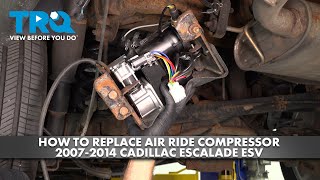
The GMT900 platform, which includes the 2007-2013 Escalade EXT, features the 'Autoride' (RPO Z55) air suspension system for automatic load leveling and improved ride quality. The air compressor assembly, which includes the pressure sensor, is mounted on the vehicle's frame rail, typically behind the driver's side rear wheel. This location exposes the compressor and its electrical wiring to road salt, moisture, and debris, leading to a high rate of failure from corrosion and physical damage to the harness. This is so common that General Motors issued a specific TSB (PIT4954D) advising technicians to inspect for pinched or shorted wiring between the compressor and frame before condemning the compressor assembly.
Diagnostic Flowchart
Tap your situation to follow the diagnostic path that matches what you're seeing on this vehicle.
Symptoms You May Notice
- "SERVICE SUSPENSION SYSTEM" message on the Driver Information Center (DIC).
- Incorrect rear ride height (vehicle sagging in the rear, especially when loaded).
- Air compressor does not run when the vehicle is started or loaded.
- A harsh, bouncy, or unstable ride quality.
- Air compressor runs constantly without raising the vehicle (indicating a major leak or failed compressor).
- Rear air helper bags appear deflated upon visual inspection.
- Replacing the air compressor assembly without first thoroughly inspecting the wiring harness for damage. The TSB specifically warns against this.
- Replacing the rear air shocks when the fault is purely electrical 🎬 Watch: Pro tips for replacing rear shocks and the air pump. and related to the compressor circuit.
- Replacing the ESCM when the problem is a simple wiring short or a faulty compressor.
Most Likely Causes
- Damaged Wiring to Air Compressor/Pressure Sensor 🔴 High Probability The wiring harness is routed near the frame and can be pinched between the compressor bracket and the frame, or chafe through from vibration and debris, causing a short to ground. This specific failure mode is the primary subject of GM TSB #PIT4954D.
How to confirm: Visually inspect the entire wiring harness leading to the air compressor assembly. The compressor may need to be unbolted or removed to see the area where the harness is pinched against the frame. Look for chafed, corroded, or broken wires right at the connector or where the loom passes the bracket. Wires can also break internally inside the insulation near the connector, requiring a 'tug test' on each individual wire.
Typical fix: Repair the damaged section of the wiring harness with weatherproof butt connectors and heat shrink. Re-route the harness to prevent future damage. Do not replace the compressor assembly for this fault, as per TSB #PIT4954D.
Est. part cost: $5-$25 - Failed Air Suspension Compressor Assembly 🔴 High Probability The pressure sensor is integrated into the compressor's dryer assembly and is not serviced separately. Moisture can enter the system, causing the sensor to fail internally. Also, leaks in the air springs or lines cause the compressor to overwork and burn out, which can damage internal electronics.
How to confirm: If wiring is confirmed to be good, the fault lies within the compressor assembly. Use a scan tool to monitor the pressure sensor voltage; if it's stuck at 0 or 5 volts with good wiring, the sensor is bad. Replacement of the entire compressor unit is required.
Typical fix: Replace the entire air suspension compressor assembly. Many aftermarket units are available, with Dorman being a popular choice that sometimes relocates the sensor or includes a redesigned harness to prevent the chafing issue.
Est. part cost: $200-$450 - Faulty Air Suspension Relay 🟡 Medium Probability
How to confirm: Locate the air suspension relay (often labeled ALC or COMP) in the underhood fuse block. Swap it with an identical relay from a non-critical system (like the horn) to see if the compressor begins to function. You can also jump the two thick-wire terminals (typically 30 and 87) in the relay socket to send power directly to the compressor and test its function.
Typical fix: Replace the faulty relay. The OEM part is often a gray 4-pin relay.
Est. part cost: $15-$40 - Blown Fuse ⚪ Low Probability
How to confirm: Check the large 30A or 40A fuse for the Electronic Suspension Control (ESC/ALC) in the underhood fuse block. A blown fuse often indicates a shorted compressor motor or wiring that must be fixed before replacing the fuse.
Typical fix: Replace the fuse after diagnosing the underlying short circuit.
Est. part cost: $1-$5
Rare But Worth Checking
- Failed Electronic Suspension Control Module (ESCM): This is uncommon. The module should only be replaced after all other possibilities, including wiring and the compressor assembly itself, have been definitively ruled out. A user on Tahoe Yukon Forum replaced the compressor twice before realizing the module was the issue. A failure of the internal 5-volt reference circuit within the ESCM can also set this code.
Diagnosis Steps
- Read the trouble codes from the Electronic Suspension Control Module (ESCM) with a capable scan tool (e.g., GM Tech-II).
- Visually inspect the rear of the vehicle. Is it sagging or sitting at an unusual height?
- Check the fuse for the suspension system (usually labeled ESC or ALC) in the underhood fuse block.
- Locate and test the air suspension relay by swapping it with a known-good relay or by jumping the power terminals to manually activate the compressor.
- If the fuse and relay are good, safely raise the vehicle and locate the air compressor on the frame rail (driver's side rear).
- Thoroughly inspect the wiring harness connected to the compressor for any signs of chafing, pinching, corrosion, or breaks, especially where it runs along the frame and can be pinched by the compressor bracket. This may require unbolting the compressor to gain access.
- If wiring damage is found, repair it, clear the codes, and re-test the system.
- If the wiring is intact, use a scan tool to monitor the air pressure sensor voltage. If it's stuck at 0 or 5 volts, it confirms a sensor or circuit fault.
- If all circuits test normal, the internal pressure sensor has likely failed, requiring the replacement of the air compressor assembly.
Parts You'll Likely Need
- Air Suspension Compressor Assembly
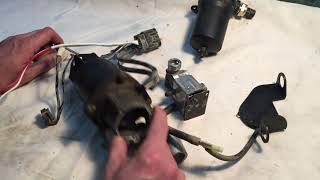
(OEM #22941806 (supersedes 15296756, 20837299, 20930288, 25913289); 23316154 (supersedes 22797525, 23232591, 23282712))— This assembly contains the compressor motor, dryer, and the integrated air pressure sensor that triggers code C0711. It is the most common part to fail if wiring is not the cause. The sensor is not sold separately by GM. 🎬 See how to rebuild your compressor instead of buying new.
Trusted brands: ACDelco (OEM), Dorman (OE FIX, e.g., 949-001, 949-099), Arnott
OEM price range: $600-$800
Aftermarket price range: $200-$450 - Air Suspension Relay
(OEM #15328866 (also marked as 8866))— This relay controls power to the compressor and can fail from the high electrical current draw, preventing the compressor from running. It's a common, inexpensive part to replace during diagnosis.
Trusted brands: ACDelco, Standard Motor Products
OEM price range: $25-$50
Aftermarket price range: $15-$40
Related Codes That Often Appear With This One
- C0696 — This code also relates to the level control sensor circuit. Both C0711 and C0696 are often triggered by the same root cause, such as a damaged wiring harness, as noted in TSB PIT4954D.
Technical Service Bulletins (TSBs) & Recalls
- Bulletin #PIT4954D: Advises that DTC C0711 (and C0696) can be caused by damaged wiring to the air compressor/pressure sensor and explicitly states to repair wiring before replacing the compressor assembly. It notes the wiring can be pinched between the compressor and frame.
- Bulletin #08-07-30-021H: Details potential for engine wiring harness to chafe against the engine or transmission, causing various electrical issues including GMLAN communication loss which could potentially affect the suspension control module.
Platform-Specific Known Issues
- A GM Technical Service Bulletin (PIT4954D) exists specifically for this code, highlighting that pinched or shorted wiring between the compressor and the frame is a primary cause and should be inspected before replacing parts.
- Another TSB, 08-07-30-021H, discusses general GMLAN communication issues from chafed harnesses at the rear of the engine and top of the transmission, which can sometimes manifest as suspension system errors.
Mechanic-Grade Diagnostic Values
- Air Pressure Sensor Signal Voltage — expected: 0.15 - 4.85 volts. Failure: Voltage less than 0.1V or greater than 4.9V will set the DTC. A reading stuck at 0V or 5V indicates a circuit fault or failed sensor.
- 5-Volt Reference at Sensor Connector — expected: 4.75 - 5.25 volts. Failure: Voltage outside this range with the sensor disconnected points to a problem with the wiring or the ESCM itself.
- Low Reference Circuit Resistance to Ground — expected: Less than 2.0 ohms. Failure: Resistance greater than 2.0 ohms indicates an open or high resistance in the ground circuit for the sensor.
Scan Tool Commands That Help
- GM Tech2 / GDS2: Actuator Test: Compressor Motor — This command allows the technician to manually turn the air compressor on and off, bypassing the relay and ESCM logic. It is used to quickly determine if the compressor motor, its power wiring, and main fuse are functional. If the compressor runs with this command, the fault is likely in the control circuit (relay, sensor, ESCM).
- GM Tech2 / GDS2: Actuator Test: Exhaust Valve Solenoid — This command tests the function of the exhaust solenoid, which is responsible for releasing air from the system. A stuck-open solenoid can prevent the system from building pressure, while a stuck-closed one can trap pressure. This test helps isolate faults within the compressor assembly.
- GM Tech2 / GDS2: Live Data: Level Control Air Pressure Sensor — Continuously monitor the sensor's voltage reading. With the key on, engine off, a normal reading should be stable and correspond to the pressure in the system (typically 1.2-1.8V). A reading stuck at 0V or ~5V confirms the circuit fault that sets C0711.
Wiring & Ground Locations
- Air Pressure Sensor Connector — On the air suspension compressor assembly, located on the driver's side frame rail, rear of the vehicle.. This is the 3-wire connector for the sensor that sets code C0711. Pin A: 5V Reference (Gray), Pin B: Low Reference/Ground (Black/White), Pin C: Signal (Dark Green). Testing for voltage and continuity at these pins is a primary diagnostic step.
- G401 — On the left rear frame rail, near the rear of the vehicle.. This is a primary chassis ground point for several rear components, including the Electronic Suspension Control Module (ESCM). A corroded or loose G401 can cause erratic voltage, floating grounds, and unpredictable behavior from the suspension system, potentially leading to false codes.
- ALC/ESC Fuse — In the underhood fuse block.. This is the main fuse (typically 30A or 40A) that provides high-current power to the compressor motor via the relay. If this fuse is blown, the compressor will not run under any circumstances. A blown fuse usually indicates a shorted compressor motor or a severe short in the power wiring.
Real Owner Repair Stories
- Tahoe Yukon Forum user 'tahoeltz2011' (2011 Chevrolet Tahoe LTZ (mechanically similar)) — Persistent C0711-00 code after multiple part replacements.
❌ Tried (didn't work) Replaced rear shock absorbers, Replaced the air suspension compressor (twice, assuming the first replacement was faulty)
✅ What actually fixed it The original problem was a dead Electronic Suspension Control Module (ESCM). After replacing and reprogramming the ESCM, the C0711 code appeared. The final resolution was to re-check the main connector at the new ESCM, which was not fully seated, causing a poor connection for the pressure sensor circuit. - Various forum reports (2007-2013 GM SUVs with Autoride) — C0711 code, compressor not running.
❌ Tried (didn't work) Visual inspection of the wiring harness showed no obvious damage.
✅ What actually fixed it The wires in the harness near the compressor connector were broken *inside* the insulation. A simple visual check did not find the fault. A 'tug test' on each individual wire revealed the broken conductor. Repairing the broken wire resolved the code.
OEM Part Supersession History
Various→Dorman 949-001 / 949-099 (OE FIX)— Aftermarket replacement
Heads up: The Dorman OE FIX versions often include design improvements, such as a redesigned harness to prevent chafing or an added thermal protection switch to prevent burnout, which the original OEM part lacked.
Helpful Videos
We Have This Part in Stock


The information in this article is provided for general reference and educational purposes only. Vehicle specifications, procedures, and part compatibility can vary by production date, trim level, and region. Always consult your vehicle's factory service manual and verify part numbers before purchasing or performing repairs. Safety-critical components such as airbags, seat belts, and braking systems should be installed by a qualified professional.
- Cadillac ESCALADE EXT:
- 🎬 Helpful Videos
- 🛍️ Shop This Part
- What's Unique About the 2007-2013 Cadillac ESCALADE EXT
- Diagnostic Flowchart
- Symptoms You May Notice
- Most Likely Causes
- Rare But Worth Checking
- Diagnosis Steps
- Parts You'll Likely Need
- Related Codes That Often Appear With This One
- Technical Service Bulletins (TSBs) & Recalls
- Platform-Specific Known Issues
- Mechanic-Grade Diagnostic Values
- Scan Tool Commands That Help
- Wiring & Ground Locations
- Real Owner Repair Stories
- OEM Part Supersession History
- 🎟️ Get 5% Off