

OBD-II Code C0710: Steering Position Signal Fault
The Ultimate 2026 Guide to What C0710 Means, Why It Triggers, and How to Fix It
- Code C0710 disables your stability and traction control systems due to a faulty steering angle sensor signal, increasing the risk of losing control.
- Before replacing parts on GM vehicles, clean the sensor's electrical connector and apply Nyogel 760G dielectric grease to fix fretting corrosion—the most common cause.
- If the code appears immediately after a wheel alignment or battery change, perform a steering angle sensor recalibration using a bi-directional scan tool.
- Always read the specific suffix code (like -42 for calibration or -5A for plausibility) to pinpoint the exact failure before spending money on a $300+ sensor replacement.
What Does C0710 Mean?

Code C0710 indicates the Electronic Brake Control Module (EBCM) detected an invalid, erratic, or missing signal from the Steering Angle Sensor (SAS). This sensor reports the exact angle and rotation rate of the steering wheel. Without this data, the EBCM cannot manage vehicle stability and disables the StabiliTrak and traction control systems as a safety precaution.
Technical definition: The EBCM has determined the analog or digital signal from the Steering Angle Sensor is outside its expected voltage range (e.g., below 0.4V or above 4.6V), corrupt, or implausible compared to yaw rate and wheel speed sensor data. This triggers a hard fault in the chassis control system.
Can I Drive With C0710?
Yes, But With Caution. Yes, but only for a short trip to a repair shop. Your electronic stability control (ESC) and traction control are disabled, increasing the risk of losing control on slippery roads or during emergency maneuvers. Furthermore, some GM vehicles experience hazardous, unwanted braking during turns due to the erratic sensor signal.
Common Causes

- Poor Connection at the Steering Angle Sensor (Very Common) — Micro-vibrations cause fretting corrosion on the electrical pins in the sensor's connector, creating high resistance. This is the leading cause of C0710 on GM trucks and SUVs, addressed in multiple TSBs (e.g., PI0639C). 🎬 Watch: Diagnosing steering angle sensor faults on GM vehicles.
- Lost Steering Angle Sensor Calibration (Common) — The sensor must be electronically calibrated to zero (straight-ahead). This calibration is frequently lost after a wheel alignment, battery replacement, or suspension work, immediately triggering the code.
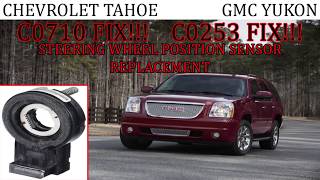
- Faulty Steering Angle Sensor (SAS) (Common) — The internal optical or contact components of the sensor fail over time. While common, it is frequently misdiagnosed and should only be replaced after ruling out connector corrosion 🎬 See this step-by-step steering wheel position sensor replacement. and calibration issues.
- Vehicle Modifications or Poor Alignment (Common) — Lift kits, oversized tires, or a severely bad wheel alignment alter steering geometry. The EBCM flags the steering angle as implausible because it conflicts with the vehicle's actual straight-line movement.
- Pinched or Chafed Wiring Harness (Uncommon) — On 2014-2019 GM K2XX trucks, the main dash wiring harness chafes against a metal bracket near the parking brake pedal, shorting the communication wires (TSB #PIT5288H).
- Incorrect Steering Shaft Indexing (Uncommon) — If the intermediate steering shaft is installed 360 degrees off-center after a rack replacement, the sensor reads a massive angle when the wheels are straight, triggering an immediate plausibility fault.
- Poor EBCM Ground or Low Voltage (Less Common) — A weak battery or a corroded EBCM ground (like G218 on GM frame rails) causes voltage drops that interrupt sensor communication, setting C0710 alongside other electrical codes.
- Faulty Electronic Brake Control Module (EBCM) (Rare) — The EBCM itself fails internally and cannot process a valid SAS signal. This is a last-resort diagnosis.
Symptoms

- "Service StabiliTrak" Message — This warning appears immediately on the driver information center, especially on GM models.
- Traction Control / ABS Lights Illuminated — The dashboard warning lights for ESC, traction control, and sometimes ABS remain on, indicating these safety systems are offline.
- Unwanted Braking During Turns — An erratic sensor signal tricks the system into thinking the vehicle is skidding, causing it to unexpectedly apply individual brakes during normal turns.
- Erratic Power Steering Assist — On vehicles with electric power steering, the steering wheel feels heavy, notchy, or unpredictable as the system struggles to calculate the correct assist level.
Diagnostic Flowchart

Tap your situation to follow the diagnostic path that matches what you're seeing on this code.
Common Fixes & Costs
- Clean, Secure, and Grease Sensor Connector — Parts: $10-$25, Labor: $120-$150, ~1.0 hr book time (DIY)
- Steering Angle Sensor Calibration — Parts: $0, Labor: $80-$150, ~0.8 hr book time (Professional)
- Replace Steering Angle Sensor — Parts: $60-$250, Labor: $150-$350, ~2.0 hr book time (Intermediate)
- Perform Four-Wheel Alignment — Parts: $0, Labor: $120-$200, ~1.5 hr book time (Professional)
Used vs. New Parts: Buying Guide
When a used part is worth it: Only when the sensor is integrated into an expensive assembly (like a $1,500 steering rack) on an older, low-value vehicle.
Donor-vehicle mileage cap: roughly under 50000 miles for the part to have meaningful remaining life.
Donor quality checklist:
- Exact part number match.
- Includes a 30-90 day warranty.
- No front-end collision or flood damage.
Decision logic:
- If A new OEM or aftermarket sensor costs under $250 → Buy new. The reliability and warranty outweigh the minimal savings.
- If The sensor is integrated into a steering column or rack costing over $1,000 → A used assembly from a verified low-mileage donor is a reasonable risk.
Warranty tradeoff: Used parts offer 30-90 day part-only warranties. New aftermarket parts offer 1-year to lifetime warranties.
Worst-case if a used part fails: $400-$800 to pay for diagnostic and labor costs a second time.
What Happens If You Wait — Timeline
- Immediate: Stability and traction control are disabled. The vehicle's safety margin is reduced. (MPG impact: 0%% · Added cost: $0)
- 1 week - 3 months: The erratic signal causes hazardous, unexpected braking during turns, increasing accident risk. (MPG impact: 0%% · Added cost: $300-$700 (Premature brake wear))
- 3+ months: If caused by a bad alignment, constant counter-steering causes accelerated, uneven tire wear. (MPG impact: 2%% · Added cost: $400-$1200 (Tire replacement))
Cost of Not Fixing It
- Immediate: Disabled stability and traction control systems, significantly increasing the risk of losing vehicle control in an emergency. (Added cost: $0)
- 0-3 months: Erratic signals cause unwanted, intermittent braking during turns, posing a severe safety hazard and prematurely wearing brake pads. (Added cost: $300-$700)
- 3+ months: If caused by a bad alignment, driving with a crooked steering wheel causes accelerated, uneven tire wear. (Added cost: $400-$1200)
Diagnosis Steps

- Read Codes and Suffixes
Use a scanner capable of reading Chassis (C-prefix) codes. Check for manufacturer-specific suffixes like -42 (Calibration Not Programmed) or -5A (Plausibility Failure) to pinpoint the exact fault type.
Tools: Bi-directional OBD-II Scanner (Beginner) - Inspect the Sensor Connector
Locate the SAS on the steering column. Disconnect the plug and inspect the pins for dark, smudgy fretting corrosion or a loose fit. This is the mandatory first physical check on GM vehicles.
Tools: Flashlight, Trim Removal Tools (Intermediate) - Analyze Live Data
View the 'Steering Angle Sensor' live data stream. With wheels straight, it should read 0.0 degrees (+/- 2.5). Turn the wheel lock-to-lock; the angle must change smoothly. Jumps or frozen values indicate a bad sensor or connection.
Tools: Bi-directional OBD-II Scanner (Intermediate) - Inspect Alignment and Modifications
Check for lift kits or a crooked steering wheel while driving straight. If the steering wheel is off-center, the EBCM sees a persistent angle that conflicts with wheel speed data, requiring an alignment and recalibration.
Tools: Visual Inspection (Beginner) - Verify EBCM Ground
Locate the main EBCM ground (e.g., G218 on the frame rail under the driver's door on GM trucks). Clean and tighten it to rule out voltage drops causing communication errors.
Tools: Socket Set, Wire Brush (Intermediate) - Inspect Wiring Harness (Specific Models)
On 2014-2019 GM trucks, inspect the dash wiring harness near the parking brake pedal for chafing against metal brackets per TSB #PIT5288H.
Tools: Flashlight (Advanced) - Test 5V Reference and Ground Circuits
Disconnect the SAS. Turn ignition ON. Measure voltage between the 5V reference pin and chassis ground (should be 4.8-5.2V). Measure resistance on the low-reference pin (should be < 2.0 ohms).
Tools: Multimeter, Wiring Diagram (Advanced)
When This Code Triggers (Freeze-Frame Conditions)
- Vehicle Speed: 10-40 mph (15-65 km/h) (The code typically sets during a turn when the EBCM detects a discrepancy between the steering angle and the vehicle's actual yaw rate.)
- Steering Wheel Angle: > 15 degrees (A plausibility fault (C0710-5A) triggers when the reported angle is mathematically impossible for the current vehicle speed and trajectory.)
- System Voltage: 12.6 - 14.8 Volts (Normal operating voltage. The fault requires stable electrical power to register conflicting sensor data.)
- Ignition Status: RUN (Detected during active driving, not at startup, because the EBCM needs vehicle movement to compare sensor inputs.)
Related Codes
- C0710-5A — Plausibility Failure. The EBCM receives a signal, but it conflicts with wheel speed data. Points to a bad alignment, lift kit, or incorrect steering shaft indexing.
- C0710-42 — Calibration Not Programmed. The sensor lost its center memory. The immediate fix is performing a scan tool calibration, not replacing parts.
- C0455 — Steering Assist Control Actuator Circuit. Frequently sets alongside C0710 on GM vehicles due to the exact same fretting corrosion issue at the connector.
- U2143 / U0126 — Lost Communication With SAS Module. Indicates a total signal loss, pointing strongly to a broken wire, disconnected plug, or dead sensor rather than a calibration issue.
Climate & Environmental Factors
- Humidity: Moisture acts as an electrolyte, accelerating fretting corrosion on the connector pins as they vibrate.
- Vibration: The primary mechanical driver of fretting corrosion. Constant micro-movements rub the connector terminals, creating signal-interrupting oxidation.
- Cold Weather: Plastics and wires become brittle, increasing susceptibility to vibration damage and worsening existing connection issues.
How to Talk to a Mechanic About This Code
Say this: "I have a 'Service StabiliTrak' light and a C0710 code. Based on my research, this is often a connector, calibration, or alignment issue. Can you please check the sensor connector for corrosion and check the live data for the steering angle before recommending a part replacement?"
Directs the technician to check the most common and least expensive potential failures first, saving diagnostic time and money.
Avoid saying:
- 'My StabiliTrak light is on, just fix it.'
- 'I think I need a new steering sensor.'
Questions to ask before authorizing the repair:
- Did you find a specific suffix code, like -42 for calibration or -5A for plausibility?
- If recommending replacement, have you already performed the GM TSB to clean and grease the connector?
- Does your estimate include the cost of the mandatory SAS calibration after installation?
Where to Take It: Dealer vs Independent vs Chain
- Dealer:
A strong choice for guaranteed fixes, as they have exact diagnostic tools and TSB familiarity.
Best for: Vehicles under warranty, Ensuring exact TSB procedures (e.g., specific grease and shim for GM) are followed
Downsides: Highest labor rates., May default to replacing parts rather than attempting simpler connector repairs. (Typical cost: +50% vs. baseline) - Independent Shop:
Best overall fit. A good independent shop handles this effectively for much less than a dealer.
Best for: Out-of-warranty vehicles., Common, well-documented issues like C0710 on GM trucks.
Downsides: Must verify they have a bi-directional scanner capable of SAS calibration. (Typical cost: +0% vs. baseline) - Chain Shop:
AVOID. They are unlikely to perform necessary diagnostic steps and may misdiagnose the problem.
Best for: Simple services like tire changes.
Downsides: Unlikely to have advanced bi-directional scan tools needed for calibration., Business model encourages quick part replacement over nuanced diagnosis. (Typical cost: -10% vs. baseline)
When to Walk Away From the Repair
If the estimated repair cost exceeds 50% of the car's private-party value, consider selling the vehicle.
- Car worth $12000, fix is $250: Fix it. This low-cost repair restores a critical safety feature.
- Car worth $5000, fix is $1800: Borderline. Get a second opinion to confirm the diagnosis before proceeding.
- Car worth $3000, fix is $2000: Walk away. The repair cost is not economically justifiable.
What Scan Tool You Need for This Code
Minimum: A scanner that reads Chassis (C-prefix) codes and views live data streams.
A $20 scanner cannot see C-codes, read manufacturer suffixes (-42, -5A), or perform the mandatory steering angle sensor calibration.
Budget: BlueDriver Pro (~$90) — Reads and clears chassis codes and graphs live steering angle data. Lacks bi-directional calibration ability.
Mid-range: Foxwell NT510 Elite (~$180) — The sweet spot for DIYers. Reads chassis codes, live data, and performs the mandatory SAS calibration procedure.
Professional: Autel MaxiCOM MK808S (~$450) — Offers full bi-directional control, robust SAS calibration, and ABS bleeding functions.
Rent vs buy: Buy. Free rental tools at auto parts stores are basic engine readers that cannot read chassis codes or perform calibrations.
How to Clear the Code After You Fix It
- Use a bi-directional scan tool to clear the Chassis fault codes.
- Perform the 'Steering Angle Sensor Calibration/Learn' procedure. This is mandatory.
- Turn the ignition off, open and close the driver's door, and wait 60 seconds.
- Test drive above 15 mph, making several left and right turns to run the system self-test.
Drive cycle (~15 minutes): Drive for 15 minutes, reaching speeds over 25 mph and executing multiple 90-degree turns. The StabiliTrak light will remain off if the repair and calibration were successful.
Readiness monitors affected: Chassis codes do not affect emissions readiness monitors, but clearing them may reset other modules.
Watch out for:
- Clearing the code without performing the mandatory SAS calibration.
- Replacing the sensor without first checking the connector for fretting corrosion.
- Assuming disconnecting the battery will clear the hard fault from the EBCM.
Will This Fail Emissions / State Inspection?
No — by itself this code doesn't fail OBD inspection (but it can keep readiness monitors from setting, which causes a separate fail).
- California: C0710 does not fail the OBD emissions check, but an illuminated ABS/StabiliTrak light causes a functional failure because technicians will refuse to run the vehicle on a dynamometer.
- New York: An illuminated ABS or StabiliTrak warning light is an automatic failure for the annual safety inspection.
- Texas: An illuminated ABS or traction control light is NOT a cause for rejection during the annual safety inspection.
Most Commonly Affected Vehicles
- Chevrolet Silverado 1500/2500/3500 (2007-2019) — GMT900 models (2007-2013) suffer fretting corrosion at the connector. K2XX models (2014-2019) suffer pinched dash wiring harnesses.
- GMC Sierra 1500/2500/3500 (2007-2019) — Shares the Silverado platform and identical connector/wiring vulnerabilities.
- Chevrolet Tahoe / Suburban (2007-2014) — Highly susceptible to C0710 from fretting corrosion. The fix is almost always servicing the connector, not replacing the sensor.
- GMC Yukon / Yukon XL (2007-2014) — TSB SB-10043887-2153 specifically addresses connector fretting on these SUVs, recommending a shim and grease.
- Ford F-150 (2011-2014) — The SAS is integral to the Electronic Power Assisted Steering (EPAS) rack. C0710 often precedes total rack failure, requiring a $1,500+ replacement.
- Chevrolet Equinox (2010-2017) — C0710-5A frequently appears after an alignment, requiring a simple SAS recalibration.
- Hyundai Sonata (2011-2014) — The SAS is integrated into the steering column. Failure requires replacing the entire column assembly.
- BMW 3-Series (E90) / 5-Series (E60) (2006-2013) — The internal optical disc clouds with age. Disassembling and cleaning the lens often fixes the code without replacement.
Manufacturer-Specific Notes
- General Motors: GM TSBs explicitly warn technicians NOT to replace the sensor first. The official fix is applying Nyogel 760G grease and installing a plastic shim (Part #19179794) into the connector.
- Ford: On 2011-2014 F-150s, the sensor is non-serviceable. A C0710 code requires replacing the entire $1,600 EPAS steering rack assembly.
- BMW: Instead of replacing the expensive optical sensor on E90/E60 models, a common DIY fix is disassembling the unit and cleaning the internal optical disc with electronics cleaner.
Real Owner Stories
2011 Chevy Silverado 2500 - The Classic Connector Fix
Owner experienced an intermittent 'Service StabiliTrak' message with code C0710-5A.
What they tried:
- Replaced the steering angle sensor, but the code returned within 10 minutes.
Outcome: The actual problem was fretting corrosion on the connector. Cleaning the pins, applying Nyogel 760G, and installing the GM shim (Part No. 19179794) permanently resolved the issue.
Lesson: Always perform the TSB-recommended connector service before replacing the sensor on GM trucks.
2017 Chevy Equinox - The Post-Alignment Problem
The 'Service StabiliTrak' light illuminated immediately after a wheel alignment.
What they tried:
- Cleared the code with a basic scanner, but it returned instantly.
Outcome: The owner used a professional scan tool to perform the 'Steering Wheel Angle Sensor Learn' procedure, recalibrating the sensor to the new alignment and clearing the fault.
Lesson: If C0710 appears right after an alignment, the cause is a lost calibration. The shop should perform the recalibration for free.
2015 GMC Sierra - The Pinched Harness
Truck had multiple intermittent electrical issues, including C0710, key fob not detected, and a blank radio screen.
What they tried:
- Focused on the steering angle sensor, but unrelated codes caused confusion.
Outcome: The main dash wiring harness was pinched against a metal bracket near the parking brake pedal (TSB #PIT5288H). Repairing the wires and rerouting the harness resolved all codes.
Lesson: If C0710 appears with random electrical codes, suspect a shared wiring harness short or ground fault.
How to Prevent This Code From Triggering
- Service the SAS connector on high-risk GM vehicles (Once, around 75,000 miles) — Applying dielectric grease and a shim prevents the micro-vibrations that cause fretting corrosion.
- Insist on SAS calibration after every wheel alignment (Every alignment) — Ensures the stability control system works with accurate data and prevents plausibility codes.
- Clean key chassis grounds (Every 30,000 miles) — Keeping grounds (like G218 on GM trucks) clean prevents voltage drops that cause communication codes.
Frequently Asked Questions
How much does it cost to fix code C0710?
Costs range from $10 for DIY connector cleaning to $150 for a shop calibration. Replacing the sensor costs $210 to $600 for parts and labor. On vehicles where the sensor is integrated into the steering rack, repairs exceed $1,500.
Can a bad wheel bearing cause code C0710?
Yes. A failing wheel bearing causes the wheel speed sensor to send erratic data to the EBCM. When the EBCM compares this to the steering angle, it flags a plausibility fault (C0710-5A).
What is the steering angle sensor shim for GM vehicles?
The shim (GM Part No. 19179794) is a small plastic wedge used in official GM TSB repairs. It inserts into the steering angle sensor's connector to eliminate excess space. This stops the micro-vibrations that cause fretting corrosion.
Can I fix code C0710 myself?
You can easily clean and grease the connector yourself for under $20. However, replacing or calibrating the sensor requires a bi-directional scan tool costing $150+. Stop DIY and visit a shop if the code persists after cleaning the connector.
What is the most common misdiagnosis for C0710?
The most common mistake is replacing the $200+ steering angle sensor before checking the connector. Technicians also frequently overlook the need for a simple sensor recalibration after a wheel alignment. Always check the sub-codes before buying parts.
I just got a wheel alignment and now this light is on. What happened?
The alignment technician failed to perform the mandatory steering angle sensor calibration. The sensor must be electronically re-centered anytime physical toe settings change. Return to the shop and insist they complete the calibration procedure.
Is the steering angle sensor the same as the clock spring?
No, but they are often housed together in the steering column. The clock spring maintains electrical connections for the airbag and horn while the wheel turns. The steering angle sensor specifically measures the wheel's position and rotation rate.
Key Takeaways
- Code C0710 disables your stability and traction control systems due to a faulty steering angle sensor signal, increasing the risk of losing control.
- Before replacing parts on GM vehicles, clean the sensor's electrical connector and apply Nyogel 760G dielectric grease to fix fretting corrosion—the most common cause.
- If the code appears immediately after a wheel alignment or battery change, perform a steering angle sensor recalibration using a bi-directional scan tool.
- Always read the specific suffix code (like -42 for calibration or -5A for plausibility) to pinpoint the exact failure before spending money on a $300+ sensor replacement.
Helpful Videos



The information in this article is provided for general reference and educational purposes only. Vehicle specifications, procedures, and part compatibility can vary by production date, trim level, and region. Always consult your vehicle's factory service manual and verify part numbers before purchasing or performing repairs. Safety-critical components such as airbags, seat belts, and braking systems should be installed by a qualified professional.
- 🎬 Helpful Videos
- What Does C0710 Mean?
- Can I Drive With C0710?
- Common Causes
- Symptoms
- Diagnostic Flowchart
- Common Fixes & Costs
- Used vs. New Parts: Buying Guide
- What Happens If You Wait — Timeline
- Cost of Not Fixing It
- Diagnosis Steps
- When This Code Triggers (Freeze-Frame Conditions)
- Related Codes
- Climate & Environmental Factors
- How to Talk to a Mechanic About This Code
- Where to Take It: Dealer vs Independent vs Chain
- When to Walk Away From the Repair
- What Scan Tool You Need for This Code
- How to Clear the Code After You Fix It
- Will This Fail Emissions / State Inspection?
- Most Commonly Affected Vehicles
- Manufacturer-Specific Notes
- Real Owner Stories
- 2011 Chevy Silverado 2500 - The Classic Connector Fix
- 2017 Chevy Equinox - The Post-Alignment Problem
- 2015 GMC Sierra - The Pinched Harness
- How to Prevent This Code From Triggering
- Frequently Asked Questions
- How much does it cost to fix code C0710?
- Can a bad wheel bearing cause code C0710?
- What is the steering angle sensor shim for GM vehicles?
- Can I fix code C0710 myself?
- What is the most common misdiagnosis for C0710?
- I just got a wheel alignment and now this light is on. What happened?
- Is the steering angle sensor the same as the clock spring?
- Key Takeaways
- 🎟️ Get 5% Off